The Enduring Mystery and Value of the $2 Bill: History, Collectibility, and What Your Note Might Be Worth Today

Introduction: The Quiet Curiosity of an Overlooked Bill

Tucked inside a drawer, slipped between the pages of an old book, or lingering at the back of a wallet, the United States $2 bill is one of the most misunderstood pieces of American currency. Many people encounter it only rarely, leading to persistent myths that it is discontinued, unlucky, or somehow illegitimate. In reality, the $2 bill remains an active denomination of U.S. currency, printed periodically and backed fully by the federal government.

What makes the $2 bill particularly fascinating is not just its scarcity in everyday transactions, but its rich historical legacy and its potential appeal to collectors. While most $2 bills are worth exactly their face value, certain examples—due to age, condition, design features, or rarity—can command prices well above two dollars on the collectors’ market.

This article offers a comprehensive and carefully researched exploration of the $2 bill: its origins, historical evolution, design changes, production patterns, public perception, and collectibility. Whether you are a casual observer, a history enthusiast, or someone who has discovered a $2 bill among personal belongings, this guide provides a clear, responsible, and informative overview of what makes this denomination unique—and when it might hold added value.


Origins of the $2 Bill: A Product of National Necessity

Currency Challenges During the Civil War Era

The story of the $2 bill begins during one of the most turbulent periods in American history. In 1862, amid the financial strain of the Civil War, the U.S. government faced an urgent need to stabilize the economy and facilitate daily transactions. Coin shortages were common, as precious metals were hoarded or diverted for war-related uses. To address this problem, the federal government expanded the issuance of paper currency.

The $2 denomination was introduced as part of this broader monetary strategy. It offered a practical middle ground between smaller denominations and larger notes, helping to ease transactional bottlenecks in commerce. Early versions of the $2 bill were known as United States Notes, sometimes referred to as “Legal Tender Notes.”

Early Designs and Symbolism

The earliest $2 bills featured portraits that reflected the political and financial priorities of the era. One of the first prominent figures to appear was Alexander Hamilton, the nation’s first Secretary of the Treasury. His presence underscored the bill’s role in stabilizing public finance and reinforcing confidence in the federal monetary system.

Over time, the design of the $2 bill evolved, reflecting changing artistic styles, political values, and technological advances in printing. These design changes now play a crucial role in determining collectibility and value.


Thomas Jefferson and the Modern Identity of the $2 Bill

The Transition to Jefferson’s Portrait

In 1869, Thomas Jefferson—third President of the United States and principal author of the Declaration of Independence—became the central figure on the obverse (front) of the $2 bill. Jefferson’s association with democratic ideals and limited government made him a fitting symbol for a denomination intended for widespread public use.

Jefferson has remained on the $2 bill ever since, making it one of the most consistent portrait choices in U.S. currency history. This continuity adds to the denomination’s historical identity and appeal.

The Reverse Design: Monticello and American Heritage

For much of the 20th century, the reverse side of the $2 bill featured Monticello, Jefferson’s Virginia estate. This architectural image emphasized American heritage, classical ideals, and the nation’s agrarian roots.

In 1976, however, the reverse design underwent a significant change, replacing Monticello with a depiction of John Trumbull’s famous painting, Declaration of Independence. This change coincided with the United States Bicentennial and was intended to renew public interest in the denomination.


Circulation Patterns and Public Perception

Why the $2 Bill Feels Rare

One of the most persistent misconceptions about the $2 bill is that it is no longer printed. In fact, the Bureau of Engraving and Printing (BEP) continues to produce $2 bills, although in much smaller quantities than other denominations.

Because demand from banks and businesses is limited, $2 bills tend to circulate less frequently. This limited circulation creates the illusion of rarity, even though millions of notes exist.

Cultural Myths and Misunderstandings

Over the years, the $2 bill has been surrounded by folklore. Some people believe it brings bad luck; others think it is too valuable to spend. In some regions, it has been associated with tipping customs, political campaigns, or novelty gifts.

Ironically, these myths often contribute to the bill’s scarcity in everyday use. When people receive a $2 bill, they are more likely to keep it than spend it, reinforcing the perception that it is unusual.


The $2 Bill in the 20th Century: Changing Fortunes

Early 20th Century Decline in Popularity

By the early 1900s, the $2 bill had fallen out of favor with the general public. Many businesses found it inconvenient, and banks reported low demand. As a result, large numbers of $2 bills traded at face value or were stored rather than circulated.

Collector Interest Emerges

During the 1920s and 1930s, interest in paper currency collecting began to grow. Collectors started paying attention to older $2 bills, particularly those with distinctive designs, seals, or serial numbers. This period marked the beginning of the $2 bill’s transformation from a mundane transaction tool into a collectible artifact.

Mid-Century Production and Red Seal Notes

In the mid-20th century, the U.S. Treasury issued $2 bills with red seals, distinguishing them from the more common green seal Federal Reserve Notes. These red seal notes, especially from certain series years such as 1928, 1953, and 1963, are now of particular interest to collectors.


Modern Production and the Bicentennial Revival

The 1976 Redesign

The year 1976 marked a pivotal moment in the history of the $2 bill. To celebrate the nation’s 200th anniversary, the Treasury reintroduced the $2 bill with a new reverse design depicting the signing of the Declaration of Independence.

This redesign was accompanied by a renewed printing effort, and many Americans received $2 bills for the first time in years. Despite the fanfare, widespread circulation still failed to materialize.

Continued Printing in Limited Quantities

Since 1976, $2 bills have been printed intermittently based on demand from the Federal Reserve System. They remain legal tender and fully spendable, though rarely encountered in daily commerce.


Understanding the Value of a $2 Bill

Face Value vs. Collector Value

It is important to clarify that the majority of $2 bills in circulation today are worth exactly $2. Their collector value depends on several factors, including age, condition, rarity, and unique characteristics.

Claims that all $2 bills are worth large sums are misleading. However, certain examples do command premiums in the collectors’ market.


Key Factors That Influence Value

1. Series Year

Older series generally attract more interest, especially those from the 19th and early 20th centuries. Notes issued before 1928, which are larger in size than modern bills, often carry higher values due to their age and limited survival.

2. Seal Color

  • Red seal notes (United States Notes) are often more collectible than green seal Federal Reserve Notes.
  • Blue and brown seals, found on certain historical issues, are also of interest to specialists.

3. Serial Numbers

Bills with unusual serial numbers may attract premiums. These include:

  • Star notes (indicated by a star symbol)
  • Low serial numbers
  • Repeating or patterned numbers

4. Condition and Grading

The physical condition of a bill plays a critical role in its value. Notes that are crisp, clean, and free from folds or marks are significantly more desirable. Professional grading services are often used to assess condition objectively.


Realistic Value Examples (With Responsible Context)

While values fluctuate based on market demand, the following examples provide general context—not guarantees:

  • A circulated modern $2 bill: typically worth face value
  • A 1953 red seal $2 bill in good condition: modest premium over face value
  • A star note from certain red seal series: potentially higher value depending on condition
  • Pre-1928 large-size $2 bills: often significantly more valuable, especially in high grades

Collectors should always consult reputable price guides or professional appraisers for accurate assessments.


Emotional and Cultural Significance

A Symbol of American History

Beyond monetary value, the $2 bill represents continuity and tradition. Its designs reflect foundational moments in American history, from Jefferson’s leadership to the Declaration of Independence.

Personal Stories and Keepsakes

For many people, a $2 bill holds sentimental value. It may have been received as a gift, a first tip, or a keepsake from a relative. These emotional connections often matter more than market price.


Responsible Collecting and Preservation

How to Store a $2 Bill

If you believe a $2 bill may have collector value, proper storage is essential. Acid-free holders, low-humidity environments, and minimal handling help preserve condition.

Avoiding Common Mistakes

  • Do not clean or wash paper currency
  • Avoid folding or laminating notes
  • Be cautious of exaggerated claims online

The $2 Bill in Today’s Economy

Legal Tender Status

The $2 bill remains legal tender for all debts, public and private. Businesses are not required to keep them on hand, but they are valid currency.

A Niche Role

Today, the $2 bill occupies a unique niche—part currency, part collectible, part conversation piece. Its continued production ensures its place in the American monetary system, even if its circulation remains limited.


Conclusion: More Than Just Two Dollars

The $2 bill is far more than an underused denomination. It is a living artifact of American history, shaped by economic necessity, cultural perception, and evolving public interest. While most examples are worth only their face value, certain bills—due to age, rarity, and condition—can hold additional appeal for collectors.

Perhaps most importantly, the $2 bill invites curiosity. It encourages people to look more closely at the money they handle every day and to appreciate the stories embedded in even the smallest details of national currency.

If you happen to have a $2 bill tucked away somewhere, it may not make you rich—but it just might connect you to a deeper story of American heritage, resilience, and tradition.


Discover the Physical and Emotional Benefits of Sex for Men’s Health

The benefits of sex for men’s health go far beyond momentary pleasure. Regular sexual activity is linked to various physical and emotional advantages, potentially contributing to quality of life in different stages of life, as some studies suggest.

Men’s sexuality is connected to multiple aspects of health. When approached positively, it promotes not only personal satisfaction but also hormonal balance, cardiovascular health, and a stronger immune system. Moreover, sex also helps maintain emotional stability and fosters healthier relationships

Powerful Earthquake Rocks Myanmar–China Border Region, Triggering Emergency Response Across Southeast Asia

Introduction: A Region Awakened Before Dawn

In the early hours of the morning, while much of Southeast Asia slept, a powerful earthquake tore through a seismically active but densely populated region, jolting millions awake and setting off a wave of emergency responses across national borders. The earthquake, which struck at 3:42 a.m. local time, originated in a mountainous area along the border between Myanmar and China’s Yunnan Province, according to preliminary data released by the United States Geological Survey (USGS).

With an estimated shallow depth of approximately 10 kilometers, the tremor was strong enough to be felt far beyond its epicenter. Reports quickly emerged from multiple countries, including Thailand, where residents in major northern cities described buildings swaying and emergency evacuations underway. As daylight broke, the full scale of the disaster began to emerge—particularly in Myanmar, which has so far suffered the most severe consequences.


The Epicenter and Seismic Characteristics

According to USGS monitoring stations, the earthquake’s epicenter was located in a rugged, mountainous zone where tectonic activity is common but infrastructure resilience is often limited. Earthquakes occurring at shallow depths, such as this one, typically result in more intense surface shaking, increasing the risk of structural damage even in areas located some distance from the epicenter.

The region lies near the boundary of the Indian Plate and the Eurasian Plate, a complex tectonic zone responsible for frequent seismic activity across Myanmar, southwestern China, and parts of Southeast Asia. While earthquakes are not unusual in this area, the timing, magnitude, and shallow depth of this event significantly amplified its impact.

Seismologists noted that early-morning earthquakes often pose greater risks because residents are indoors and less prepared to respond immediately, complicating evacuation and rescue efforts.


Myanmar Bears the Heaviest Impact

State of Emergency Declared

Myanmar has emerged as the worst-hit country in the aftermath of the earthquake. Government authorities declared a state of emergency in multiple regions, as reports confirmed at least 48 fatalitiesmore than 300 injuries, and dozens of individuals still unaccounted for. Officials cautioned that these figures remain preliminary and may change as rescue operations continue.

In several affected areas, particularly the city of Lashio, entire buildings were reported to have collapsed. Local authorities and international aid organizations are now racing against time to locate survivors, assess structural safety, and deliver essential supplies.

Lashio: A City Struggling to Recover

Lashio, a key urban center in northern Myanmar, suffered extensive damage. Residential structures, small businesses, and public buildings were among those affected. Emergency responders reported that narrow streets and damaged infrastructure have complicated rescue operations, slowing the movement of heavy equipment and medical teams.

Residents described scenes of confusion and fear as the earthquake struck without warning. Many fled their homes in the dark, uncertain whether it was safe to return.

“We heard a loud noise, and suddenly everything started shaking,” said Myo Thant, a local resident. “The walls cracked, and it felt like the ground was moving in waves. My family and I ran outside just moments before our house collapsed.”

Stories like his have become increasingly common as survivors share accounts of narrow escapes and sudden loss.


Rescue and Emergency Response Efforts

Search and Rescue Underway

Rescue teams across Myanmar have been deployed to affected regions, focusing on collapsed structures and areas where people are believed to be trapped. Volunteers, firefighters, medical personnel, and local residents are working together, often using basic tools where heavy machinery is unavailable.

International humanitarian organizations have begun coordinating with Myanmar authorities to provide medical aid, temporary shelters, food, and clean water. The emphasis remains on saving lives, stabilizing the injured, and preventing secondary health crises.

Medical Systems Under Strain

Hospitals in the region are facing significant pressure as injured residents seek care. In some areas, medical facilities sustained damage themselves, forcing healthcare workers to treat patients outdoors or in temporary structures.

Public health officials have emphasized the importance of sanitation, clean water access, and disease prevention in the days following the disaster, particularly in displacement camps where families have gathered after losing their homes.


Tremors Felt Across Borders

Impact in China’s Yunnan Province

In China’s Yunnan Province, residents near the border with Myanmar reported strong shaking, though no large-scale casualties have been confirmed as of the latest updates. Chinese authorities initiated inspections of infrastructure, including roads, bridges, and public buildings, to ensure safety.

Emergency management teams in Yunnan activated contingency plans, reflecting China’s growing emphasis on disaster preparedness in seismically active regions.

Thailand Reports Evacuations

The earthquake was also strongly felt in northern Thailand, particularly in the cities of Chiang Rai and Chiang Mai. Residents described being awakened by swaying buildings, rattling windows, and emergency alarms.

Local authorities in Thailand reported mass evacuations from hotels, residential complexes, and hospitals as a precautionary measure. While no major structural damage has been confirmed, officials stressed that safety protocols were enacted swiftly to protect residents and tourists.


Why This Earthquake Was So Widespread

Several factors contributed to the wide-reaching effects of the earthquake:

  1. Shallow Depth – Earthquakes occurring close to the surface transfer more energy to buildings and people.
  2. Geological Conditions – Mountainous terrain can amplify seismic waves.
  3. Regional Connectivity – Northern Southeast Asia shares interconnected fault systems.
  4. Population Density – Even moderate shaking affects large populations in urban areas.

Experts emphasize that while seismic magnitude is important, depth and location often play a greater role in determining damage levels.


A Region Familiar With Seismic Risk

Myanmar is among Southeast Asia’s most earthquake-prone countries, yet many of its buildings were constructed without modern seismic standards. Rapid urbanization, limited resources, and ongoing political challenges have hindered widespread infrastructure upgrades.

Historically, earthquakes in the region have caused significant loss of life, not solely due to seismic strength but because of structural vulnerability and limited emergency response capacity in rural areas.

This latest disaster has renewed calls from international organizations for long-term investment in disaster resilience, early-warning systems, and public education.


Human Stories Behind the Statistics

Beyond the numbers, the earthquake has left a profound emotional toll. Families have been separated, livelihoods disrupted, and entire communities forced into uncertainty overnight.

Children who went to sleep in familiar homes woke up in evacuation shelters. Elderly residents struggled to flee damaged buildings. Small business owners surveyed ruins where shops once stood.

Yet amid the devastation, stories of solidarity have emerged. Neighbors helping neighbors, volunteers providing food and blankets, and rescue workers pushing through exhaustion all reflect the resilience of affected communities.


International Response and Aid Coordination

As news of the earthquake spread, governments and humanitarian agencies around the world expressed concern and readiness to assist. Disaster response experts emphasized the importance of coordinated aid delivery, particularly in politically complex regions.

Aid organizations are prioritizing:

  • Emergency medical supplies
  • Temporary shelter materials
  • Clean water and sanitation support
  • Psychological first aid for trauma survivors

The coming weeks will be critical in determining how quickly affected areas can stabilize and begin rebuilding.


Looking Ahead: Recovery and Preparedness

While immediate rescue operations remain the top priority, attention will soon shift toward recovery and reconstruction. Rebuilding safely will require not only resources but also policy decisions aimed at reducing future risk.

Seismologists stress that earthquakes cannot be prevented, but their impact can be mitigated through:

  • Stronger building codes
  • Public education on emergency response
  • Regional cooperation on seismic monitoring

The disaster serves as a stark reminder of the importance of preparedness in vulnerable regions.


Conclusion: A Wake-Up Call Across Southeast Asia

The early-morning earthquake that struck the Myanmar–China border has left a deep mark across Southeast Asia. For Myanmar, it represents both a humanitarian emergency and a long-term recovery challenge. For neighboring countries, it underscores the shared risks of living along active fault lines.

As rescue teams continue their work and families search for loved ones, the region stands united in grief, resilience, and determination. While the ground has stopped shaking, the aftershocks—physical, emotional, and social—will be felt for months and years to come.

“She Thought She Won $20,000 on a Lottery Scratch-Off — What Happened Next Left Her Sh*cked”

A woman in Virginia believed her luck had finally changed when she scratched a lottery ticket and saw what looked like a $20,000 winning result. But instead of celebrating a life-changing payout, she found herself locked in a frustrating dispute after being told she would not receive the money.

The incident began when the woman purchased a scratch-off lottery ticket from a local retailer. After scratching the surface, she noticed a combination of numbers and symbols that, according to her understanding of the game, clearly indicated a $20,000 win. Overwhelmed with excitement, she double-checked the ticket several times, convinced she had just hit a major prize.

Like many lottery players, she immediately began imagining what the money could mean for her future — paying off bills, helping family members, and finally getting some financial breathing room. Confident in the result, she took the ticket to have it validated.

That’s when everything changed.

According to the woman, lottery officials reviewed the ticket and informed her that it was not a valid winning ticket. Their explanation centered on a technical issue related to the scratch-off surface and the underlying security markings. Officials claimed that the ticket did not meet the required criteria for a payout, despite appearing to show a winning combination.

The woman strongly disagreed.

She argued that the symbols were clearly visible and that she had followed the instructions exactly as printed on the ticket. From her perspective, the rules were straightforward — match the correct numbers, win the prize. She believed the lottery was unfairly denying her the money based on fine print and internal verification processes that consumers rarely understand.

“This isn’t right,” she reportedly said. “If the ticket shows I won, I should be paid.”

Lottery representatives, however, stood firm. They explained that scratch-off tickets include multiple layers of validation beyond what players can see. While the surface symbols are designed for entertainment, the final authority lies with the ticket’s barcode and internal security code. If those systems don’t register a win, the ticket is considered invalid — even if it appears otherwise.

Consumer advocates say cases like this, while rare, do happen. Scratch-off tickets can sometimes be damaged during printing, scratching, or handling. In other instances, over-scratching or using sharp objects can unintentionally remove critical validation elements, voiding the ticket.

Still, critics argue that the system is confusing and stacked against players.

“This highlights a serious transparency issue,” one expert noted. “Most people assume what they see is what counts. They don’t realize there’s an invisible layer that ultimately decides everything.”

The woman explored her options, including filing complaints and seeking legal advice. While lottery rules typically favor the issuing authority, public pressure and media attention can sometimes force a closer review of disputed tickets.

For now, the $20,000 prize remains unpaid — and the woman says the experience has completely changed how she views lottery games.

“I’ll never trust one again,” she said.

Her story serves as a cautionary tale for players everywhere: when it comes to scratch-off tickets, what looks like a win doesn’t always guarantee a payout — and the real rules may be hidden beneath the surface.

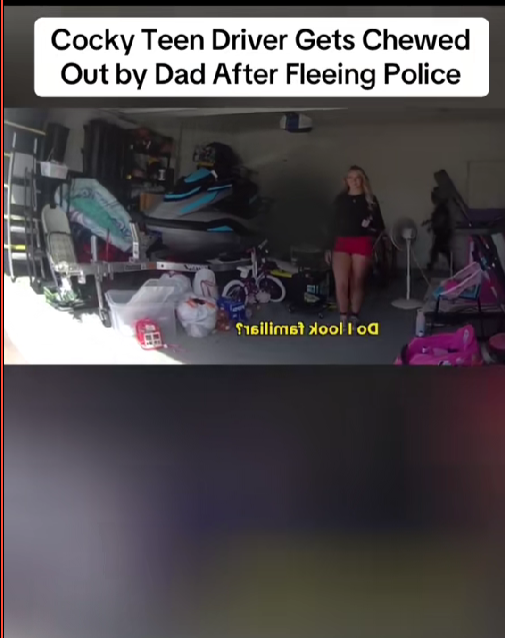
“Cocky Teen Flees Police — Dad’s Brutal Reality Check Leaves Him Sp*echless ”

What started as a reckless decision on the road ended with a harsh — and unforgettable — lesson at home, after a cocky teenage driver fled from police and was later confronted by his own father in a moment that stunned viewers.

According to footage and reports surrounding the incident, the teen initially refused to pull over when police attempted a traffic stop. Instead of stopping, he chose to flee, escalating what could have been a minor situation into a serious offense with long-term consequences.

The chase didn’t last forever — it rarely does. Authorities eventually tracked the teen to his home, where officers arrived to question him in front of his family. That’s when the situation took a dramatic turn no one expected.

As police explained what had happened, the teen reportedly tried to downplay the situation, brushing it off with a dismissive attitude. But his father wasn’t having it.

Witnesses say the dad’s demeanor shifted instantly — calm at first, then visibly furious. He demanded answers, pressing his son about why he thought running from police was acceptable. When the teen offered excuses, the father cut him off and delivered a blunt, no-nonsense lecture that quickly became the most powerful moment of the encounter.

“You could have gotten someone k*lled,” the father reportedly said, emphasizing that fleeing police isn’t a game, a prank, or something to laugh about. He reminded his son that one bad decision could have ended his life, ruined another family’s future, or permanently altered his own.

The teen, once smug and confident, appeared to shut down as the weight of his actions finally sank in.

Police officers on scene reportedly allowed the father to speak, recognizing that sometimes the most effective discipline doesn’t come from handcuffs — but from accountability at home. While the teen still faced legal consequences, that conversation seemed to hit harder than any citation ever could.

Online reactions have been overwhelming. Many praised the father for stepping up instead of defending or excusing his child’s behavior.

“This is what real parenting looks like,” one commenter wrote.
“Too many parents blame everyone else — this dad held his kid accountable,” said another.

Experts say incidents like this highlight a growing issue: teens underestimating the seriousness of police encounters. Fleeing law enforcement can quickly turn deadly, even if the original reason for the stop was minor. High-speed pursuits increase the risk of crashes, injuries, and tragic mistakes — for drivers, officers, and innocent bystanders alike.

For this family, the night became a wake-up call. The teen learned that arrogance disappears fast when real consequences arrive — and that respect for the law starts at home.

In the end, it wasn’t the flashing lights or police presence that broke through the teen’s attitude.

It was his dad.

“Mother-in-Law EXPLODES Over My Pregnancy — Her Reaction Left Everyone Sh*cked ”

What was supposed to be a joyful, emotional moment turned into absolute chaos when a woman decided to share her pregnancy news with her family — and her mother-in-law’s reaction stunned everyone in the room.

The moment began innocently enough. The expecting mother presented a small white baby onesie, a classic and heartfelt way to announce that a new baby was on the way. At first, there was silence. Then confusion. And within seconds, disbelief turned into visible outrage.

Instead of smiles or happy tears, the mother-in-law reportedly stared at the tiny shirt in shock, her expression hardening as the realization set in. Witnesses say she looked offended — not emotional — as if the pregnancy announcement was a personal attack rather than life-changing news.

According to the expecting mother, the reaction was immediate and intense.

“She didn’t ask how I was feeling. She didn’t say congratulations,” the woman explained. “She just kept saying this wasn’t the right time, that we weren’t ready, and that this would ruin everything.”

What made the moment even more painful was that the pregnancy was planned and welcomed by the couple. They had prepared for this step, emotionally and financially. But none of that seemed to matter.

Instead, the mother-in-law allegedly focused on herself — how the baby would affect her lifestyle, her expectations, and her image of the future. Some family members attempted to calm the situation, but the tension only escalated.

At one point, the mother-in-law reportedly raised her voice, accusing the couple of being irresponsible and making “selfish decisions.” The room fell silent as the joy of the announcement evaporated.

The expecting mother later admitted the moment stayed with her long after the visit ended.

“I replay it in my head constantly,” she said. “This was supposed to be one of the happiest moments of my life, and instead I felt ashamed for being pregnant — and that broke me.”

Online, reactions to the story have been fierce. Many commenters expressed outrage, calling the behavior controlling and emotionally harmful. Others shared similar experiences, saying pregnancy often reveals deep family power struggles that were hidden before.

Mental-health experts note that pregnancy announcements can trigger unresolved issues in family dynamics — especially when boundaries have never been clearly established. When control, fear, or entitlement are involved, reactions can quickly turn toxic.

Still, many agree on one thing: no one has the right to steal joy from an expecting parent.

Since the incident, the couple has reportedly taken space to protect their peace and focus on the baby’s health and happiness. The mother-in-law has yet to apologize.

What should have been a moment of love became a painful reminder that not everyone celebrates new life the same way. And for this expecting mother, the lesson was clear — sometimes, the hardest part of pregnancy isn’t the physical changes… it’s the people around you.

Would you forgive a reaction like this — or set firm boundaries moving forward?

“A Drone Pilot Hit ‘Record’ in a Remote Mountain Range — What Appeared Next Left Him Terr*fied”

What began as a routine camera test quickly turned into a moment that many online are calling one of the most unsettling drone recordings ever shared.

A drone pilot flying over a remote mountain range says he captured something deeply disturbing while testing his equipment in a densely forested area far from civilization. The footage, originally meant to check image clarity and range, instead appears to show unexplained moving figures emerging between the trees — shapes that don’t seem to match any known animal or human activity.

According to the pilot, the flight conditions were normal. The drone was operating within expected altitude limits, visibility was clear, and no other people were present in the area. That’s what makes what happened next so unsettling.

As the drone glided above the tree line, heat-signature imagery began highlighting several bright shapes moving rapidly across the forest floor. At first glance, the figures appear humanoid — upright, fast, and oddly coordinated. In one moment, a single bright figure seems to pause, then suddenly change direction at a speed that shocked viewers watching the playback.

The pilot later said he didn’t notice anything unusual in real time. It wasn’t until he reviewed the footage afterward that he realized something was wrong.

“I thought it was a glitch at first,” he explained. “But frame by frame, it didn’t behave like a software error, wildlife, or wind distortion. Whatever it was… it moved with intent.”

Short clips from the recording were shared online, quickly igniting debate. Some viewers believe the figures could be thermal reflections, wildlife distorted by terrain, or overlapping heat sources creating an illusion. Others aren’t so sure.

Comment sections filled with speculation almost immediately. Some users suggested the figures resemble folklore creatures, while others referenced military testing zones, experimental technology, or unknown natural phenomena. A smaller — but very vocal — group insists the footage shows something not meant to be seen.

Experts urge caution.

Drone and imaging specialists note that thermal cameras can exaggerate shapes, especially in forests where temperature differences between trees, rocks, and animals overlap. Fog, moisture, and elevation changes can also create misleading visuals that appear far more dramatic than they truly are.

Still, even skeptics admit that this footage is unusual.

“What makes this clip stand out,” one analyst said, “is the consistency of movement. Random heat noise usually flickers or breaks apart. These shapes remain cohesive.”

The pilot has since stopped flying in the area and says he has no plans to return.

“I didn’t feel scared until after,” he admitted. “But once you realize you captured something you can’t explain… it sticks with you.”

Authorities have not commented, and no official explanation has been released. The location of the footage remains undisclosed, adding another layer of mystery.

Is this just a trick of technology — or did a simple drone test reveal something far more unsettling?

For now, the truth remains unclear. But one thing is certain: whatever the drone captured has reignited a chilling question — how much of the world around us do we truly understand?

@l4npkvjih2

A DRONE PILOT TESTING HIS CAMERA IN A REMOTE MOUNTAIN RANGE CAPTURES SOMETHING TERRIFYING #news #usa🇺🇸 #foryou #fly

♬ original sound – l4npkvjih2
“She Said ‘I Don’t Care’ — The Shcking Truth Behind the Blech Food Scandal Finally Revealed”

A disturbing incident that sent shockwaves through social media is now taking an unexpected turn, as new details emerge about the woman accused of pouring ble*ch into food during a public health inspection. What many initially believed to be a random act of malice is now being framed by officials as a far more complex — and deeply troubling — situation.

The woman at the center of the controversy, identified as a Denver health inspector, was caught on video allegedly pouring a liquid believed to be ble*ch into containers of food at a vendor’s stand. The footage spread rapidly online, sparking outrage, confusion, and a flood of speculation. Viewers immediately demanded answers, with many calling for harsh punishment and questioning how someone tasked with protecting public health could engage in such behavior.

But according to a breaking update, authorities say the full context was missing from the viral clips.

In a newly surfaced interview, the inspector appears defiant, stating she “doesn’t care” about the backlash and insisting that the public has been misled by incomplete information. Officials now claim the incident occurred during an enforcement dispute after a vendor allegedly refused to comply with repeated health-code violations and failed to pay required inspection fees.

Sources familiar with the investigation say the inspector was attempting to render the food inedible to prevent it from being sold to the public — a controversial enforcement method that is legal only under very specific conditions and protocols. Whether those procedures were followed in this case is now the central question.

Health department representatives confirmed that an internal review is underway. “This is not a matter we are taking lightly,” a spokesperson said. “Any action involving food safety must be carried out according to strict guidelines. If those guidelines were violated, there will be consequences.”

Despite these explanations, public reaction remains intense. Many critics argue that pouring a toxic substance like ble*ch near food — regardless of intent — creates unnecessary risk and sends the wrong message. Others are questioning whether power and authority were abused in the heat of the moment.

Legal experts note that intent will play a major role in determining the outcome. “If it’s proven that the inspector acted outside her authority or endangered others, disciplinary action — and possibly criminal charges — could follow,” one attorney explained. “But if procedures were technically followed, this may remain an administrative issue.”

The vendor involved has not remained silent. According to reports, they are considering legal action, claiming the inspector caused financial loss and reputational damage. Supporters of the vendor argue that enforcement should never escalate to actions that appear retaliatory or reckless.

Meanwhile, officials are urging the public not to jump to conclusions as the investigation continues. “Short clips rarely tell the whole story,” the spokesperson emphasized. “We ask for patience while all facts are reviewed.”

What began as a viral moment of outrage has now evolved into a broader conversation about authority, accountability, and the limits of enforcement power. As the truth continues to unfold, one thing is clear: this incident has exposed serious questions that won’t be easily brushed aside — no matter how loudly rumors spread online.

@xiami2756

City officials say the food stand had serious food safety violations, and the inspector’s actions were completely legal.#news #fyp #breakingnews #foryou #crime #court

♬ original sound – xiami2756
Ab*sive Mother Completely Loses Control When Police Expose Her Darkest Secret

A chaotic and deeply unsettling scene unfolded in a quiet residential neighborhood after police arrived to investigate what initially appeared to be a routine call. Within minutes, officers realized they had uncovered something far more disturbing — triggering an emotional meltdown from a mother now at the center of a serious child ab*se investigation.

According to authorities, officers were called to the home following reports of ongoing domestic disturbances and concerns for a child’s well-being. Neighbors later said they had heard repeated shouting and had noticed alarming behavior over a period of time but were unsure how severe the situation truly was.

That changed the moment police stepped onto the property.

Body-camera footage shows the woman becoming visibly agitated as officers began asking basic questions. Her tone quickly escalated from defensive to explosive, with yelling, frantic gestures, and repeated attempts to redirect blame. Officers remained calm, but the situation intensified when they revealed they were already aware of troubling evidence connected to her child.

Sources close to the investigation say police had received prior reports and were acting on specific information suggesting long-term ab*se and neglect. When confronted with those details, the woman reportedly “lost all composure,” shouting incoherently and denying responsibility while simultaneously contradicting herself.

One officer can be heard stating that the child’s safety was now the priority — a statement that appeared to trigger the mother’s complete breakdown.

“She knew in that moment it was over,” a source familiar with the case said. “She realized they weren’t leaving without the child.”

Authorities confirmed that child protective services were immediately contacted and the child was removed from the home as a precaution. Medical evaluations were ordered shortly afterward, and investigators began documenting the living conditions inside the residence.

While officials have not released full details, they confirmed that the case involves serious allegations and could lead to criminal charges. Prosecutors are now reviewing evidence, including witness statements, prior complaints, and officer footage.

The woman was not taken into custody at the scene, but police made it clear the investigation is ongoing. Legal experts note that this is common in cases involving children, where authorities often prioritize safety and evidence collection before making arrests.

Public reaction has been swift and emotional. Many viewers who later saw clips from the incident expressed outrage, particularly at the woman’s reaction when confronted by police.

“That wasn’t shock,” one commenter wrote. “That was fear of being exposed.”

Advocates stress that situations like this highlight the importance of reporting concerns early — even when uncertainty exists.

“Ab*se often hides in plain sight,” said a child welfare specialist. “It takes courage from neighbors, teachers, or family members to speak up.”

As the case moves forward, officials are urging the public not to harass or attempt to identify those involved, emphasizing that the focus must remain on the child’s recovery and protection.

What began as a routine police visit has now become a chilling reminder of how quickly hidden ab*se can surface — and how explosive the truth can be when it finally comes out.

Breaking Twist: FBI Steps In as Chilling New Details Emerge in Teen’s Cruise Ship D*ath

A disturbing new chapter has emerged in the tragic case of a teen who d*ed aboard a cruise ship, prompting the FBI to formally step in and expand the investigation. What was initially believed to be a straightforward incident has now taken a far more complex — and troubling — turn.

According to early reports, the teen was traveling with family on what was meant to be a routine vacation at sea. At first, officials suggested there was no immediate sign of foul play, and the situation was handled internally by ship security. However, newly surfaced information — including surveillance footage and witness statements — has raised serious questions that authorities say can no longer be ignored.

Sources familiar with the investigation say federal agents became involved after inconsistencies were identified in the timeline of events leading up to the teen’s d*ath. Surveillance video reportedly shows unusual movement in the ship’s corridors during the critical time window, contradicting earlier explanations provided to both the family and local authorities.

“The moment we saw discrepancies, it became clear this case required federal oversight,” a law enforcement source explained.

The FBI’s involvement signals that investigators are now considering multiple possible scenarios, including whether negligence, third-party involvement, or a criminal act may have played a role. While officials have not publicly named any suspects, they confirmed that interviews are ongoing and evidence is being re-examined.

Family members have expressed heartbreak and frustration, saying they were initially reassured that there was nothing suspicious about their loved one’s passing. Now, they say, learning about the federal investigation has reopened emotional wounds — but also brought a sense of hope that the full truth may finally come out.

“We just want answers,” a family representative said. “No family should have to fight this hard to understand what happened to their child.”

Legal experts note that cruise ships operate under complex international jurisdictions, which can delay or complicate investigations. Depending on where the ship was registered and its location at the time of the incident, multiple agencies may share responsibility — a factor that often leads to confusion in the early stages of cases like this.

That complexity is one reason why the FBI’s involvement is so significant.

“When federal authorities step in, it usually means something didn’t add up,” said a former maritime investigator. “This isn’t routine.”

Public reaction online has been swift and emotional. Many are questioning how such incidents are initially handled on cruise ships and whether passenger safety protocols are sufficient. Others are calling for greater transparency from cruise lines, particularly when minors are involved.

So far, the cruise company has released a brief statement saying it is “cooperating fully with authorities” and extending condolences to the family. Critics argue that such statements have become standard — and often avoid addressing deeper accountability.

As the investigation continues, officials are urging the public to avoid speculation and allow the process to unfold. Still, one thing is clear: this case is far from over.

What began as a tragic loss at sea has now become a federal matter — and the answers uncovered in the coming weeks could have lasting consequences far beyond a single voyage.

@worknews01

New twist as FBI investigates teen’s death on cruise ship #foryou #greenscreen #fyp

♬ original sound – worknews01