She Was Sleeping on Airport Chairs — What Viewers Did Next Changed Her Life Forever

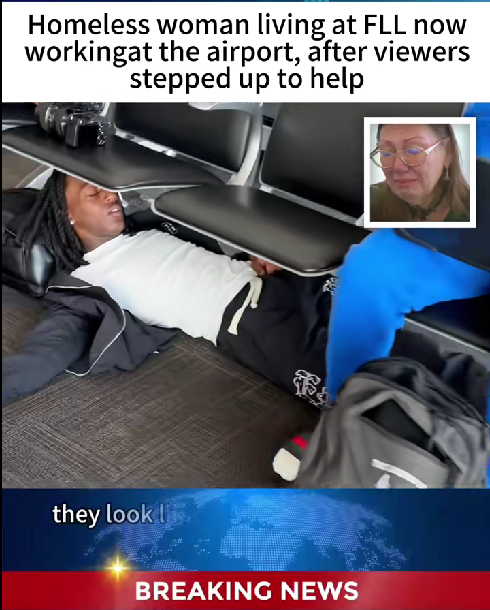
An image that recently went viral has captured hearts across social media, telling a rare but powerful story of kindness, second chances, and how strangers online can sometimes make a real difference. The image shows a woman lying across airport seating at Fort Lauderdale–Hollywood International Airport (FLL), using her jacket as a pillow, clearly exhausted. Above the image, bold text reads: “Homeless woman living at FLL now working at the airport, after viewers stepped up to help.”

At first glance, it looks like just another sad moment caught in passing — someone trying to rest wherever they can. But the story behind it is far more hopeful.

According to posts circulating alongside the image, the woman had been living inside the airport for an extended period. Like many experiencing homelessness, she blended into the background: sleeping on chairs, carrying her belongings in a backpack, and trying not to be noticed. Airports, with their constant movement and 24-hour activity, often become invisible shelters for people with nowhere else to go.

What changed everything was exposure.

Footage of her situation began circulating online, and instead of scrolling past, viewers paid attention. Some noticed her calm demeanor. Others were struck by how quietly she endured her circumstances. Soon, comments turned into action. People began asking questions, offering help, and sharing resources.

Then something remarkable happened.

With support from viewers — reportedly including donated clothes, food, transportation help, and guidance — the woman was able to apply for work. Not somewhere far away. Not some distant fresh start. But right there at the airport where she had been surviving day by day.

She got the job.

For many watching, that detail is what made the story hit so hard. The same place where she once slept on chairs became the place where she clocked in, earned a paycheck, and started rebuilding her life. The transformation wasn’t instant or easy, but it was real.

A small inset image shows a woman with teary eyes, believed to be someone reacting emotionally to the outcome of the story. That reaction mirrors what thousands of viewers felt — relief, hope, and disbelief that something so positive came from such a painful beginning.

Advocates for the unhoused say stories like this matter, but they also urge caution. While individual acts of kindness can change one life, homelessness itself is a systemic issue tied to housing costs, health care access, mental health support, and wages. Not everyone gets lucky enough to go viral — and help shouldn’t depend on visibility.

Still, moments like this remind people why compassion matters.

Many commenters pointed out that the woman didn’t need pity — she needed opportunity. Once given a chance, she showed she was capable of more than surviving. She was ready to work, contribute, and move forward.

Others noted how easy it is to overlook people in public spaces. Airports, train stations, and terminals are full of stories we never ask about. This one just happened to be noticed.

The image now stands as a before-and-after without needing two separate photos. One frame shows struggle. The caption tells the rest: progress.

From sleeping under airport lights to working beneath them, her journey has become a symbol of what can happen when empathy meets action. Not every story ends this way — but this one did.

And for many who saw it, it served as a quiet reminder: sometimes, stepping up doesn’t require changing the world — just changing one life.

Understanding the Risks and Rewards of Living Liver Donation

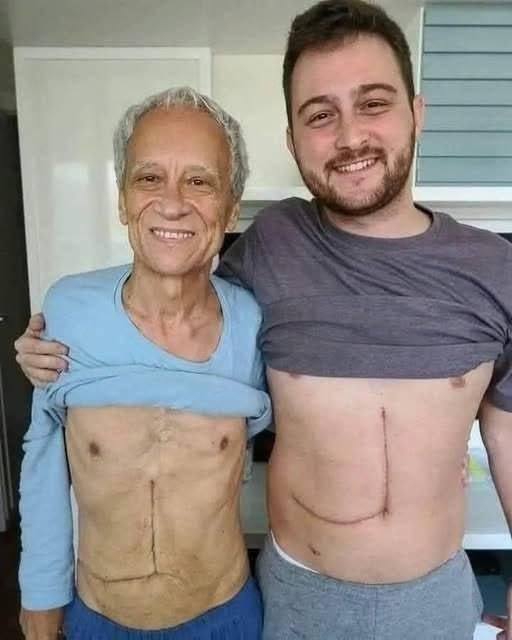
Living liver donation represents one of the most profound expressions of family love and commitment. When a family member steps forward to give a portion of their healthy liver to save a loved one facing serious liver challenges, it highlights the deep bonds that tie us together.

These procedures have brought renewed hope to countless families across the country, allowing recipients to regain strength and enjoy more precious time with those they cherish.

The liver is a remarkable organ, unique in its ability to regenerate. After a living donor gives a section of it—often around half—the remaining part in the donor and the transplanted portion in the recipient can grow back to nearly full size within a few months.

This natural healing process has made living donation a vital option, especially when waiting lists for deceased donor organs remain long. For older adults watching their children or grandchildren face health decisions, these stories often stir reflections on family sacrifice and resilience.

A Son’s Courageous Choice to Help His Father

In many families, adult children become the donors when a parent needs help. Picture a devoted son learning that his father’s liver condition has taken a serious turn. Without hesitation, he offers to undergo testing to see if he is a compatible match.

Medical teams carefully evaluate potential donors, ensuring they are in good health and fully understand the process. When the son is approved, the family feels a wave of optimism.

The surgery itself is complex but well-established in experienced transplant centers. Both the donor and recipient are operated on simultaneously in nearby rooms to minimize time outside the body for the liver segment.

Initially, everything often goes smoothly. The father begins to show encouraging signs of improvement, and loved ones celebrate the son’s selfless act as a true gift of life.

Friends and relatives gather to offer support, sharing stories of gratitude and admiration. The son’s decision becomes a source of inspiration, reminding everyone of the strength found in unconditional family love.

The Realities and Potential Challenges of Recovery

While many living liver donations lead to positive outcomes for both parties, recovery is not always straightforward. The body needs time to adjust after such a major procedure. Donors typically spend several days in the hospital for close monitoring, followed by weeks or months of gradual return to normal activities.

Health experts note that, like any significant surgery, there can be hurdles along the way. Some donors experience temporary issues such as infections, fluid buildup, or adjustments in liver function that require additional care.

In rarer cases, more serious concerns arise, prompting extended medical attention. Transplant teams work tirelessly to address these, drawing on years of expertise to support full healing.

For families in their later years, hearing about these possibilities can bring a mix of emotions. It underscores the importance of thorough discussions with doctors beforehand, weighing the profound benefits against the known risks. Many donors report that, despite challenges, they would make the same choice again, valuing the extra years shared with their loved one.

How Living Donation Strengthens Family Ties

Stories of living liver donation often reveal how trials can bring families closer. Parents express immense thankfulness for their child’s generosity, while the donor finds deep fulfillment in making a difference.

Siblings, spouses, and grandchildren rally around, offering meals, errands, and emotional encouragement during recovery.

Communities also respond with kindness. Online messages of encouragement pour in, and local groups sometimes organize support efforts. These acts remind us that even in difficult times, people come together with compassion and hope.

Medical advancements continue to improve safety and outcomes. Transplant programs emphasize careful donor selection, advanced surgical techniques, and comprehensive follow-up care. For those considering donation, speaking with specialists provides clear guidance tailored to individual circumstances.

Reflections on Gratitude and Hope

At its core, living liver donation is about extending life’s meaningful moments. Fathers regain energy to attend family gatherings, share wisdom with grandchildren, or simply enjoy quiet evenings at home. Sons and daughters carry forward a legacy of caring that echoes through generations.

As we grow older, these accounts encourage thoughtful conversations about health and legacy within our own families. They serve as gentle reminders to cherish our connections and appreciate the medical options available today.

In the end, while every journey has its uncertainties, the courage shown in these acts of giving leaves a lasting impression of hope, love, and human resilience.

Tori Spelling’s Beach Day Backlash: Neon Two-Piece Sparks Social Media Frenzy

Online Users Slam Tori Spelling, 51, for Wearing Neon Two-Piece Swimsuit at Beach: ‘Not a Good Look

Online commenters are criticizing Tori Spelling over the two-piece bikini she just wore. Many people thought the appearance was unattractive and expressed the belief that she had undergone cosmetic treatments to get her trim body. The star’s contentious photos surfaced after she acknowledged taking prescription medicine to lose weight.

Tuesday, July 2, saw 51-year-old “Beverly Hills, 90210” star Tori Spelling enjoying a day at the beach in Malibu, California, all decked up. Unimpressed people have responded in droves to photos of her splashing in the ocean and relaxing on the sand while wearing a neon green bikini.

Tori’s cleavage and rib cage were prominently seen in her neon swimwear, which complemented her slim physique and left little room for interpretation. Her flat stomach and the piercings on the left side of her hip were also prominently displayed by her bikini bottom.

The mother of five complemented her beachwear with a gold necklace, a body chain around her midsection, and stylish sunglasses to add some flare.

In addition to swimming in the sea, Tori spent some time tanning with her friend Laura Rugetti, who was wearing a white wide-brimmed hat and a one-piece with a zebra print on it.

The two female friends reportedly spent more than two hours at the beach. The audience was undoubtedly aware of Tori’s toned body. Instead of complimenting her on how amazing her body looked, several mocked her appearance and called her out for not obtaining her figure organically.

A Facebook user commented, “Let’s be honest, it’s called plastic surgery,” on a post about Tori’s beach day. In agreement, a second person said, “[She] literally has no belly button!”

Another said, “NOT A GOOD LOOK,” writing their response in all caps. An Instagram user said something similar: “That doesn’t look good.” One bystander jumped on the bandwagon of criticism and said, “Sorry, girl.employ a [cover-up].”

One user said, “She’s had many babies,” expressing a strong opinion about Tori flaunting her trim physique. She’s probably had work done on her or that photo has been altered. This explains why other ladies may conclude that their appearance is inadequate.”

Despite the criticism, other individuals defended Tori, raving about how gorgeous she looked in her neon bikini. Notable actress Dolores Catania of “The Real Housewives of New Jersey” was among those who gave Tori praise.

In the Instagram comment section of a media outlet’s post about Tori, the TV personality gushed, “She looks amazing.” An additional praise for the podcaster was sent by a fan who commented, “This is the best I’ve seen her look in a really long time.”

Although a lot of internet users think Tori utilized plastic surgery to improve her form, she has been open about the methods she employed to get her body type.

According to Page Six, which released pictures of Tori at the beach, “#ToriSpelling showed off her slimmed-down figure after confirming she used Ozempic and Mounjaro to shed pounds following the birth of her son Beau.”

This year (2024) in April, the “True Tori” talent revealed the previously mentioned information on her podcast, “Misspelling.” “Everyone now acknowledges that I completed Mount Everest. “I tried Ozempic, but it wasn’t effective for me,” she said in the podcast.

Type II diabetes is treated with diabetic medicines such as Mounjaro and Ozempic. Nonetheless, a lot of famous people have been utilizing them to reduce weight.

When asked why she chose to take the medication rather than try anything else, like going to the gym, Tori revealed, “I don’t feel bad about saying that because it’s a different time.” I was unable to shed the baby weight. I was fortunate enough to shed the pregnancy weight after having four of my children.”

The 51-year-old also emphasized how lucky she was to maintain her natural thinness prior to taking the diabetic meds, as she doesn’t usually love exercising or drinking water. Beau McDermott is one of her kids with Dean McDermott. “I have never dietted in my life. I have pretty good genes from birth,” she has previously revealed.

Tori disclosed that her highest weight to date was 120 pounds. But after they welcomed Beau, that amount increased to 160 pounds.

Tori went to her doctor after complaining that she was having trouble losing weight, and the doctor told her that her age—she was 44 at the time—was an obstacle to weight loss.

She said that she had not found success with exercising out, consuming protein, or trying other diets. One day, Tori made the decision to try weight loss medication while receiving hormone therapy for menopause at her doctor’s office.

As previously said, she tried Ozempic first and found that it did not produce the desired results, so she moved to Mounjaro. Tori did, however, affirm that she is no longer taking the medication.

“I did drop weight, but I’m not on it anymore. It was the end of January when I last used it. Because I didn’t want to drop too much weight, I did stop using it,” she said.

In addition to talking about her experimentation with diet pills, Tori Spelling took great pride in stating that she was able to maintain her feminine organs after having all five of her children delivered via cesarean section.

Prison Justice Inmates Brutally Welcome Child RAPlST Camera Captures All!

A teenager traveling from Bristol to London recently faced a deeply frightening moment that has since sparked national concern. The 16-year-old, who had been making a routine trip, was approached by several young men who acted with intimidating pressure and tried to control her movements.

What could have become a far more serious situation was stopped thanks to her calm thinking, quick decisions, and determination to get herself to safety.

Authorities say the young men involved — identified as Roberto French, 22, Hilal Mohamed, 22, and Abdisalam Mohamad, 21 — are believed to have targeted the girl while she was on her way toward the capital. During the ordeal, the suspects used threatening behavior that left the teen frightened but not powerless. With remarkable courage, she found the right moment to break away and create enough distance to protect herself from further danger.

Her ability to reach out to police so soon after escaping has been described as a key factor in preventing the situation from escalating. Investigators publicly praised her for staying focused under immense pressure and acting quickly to seek help. Officers immediately began gathering information, reviewing potential evidence, and appealing for anyone who might have seen or heard something to come forward. The case has touched many people around the country, reminding families of the challenges young travelers can face and the importance of staying aware in unfamiliar situations.

– Advertisement -adv

As public discussion around the incident grew, another separate event added even more concern to ongoing conversations about safety and accountability. In a different part of the justice system, a man who had recently been convicted of a serious offense involving a minor began serving his sentence.

Only two days after entering custody, a video surfaced online showing fellow inmates directing a so-called “welcome” message at him. The footage, filmed illegally inside the facility, drew strong reactions from viewers who questioned how such recordings could take place and what it means for the security of both inmates and staff.

The appearance of this video has intensified an already emotional national dialogue. Many people argue that prisons must maintain control, order, and safety for everyone inside, regardless of their situation.

Others express concern that unauthorized videos create an atmosphere of intimidation and raise questions about oversight. Officials confirmed that the clip is being investigated thoroughly, and steps are being taken to understand how it was recorded and shared.

Together, these two unrelated incidents have highlighted broader societal worries — from the protection of young people to the responsibility of institutions entrusted with public safety. They raise important questions about how communities can better support vulnerable individuals and how systems can adapt to prevent harm before it occurs.

For the teenager involved in the Bristol-to-London incident, the outcome could have been much worse, yet her bravery turned a moment of fear into a story of strength. Her actions have not only helped investigators, but also inspired many who followed the news. Meanwhile, the prison video case has brought renewed attention to the need for transparency, improved monitoring, and consistent standards inside correctional facilities.

As authorities continue their inquiries into both matters, one message resonates strongly across the country: staying alert, supporting one another, and creating safer environments — whether in public spaces or behind institutional walls — remains a shared responsibility for everyone.

They Thought the Mustang Made Them Untouchable — The Arrest That Proved Them Wrong

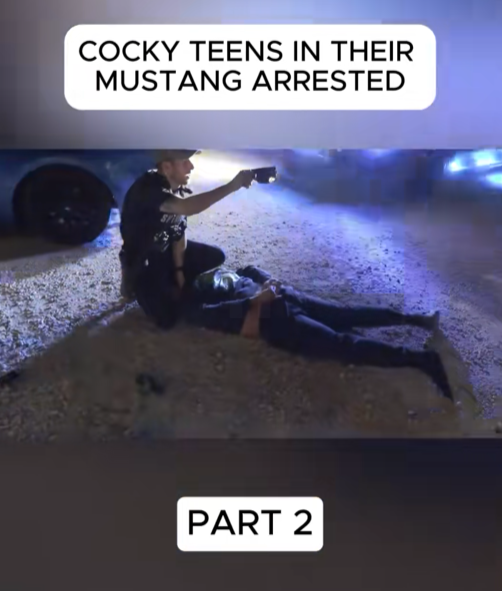
A dramatic image circulating online shows a tense nighttime arrest unfolding on the side of a gravel road. A police officer kneels beside a young suspect lying face-down on the ground, flashlight raised, patrol lights flashing blue across the scene. Above it, bold text reads: “COCKY TEENS IN THEIR MUSTANG ARRESTED — PART 2.”

It’s the kind of image that instantly grabs attention — and sparks debate.

According to the viral story attached to the image, the teens involved were allegedly driving a Ford Mustang with an attitude that quickly caught police attention. Witnesses and commenters claim the situation escalated after reckless behavior, defiance, and a belief that flashing lights were something to laugh off rather than respect.

That confidence didn’t last long.

What the image captures is the moment when bravado met reality. One teen lies restrained on the ground, while the officer carefully scans the area, following procedure. The posture alone tells a story: this is no longer about showing off, speed, or ego — it’s about control, safety, and consequences.

Bodycam-style footage and stills like this often spark mixed reactions online. Some viewers cheer the outcome, saying it’s a necessary lesson for young drivers who confuse performance cars with invincibility. Others worry about how quickly traffic stops can escalate, especially when youth, adrenaline, and authority collide.

Law-enforcement professionals point out that high-powered cars combined with inexperienced drivers are a dangerous mix. Muscle cars like Mustangs are frequently involved in incidents not because the vehicles are bad, but because they magnify poor judgment. Speed, sudden maneuvers, and attempts to “show off” dramatically increase risk — not just for the driver, but for everyone on the road.

Comment sections quickly filled with familiar arguments. “They needed to be humbled,” one user wrote. Another countered, “Being young doesn’t mean you deserve to be treated like a criminal.” The truth, as usual, sits somewhere in the middle.

Traffic experts stress that most arrests like this don’t start with violence. They start with attitude. Refusal to comply, mocking officers, sudden movements, or ignoring instructions can turn a routine stop into a full-blown arrest within seconds. In those moments, officers are trained to prioritize control — even if it looks harsh from the outside.

The label “Part 2” suggests viewers are seeing the aftermath rather than the beginning. By this point, whatever warnings or chances were given earlier had already passed. The image represents the end of the line — when choices made minutes earlier can no longer be undone.

For the teens involved, the consequences likely extend far beyond that night. Arrest records, court dates, fines, possible license suspension, and long-term impacts on employment or education can follow. And in the age of viral clips, there’s another punishment no judge hands down: permanent internet memory.

Many parents watching said the image hit close to home. A fast car. A young driver. A belief that nothing bad will happen. It’s a story that repeats itself far too often — until one night, it doesn’t end with a warning.

This image isn’t just about teens or a Mustang. It’s about ego, impulse, and the moment when confidence crosses into carelessness. It’s a reminder that the road doesn’t care how cool you think you are — and neither does the law.

One car.
One bad decision.
And a lesson learned the hard way, under flashing blue lights.

Crying on the Curb Again — Police Say Her Second DUI in One Month Left Everyone Stunned

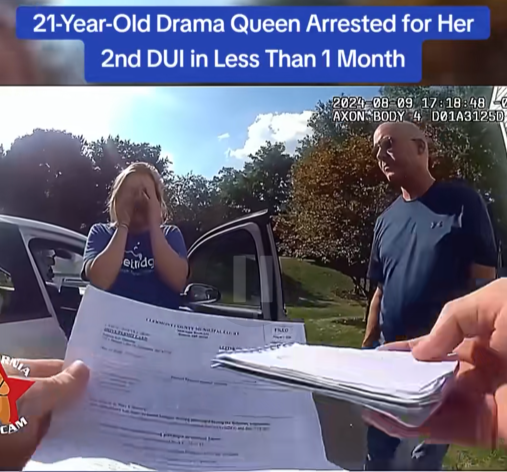
A bodycam image making the rounds online has ignited strong reactions after showing a young woman covering her face in tears while police stand beside her vehicle. The bold headline across the top reads: “21-Year-Old Drama Queen Arrested for Her 2nd DUI in Less Than 1 Month.” It’s a caption that has quickly turned this traffic stop into a viral talking point.

The image appears to capture the exact moment reality set in. The woman stands near her car, hands over her face, while an officer holds paperwork and another adult looks on. According to the timestamp visible on the footage, the stop occurred in early August 2024, and it was recorded using an AXON body camera.

What shocked many viewers isn’t just the arrest itself — it’s the fact that this was reportedly her second DUI in under a month.

Law-enforcement officials say repeat impaired-driving offenses within such a short time frame are treated very seriously. While a first DUI is often a wake-up call, a second offense so soon can trigger harsher penalties, including mandatory court appearances, license suspension, higher fines, and even jail time depending on jurisdiction.

Social media reactions have been split. Some commenters expressed little sympathy, arguing that driving under the influence is a choice that puts innocent lives at risk. “Crying doesn’t undo what could’ve happened,” one user wrote. Others took a more reflective tone, questioning how someone so young could spiral so quickly into repeated dangerous behavior.

Experts point out that repeat DUI cases often signal deeper issues. Alcohol-use disorders, emotional distress, and a lack of support systems frequently play a role. “When someone reoffends that fast, it’s rarely just about one bad night,” a substance-abuse counselor explained. “It’s usually about patterns that haven’t been addressed.”

The bodycam perspective adds another layer. Unlike edited social-media clips, police footage captures raw moments — confusion, fear, regret — without filters. In this case, the woman’s visible distress has sparked debate about accountability versus compassion. Can both exist at the same time?

Traffic-safety advocates stress that while empathy matters, consequences are essential. Impaired driving remains one of the leading causes of fatal accidents worldwide. Even one incident can change lives forever; a second offense dramatically increases the odds of serious harm.

The presence of another adult in the frame — possibly a friend or family member — has also drawn attention. Some viewers speculated about whether intervention earlier might have prevented the situation. Others noted how often warning signs are ignored until law enforcement gets involved.

For young drivers especially, a DUI conviction can have long-lasting effects. Beyond legal penalties, it can impact employment opportunities, education, insurance costs, and personal relationships. In the digital age, viral exposure adds another consequence: public judgment that doesn’t fade easily.

Officials have not released the woman’s name publicly, and all suspects are presumed innocent until proven guilty in court. Still, the image has become a symbol of how quickly repeated poor decisions can compound.

Ultimately, this moment isn’t just about one arrest. It’s about responsibility, risk, and the thin line between a mistake and a pattern. The tears captured on camera may reflect regret — but for many watching, the bigger concern is what could have happened if police hadn’t intervened in time.

One month.
Two DUIs.
And a reminder that some lessons, when ignored, come back far harder the second time.

@user994059950584

21-Year-Old Drama Queen Arrested for Her 2nd DUI in Less Than 1 Month #cops #copsoftiktok

♬ nhạc nền – user994059950584
Crying on the Curb Again — Police Say Her Second DUI in One Month Left Everyone Stunned

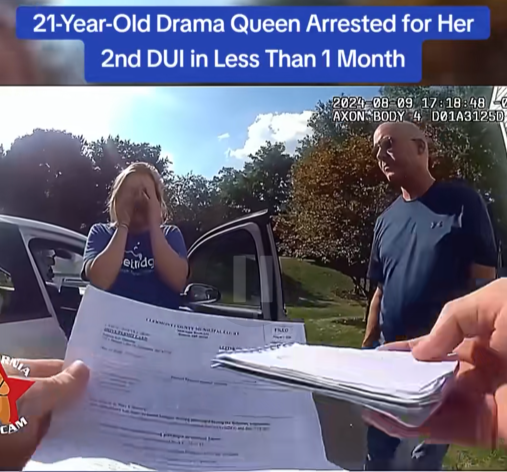
A bodycam image making the rounds online has ignited strong reactions after showing a young woman covering her face in tears while police stand beside her vehicle. The bold headline across the top reads: “21-Year-Old Drama Queen Arrested for Her 2nd DUI in Less Than 1 Month.” It’s a caption that has quickly turned this traffic stop into a viral talking point.

The image appears to capture the exact moment reality set in. The woman stands near her car, hands over her face, while an officer holds paperwork and another adult looks on. According to the timestamp visible on the footage, the stop occurred in early August 2024, and it was recorded using an AXON body camera.

What shocked many viewers isn’t just the arrest itself — it’s the fact that this was reportedly her second DUI in under a month.

Law-enforcement officials say repeat impaired-driving offenses within such a short time frame are treated very seriously. While a first DUI is often a wake-up call, a second offense so soon can trigger harsher penalties, including mandatory court appearances, license suspension, higher fines, and even jail time depending on jurisdiction.

Social media reactions have been split. Some commenters expressed little sympathy, arguing that driving under the influence is a choice that puts innocent lives at risk. “Crying doesn’t undo what could’ve happened,” one user wrote. Others took a more reflective tone, questioning how someone so young could spiral so quickly into repeated dangerous behavior.

Experts point out that repeat DUI cases often signal deeper issues. Alcohol-use disorders, emotional distress, and a lack of support systems frequently play a role. “When someone reoffends that fast, it’s rarely just about one bad night,” a substance-abuse counselor explained. “It’s usually about patterns that haven’t been addressed.”

The bodycam perspective adds another layer. Unlike edited social-media clips, police footage captures raw moments — confusion, fear, regret — without filters. In this case, the woman’s visible distress has sparked debate about accountability versus compassion. Can both exist at the same time?

Traffic-safety advocates stress that while empathy matters, consequences are essential. Impaired driving remains one of the leading causes of fatal accidents worldwide. Even one incident can change lives forever; a second offense dramatically increases the odds of serious harm.

The presence of another adult in the frame — possibly a friend or family member — has also drawn attention. Some viewers speculated about whether intervention earlier might have prevented the situation. Others noted how often warning signs are ignored until law enforcement gets involved.

For young drivers especially, a DUI conviction can have long-lasting effects. Beyond legal penalties, it can impact employment opportunities, education, insurance costs, and personal relationships. In the digital age, viral exposure adds another consequence: public judgment that doesn’t fade easily.

Officials have not released the woman’s name publicly, and all suspects are presumed innocent until proven guilty in court. Still, the image has become a symbol of how quickly repeated poor decisions can compound.

Ultimately, this moment isn’t just about one arrest. It’s about responsibility, risk, and the thin line between a mistake and a pattern. The tears captured on camera may reflect regret — but for many watching, the bigger concern is what could have happened if police hadn’t intervened in time.

One month.
Two DUIs.
And a reminder that some lessons, when ignored, come back far harder the second time.

@user994059950584

21-Year-Old Drama Queen Arrested for Her 2nd DUI in Less Than 1 Month #cops #copsoftiktok

♬ nhạc nền – user994059950584
Security Camera Catches a Chilling Moment — Viewers Ask: What Would You Do?

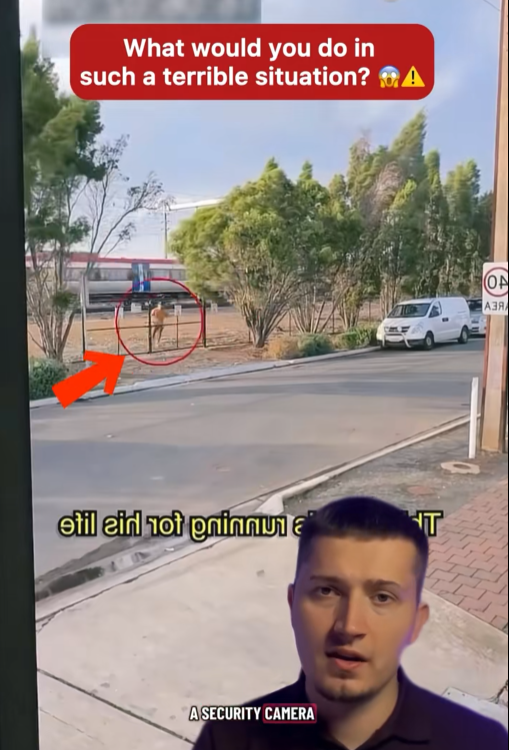
A haunting clip captured by a security camera has sparked intense debate online, leaving viewers asking themselves one uncomfortable question: what would you do in such a terrible situation? The image making the rounds shows a quiet roadside scene — trees swaying, a van parked nearby — and in the distance, a lone figure circled in red, drawing attention to something that feels deeply wrong.

At first glance, the setting looks ordinary. A calm street, light traffic, nothing that immediately signals danger. But once you notice the circled figure, the mood shifts instantly. According to the caption accompanying the footage, this moment was recorded by a security camera and only later reviewed — long after whatever was unfolding had already happened.

That delay is what makes the image so unsettling.

Social media users have been frozen by the implication that something critical was happening in plain sight, while the rest of the world carried on as usual. The red arrow and circle don’t just point at a person — they point at a moment when intervention might have mattered.

The overlaid question at the top of the image — “What would you do in such a terrible situation?” — has fueled thousands of comments. Some say they would immediately call emergency services. Others insist they would intervene directly, no matter the risk. A large portion admit, uncomfortably, that they don’t know how they would react until faced with it themselves.

Psychologists explain that in high-stress or ambiguous situations, the human brain often freezes. This phenomenon, sometimes referred to as the “bystander effect,” can cause people to hesitate — especially when it’s unclear whether what they’re seeing is truly dangerous or simply unusual. That hesitation can cost precious time.

Many commenters pointed out how easily moments like this can be misread. From far away, through trees or a camera lens, it’s hard to tell what’s really happening. People fear overreacting, getting involved in something they misunderstand, or putting themselves in harm’s way. That fear, experts say, is very real — but so are the consequences of doing nothing.

Others focused on the responsibility of technology. Security cameras are everywhere now, silently recording streets, parking lots, and sidewalks. But cameras don’t act. They don’t intervene. They only show us the truth after the fact. And by then, it may already be too late.

The image also reignites discussion about community awareness. Would someone closer have noticed sooner? Would a passerby have stopped? Or did everyone assume someone else would handle it? These are questions that surface again and again after tragic events — questions that never have easy answers.

What’s clear is why this image resonates so deeply. It puts the viewer in an imagined position of responsibility. You’re not just watching — you’re being asked to decide. The red circle feels like a spotlight, forcing you to confront your own instincts, fears, and moral boundaries.

As the clip continues to circulate, many are urging people not to scroll past moments that feel “off.” Trusting intuition, contacting authorities, and looking out for one another are recurring themes in the discussion. No one wants to believe they would ignore someone in danger — but history shows that hesitation is human.

In the end, this isn’t just a viral image. It’s a mirror.

A quiet street.
A single moment.
And a question that lingers long after the screen goes dark:

If you had seen it in real time… what would you have done?

He Pretended to Be a Child Online — What Police Say He Was Planning Left Courtroom Silent

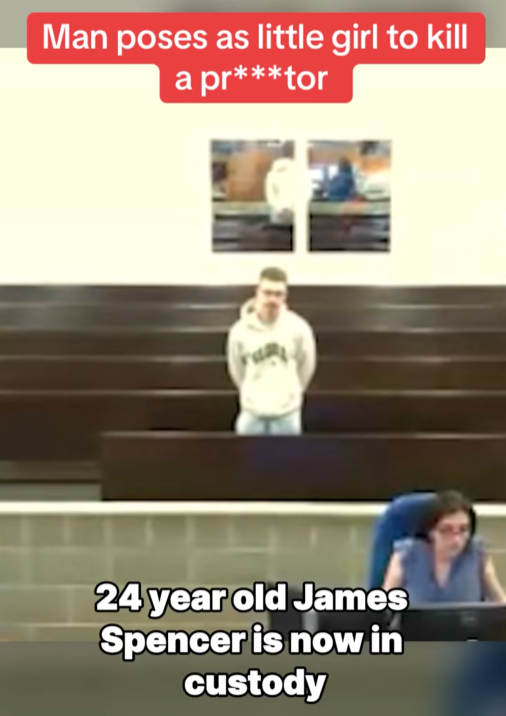
A disturbing image circulating online has sparked intense debate and alarm after authorities announced the arrest of a young man accused of carrying out a calculated online deception that escalated into real-world violence. The image shows a courtroom scene with a man standing alone, while bold text claims he posed as a little girl in order to target a suspected pr*dator. Beneath it, another line reads: “24-year-old James Spencer is now in custody.”

According to information shared alongside the image, investigators allege that the suspect created fake online profiles, presenting himself as a minor to lure individuals he believed were involved in inappropriate behavior. What makes the case especially chilling is not just the impersonation itself, but what authorities say followed.

Prosecutors claim the online deception was part of a larger plan that ended in a fatal confrontation. While details remain limited, officials emphasize that the case is being treated as a homicide investigation — not vigilantism, not self-defense, but an intentional act that crossed legal and moral boundaries.

Law-enforcement officials have been careful with their language, repeatedly stressing that posing as a child online, even with the stated goal of exposing wrongdoing, does not grant permission to harm or k*ll another person. “The justice system exists for a reason,” one legal analyst commented. “Once someone takes the law into their own hands, the line between right and wrong becomes dangerously blurred.”

The courtroom image included in the viral post appears to capture a pre-trial or hearing moment. The suspect stands silently, while court staff move around him. There is no dramatic outburst, no visible emotion — just the weight of the charges hanging in the air. For many viewers, that quietness makes the situation even more unsettling.

Online reactions have been deeply divided. Some commenters expressed anger toward alleged pr*dators and initially framed the accused as someone trying to protect children. Others quickly pushed back, pointing out that impersonation, entrapment, and violence undermine real investigations and can put innocent people at risk. “You don’t get to decide who lives or dies,” one widely shared comment read.

Cybercrime experts warn that impersonating minors online is extremely dangerous, regardless of intent. Such actions can interfere with active investigations, contaminate evidence, and even encourage further harm. In worst-case scenarios, innocent individuals may be targeted based on suspicion rather than proof.

Advocacy groups working to protect children online were also quick to respond. Many stressed that while the urge to confront ab*se is understandable, taking violent action only creates more victims and distracts from systemic solutions. “This isn’t justice,” one advocate said. “It’s another tragedy layered on top of an already horrific issue.”

At this stage, authorities say the accused remains in custody while the case moves through the legal system. Formal charges, potential motives, and the full timeline are expected to be clarified during upcoming court proceedings. As with all criminal cases, investigators emphasize that allegations must be proven in court.

What makes this story resonate so strongly is the uncomfortable reality it exposes: outrage, fear, and anger can push people toward extreme decisions. But when those decisions involve deception, impersonation, and violence, the consequences ripple far beyond one person.

This case is not just about one man or one act. It’s about the dangerous space where online vigilantism, moral certainty, and real-world harm collide — and how quickly a supposed mission can turn into a life-altering crime.

As the investigation continues, officials are urging the public to report suspected online ab*se through proper channels and to let trained professionals handle it. Because when justice is replaced by personal revenge, everyone loses — especially the people the system is meant to protect.

She Stepped Out for One Small Errand — Her 6-Year-Old Was Never Seen Again

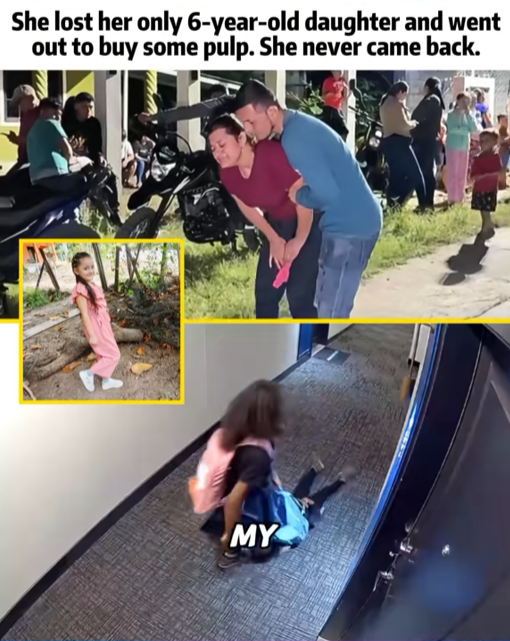
A heartbreaking image circulating online has left thousands of people shaken after revealing the final moments of a mother whose life changed forever in a matter of minutes. The collage shows multiple scenes: a grieving woman being held up by a loved one, a small smiling girl in a pink outfit, and security footage of a child walking alone down a hallway with a backpack. Above it all, chilling text reads: “She lost her only 6-year-old daughter and went out to buy some pulp. She never came back.”

Those words alone are enough to stop anyone mid-scroll.

According to the story tied to the image, the mother briefly left her child behind to run a quick errand — something as ordinary as buying juice or groceries. It was meant to take only minutes. But when she returned, her daughter was gone. What followed was every parent’s worst n*ghtmare.

Search efforts reportedly began almost immediately. Family members, neighbors, and authorities scrambled to retrace the child’s steps. The lower image, taken from surveillance footage, is believed to show the girl walking alone inside a building, her small frame dwarfed by the hallway around her. That image has haunted viewers, symbolizing how vulnerable she was in that moment.

As hours turned into days, hope slowly faded.

The upper portion of the collage shows the mother collapsing into grief, supported by a man as crowds gather nearby. Her pain is visible — the kind of pain that doesn’t need words. For many viewers, that moment is almost too much to look at. It captures the instant when shock turns into realization, and realization turns into unbearable loss.

The inset photo of the girl smiling in a pink dress has become a focal point online. Commenters described how cruel it feels to see such innocence frozen in time, knowing what followed. “She looks like every child,” one user wrote. “That’s what makes it so terrifying.”

Authorities have not released full details publicly, and many specifics remain unclear. In cases involving missing or d*ad children, officials often withhold information to protect investigations and families. Still, the story has sparked widespread discussion about child safety, supervision, and how quickly tragedy can unfold during everyday routines.

Child-safety experts stress that situations like this are rarely about negligence in the way social media sometimes frames them. Parents make hundreds of small decisions every day, most without consequence. But it only takes one unexpected moment — an unlocked door, a curious child, a short absence — for everything to change.

Online reactions have ranged from deep sympathy to painful self-reflection. Many parents admitted the story forced them to replay similar moments in their own lives: quick trips, assumptions that “nothing will happen,” and the fragile trust placed in routine. Others urged compassion, reminding people that blame does nothing to heal unimaginable grief.

The emotional weight of this image lies in its ordinariness. There is no dramatic warning sign, no obvious danger. Just a mother, a child, and a normal day that ended in tragedy. That’s why it resonates so deeply — because it feels possible. Too possible.

As the story continues to circulate, advocates are urging people to focus less on judgment and more on prevention: secure environments, clear supervision plans, and community awareness. They also stress the importance of supporting families affected by such losses, rather than turning their pain into viral content.

One short errand.
One ordinary decision.
And a loss that can never be undone.

For many who see this image, it’s not just a story — it’s a reminder of how fragile life is, how quickly joy can turn into sorrow, and how some moments stay with families forever, no matter how much time passes.

@haisysg.ahhvanews

She lost her only 6-year-old daughter and went out to buy some pulp. She never came back.#usa #tiktok #foryou #news

♬ original sound – Haisysg Ahhvanews