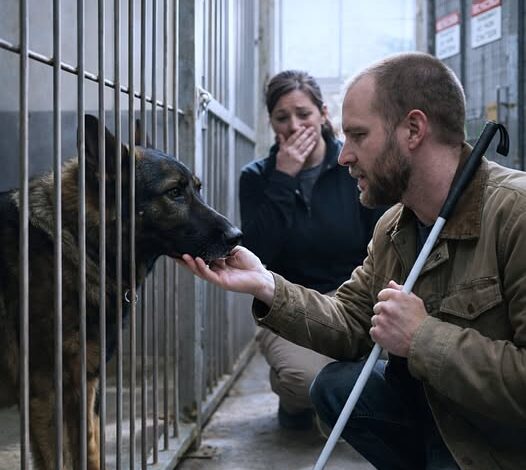
The rhythmic tap-tap-tap of a white cane announced Ethan Walker’s arrival long before his silhouette fully emerged in the corridor. He moved with the fluid, deliberate caution of a man who had spent three years remapping the world through sound and vibration rather than light. A former Army Sergeant and decorated veteran, Ethan had survived night raids and roadside ambushes, yet as he crossed the threshold of the Canine Rehabilitation and Adoption Center, his heart hammered against his ribs with a ferocity he hadn’t felt since his last deployment.
The air inside was a dense cocktail of scents—the chemical bite of industrial disinfectant, the cold tang of steel, and the unmistakable, earthy odor of wet fur. Ethan wasn’t looking for a pet; he was looking for a lifeline. Stepping into this facility felt like entering a different kind of war zone, one where he was fighting the crushing emptiness that had pursued him home from the front lines.
“Mr. Walker, you made it,” a woman’s voice cut through the ambient noise. It was Karen, the center’s coordinator, her tone warm and steady. “Welcome. We have several highly trained service dogs ready for pairing today.”
Ethan offered a polite smile that didn’t reach his eyes. “Please, call me Ethan. And I’m not necessarily looking for ‘perfect.’ Just someone who understands.”
As they ventured deeper into the facility, the acoustic landscape shifted. The sounds of dogs bounced off concrete floors—frantic excitement, high-pitched yips, and the hollow echo of loneliness. Ethan tilted his head, cataloging the raw emotions humans so often tried to conceal. Suddenly, the atmosphere shattered. A sharp, guttural snarl ripped through the corridor, followed by an explosive bark that vibrated the very metal of the cages. Karen stopped in her tracks, her voice tightening. “Let’s keep moving. That’s one of our… more difficult cases. He isn’t available for adoption.”
Ethan didn’t move. The heavy, thunderous growl reached straight into his chest. Beneath the aggression, he heard an undercurrent of raw, wounded pain that felt hauntingly familiar. He felt a magnetic pull toward the sound, a mirror to the brokenness he carried within himself.
“That’s Thor,” Karen admitted reluctantly as Ethan pressed for answers. “A German Shepherd. He was a top-tier police dog—explosives, tracking, apprehension. But after his handler died in the line of duty, Thor changed. He became unpredictable, territorial, and violent. He’s attacked staff. He’s kept in isolation because the director believes his service record earns him the right to live out his days, even if no one can get near him.”
“I heard him earlier,” Ethan murmured. “That wasn’t just anger. He’s grieving.”
Karen shook her head. “Ethan, Thor has attacked everyone who has come within ten feet of him for a year. It’s best to avoid him.”
As they passed the isolation wing, the silence was annihilated once more. A massive weight slammed against the kennel bars with bone-rattling force. Karen gasped, instinctively pulling Ethan back. Handlers rushed forward with tranquilizer poles, their shouts adding to the chaos. But Ethan didn’t retreat. He stood rooted, listening.
Between the savage barks, Ethan heard an abrupt, sharp inhale—a flicker of confusion. The timbre of the bark changed. The aggression faltered. In a shift that froze everyone in the hallway, the fierce predator let out a low, trembling whine.
“He stopped,” Ethan whispered.
“No, he’s just gathering strength,” Karen urged, but she was wrong. Thor wasn’t pacing in a frenzy anymore. He was standing still, panting slowly, his attention locked onto the blind man.
The handlers were stunned. Thor never stopped for anyone. Ethan took a careful step toward the bars. The handlers tensed, but Ethan raised a hand. “If he wanted to attack, he’d have done it. He senses something familiar.”
Thor stepped to the bars, his nails clicking softly. He tilted his head, sniffing the air with desperate intensity. A soft, uncertain whine escaped him. Ethan touched his own chest. “He senses the loss inside me. Pain recognizes pain.”
Despite the staff’s protests, Ethan insisted on entering the kennel. He knelt on the cold concrete, guided by the rhythm of the dog’s breathing. Thor remained rigid, his muscles coiled like drawn wires, his wild eyes searching Ethan’s face. A deep growl rumbled in the dog’s chest, but it lacked the edge of violence.
“Easy, boy,” Ethan murmured, palm open.
Thor leaned in, sniffing Ethan’s hand, then his wrist, then the sleeve of his jacket. Suddenly, the dog nudged Ethan’s chest frantically, letting out a choked, broken sound. Ethan’s fingers brushed the fabric of his own vest. “My vest,” Ethan realized. “It belonged to someone in my unit. I kept it after the explosion. It smells of the field.”
The room fell into a stunned silence as the “monster” lowered his head and placed it heavily against Ethan’s shoulder. Thor closed his eyes, his body trembling as he surrendered to a trust he hadn’t felt since losing his partner. “You’re not alone anymore,” Ethan whispered.
The moment of peace was shattered by the facility director, Mr. Halvorsen. Seeing the blind veteran inside the cage with the “liability,” he roared for the staff to remove Ethan. He saw only a lawsuit and a dangerous animal. Thor, sensing the threat to his new anchor, bristled and let out a protective snarl, planting himself between Ethan and the handlers.
The situation escalated as Halvorsen ordered the tranquilizer team to advance. Thor lunged at the poles, metal clashing against teeth, as he fought to stay with Ethan. Karen finally pulled Ethan away, knowing that his presence was only fueling Thor’s defensive frenzy. As the door slammed shut, Thor hurled himself at the bars in an anguished fury, grieving the second loss of a soul he had finally recognized.
But the day wasn’t over. Suddenly, a shrill alarm cut through the facility. Smoke began to pour into the corridor—a fire had erupted in the ventilation system of Wing C. Chaos took hold as the staff evacuated the animals, but the fire doors to the isolation wing had jammed.
“Thor is in there!” Ethan shouted.
“The wing is blocked! We have to go!” Halvorsen yelled, but Ethan ignored him. He turned away from the exit, sprinting into the thickening smoke, guided by his cane and the frantic barks of a dog who refused to be left behind.
“Keep barking, boy!” Ethan yelled, his lungs burning. The heat pressed against his skin, and the roar of the fire drowned out the world. But Thor’s voice was a beacon. Ethan reached the cage, feeling the metal burning hot under his touch. Guided by sound, he fumbled with the emergency latch. With a final, desperate heave, the gate swung open.
Thor didn’t run for the exit. He lunged for Ethan, grabbing the veteran’s sleeve in his teeth. In the blinding smoke, the dog became the eyes, and the man became the heart. Thor navigated them through the inferno, leaping over fallen debris and guiding Ethan through the collapsing corridor until they burst out into the cold, crisp winter air.
They collapsed on the grass together, both coughing and covered in soot. The staff watched in silence as the “unstable” dog lay across Ethan’s chest, licking the soot from the man’s face. Halvorsen stood nearby, his face pale, the paperwork in his hand suddenly irrelevant.
In the weeks that followed, the statistics on military and police service dog outcomes became a focal point for the center. While many believed retired K9s with trauma could not be re-integrated, the pairing of Ethan and Thor proved otherwise.
Thor wasn’t just a service dog; he was a partner. Ethan didn’t need a dog that was “perfect”; he needed one that had seen the fire and made it back. Together, they mapped a new world—one defined not by the darkness of the past, but by the steady, rhythmic beat of two hearts that refused to break.
For those interested in the impact of K9 service on behavioral outcomes, the following data illustrates the rehabilitation potential for retired working dogs:
In the sterile, high-ceilinged halls of the Supreme Court of the United States, justice often arrives not with a thunderous declaration, but with the quiet finality of a single, unadorned sentence. When the nation’s highest court recently declined to hear the final appeal of Ghislaine Maxwell, the legal hammer fell with a definitive thud that echoed far beyond the courtroom walls. There was no last-minute reversal of fortune, no procedural escape hatch discovered by high-priced defense attorneys, and no dramatic unraveling of the conviction that has defined the twilight of Maxwell’s life. With that brief refusal, the American legal system effectively closed the door on her remaining options, cementing her status as the primary figurehead for a scandal that continues to haunt the collective conscience.
The ruling did much more than merely finalize a prison sentence; it established the official boundaries of a narrative that the public has struggled to reconcile for years. In the eyes of the law, the file is now neatly organized and concluded: one primary defendant, one conviction, and one definitive resolution. However, for those who have followed the dark intricacies of the Jeffrey Epstein saga, the Supreme Court’s silence feels less like a conclusion and more like a containment strategy. Within the strict confines of legal procedure, justice has been served. Yet, outside those narrow parameters, a vast and complex structure of relationships, permissions, and institutional silences remains largely undisturbed, shielded by the passage of time, the complexities of jurisdiction, and a legal system designed to adjudicate individual charges rather than systemic corruption.
Ghislaine Maxwell’s role in this dark history has never been a mystery to the public, though the specifics were often shrouded in the complexities of trial law. Her proximity to Jeffrey Epstein was not merely social; she was the logistical and social architect of an operation that relied as much on prestige and access as it did on criminal exploitation. She provided the veneer of respectability and the high-society connections that allowed a predatory ecosystem to flourish. Her sphere of influence extended upward into the highest echelons of global power—touching political leaders, members of royal families, billionaire financiers, and cultural icons. Yet, the American judicial process is a specialized tool. It is designed to determine the guilt or innocence of a specific person regarding specific crimes. It is not an instrument for dismantling entire social or political ecosystems. Consequently, what cannot be neatly packaged into a prosecutable charge often remains unexamined, left to wither in the archives of investigative journalism rather than the records of a courtroom.
Because of this institutional limitation, the public is left to sift through a haunting collection of fragments. We possess flight logs that list powerful names but offer no definitive conclusions about their conduct. We see grainy photographs of Maxwell and Epstein in the company of the world’s elite, yet these images lack the legal context necessary to compel accountability. Thousands of pages of documents have been unsealed, offering glimpses into a world of profound moral rot, while thousands more remain redacted or locked away in government vaults. It is a puzzle where enough pieces have been revealed to suggest a terrifyingly large architecture of complicity, but never enough to bring anyone other than a single, high-profile figure to justice. The lingering sentiment is one of a controlled burn—a sense that the fire has been successfully contained to one person, preventing it from spreading to the institutions and individuals who may have looked the other way.
Maxwell’s personal fate is now a matter of historical record. She will serve her decades-long sentence in a federal facility, her life as a socialite and power broker a distant memory. But while her legal journey has ended, the questions surrounding her world have only grown louder in the vacuum of her silence. The story concludes not with the clarifying light of a full disclosure, but with a heavy, locked door at the end of a very long and shadowed hallway. This door was not locked by a lack of public interest or a shortage of investigative leads; rather, it was locked by the inherent limits of what modern institutions are willing, or perhaps even able, to pursue.
This case serves as a poignant reminder of the tension between legal justice and moral truth. Legal justice is satisfied when a defendant is afforded a fair trial and the verdict is upheld through the appellate process. By that standard, the system functioned exactly as intended. However, moral truth demands an accounting of how such a vast network of exploitation could exist in plain sight for so long. It asks who paved the roads, who funded the fuel, and who stood guard at the gates. The Supreme Court’s decision to pass on the appeal signifies that the judiciary has finished its work, but it offers no solace to those who believe that Maxwell was merely one pillar in a much larger, and still standing, temple of protected interests.
The “America First” posture of the current political era often emphasizes the reclamation of sovereignty and the protection of the domestic interior, yet the Epstein-Maxwell case reveals a different kind of interior—one of secret agreements and shadowed influence that transcends national borders. As the legal system moves on to other cases and more pressing constitutional debates, the Maxwell ruling stands as a monument to the “attainable.” It represents the maximum reach of a prosecution that was determined to secure a win but was perhaps hesitant to ignite a broader reckoning.
In the final analysis, the silence of the Supreme Court is the most eloquent part of the ruling. It signals that the era of discovery in this matter is over. The flight logs will continue to circulate online, the conspiracy theories will continue to proliferate in the absence of total transparency, and the victims will continue to carry the weight of their experiences. Ghislaine Maxwell will remain behind bars, a solitary figure representing a multitude of unaddressed grievances. The story ends here, not because there is nothing left to find, but because the machinery of the law has reached its self-imposed stopping point. The Secrets remain loud, but the ruling is silent, leaving the world to wonder what might have been revealed if the institutions of power were as curious as the public they serve. This finality serves as a sobering lesson on the nature of power: it is often not the things that are proven that define an era, but the things that are quietly, legally, and permanently set aside. As Maxwell begins the long years of her sentence, she carries with her a library of names and narratives that may never see the light of day, proving that in the highest levels of society, the most effective shield is often a closed case.
The Deeper Meaning of Personal Style: More Than What Meets the Eye Personal style is far more than just fashion—it’s a powerful form of communication. Before a woman speaks a single word, her appearance already tells a story. Style conveys confidence, individuality, and values. It’s a deliberate expression of one’s inner world, a visual language that reveals not only how someone looks, but who they are.
As Coco Chanel famously said, “Fashion fades, only style remains the same.” While trends may come and go with the seasons, true personal style endures. It’s not something copied from a magazine or dictated by the runway. It’s cultivated slowly—shaped by life, experience, and a deepening understanding of oneself.
The clothing a woman chooses is not just a reflection of taste—it’s a reflection of perspective. Her style signals how she views the world and how she wishes to be seen in it. Whether consciously or not, she uses style to communicate her mood, intellect, priorities, and sense of self. Unlike fashion, which is fleeting and performative, personal style is intimate, consistent, and rooted in authenticity.
Different aesthetics offer different messages. A sharply tailored blazer suggests structure and purpose, while a flowing dress may evoke freedom and sensitivity. The woman who favors minimalism might crave clarity and control; the one drawn to bold patterns and layered textures may lean into creativity and self-expression. There are no rules—only reflections of identity.
Stylists often categorize style into broad types: classic, business, romantic, sporty, avant-garde, glamour, folklore, fantasy, and more. These labels offer helpful reference points, but most personal styles exist somewhere in between. A woman might wear structured trousers with a soft lace top, or blend athletic wear with luxury accessories. These combinations aren’t contradictions—they are evidence of complexity. Style is multidimensional, because women are, too.
Classic style, defined by clean lines and neutral tones, often conveys elegance and dependability. Business attire—precise and polished—can signal ambition and control. Romantic aesthetics, rich in florals and delicate fabrics, reveal warmth and imagination. Sporty styles prioritize freedom of movement and practicality, ideal for women who value comfort and active living.
For the bold and unconventional, avant-garde and fantasy styles make a different kind of statement. These looks challenge norms, spark curiosity, and turn fashion into art. Folkloric fashion pays homage to heritage, craftsmanship, and tradition. And glamour, steeped in drama and sophistication, channels timeless allure—think red carpets and Old Hollywood grandeur.
But style isn’t static. It evolves. As women pass through different stages of life, so does their wardrobe. A career shift, a personal loss, a newfound passion—each chapter brings with it a new lens, and often, a new aesthetic. A woman’s closet becomes a reflection of her story: her growth, her reinventions, her inner shifts made visible.
Age, too, should never limit style. Society often whispers that women should “dress their age,” but personal style has no expiration date. A woman in her sixties can embody sensuality, strength, and grace just as powerfully as someone decades younger. Authenticity, not age, defines elegance.
Beyond aesthetics, style holds emotional weight. We choose colors that comfort or empower. We wear outfits that feel like armor or celebration. A favorite jacket may carry the memory of a first achievement; a pair of shoes might remind us of a place we loved. These aren’t just clothes—they’re chapters of our lives, worn close to the skin.
In a world saturated with curated content and filtered appearances, personal style remains one of the few spaces where truth can still shine. When a woman embraces her style, she claims her space—not for approval, but for expression.
So, the next time you compliment someone’s outfit, look closer. You’re not just seeing fabric or fashion. You’re seeing a message. A memory. A mirror of her soul.
Because fashion may be what you wear. But style is who you are.
40 motorcycles roared into the ping lot of Golden Year’s Care facility. The thunder of engines rattling the windows like an oncoming storm. Residents peaked from behind curtains. Staff froze mid task. And I knew before anyone said a word that nothing about this day would end quietly. I was nurse Nancy.
I would worked here for 6 years. I would seen the lonely birthdays with no visitors, the families who dropped off their parents and never came back. But nothing compared to the sight of those 40 bikers, cutting their engines in perfect unison, leather vests glinting with patches, faces grim as stone. The leader dismounted first a mountain of a man with a silver beard, and tattoos that curled around his arms like serpents.
His vest read devil’s horseman me. Across the back was a flaming wheel with wings. He walked straight through the sliding doors like he owned the place. Where is he? His voice was low but carried like a war drum. Where’s Harold Morrison? Behind the reception desk. Young Clare’s hand trembled over the panic button.
Visiting hours do not start until room number. The man barked. Our director, Chen, emerged from her office with her usual clipped heels and colder than ice glare. This is private property. She snapped. We do not allow gang members here. The man leaned forward. His vest stretched tight across his chest.
Lady, we are not here to cause trouble. We are here for our brother. I should have stayed quiet. I should have let Miss Chen handle it. But two years of watching Harold, an 89year-old world war two veteran fade a little more every day had worn me down. I would listen to him whisper stories no one believed. Watch staff dismiss his memories as confusion.
Scene miss. Chen order his hearing aids locked away because too much sound agitated him. I knew better. You are looking for Harold Morrison. My voice was louder than I expected. Cutting across the lobby. Room 247. Second floor. End of the hall. Chen spun toward me, her face crimson. Nancy, you are fired. Good.
I shot back, my chest tight with adrenaline. I am tired of watching you drug old people for being inconvenient. Gasps filled the lobby. The bikers were already moving. Boots hammering the lilium. Leather and steel swallowing the sterile smell of bleach and disinfectant. Chen barked orders at security. Phones lit up.
I should have been terrified, but for the first time in months, I felt something like hope because I knew who Harold really was. 3 years forgotten. For 3 years, Harold had sat by the window in that dreary room, staring at the same patch of parking lot asphalt, watching pigeons fight over breadcrumbs. His son and daughter had not visited once.
They would dumped him here after he refused to sign over his house. He says he was in a motorcycle gang. One aid had whispered to me once, rolling her eyes. He was confused. Chen insisted whenever Harold tried to talk about his club. delusions, dementia. But I would Google the name. The Devil’s Horseman motorcycle club, founded in 1947. Old photos appeared grainy black and whites of young men in leather vests.
Veterans Home from the war. And there in the center was a broad-shouldered 20some with sharp eyes. Herald Morrison, the founder. He was not delusional. He was a legend, and his brothers had finally found him. The march to room 247. I followed them upstairs despite miss, Chen shouting for me to stay put. Residents peered out of doorways as the thundering boots approached, whispering like school children watching soldiers march to battle.
At the very end of the hall was Harold’s door. The leader stopped, laying one massive hand against the wood. He looked back at his men, then at me. Two years you have been his nurse? He asked. Yes. My throat was dry. Then you know what he needs. I nodded. He needs to be believed. The man turned the handle. Inside her old sat slumped in his wheelchair.
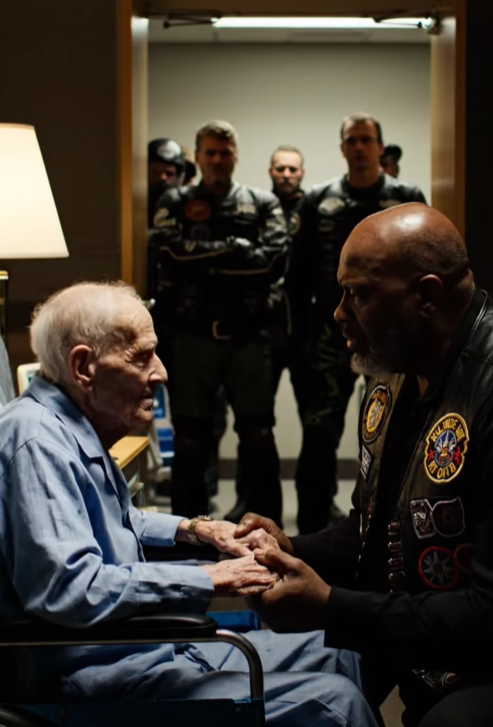
Gray sweatuit wrinkled, eyes vacant as he stared out the window. His hearing aids were gone, his shoulders hunched. For a second, I worried he would not even recognize them. But then the leader stepped in, knelt down, and touched Harold’s shoulder. “Pop,” he said softly. “It is my little Mikey from Detroit. You taught me to ride in 73.” “Remember?” Hurl turned slowly, his cloudy eyes straining to focus. His lips trembled.
The other bikers crowded the doorway. their patches glowing like flames in the fluorescent light. Pop. Mike whispered again. We found you. The whole club’s here. We have been looking everywhere for the first time in years. Her old’s face changed. His trembling hand rose, brushing the patch on my s vest, the flaming wheel with wings he himself had drawn nearly 75 years ago.
His lips moved, a whisper barely audible. Boys, yes. Hop. Mike said, voice breaking. Your boys and Harold began to cry. Not soft tears, but the kind that shook his frail body. Years of isolation breaking loose at once. behind me. Chen appeared with two security guards. Her voice was sharp,indignant.
This man has advanced dementia. He makes up stories about motorcycle gangs. His family said no visitors who encourage his delusions. Delusions? I snapped. Look at him. Look at them. This is real. she hissed. This is a liability. I will call the police. Mike rose to his full height, towering over her, his jaw clenched. “Call them,” he said evenly.
“But you are not keeping Pops locked up one more day.” The bikers began to step inside. Security looked nervous. Chen’s voice rose to a shriek. You can te just take a patient out of this facility. But Harold raised his frail hand, stopping everyone in their tracks. His voice, though cracked with age, was stronger than I would heard it in months.
Wait, he said if I am leaving, he coughed, his body shuddering. Then his eyes found mine. Nancy bottom drawer under the blankets. My chest tightened. I knew exactly what he meant. I crossed the room, pulled open the drawer, and lifted out a bundle wrapped in cloth. When I unfolded it, the smell of leather and decades of road dust filled the air.
a black vest, butter soft with age, covered in patches and pins. The wound fell silent. This was no delusion. This was history. This was proof. And when I draped it across Harold’s thin shoulders, something changed. His back straightened, his chin lifted. For a moment, I did not see a frail old man in a wheelchair.
I saw Hawk Morrison, founder of the Devil’s Horsemen. The bikers dropped their heads in reverence. Chenner’s face drained of color. Herald looked around the room, his fingers tightening on the worn leather. He said, his voice steady. Now I am ready. And that was the moment the hallway shook with a new sound deeper, louder than before.
The rumble of dozens more motorcycles pulling into the lot. Not 40 this time. Hundreds. The floor vibrated beneath us. The windows rattled. Security glanced at each other, unsure. Herald’s eyes gleamed with tears as he whispered one word. brothers. I leaned out the window. The parking lot below was filling fast. Chrome and steel stretching as far as I could see.
Old men, young men, even women all in the same vest, all bearing the same patch. They had come for their founder. And what happened next would change everything. Part two pops either The hallway outside room 247 had never been so alive. Nurses huddled together, whispering. Residents shuffled toward their doors, and security stood stiff and uncertain, glancing nervously between Miss Chen and the leatherclad wall of men pressing deeper into Harold’s room.
I stayed by the window, heart pounding as Harold’s trembling hand traced the devil’s horseman patch on Big Mike’s vest. His clouded eyes shimmerred with recognition. My boys, he whispered again, voice cracking. Yes, pop. Big Mike said, kneeling lower so Harold could hear him. your boys. We found you.” Herald sobbed like a child.
His frail shoulders shook beneath the old leather vest I had pulled from his drawer. The sound was raw, guttural, and it ripped through every man in that room. Harden bikers who had seen wars, prisons, divorces, and funerals. Men not known for soft emotions suddenly wiped at their eyes. “Behind us,” Chenn’s voice cut through the moment like broken glass.
“This is unacceptable,” she snapped. “This man is not of sound mind. He suffers from dementia. His family left strict instructions that no visitors are allowed to encourage his fantasies. You are trespassing. If you do not leave immediately, I will call the police and have every one of you arrested. The bikers bristled.
A low murmur of growls and curses filled the air. Big Mike rose to his full intimidating height. Lady, the only crime happening here is locking a war hero in a cell and drugging him into silence. Security shifted uneasily, but no one moved forward. Chen turned her fury on me. “Nancy, you have already cost yourself your job. Don’t cost yourself a lawsuit.
These are dangerous men. You do not understand liability.” That is when another voice spoke up from the doorway. Calm, steady, sharp as a knife. She is right about one thing, the man said. This is about liability, but not the kind you think. The crowd parted. A biker stepped into view, tall and lean, with a salt and pepper beard and eyes that missed nothing.
His leather vest carried the same flaming wheel, but beneath it was a patch stitched in bold white letters. Lawyer, he carried no weapon, no threat in his stance, just quiet authority. I am an attorney, he said, pulling a business card from his vest pocket and holding it out to Mrs. Chen. Elder law, 30 years in practice.
If Harold Morrison wants to leave this facility, you have no legal right to hold him against his will. Chen snorted. He is incompetent. His family has power of attorney that gives them full control. The lawyer did not flinch. Power of attorney does not mean imprisonment. It does not mean drugging him to shut him up and it certainly does not give you the right to deny him visits fromhis community.
He is delusional,” she insisted. “He makes up wild stories about motorcycles. He does not know what is real. I could not take it anymore.” I pulled my phone from my pocket, thumb shaking as I scrolled through the photos I had saved months ago. This, I said, shoving the screen in front of her face, is Harold Morrison in 1947, founding the Devil’s Horseman motorcycle club after returning from Normandy.
This is him in 1969, leading a thousand bike ride for veterans rights. This is him in 1985 raising $3 million for children’s hospitals. Gasps rippled through the crowd of bikers as the old black and white Antonia photographs flashed in the sterile light of the nursing home. Delusions. I said, “This man is living history, and you have been drugging him because the truth did not fit your paperwork.
” The lawyer’s voice cut in, “Calm, but deadly serious, that director Chen is called elder abuse, and I would be more than happy to file suit.” Chen’s lips pressed tight, but I saw her hand tremble. A brother’s defense. Big Mike crouched again, speaking softly to Harold. Pop. We are here to take you home. You do not belong in this cage.
Harold blinked, tears still sliding down his cheeks. Home. Yes. Pop. With your family. With us. Chen exploded. Absolutely not. His children left explicit instructions. The lawyer cut her off. His children abandoned him. Haven’t he visited in 2 years. Legally, they would have a hard time proving concern now.
And if they want to fight in court, I will be there every step of the way. One of the other bikers, a burly man with tattoos creeping up his neck, barked a laugh. Good thing our club Jews have been paying a lawyer for decades. That got a ripple of grim chuckles through the room. Herald, however, seemed lost in his own storm, his fingers twisted in his vest, his lips moving in a whisper.
I leaned closer. They said, “I was dead.” He murmured. Ignis jaw clenched. “We thought so.” “Pop, we had a memorial ride for you 5 years ago. Your son told us you were gone.” We searched, but he shook his head. We never stopped looking. 18 months we have been chasing every lead until we found you here. Harold’s watery eyes lifted.
He spat a single word with surprising venom. Family. The room went quiet. They wanted my house. My money. Dump me here when I would not sign over the deed. The lawyer nodded grimly. Classic case. financial exploitation of the elderly. I have seen it a hundred times, but now you have got representation. Harold, they want to steal from you again.
Herald stared at him, almost disbelieving. Lawyer? Yes, a lawyer who rides. He smiled faintly. Not every brother carries a wrench or a chain. Some of us carry law books and the law is on your side. Something sparked in Harold’s expression then. Not just relief but dignity. Recognition that he was not powerless. Rising tension. Chen’s face darkened.
This is outrageous. You can te just walk out with him. He is under our care. The lawyer’s voice sharpened under your sedation. You mean there is a difference? If this goes to court, your entire facility will be investigated for malpractice. How many other residents have been drugged for convenience? A murmur rippled through the nearby doors.
residents whispering, “He is right. They drug us.” Patterson, 85, poked her head out of her room. Her old, “You were right all along.” She called, “I heard them. You said you were a founder. They said you were crazy, but you were not.” A male voice down the hall shouted, “Take me with you. The facility was unraveling.
” “Shen knew it.” Her jaw worked furiously, but she said nothing. Big Mike straightened, resting a huge hand on Harold’s thin shoulder. “Pop, we are taking you out of here. But it is your choice.” The room stilled, every eye turned to Harold. For a long moment he stared out the window at the swarm of motorcycles filling the parking lot below. His lips trembled.
Then slowly his gaze returned to Mike, then to the lawyer, then to me. I want to ride, her old whispered. His voice was soft but steady. One more time before I die in this beige prison. You can te ride Chen burst out. You are 89 years old. You can barely walk. I can ride. Harold said firmly lifting his chin. My body remembers what the mind sometimes forgets.
Big Mic eyes shown. We brought your bike. Pop Harold’s head snapped up. Pan head. The lawyer stepped forward, nodding, your 1958 Harley. We tracked it down, brought it back, restored it to perfection. It is waiting outside. Legally yours, paperwork and all. The dam broke. Her old began to cry again. But these were different tears.
Tears of hope of vindication. You found her. His voice shook. You found Delila. Yes. Hop. Big Mike said, gripping his hand. Every brother pitched in. Even chapters overseas. Everyone wanted Hawk Morrison back on his bike. The lawyer folded his arms. Gaze locked on me. Chen director, are you going to keep fighting or will you let this man walk out free and avoidthe lawsuit that is about to bury your career? Her lips pressed tight.
Security shifted clearly unwilling to stand in the way. And then Harold lifted his voice clear. Strong, defiant. Get me to my bike. The room erupted in motion. Bikers moved to wheel Harold’s chair. Others stood guard at the door. Residents clapped weakly from their doorways. Nurses whispered prayers under their breath, and the sound from the parking lot grew deafening as engines revved in unison.
I slipped to Harold’s side, gripping his hand. You are really going to ride? I asked, his watery eyes locked with mine. I was born to ride and I will die that way. The hallway shook with the thunder of a hundred engines. The devil’s horsemen were waiting, and Harold Hawk Morrison was about to return to the road.
Before we begin part three, take a moment to subscribe, like the video, and share your thoughts about the two stories. It may seem like a small gesture, but it truly helps keep these timeless tales alive. This story still has a long way to go, so if you do not have time to watch it all now, do not forget to save it and come back whenever you are ready.
Part three, the fight for Harold. The air in room 247 felt electric like the charged silence before a lightning strike. Harold sat taller than I would seen in years. His old leather vest draped across his shoulders, the tears on his face drying into lines of determination. Outside, the rumble of a hundred engines shook the floorboards.
inside. Chen was shaking for a different reason. If you’re in fear, you can tea take him. She hissed. His family has power of attorney that gives them the legal right to decide his care. If you walk out with him, it is kidnapping. You will all be arrested. And you, Nancy, will never work in healthcare again.
Her words snapped through the room like whips. I should have flinched, but I did not. I looked at Harold, saw the life returning to his eyes, and I knew I would made the right choice. The biker lawyer stepped forward, calm but commanding. He adjusted the patch on his vest that simply read. lawyer director Chen, he said evenly, I have spent 30 years practicing elder law.
And let me be very clear, power of attorney is not absolute. It does not allow family members to imprison an elder against his will or authorize unnecessary sedation. What you have done here is not care. It is control. Chen crossed her arms, chin high. This man is not of sound mind.
Every doctor’s note in his chart confirms dementia. The lawyer’s voice sharpened. Funny thing about dementia diagnosis, they are easy to abuse, especially when facilities benefit financially from keeping a bed filled. But I will ask you one question. If Herald is so incompetent, how is he recognizing his lifelong brothers? How is he recalling details from decades ago with perfect clarity? Her lips thinned.
He is being manipulated. These men are exploiting his confusion. Wrong. The lawyer shot back. What is happening here is elder abuse, plain and simple. denying him visitors, withholding hearing aids, medicating him for inconvenience. Those are violations of both state and federal law. And if you would like me to prove it, I would be delighted to file a lawsuit.
I specialize in exactly this kind of case.” The word lawsuit hit like a grenade. Security shifted uncomfortably. A few nurses glanced at each other wideeyed. One of the bikers stocky scarred with a voice like gravel growled. Lady, if our lawyer says we are good, we are good. You can scream all you want, but Pops is leaving.
Power of attorney. Shen jabbed a finger at Harold. His son and daughter gave us strict orders. They are his legal guardians. The lawyer raised a hand, silencing her. Correction: They hold a power of attorney. That is not the same as guardianship, and even then their authority must align with Harold’s best interests.
abandoning him here, refusing visits, and stripping him of his identity does not qualify. He pulled a folded packet from his vest. I have already reviewed his file. There are glaring irregularities signatures obtained under juress. Medical records altered to exaggerate confusion. If I bring this to court, your facility will face not only civil liability but criminal charges.
You are bluffing. She spat. Why? He held up his phone. Because I have already emailed a copy to the state’s Department of Health and Human Services. And if Harold walks out with us today, it will be as a free man fully capable of making his own choices. If you try to stop him, director, you will be the one answering to the law for the first time.
Chen faltered. Her face went pale. Harold speaks. All eyes turned as Harold cleared his throat. His voice was raspy but steady. My name is Harold Morrison. I served in Normandy. I founded the devil’s horsemen in 1947. I built my bike Delila with my own hands. I led rides for veterans, raised money for hospitals, and buried brothers who never came home. He lifted his chin,gay sharp despite the fog of age.
I am not delusional. I am not incompetent. I’m choose to ride. The room went silent. The lawyer’s eyes gleamed. There you have it. A clear, direct statement of intent. That is all we need. Chen sputtered. This is a liability nightmare. If he falls, if it is, then he dies free. Big Mike cut in. Voice booming.
Better on two wheels than in a beige prison. Escalation. Chen turned to the security guards. Stop them. Danty let them move him. The guards hesitated. One finally muttered. Madam, I am not tackling a veteran who wants to leave. I am not standing in front of a 100 bikers either. Another guard nodded. If the lawyer says it is legal, I am not risking my badge.
Chen’s face turned crimson. You cowards, his family will sue. The lawyer’s lips curved in a cold smile. Then we will counters you for elder abuse, unlawful restraint, and financial exploitation. Trust me, I have won bigger cases than this. And the jury always sides with the veteran, not the corporate nursing chain. The crowd gathers.
By now, residents lined the hallways. Old men in wheelchairs, women clutching walkers, eyes wide with hope. Take me with you, one man shouted. You were telling the truth. her old. Another woman called, “I always believed you.” Even the staff looked shaken. One young nurse whispered, “If this gets out, the whole facilities see in trouble.” I looked at Harold.
He seemed taller somehow, his spine straighter, his eyes clearer. For 3 years, he would been fading. In the face of danger, he was alive again. The lawyer crouched beside him. “Herald, I will ask you directly. Do you want to leave Golden Years?” “Yes,” Harold said without hesitation. “I want to leave. I want my bike. I want my brothers.
And I want my life back.” “That is legally binding,” the lawyer announced. You all heard it. Chen clutched her phone like a lifeline. I am calling his children right now. They will have you all arrested. Call them, the lawyer said smoothly. But when they arrive, I will be waiting with a stack of legal documents that prove they have abandoned their father, drained his finances, and lied about his death to seize his assets.
That is fraud. That is criminal, and I will make sure they face charges. Her hand froze halfway to dialing. The room buzzed with tension. The bikers stood shouldertosh shoulder. A wall of leather and loyalty. The residents whispered like a congregation at church. Outside the roar of engines built to a crescendo. Big Mike leaned down, meeting Herold’s gaze.
Pop. We are ready when you are. Herald’s trembling hands gripped the armrests of his chair. His voice cracked, but the words were clear. Get me out of here. The bikers surged forward, wheels squeaking as Harold’s chair rolled toward the door. Chen shouted after them, her voice shrill and desperate. This is not over.
You will regret this. I will bring every lawyer in the state down on you. The biker lawyer turned in the doorway, his gaze hard as steel. then you would better bring your best because this war hero just hired me and I do not lose. With that, the devil’s horsemen wheeled Harold into the hallway. Residents clapped.
Nurses cried. The engines outside thundered like an army waiting to march. I walked beside Harold, my heart hammering. For the first time, I was not afraid of Miss Chen. I was not afraid of the system because Harold was not alone anymore. And he had something even stronger than brothers on his side. He had a lawyer.
Part four, the vest of a legend. The hallway of Golden Year’s Care facility had never seen a procession like this. Residents clapped weakly from their wheelchairs. Some whispering Harold’s name like he was a folk hero. Nurses peered out from behind clipboards, torn between fear of miss.
The Chen’s wrath and awe at what was happening. At the center of it all was Harold no longer just a frail patient in sweats. But Hawk Morrison reborn. The old vest on his shoulders seemed to transform him. Each patch and pin stitched across the leather told a story. Normandy 1944, Brotherhood Ride, 1969. Children’s Hospital fundraiser 1985.
His whole life was there soon into the fabric. The bikers wheeled him down the hall like royalty, and I walked beside him, heart pounding. Chen’s voice sliced through the applause. Stop this madness right now. She charged after us, heels clicking furiously. You are stealing a patient. This is illegal.
I will have every single one of you arrested. The biker lawyer paused midstep, turning to face her. His voice was calm, but his eyes burned with fire. Director Chen Harold is not a prisoner. He has declared his intent to leave and under elder law. His choice is legally binding. She sputtered red-faced. He is incompetent. His children hold power of attorney that gives them final say. The lawyer shook his head.
Power of attorney does not erase a man’s basic rights, especially not when there is evidence of financial exploitation and neglect. If you want to fight this, I will be happyto meet you in court. But I warn you, elder abuse cases do not go well for directors who lock veterans in rooms and medicate them into silence.
Chen faltered, but her pride would not let her back down. She jabbed a finger at Harold. If he leaves, his family will sue you all into the ground. Her old lifted his ching, his voice rasping, but strong. Let them try the parking lot. As the doors opened, sunlight flooded in, blinding after years of beige walls and fluorescent bulbs.
The roar outside swelled until it shook my chest. The parking lot was filled hundreds of motorcycles, chrome gleaming in the afternoon sun. Men with gray beards and wrinkled faces, sons and grandsons bearing the same patches, women riders, too. Leather vests snapping in the wind. Every eye turned to Harold. The moment the devil’s horsemen saw their founder, a roar of cheers went up louder than any stadium crowd, engines revved, fists pumped, and I swear I felt the ground vibrate.
Harold’s hand trembled on the armrest of his chair, his lips parted in awe. My boys, he whispered. They came. Big Mike bent low. Not just your boys. Pop your legacy. At the edge of the lot, parked in a perfect circle of reverence. Sat a bike unlike any other. Cherry red paint gleamed like liquid fire. Chrome sparkled so bright I had to squint.
White wall tires, shining spokes, every detail restored with love. Herald gasped, his frail hand shot to his chest. Delila. It was his pan head. The bike he had built with his own hands after the war. The bike he had ridden across America on which he would led rides, met his wife, carried his children.
the bike his grandson had sold for profit years ago, lost to collectors, and now here she was brought back, whole and beautiful, waiting for him. Her old sobbed, tears spilling freely. You found her. You found my Delila. Big Mike nodded. Took us a year. Every brother pitched in. We had to convince a collector to let her go.
But we were not leaving you behind. Pop or her. Showdown. The moment was almost holy until Miss Chen broke it with her shrill voice. This is insane. He is not medically fit to ride a motorcycle. If he gets on that bike and anything happens, you will all be liable. The lawyer stepped forward. Voice cutting across the lot.
Liability does not apply when a man makes a free and informed choice. Herald knows the risks. He accepts them and under the law. That is his right. You have no standing here. Director Chen, his family will. His family abandoned him. The lawyer snapped. sharper than I would ever heard. They lied about his death. They drained his accounts.
They signed him away like property. The courts will side with Harold, not them. And if you persist, I will personally file charges against you for unlawful restraint, malpractice, and elder abuse. The crowd erupted in cheers. Lawyer, lawyer. Some bikers chanted, clapping the attorney on the back. Chen’s face twisted in rage.
You are all criminals, thugs. You think leather jackets and threats make you above the law. The lawyer said coldly. But knowledge does and so does truth and the truth is Harold Morrison is free. Harold’s choice. Big Mike wheeled Harold closer to Delila. The old man reached out with trembling fingers, brushing the polished chrome.
The instant his skin touched the bike. It was like lightning passed through him. His spine straightened. His shoulders squared, his cloudy eyes cleared. Just for a moment. She is perfect, he whispered. Better than I remembered. A mechanic brother stepped forward. We made some adjustments. Pop supports for your legs.
A harness if you need it. She is safe. I do not need much help. Herald said stubborn pride in his voice. The body remembers. The lawyer crouched beside him. Herald, as your attorney, I need to ask one more time. Do you understand the risks of what you are about to do? Herald looked him dead in the eye. Yes, I could fall. I could die.
But that is better than waiting to die in that room. I choose this. The lawyer smiled, firm and approving. Then legally, nothing can stop you. Chen screamed in frustration. You will kill him. You will all be responsible for his death. Harold turned his head, voice rising above the engines. Death finds us all.
director, but I would rather meet it on my terms on two wheels in the wind with my family. The lift. The bikers moved in unison, strong arms lifting Harold from his wheelchair like he weighed nothing. For a moment he hovered above them, a frail old man cradled by giants. Then carefully they lowered him onto Dilla s seat.
His hands wrapped around the handlebars like they had never let go. His chin lifted. His eyes shown. A hush fell across the crowd. Start her up. Pop. Big Mike whispered. Her old thumb the ignition. The pan head roared to life. A deep throaty rumble that seemed to shake the sky itself. The crowd exploded, engines revving in harmony, fists punching the air.
Herald closed his eyes, face tilted toward the sun, and for a moment I did not seewrinkles or frailty. I saw a warrior, a leader, a legend reborn. Chen stood at the edge of the lot, screaming into her phone, trying to explain to corporate how she had just lost her most famous resident. Her words were swallowed by the roar of engines.
The lawyer stood tall, arms folded, a small smile tugging at his lips. He leaned close to me and said, “This is more than a ride. This is justice.” Big Mike mounted his bike beside Harold. The other brothers followed suit, engines thundering in unison. Harold opened his eyes, looked at me one last time, and said, “Watch me.
” And then, with the power of a 100 engines escorting him, her old Hawk Morrison rolled out of the parking lot free at last. Part five, the roar of brotherhood. The parking lot thundered like a battlefield. Chrome gleamed under the sun. Engines growled in perfect rhythm. And at the center of it all sat Harold Hawk Morrison a stride dilla, his resurrected 1958 pan head for a heartbeat.
Silence fell. The world seemed to hold its breath as an 89year-old man who had been written off as senile. Forgotten, drugged into submission, wrapped his hands around the handlebars of his life. Then he twisted the throttle. The pan head roared like a dragon waking from a long sleep.
The sound ripped across the lot, rattling windows and punching straight into the hearts of everyone watching. Herald’s eyes closed, his face tilted toward the sky, the sunlight spilling across his lined features, his chest rose with a deep breath. And when he opened his eyes, he looked 20 years younger. I told you,” he shouted over the noise, voice cracking but strong.
The body remembers. The bikers roared back, revving their engines until the earth itself seemed to shake. “The formation.” Big Mike mounted his bike beside Harold. “Full escort,” he barked. Immediately the devil’s horsemen snapped into action, engines revved, wheels turned, and the parking lot swarmed with movement.
Riders formed a protective V around Harold, dozens more falling into line behind. The lawyer swung a leg over his own Harley. Checking mirrors with the calm precision of a man who knew this ride was not just symbolic. It was legally strategic formation doubles as security. He explained to me no car can get close.
No one can claim negligence if he is surrounded by a rolling fortress. Even I, standing at the edge of the lot with tears streaking my cheeks, could see the brilliance of it. This was not chaos. It was choreography. Brotherhood in motion. Inside the nursing home, residents pressed against windows, some pounding the glass in joy. Patterson clutched her chest, sobbing openly. He was right.
she whispered. He was telling the truth all along. Staff members, nurses, janitors, even a cook still in his apron slipped outside to watch. A few filmed on their phones, tears shining in their eyes. For years, Harold had been a ghost in that beige prison. He was a legend reborn about to roll into history. The ride begins.
Big Mike raised his fist and a hund fists followed. Engines roared in unison. The smell of oil and leather filled the air. Then, like a general leading an army, he dropped his hand. The pack surged forward. Tires squealled against pavement. The roll became a living beast. And at its heart, her old rolled out of the parking lot, [Music] Dilla gleaming, his vest fluttering in the wind.
I stood frozen, hand over my mouth, watching him go. The tears would not stop. He was really doing it. At 89, after 3 years of being sedated and silenced, her old Morrison was riding free. media attention. It did not take long for the world outside golden years to notice. The roar of engines drew neighbors out of their houses. Phones filmed from porches.
Cars honked in support. By the time the riders hit the highway, a local news van had caught up. A reporter leaned half her body out the window, shouting questions into the wind. Is it true? Is that the founder of the Devil’s Horsemen? Is that Harold Morrison? Big Mike’s voice boomed over the rumble. It is Hawk. He’s back.
[Music] Within minutes, the footage hit social media. A 100 phones streamed live. Thousands of comments poured in elder abuse, nursing homes or prisons. That old man is a legend. The chant spread across feeds like wildfire. Ride, hawk, ride. The lawyer’s shield. But for all the cheering, the lawyer knew danger was close.
He rode near Harold’s flank. [Music] Scanning traffic, one hand steady on the bars, the other checking his phone mounted on the dash. Nancy, he shouted to me, riding pillion behind one of the younger bikers who had insisted I come. The facility is calling the police. They will try to frame this as kidnapping. Fear clutched my chest.
What do we do? The lawyer grinned. We beat them at their own game. He tapped his phone. I have already filed a statement electronically. Harold declared his intent in front of dozens of witnesses. I recorded it [Music] legally binding. If the police stop us, I will hand them the evidence.His confidence steadied me.
This was not just rebellion. It was a legal rescue. Flashbacks in the wind. The highway stretched ahead, wide and open. Herald leaned forward slightly. the wind tugging at his thin gray hair. He laughed a sound I would never heard from him in 2 years of care. In his mind, I knew he was not in 2025. He was back in 1947, roaring down open roads with his brothers, fresh from the war, alive with youth, or maybe it was 1969, leading a thousand bikes to Washington for veterans rights.
or 1985 when the horsemen raised millions for sick kids. The years melted away in the wind. Every bump in the road, every gear shift, every vibration beneath him, it was not just a ride. It was resurrection. Back at Golden Years, Chen stood at the entrance, screaming into her phone, “They have kidnapped a patient. send police immediately.
But even as she raged, residents cheered from their windows. Staff whispered about contacting the state board. The truth was slipping from her control, and she knew it. Inside, Harold’s empty wheelchair sat abandoned in room 247. His vest drawer stood open, blankets shoved aside. The ghost was gone. and in his place rode a man who refused to be forgotten.
The police encounter 20 mi down the road. Red and blue lights appeared in the mirrors. Sirens wailed. A pair of highway patrol cars moved in, ordering the formation to pull over. The bikers did not scatter. They slowed in unison, guiding Harold to the shoulder with practiced precision. Engines idled like beasts waiting to spring.
An officer stepped out, hand hovering near his weapon. Who is in charge here? The lawyer dismounted calmly, helmet tucked under his arm. I am elder attorney. I represent Harold Morrison. The officer’s eyes narrowed. We got a call about a kidnapping. Nursing home says this man is mentally incompetent. The lawyer held up his phone. I have video proof of Harold declaring his intent to leave. Dozens of witnesses.
Power of attorney does not override his basic rights. If you try to force him back, you will be complicit in elder abuse. You want that headline? The officer hesitated. Glancing at the sea of cameras pointed his wones reporters live streams. Every move was being recorded. From his bike, Harold called out, voice trembling but clear. I want to ride.
I am not kidnapped. I’m free. The officer lowered his hand. Slowly he stepped back. Then ride safe, he said. The bikers erupted in cheers. Engines roared again, drowning out the sirens. The patrol cars did not follow. The road was theirs. The message spreads. By nightfall, the story was everywhere. Headlines blared across news sites.
Bikers rescue 89year-old U2 veteran from nursing home. Elder lawyer defends veteran’s right to ride. Forgotten founder of motorcycle club escapes facility takes one last ride. Comment sections exploded with outrage at the nursing home system. With admiration for Harold, with praise for the lawyer who stood his ground.
And in the middle of it all, Harold sat at a roadside diner, sipping black coffee from a chipped mug. Dilla parked proudly outside, his vest glistened under neon lights. He looked exhausted, but alive. I told them I would ride again. He whispered to me, his hand shaking slightly around the cup. They did not believe me.
I believed you, I said softly. He squeezed my hand. So did my lawyer. That is why I am free. But freedom always comes with a price. As the night deepened, a black sub pulled into the lot. Two figures stepped out Harold s son and daughter. Their faces twisted with fury. You think you are free, old man? His son spat. We will see about that.
The house, the bike, the money, it all belongs to us. You can tea run forever. The lawyer rose from his seat, eyes cold as steel. Actually, he said, sliding a folder across the table. He can. Harold looked from his children to his brothers to the bike outside to the lawyer at his side. The battle was not over. It had only begun.
Part six family versus brotherhood. The black sub idled in the diner parking lot, its headlights glaring across the rows of Harley-Davidsons like hostile eyes. The night air was heavy with tension, cut only by the soft clink of coffee mugs inside. Her old sat across from me in a booth, vest gleaming under the neon sign, his trembling hands wrapped around a cup of coffee.
His son and daughter stood at the entrance, blocking the doorway like prosecutors in a courtroom. You think this stunt changes anything? His son sneered. He was in his 60s. broad-shouldered but soft around the middle, expensive watch flashing under the fluorescent light. You are not in charge anymore, dead.
We are, and we have got lawyers who will bury you and these clowns before the week is out. His daughter crossed her arms, her silk blouse crisp, her face twisted with disdain. You are embarrassing yourself riding motorcycles at your age. You will kill yourself. And when you do, we will be left cleaning up the mess. That house isours. The accounts are ours.
The law is on our side. The word law hung heavy in the air. But Herald’s lawyer vest patch proudly stitched with lawyer rose from his seat with quiet authority. Correction, he said evenly. The law is on his side. The first clash. The children’s attorney appeared a day later. A man in a three-piece suit with sllicked back hair and the cold smile of someone who build $800 an hour.
He introduced himself as M Carnisle. We met in a community center hall the horsemen had rented for Harold’s welcome home gathering. The place buzzed with bikers swapping stories. [Music] Polishing chrome and laughing loudly, but when Carisel entered, silence rippled through the crowd. He looked out of place, clutching a leather briefcase like a shield, his polished shoes squeaking on the scuffed floor.
“I represent the Morrison family,” he announced. “And let me make this perfectly clear. Harold Morrison is not mentally competent to make decisions for himself. My clients hold power of attorney. They will be filing an injunction to return him to Golden Year’s Care facility immediately. The room bristled.
Dozens of bikers shifted on their boots, eyes narrowing. But Harold’s Sawyer stepped forward, calm as ever. And I represent Harold, a veteran, a founder, a man whose wishes have been recorded on video, witnessed by over a 100 people if you want to challenge his competency. Carissle, you will have to do it in court, and I will be there to meet you.
Carissell smirked. Then we will see you there. The betrayal. That night, Harold sat with me outside the clubhouse, the hum of distant engines lulling the air. He stared at Dila, his hand resting gently on the tank. They were supposed to be my blood. He whispered, “I gave them everything. I paid for their colleges.
their weddings. I taught my son to ride on this very bike and now his voice cracked. Now I am just a bank account to them. I did not know what to say. So I just held his hand. The lawyer joined us kneeling beside Harold. Hop, he said gently. I have seen this before. Children pushing their parents into facilities, grabbing for assets, calling it love.
It is a but you do not have to face it alone. You have got me. You have got the law and you have got your brothers. Her’s eyes glistened. Do you think a judge will believe me? The lawyer smiled faintly. I do not just think it. I will make sure of it. legal lines in the sand. The next morning, a thick envelope was delivered to the clubhouse.
Inside, a stack of legal documents stamped with court seals, an emergency petition. Caris had moved fast. The language was cold and ruthless, incompetent, delusional, unsafe. The children claimed Harold was incapable of making rational decisions, citing episodes of confusion documented by the nursing home.
They demanded immediate guardianship and control over his estate. Herald’s hands shook as he read it. “They are trying to erase me on paper,” he whispered. The lawyer skimmed the pages, then looked up with steel in his eyes. Then we fight on paper. I will file a counter petition today. We will challenge every line. And when this goes to court, we will walk in with witnesses.
Video proof and history itself on our side. Big Mike clapped a hand on Harold’s shoulder. Don T worry pop. We have fought tougher battles. You just keep riding. Let the lawyer swing the punches this round. The hearing. Two weeks later, we entered the county courthouse. The bike affirmation outside stretched for blocks.
Engines echoing through the city streets like a rallying cry. The courthouse had never seen so much leather in one place. Inside Colossal stood smug beside Harold’s children. They looked polished, perfect. Everything about them screamed wealth and entitlement. Harold’s lawyer stood tall in his wor vest. His briefcase battered from years of service, but his confidence radiated like armor.
The judge, a tired looking woman with sharp eyes, called the hearing to order. Collison launched into his argument, painting Harold as a confused old man prone to fantasies about motorcycles. He waved medical notes from golden years, declaring Harold unsafe to make decisions. The judge nodded, [Music] “Scribling notes for a moment.
My stomach twisted with fear. Then it was our turn.” The lawyer rose, clearing his throat. Your honor, what the other side calls fantasy, the rest of us call history. Herald Morrison is not just some confused patient. He is a decorated veteran. He is the founder of the Devil’s Horseman motorcycle club. He has photographs, records, and hundreds of witnesses who can attest to his identity and his competency.
And if you need proof, he gestured toward Harold. Why do not you ask the man himself? All eyes turned to Harold. He rose slowly, gripping the edge of the table, and spoke in a voice that silenced the room. My name is Harold Morrison. I stormed Normandy in 44. I founded my club in 47.
I rode across this country a dozen times. I buried brothers. I raisedmillions for children’s hospitals. And when my own blood abandoned me, my brothers came back for me. I am not delusional. I am not incompetent. I’m The courtroom buzzed. The lawyer smiled faintly. Rest my case. A partial victory. The judge leaned back, [Music] fingers steepled.
At this time, I cannot rule Harold Morrison incompetent. His testimony today was lucid. However, questions about financial management remain. Until a full trial, I am appointing a neutral conservator to oversee his assets. Carissell smirked, whispering something to the children. Harold sagged. They are still trying to steal my life.
He murmured. But the lawyer leaned close. Don T worry. Pop. This is just round one. We won the right to keep you free. That is the biggest battle. The rest we will win step by step. Outside the crowd erupted as Harold emerged, still free, still riding. But that night, as the horsemen gathered at the clubhouse, a shadow lingered at the edge of the lot.
The blacks of again, the children were not done. Her oldest son stepped out. Flanked by Carisle. His voice was venom. You won today. He spat. But we will drain him in court fees. We will drag this until he is broke or dead. And when he is, everything comes to us. The lawyer stepped forward. Unflinching. Not if I have anything to say about it.
Carissell smirked. Then let us see who lasts longer, brother. Engines growled in the darkness as the sub pulled away. Her old stood, shoulders squared, vest gleaming, his eyes though tired, burned with fire. They can take my money, he growled. But they will never take my ride. The lawyer placed a hand on his shoulder.
And as long as I am here, pop, they will never take your rights. But in the silence that followed, we all knew the war had only begun. Part seven, Freedom at 89. The highway stretched endlessly ahead, lit by the glow of street lamps and the moon silver gaze. Her old sat tall on Delila, the cherry red pan head humming beneath him like a faithful warhorse.
The roar of his brothers surrounded him a 100 engines forming a wall of sound, a rolling fortress of leather and chrome. At 89 years old, her old Morrison was alive again, not waiting for death in a beige prison. Not silenced by sedatives, but riding free. The image was irresistible. Cars slowed to film him.
Teenagers leaned out of windows. Cheering. Truckers honked their horns in salute. Within hours, the clips of Harold on Dila flooded the internet. 89year-old veteran rescued by bikers takes one last ride. The chant spread, “Ride, hawk, ride.” Media frenzy. By the time the horsemen stopped at a rest station for gas, herald’s face was already plastered across national news.
Anchors debated the story with fiery intensity. One network showed a split screen, Harold riding with his brothers on one side, Chen railing into microphones on the other. This man is suffering from advanced dementia. She insisted he was manipulated by dangerous gang members. His life is at risk.
On another channel, a veteran advocate countered, “What is dangerous is drugging a war hero into silence. What is at risks is our respect for those who built this country.” Herald watched the coverage on a phone a young rider handed him. His hands shook, not from weakness, but from something deeper. They are talking about me like I am already gone.
He muttered. The biker lawyer leaned against a pump. Arms folded. Let them talk. Pop. Every headline just strengthens our case. The more people see you clearheaded and riding. The harder it will be for any judge to call you incompetent. The children strike back. But Harold’s son and daughter were not about to let the tide turn without a fight.
The next morning, they appeared on television, flanked by Carisle, their highpriced attorney. Our father is unwell, the daughter said, her voice trembling with practiced sorrow. We love him, but he does not understand what is best anymore. These bikers are exploiting him. We are only trying to protect him. The son nodded gravely.
He is a danger to himself and others. If the courts do not intervene, we could lose him entirely. That is why we have hired legal counsel to ensure his safety. Kizle leaned toward the microphone. Smooth as oil. My clients are pursuing a guardianship order. Until then, any continued removal of Mr. Morrison from licensed care facilities could be considered unlawful.
We urge authorities to act quickly. The words hung heavy. “Guardianship,” the biker lawyer muttered when he heard it, pacing the clubhouse floor later that day. “That is the nuclear option. If a judge grants it, your kids own you. Every choice, every penny, every breath. They will have the power to lock you away forever.
Her old’s face hardened over my dead body. The lawyer’s counter move. The horsemen gathered in the clubhouse that night, the air thick with smoke and tension. Herald sat at the head of the table, his vest glowing under the low light, his lawyer spread documents across the scarred wood. “Here’s what we do,”he said, tapping the pages.
“We file for a durable power of attorney revocation. Then we push for Harold to draft a new living will and healthc care proxy naming who he actually trusts that proves he is competent to decide. And if they drag us into court, we walk in with airtight documents. Big Mike frowned. But one t Carus will fight that tooth and nail. The lawyer smirked.
Of course he will. But I have eaten sharks like him for breakfast. the laws on our side as long as Harold stays clearheaded and public opinion stays hot. He looked at me then. Nancy, your testimony will be crucial. You have seen the sedation. You have seen how lucid he is when he is not drugged. I swallowed hard.
I will tell the truth, every ugly detail. The brotherhood’s vigil that week. The horsemen turned their clubhouse into Harold’s new home. Brothers took shifts cooking, a cleaning, and making sure he took his real medications, the necessary ones, not the sedatives Mrs. Chen had forced on him. At night, Harold sat by the fire pit outside, telling stories to younger riders.
Tales of Normandy, of founding the club, of cross-country rides when gas was 25 cents a gallon. His voice cracked sometimes, but his eyes lit up. They thought I was finished. He told them one night. Thought I was a burden, a liability. But look at me now. I am not just alive. I’m living. The men raised their bottles in salute. To Hawk. The hearing looms.
Two weeks later. Papers arrived. Carissell had filed for emergency guardianship. A hearing was scheduled. The clubhouse buzzed with preparations. The lawyer drilled Harold gently going over likely questions. They will ask about dates, about finances. They will try to trip you up. Don’t panic if you forget something small.
Focus on what matters, who you are, what you want, and why you are competent to decide. Herald nodded, gripping his hand firmly. I can do that. I may be all, but I am not gone. Big Mike grolled. If they try to lock him away again, they will have to go through all of us. The lawyer shot him a look. And that is why I am here.
So they won’t te have to media allies. Meanwhile, the story had caught fire online. Veterans groups rallied behind Harold. Motorcycle clubs across the country pledged support. Talk shows debated elder rights. One viral tweet read, “If you live long enough, your own kids can steal your freedom unless you have brothers who fight back.
” Another get yourself a lawyer like Harolds. Elder law is not about paperwork. It is about dignity. The phrase stuck soon. Hashtags trended. Hash elder # ridef freehurald # family’s brotherhood. Carissell sneered on camera about media manipulation. But the tide was turning. The public loved Harold’s ride and they hated the idea of greedy children ripping freedom away from a veteran. A quiet moment.
One evening I found Harold sitting alone in the garage polishing Dila’s chrome with slow reverent strokes. They will never forgive me. He said softly. My son, my daughter, they will hate me till I am gone. They made their choice. I said gently. You offered them love. They chose money. That is not on you.
He looked up, eyes wet. But they are still my blood. That is the part that hurts. The lawyer appeared in the doorway. Quiet but firm. Blood betrays. Brotherhood defends. And the law, the law remembers the truth. That is why we will win. Pop. Herald gave a faint smile. You talk like a preacher. The lawyer shrugged. 30 years in courtrooms will do that.
The night before the hearing, the horseman gathered for one last ride, a silent show of strength. her old road in the center, headlights glinting off his vest. The highway stretched before them, endless, infinite. But as they returned to the clubhouse, a shadow awaited, the blacks of Carisel stood beside it, smirking under the street light.
Her oldest son and daughter flanked him, arms crossed. This ends tomorrow, Carissell said smoothly. Guardianship will be granted. And when it is, Morrison goes back to the facility. You can teide forever. The lawyer stepped forward, eyes cold, maybe not. But tomorrow in that courtroom, we will prove something you will never understand.
Freedom does not expire with age and no law worth its ink will strip it away. Collis smirk widened. We will see. Engines idled in the darkness. Brotherhood and blood stood face to face. The law between them. The storm was about to break. Part 8. Breaking point. The county courthouse was not built for thunder. Yet that morning thunder came anyway the thunder of engines.
Hundreds of Harleyies filled the streets lined up like soldiers in formation. Chrome glittered under the rising sun. Veterans in worn vests stood shoulderto-shoulder with younger riders. A sea of patches all bearing the same flaming wheel with wings. Inside the air was thick with tension. The marble halls echoed with the murmur of journalists, the clicking of cameras, the whispers of staff who had never seen a case like this.
At the center of it all sat HaroldHawk Morrison, 89 years old, leather vest stretched across his narrow frame, eyes alert. He was not in a wheelchair today. He insisted on walking slow, deliberate, each step supported by Big Mike’s steady hand. His pride carried him farther than his legs could. Behind him, his biker lawyer carried a battered briefcase, his patch stitched with one word.
Lawyer, his calm confidence radiated like a shield across the ail. Her oldest son and daughter sat stiffly beside Carisle, their highpriced attorney in a gleaming suit, his hair slick and his smirk sharper than any knife. The battle lines were drawn. Opening salvos. The judge, a stern woman named Justice Mallerie entered.
The courtroom rose, then sat. Her gaze swept the packed benches, lingering on the rows of leather jackets before focusing on the table before her. This hearing concerns the petition for guardianship over Mr. Herald Morrison. She began, “Carisle, you may present your case.” Carissell rose smoothly, his voice polished and theatrical.
Your honor, we are here today to protect an elderly man from exploitation. Morrison is nearly 90 years old. He suffers from advanced dementia. His own medical records from Golden Years Care Facility describe episodes of confusion and paranoia. He believes he founded a motorcycle gang decades ago. Delusions clearly inconsistent with reality.
Gaspiece and groves rippled through the biker gallery. Carissell pressed on. His family, my clients, have held power of attorney for years. They have his best interests at heart. Yet a group of bikers, many with criminal records, forcibly removed him from a licensed facility. They manipulated him into believing dangerous fantasies, paraded him through the streets on a motorcycle, and exposed him to significant harm.
“Your honor, if guardianship is not granted today, Morrison’s life is in danger,” he sat. Satisfied, the judge nodded. Thank you, council for Morrison. The biker lawyer stood. His voice was not polished. It was sharp, direct, forged in years of courtroom combat. Your honor, what the petition calls delusion, the rest of us called truth.
Morrison did not imagine his life. He lived it. He stormed Normandy. He founded the Devil’s Horseman motorcycle club in 1947. He led rides across this nation, raised millions for veterans and children, and built a legacy that stands before you in this courtroom. He gestured to the benches filled with men and women in vests.
These are not strangers. These are his brothers, his children by choice, his family of 75 years. They found him abandoned, drugged into silence, and locked away in a facility that denied his history. That is not care. That is abuse. He paused, letting the words hang. Your honor, the question before us is simple.
Does Harold Morrison still have the right to decide his own life? The law says yes, and we are here to prove it. Testimony of blood. Colossal called Harold’s daughter first. She walked to the stand with the confidence of entitlement, dabbing fake tears from her eyes. My father was always difficult. She began. After mom died, he became obsessed with his motorcycle friends.
He told stories no one could verify. At golden years, the doctors confirmed his confusion. He thought the 1950s were yesterday. He insisted strangers were his family. We love him, but he does not know what is real anymore. Carissell smiled like a wolf. And is that why you sought power of attorney? Yes, she sniffed.
We only wanted to protect him. Gas came from the biker benches. The lawyer cross-examined. Morrison, how often did you visit your father in the last 3 years? Her lips tightened. I had responsibilities. Work, family. Answer the question. Not often, not once, the lawyer pressed. Records show zero visits. In fact, the facility confirmed no family contact in over 2 years.
Yet, you claim you sought power of attorney to protect him. She shifted uncomfortably. We were managing his finances. Yes. The lawyer’s voice sharpened. finances. Tell the court how much money did you withdraw from his accounts in the last 5 years. [Music] Carnissol objected. Irrelevant. The judge overruled. Answer the question.
The daughter’s face flushed. [Music] Some withdrawals. Four maintenance for for yourselves. The lawyer cut in bank records show over dollar 200,000 moved to your accounts. And what about his house? Did you not attempt to sell it after declaring him deceased? The gallery erupted in shouts. The daughter pald. No further questions.
The sun has turned. Her old son took the stand next. [Music] Arrogant oozing. My father has not been of sound mind for years. He repeats the same stories. Cries at night. Does not remember where he is. He needs care. Not motorcycles. The biker lawyer rose slowly. Morrison, you told people your father died 5 years ago.
Is that correct? The son stiffened. That is what the doctors said. Really? Because his nurse Nancy Carter will testify that he was very much alive, coherent, and begging to be believed. So why tellthe world he was dead? The sun faltered. It was a misunderstanding. A misunderstanding or a memorial ride to secure sympathy and maybe shake loose donations you kept for yourself.
Caris leapt to his feet. Objection. Sustained. The judge said sharply. But the damage was done. The gallery growled with outrage. Testimony of truth. Finally, it was Harold’s turn. He rose slowly, leaning on Big Micah’s arm, and shuffled to the stand. The room stilled. “Morrison,” the judge said gently, “do you understand why you are here today?” “Yes, madam.
Herald said voice steady, “My children want to own me, but I am not property. I am Do you believe you are capable of making your own decisions? I have been making them for 89 years. I know who I am. I know what I want. I want to ride my bike. I want to live with my brothers. I do not want to die in a beige prison with strangers calling me crazy.
The biker lawyer nodded proudly. Your honor, may I submit exhibits? He laid photos on the bench heraldled in 1947. Young and fierce. Founding the club heraldled in 1969. Leading a thousand bike rally herald in 1985. presenting a donation check to a children’s hospital. This is not fantasy, the lawyer said. This is history, and history does not lie.
Carisle’s last gambit. Carisle rose for cross-examination. Smile razor thin. Morrison, he said smoothly. What year is it? Herald hesitated. 2000 20s something. You do not know. I know it is later than I would like. Her old shot back earning laughter from the gallery. Carisle size narrowed. What day of the week is it? Does it matter? Her old counted.
Every day feels the same when you are locked away. Carissell smirked. Confusion. Your honor, proof of incompetence. But Harold leaned forward, his eyes sharp. Ask me who founded the Devil’s Horseman. Ask me who designed the patch on that man’s vest. Ask me what I named my pan head in 1958. I will answer those questions until the day I die.
Because those answers are me and I am not confused about who I am. The gallery erupted in applause. The judge banged her gavvel order. The lawyers closing. The biker lawyer rose for closing arguments. Your honor, dementia does not erase humanity. Forgetting a date does not strip a man of his right to decide who he is.
Her old Morrison is not incompetent. He is 89 years old. Yes, but age is not incapacity. What his children call confusion is really memory. Memory. They would rather bury because it threatens their inheritance. They want guardianship not to protect him but to control him. The law does not serve greed. It serves justice.
And justice says this man deserves to live free on his terms until his last breath. He paused, then added softly. and I will remind the court. Her old Morrison fought for this country at Normandy. If he was competent enough to risk his life for our freedom at 19, he is competent enough to choose his own freedom at 89. The courtroom went silent.
Judge Mallalerie’s face was unreadable. She tapped her gavl once. This court will recess. I will deliver my ruling tomorrow morning. Gasps rippled through the room. Harold’s children smirked. Confident, Carissle whispered to them, already planning his next move. The horsemen gathered around Harold. Fists clenched, ready for a fight that was not over yet.
As we stepped into the sunlight, engines revving in solidarity, the lawyer leaned close to me. “Tomorrow decides everything. Guardianship or freedom, blood or brotherhood, war abuse,” he looked toward the fourth house steps where reporters swarmed. “Either way,” he said grimly, “the world is watching.” and Harold, frail but unbroken, lifted his fist in the air.
The roar of a 100 engines answered him. Part nine, Hawk’s last chapter. The gavvel echoed like a gunshot. Judge Mallalerie’s ruling had been cautious. Herald would not be forced back into golden years. Guardianship would not be granted to his children, but a neutral conservator would temporarily oversee his assets until a full trial could decide.
It was not victory, but it was freedom. The horsemen roared outside the courthouse. Their engines drowning out the reporter’s questions. Cameras captured Harold raising his fist, his vest gleaming under the sun. Free,” he whispered to me as Big Mike steadied him down the steps. “I am still free.
” The toll of battle, but freedom came at a cost. By the time we returned to the clubhouse that night, Harold looked exhausted. His hands shook as he lifted a mug of coffee, and when he smiled, it was thin, fleeting. The lawyer pulled me aside. The stress is catching up. He is strong in spirit, but his body. He shook his head.
We need to think about what comes next. What do you mean? I asked. I mean legacy, he said quietly. If Harold’s children keep fighting, they will try to snatch everything once he is gone. We need a final will. airtight written while he is still lucid. That is how we win the war. No matter what happens. My chest tightened. You think he does not have much time.The lawyer did not answer.
He did not need to drafting the will. The next morning, Harold sat at the clubhouse table with his lawyer. Papers were spread across the scarred wood. The air smelled of ink and leather. I want everything clear, Harold rasped, his hand trembling as he gripped the pen. No loopholes. No chance for them to twist it. The lawyer nodded. We will make it airtight.
assets, property, the bike, your accounts. Who do you want to inherit? Harold looked around the room at the brothers gathered men with graying beards, women with weathered hands, young riders with patches barely worn in, his eyes softened. The club, he said, they are my family. Use it to take care of brothers who get old like me.
No more dying forgotten in beige prisons. The lawyer scribbled notes. A foundation. Then we will call it the Hawk’s Nest, a fund for aging bikers and veterans. That way your legacy helps others long after you are gone. Harold’s eyes glistened. Yes, the hawk’s nest. He signed with a shaky hand, the pen dragging across the page.
When it was done, the lawyer slid the document into a folder with reverence as if it were scripture. It is binding, he said. They can scream. They can threaten, they can sue, but the law will hold. This is your voice on paper. Herald exhaled deeply like a man unbburdened. Memories by fire light. That night, the horsemen lit a fire outside the clubhouse.
Flames danced in the dark as Harold sat wrapped in blankets. Dilla parked beside him. Chrome reflecting the fire light. He told stories about storming Normandy, about building Dilla piece by piece, about meeting his wife on a ride through Kentucky. His voice cracked, but his eyes burned bright. One younger rider asked, “Pop, do you regret anything?” Herald stared into the flames.
I regret letting my children forget who I was. I thought they would carry my stories. Instead, they carried my bank account. Silence fell. Then Harold lifted his chain. But I do not regret my brothers. Brotherhood does not die. It only multiplies. The men raised their bottles to hawk the children’s last move. Of course, the children were not done.
Days later, a courier arrived with another stack of papers. Carissell had filed for an emergency injunction, accusing the club of undue influence. They are claiming you manipulated him into rewriting his will. The lawyer explained grimly. Classic move. They will argue you pressured him. That he was not competent. Herald laughed weakly.
Competent enough to know when I am being robbed. The lawyer set a steady hand on his shoulder. Don T. Worry pop. I will fight this. I will drag them through discovery. Suboer their bank records. Expose every dime they stole. They want a war. They have got one. Her old grinned faintly. That is why you are my lawyer.
You fight like a brother. Health declined. But even as the lawyer battled in court, Herald’s health began to slip. Some days he rode Delila around the clubhouse lot, smiling like a boy. Other days he could barely rise from bed. His cough grew harsher. His steps faltered. One night I found him sitting alone in the garage, staring at the bike.
She is the last piece of me, he whispered. When I am gone, promise she stays with the club. Don’t he let them sell her like junk. You already made sure of that, I said softly, placing a hand on his shoulder. Your lawyer locked it down in the will. Herald smiled faintly. Good. Then I can go easy. Brotherhood rallies.
The horsemen saw the decline, too. They came in shifts cooking, the cleaning, telling jokes. Old men shared oxygen tanks. Young riders polished chrome. No one let Harold sit alone. Even on his weakest days, they wheeled him outside to feel the wind. engines idled softly, a liabby of brotherhood. The lawyer visited daily, updating him on filings, counter motions, and hearings.
He spoke of statutes and precedents, but what he really gave Harold was reassurance. Your voice still matters. The law still hears you. A quiet talk. One evening, Harold asked to see me alone. His voice was barely above a whisper. They will keep fighting, he said. Even after I am gone, Danty let them win. They won tea. I promised the lawyer won te let them.
He nodded. He is more than a lawyer. his family. Make sure the others know that he is one of us. Tears blurred my vision. I will, Herald. I swear. The last ride at dawn. The next morning, Herald surprised us all. He asked to ride Dilla one last time. The lawyer hesitated. Pop, you are weak. It is risky.
I do not care. Harold rasped. I want the wind one more time. So the horsemen prepared. They reinforced the leela with subtle supports, strapped Harold gently in place, surrounded him with a formation tighter than any convoy. As dawn broke, the engines roared. Harold rolled out, his vest gleaming, his eyes a light.
The highway opened, endless and golden. He did not go far, just a stretch of open road, enough for the wind to kiss his face, enough for his brothers to ride besidehim. When they returned, his smile injured even as exhaustion weighed heavy. That, he whispered, was worth everything. the final papers. That evening, Herald signed his last set of documents, a sorn affidavit affirming his will, videotaped with the lawyer present.
His voice was frail, but his words were iron. This is my choice. No one forced me. The club is my family. My children abandoned me. My lawyer protected me. This is my truth. When he finished, he leaned back, spent. The lawyer closed the folder gently. It is done. They can fight all they want. They will never undo this. That night, Harold fell asleep in his bed at the clubhouse, brothers keeping vigil by his side.
His breathing was shallow, his chest rising slowly. The lawyer sat beside him, hand resting on the folder containing his will. Rest easy, pop, he murmured. The laws got your back. But outside, in the shadows beyond the rumble of idling engines, the blacks have lurked once more. Carissell stood with Harold’s children, the faces lit by cigarette glow. Time is on our side.
Carissle muttered, “He can tea fight forever, and when he is gone, we will be waiting inside.” Harold stirred, whispering in his sleep. “Ride, free!” and the brothers kept their vigil. Engines ready as if daring death itself to try and take him. Part 10. The Hawk’s Nest. Her old Morrison passed quietly in his sleep.
It was dawn when Big Mike shook me awake in the clubhouse. The fire outside had burned down to embers, engines idling soft through the night as brothers kept their vigil. Her old lay on his bed, leather vest draped over his chest. Dilla parked just outside his window. His lips were curved in the faintest smile.
He was gone, but he had not died in a bage prison, drugged into silence. He had died free. Word spread fast. By noon, hundreds of bikers had gathered, engines thundering in mourning. The air was heavy with grief, but also pride. Hawk had flown home on his own terms. The immediate aftermath. It did not take long for the black sub to arrive.
His son and daughters stormed into the clubhouse. Colos trailing behind with his briefcase. This is outrageous. His son barked. You have been brainwashing him. We will take everything back now. the house, the bike, the accounts. The lawyer stood comma stone. He held up the folder Harold had signed just days before. Not anymore. Her rule’s will is clear.
He left everything to the club. The Hawkus Nest Foundation will be funded in full. [Music] Carlos all sneered. Undo influence. This one te hold up. A jury will see through your theatrics. The lawyer’s eyes glinted. I recorded every word on video with witnesses. The man was lucid until the end. He knew exactly what he wanted.
And what he wanted was freedom from you. The children’s faces twisted with rage. We will see about that. The final court battle. A month later, the fight moved back to court. The case was broadcast. Live the country had been following every twist of Harold’s story, and now the finale was unfolding in real time.
Carissell strutted like a peacock, waving his arms as he thundered about undue influence. [Music] biker manipulation and elderly delusion. He painted the horsemen as thugs who prayed on a confused old man. But when it was the biker lawyer turn, he did not posture. He did not shout. He simply played the video. on screen.
Herald sat in his vest, eyes clear, voice steady. This is my choice. No one forced me. The club is my family. My children abandoned me. My lawyer protected me. This is my truth. Gasps filled the courtroom. Viewers at home cried openly. Reporters scribbled furiously. The lawyer closed his briefcase with finality. That is not undue influence.
That is agency. That is dignity. And that is the law. The verdict. Judge Mallerie leaned forward. Her voice firm. This court finds that the will of Harold Morrison is valid. His assets shall pass to the Hawks Nest Foundation. as he directed. Claims of undue influence are unfounded. The gavl fell.
The biker gallery erupted in cheers. Engines outside revving in unison. Herald had won. Even in death, he had chosen his legacy. The funeral ride. They buried him a week later, not in a sterile plot with fake grass, but on a hill overlooking open highway. Dilla parked at the head of the grave like a sentinel. Thousands came, riders from across the country, even overseas.
Veterans in faded uniforms, nurses who deseen too many forgotten old men and women vanish without ceremony. Reporters, strangers. The lawyer stood at the podium, vest over his suit. His voice rang out. Her old Morrison did not die in a facility bed, waiting to be erased. He died free, surrounded by brothers, leaving behind not just memories, but a legacy that will protect others from the same fate.
That is elder law at its core. Not paperwork, not bureaucracy, but dignity. Big Mike placed Harold’s helmet on the coffin. “Ride free, hop,” he whispered. The roar of engines shook the sky as the horsemen escorted him onelast time. “The Hawk’s Nest.” Months later, the Hawishnesses Foundation opened its doors.
A converted warehouse near the clubhouse became a sanctuary for aging bikers and veterans. Not a nursing home, but a place of brotherhood. Walls were lined with photos of Harold. Young soldier, fearless rider, weathered elder with a grin. Dilla sat on display. gleaming under spotlights. Forever his, the lawyer became the foundation’s legal guardian angel, ensuring no one could strip residents of their rights.
No one here, he said, will ever be medicated into silence again. Nancy, me, I stayed on too as head nurse. But it was not nursing like before. It was living. The residents rode in sidec cars, told stories by fires, played cards with laughter instead of silence. Every Sunday the engines roared outside, a rolling vigil of brotherhood herald’s children. They tried again.
of course, appeals, lawsuits, threats. Carissell filed motion after motion, draining their bank accounts with his fees. But each time the lawyer countered. Each time the laws sided with Harold’s voice on paper. Eventually, the children stopped coming. Their inheritance was gone. Their reputations ruined.
The world saw them for what they were. Blood without loyalty. The viral legacy. The story did not fade. Clips of Harold’s last ride still circled online. Captioned with words that struck like gospel. You are never too old to be who you really are. Blood may abandon you. Brotherhood never will. Get a lawyer who fights for your dignity, not your death.
Veterans groups shared it. Motorcycle clubs printed it on banners. Nursing home reform activists used it in speeches. Her old Hawk Morrison had become a symbol, not of decline, but a defiance, a pillog. One evening, months after the funeral, I stood on the clubhouse porch. The sun dipped low, painting the highway gold.
The lawyer joined me, sipping coffee from a chipped mug. You think he would be proud? I asked. He smiled faintly. He would laugh. He would say we made too much fuss. Then he would kickstart Dilla and remind us life is not about endings. It is about rides. Engines rumbled in the distance.
A pack appeared on the horizon. Headlights glinting. They rode past the clubhouse in perfect formation. Leaving a space in the middle. A space for Hawk. Tears blurred my vision. The lawyer’s voice was steady. “They will ride like that forever,” he said. “Because brotherhood does not die. It carries on.” As the roar faded into the horizon, I whispered the words Harold had left us with.
“Ride free!” And so Harold Morrison s story became more than a tale of one man. It became a movement, a reminder to every son, daughter, and stranger. Old age is not incompetence. Silence is not care. Family is not blood. Family is who shows up. Herald Hawk Morrison died free because his brothers showed up.
Because a lawyer defended his rights. Because the law remembered the truth. And every time a Harley engine rumbles on the open highway, every time an old veteran tells his story, Hulk rides
After more than three decades behind bars, the state of Tennessee has set an execution date for Christa Gail Pike, a case that continues to unsettle even those familiar with the darkest corners of the criminal justice system. Her execution, scheduled for September 30, 2026, would mark the end of a legal saga that began in the mid-1990s and has remained one of the most disturbing crimes in the state’s history. Pike remains the only woman on Tennessee’s death row, and her case symbolizes a collision between extreme violence, mental illness, youth, and the limits of punishment.
In January 1995, Pike was just 18 years old when she and two accomplices murdered 19-year-old Colleen Slemmer. The crime shocked Knoxville not only because of its brutality but also due to its chilling details. Slemmer was lured into a wooded area under false pretenses, where she was beaten, stabbed, and tortured for an extended period. A pentagram was carved into her chest, and after her death, Pike reportedly removed a fragment of Slemmer’s skull and kept it as a souvenir. Investigators later testified that Pike described the killing with disturbing enthusiasm, laughing as she recounted the events. These accounts quickly cemented her public image as a remorseless killer.
At trial, prosecutors focused heavily on these facts. They portrayed Pike as calculating, sadistic, and fully aware of her actions. The jury agreed, convicting her of first-degree murder and sentencing her to death. For many, the verdict seemed like the only possible response to a crime that defied comprehension. Pike became a symbol of something monstrous: a teenager capable of extreme cruelty, apparently unrestrained by empathy or fear.
However, as the years passed, Christa Pike’s story became more complex. Defense attorneys and mental health experts began arguing that the crime could not be understood without considering Pike’s upbringing and psychological state. Court records show that she grew up in an environment marked by severe abuse, neglect, and instability. From a young age, she was exposed to violence, substance abuse, and sexual exploitation. By her early teens, she was already struggling with profound emotional and behavioral issues.
Mental health evaluations conducted after her arrest diagnosed Pike with bipolar disorder and post-traumatic stress disorder. Experts testified that she displayed signs of emotional immaturity, impaired judgment, and a limited understanding of consequences at the time of the crime. Her defense has long argued that these factors, combined with her age and history of trauma, significantly limited her ability to regulate her behavior and impulses.
Over nearly 30 years on death row, Pike’s attorneys say she has undergone a dramatic transformation. Prison records and staff testimonies describe a woman who no longer resembles the teenager portrayed at trial. They highlight her consistent behavior, participation in counseling and mental health treatment, and expressions of remorse for what she did. According to her legal team, Pike has repeatedly acknowledged the horror of the crime and the pain she caused Slemmer’s family, something that was absent in the initial portrayal of her as incapable of empathy.
These claims have fueled ongoing legal battles, including appeals centered on Pike’s mental health, the effectiveness of her original defense counsel, and the broader question of whether executing someone for a crime committed as a teenager aligns with modern standards of justice. Over the past two decades, the U.S. Supreme Court has issued landmark rulings recognizing that juveniles and young adults are neurologically different from fully mature adults, with less developed impulse control and decision-making capacity. While Pike was legally an adult at 18, her attorneys argue her psychological development lagged far behind her chronological age.
Nevertheless, Tennessee has continued to pursue the death penalty. State officials maintain that the severity and cruelty of the crime outweigh mitigating factors. Prosecutors repeatedly emphasize that Pike planned the murder, actively participated in its execution, and took steps afterward that demonstrated awareness and intent. In their view, the passage of time does not erase responsibility, nor does personal growth negate the original act.
The decision to set an execution date has reignited debate within Tennessee and beyond. For some, it represents long-delayed justice for Colleen Slemmer and her family, who have waited decades for closure. For others, it raises troubling questions about the purpose of capital punishment and whether executing someone who committed a crime as a teenager, after decades of incarceration, serves any meaningful societal goal.
Victim advocates argue that Pike’s background, however tragic, cannot excuse the deliberate torture and killing of another young woman. They stress that Slemmer’s life was stolen, her future erased, and her family forever changed. From this perspective, focusing too heavily on Pike’s suffering risks overshadowing the victim and minimizing the gravity of the crime.
On the other hand, opponents of the execution point to Pike’s age at the time of the offense, her documented mental illness, and her apparent rehabilitation. They argue that executing her now would punish not the person she is today, but the person she was at 18, frozen in time by a single horrific act. They also question whether the death penalty, applied so rarely and after such prolonged delays, truly functions as justice or simply as a ritual of retribution.
As September 2026 approaches, Christa Gail Pike’s case sits at the uncomfortable crossroads of law, morality, and human psychology. It forces society to confront difficult questions: how much weight should be given to trauma and mental illness, how accountability should be balanced with capacity for change, and whether the ultimate punishment remains justified in cases involving young offenders.
For Tennessee, the execution would close a chapter that has been open for more than 30 years. For the public, it serves as a stark reminder that some crimes leave no easy answers. Whether viewed as a necessary act of justice or a tragic continuation of violence, Christa Gail Pike’s fate ensures that debates over punishment, redemption, and responsibility will continue long after the final date is set.
At first glance, it’s a quiet scene. Almost peaceful. A young woman sits cross-legged on a wide stretch of green grass, her posture steady, her movements precise. Sunlight falls evenly across the field. There’s no rush, no visible threat, no urgency in the air.
And yet, the longer you look, the heavier the moment feels.
In her hands is a long blade — carefully laid across her lap. She isn’t swinging it. She isn’t testing it. She’s sharpening it, slow and deliberate, guiding the stone along the metal with practiced control. Each motion is intentional. Each pass measured. This isn’t curiosity. This is preparation.
What unsettles people most is not the blade itself — it’s her calm.
There’s no fear in her expression. No anger. No hesitation. She isn’t looking around to see who’s watching. She isn’t performing. She’s focused entirely on the task in front of her, as if the rest of the world has faded into background noise.
That level of calm is rare.
Historically, sharpening a blade was never a casual act. It meant something was coming — hunting, travel, protection, survival. Blades were not maintained for decoration. They were maintained because dullness could mean failure, and failure could mean d*ath.
And here she is, doing it in the open.
The field is wide. Exposed. There’s nothing to hide behind. Which makes the act feel even more intentional. She didn’t retreat into a workshop or a shed. She chose open ground. Light. Visibility.
Viewers online were divided almost immediately. Some saw craftsmanship. Discipline. Respect for tools. Others felt a quiet tension they couldn’t explain. “This feels like the moment before a story starts,” one comment read. Another said, “People who are calm while sharpening something are the ones who know exactly what they’re doing.”
Psychologists often point out that unease comes not from danger itself, but from unpredictability. Anger is loud. Fear is obvious. Calm, however, is unreadable. When someone prepares carefully without emotion, the brain struggles to categorize intent.
Is this routine? Is this ritual? Is this necessity?
The image doesn’t answer those questions — and that’s precisely why it holds attention.
Her clothing tells another story. A simple white shirt, marked faintly with dirt. Practical pants. Shoes meant for movement, not display. Nothing about her appearance suggests aggression. Nothing suggests performance. She looks like someone who has done this before — not because she enjoys it, but because she understands its importance.
The blade itself is long, clean, and well-maintained. This isn’t something found by accident. It’s something chosen. Cared for. Kept.
Anthropologists often say tools reflect values. A person’s relationship with their tools reveals how they move through the world. Sloppy tools suggest improvisation. Precise tools suggest planning. Respect.
And respect is exactly what this moment radiates.
There’s also something ancient about it. Long before cities, long before machines, sharpening blades in the open was a normal part of life. People sat in fields, near camps, under the sky, preparing for what came next. Food didn’t come packaged. Safety wasn’t guaranteed. Readiness mattered.
This image taps into that memory — even if we don’t consciously recognize it.
Nothing violent is happening here. And yet, the preparation itself carries weight. Because preparation implies purpose. And purpose implies direction.
Some viewers assumed danger. Others assumed survival training. Some imagined travel, or work, or protection. But the most compelling interpretations weren’t about what she was preparing for — they were about what she was prepared to do.
There’s a difference.
She isn’t reacting. She’s acting. On her terms. In her time.
The field around her remains indifferent. Grass doesn’t judge intent. Wind doesn’t care about tools. Nature simply exists alongside human readiness. That contrast — between the softness of the setting and the sharpness of the blade — creates the tension that makes the image linger.
This is not chaos. This is control.
And control, when quiet, is powerful.
The image ends without resolution. She doesn’t stand up. She doesn’t swing the blade. She doesn’t look toward a destination. The moment stays suspended — sharpening in progress, outcome unknown.
And maybe that’s the point.
Because the most unsettling moments aren’t the ones where something happens.
They’re the ones where someone is clearly ready — and we don’t know why.
Sometimes, the sharpest thing in the room isn’t the blade.