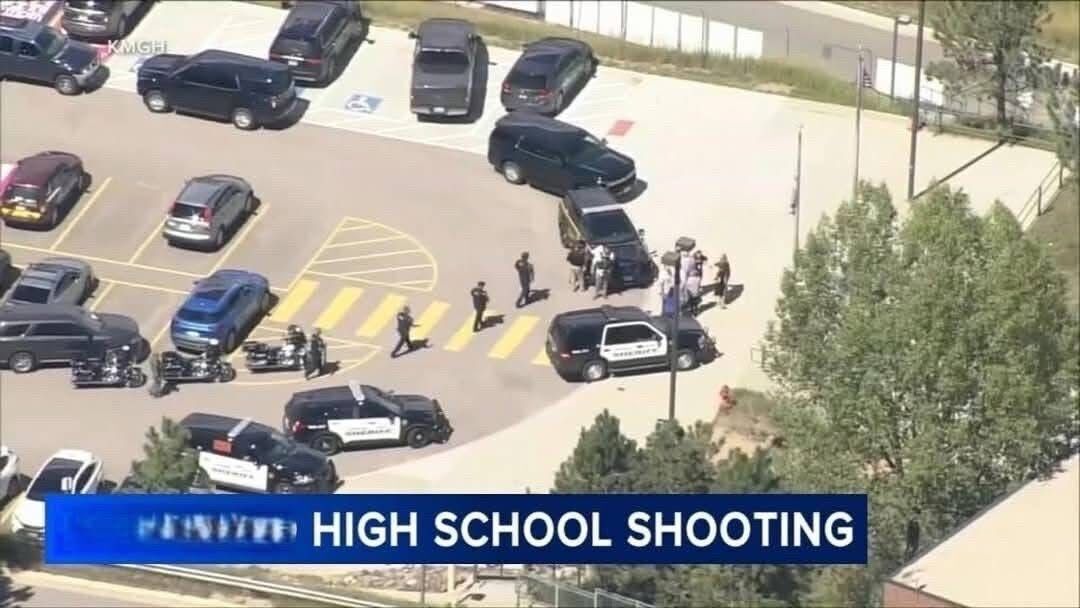
On Saturday, December 13, 2025, a winter afternoon at Brown University was shattered in ways no one on campus could have imagined.
Snow had begun to fall lightly over Providence, softening footsteps along College Hill. Students drifted between libraries and dorms, scarves pulled tight, minds focused on exams, weekend plans, and the ordinary rhythm of university life.
Then the sound came.
Sharp. Violent. Unmistakable.
Gunfire echoed through the halls of the Barus & Holley engineering building, slicing through conversations and lectures in an instant. At first, some thought it was construction noise. Others froze, unsure.
Seconds later, screams followed.
Students dropped backpacks and ran. Faculty shoved open classroom doors, pulling anyone nearby inside. Phones were raised with shaking hands as emergency calls flooded dispatch centers.
Two students were killed inside the building.
Nine others were wounded.
Hallways filled with chaos. Footsteps thundered. Doors slammed shut. Desks were dragged across floors as makeshift barricades. Some hid in closets. Others crouched beneath lab tables, whispering prayers or texting loved ones with hands that would not stop trembling.
The gunman fled on foot.
By the time police arrived, the campus had transformed into something unrecognizable.
Sirens cut through the cold air. Officers rushed between buildings, rifles raised, shouting commands. Helicopters circled overhead. Students were ordered to shelter in place as the university issued an emergency lockdown alert.
Brown University — normally alive with voices and movement — fell silent.
Inside dorm rooms and lecture halls, hundreds waited in darkness, refreshing their phones for updates, listening to distant sirens, wondering if footsteps outside meant safety or danger.
Classes were immediately canceled.
Counseling centers expanded their hours within minutes of the lockdown lifting. Professors sent emails that felt painfully small compared to the loss already etched into the campus.
By nightfall, candles flickered across College Hill.
Students gathered quietly outside buildings, placing flowers, handwritten notes, and photos along sidewalks dusted with snow. Some stood alone. Others held hands. Many cried without making a sound.
Names were not released.
Only the weight of absence.
Law enforcement launched a massive investigation involving local police, Rhode Island state authorities, and federal agencies. Surveillance footage was reviewed frame by frame. Witness statements were collected from students who still struggled to form sentences.
A reward was offered for information.
But no immediate arrest was made.
The uncertainty lingered like frost in the air.
In the days that followed, Brown tried to move forward — carefully, gently.
Town halls were held about safety.
Security was increased.
Professors offered deadline extensions no one knew how to use.
Some students returned to class.
Others couldn’t step back inside the building.
Every loud noise caused heads to turn.
Every backpack left unattended drew uneasy glances.
The campus had changed.
Not visibly.
But permanently.
Parents arrived early. Dorm rooms emptied faster than usual. Conversations became quieter, heavier, more fragile.
And yet, something else appeared too.
Students brought meals to strangers.
Professors hugged students before lectures.
Athletes stood guard at vigils.
Messages covered the sidewalks:
“You are not alone.” “We remember.” “We will heal.”
No words could undo what had happened.
But they tried to hold what remained.
Recovery did not come as a moment.
It came in small steps.
In reopened doors. In shared silence. In counseling rooms filled with tears. In lectures where voices shook but continued.
The investigation remained ongoing.
So did the grief.
So did the questions.
But the community learned what tragedy always teaches too late:
That safety feels permanent… until it isn’t.
And that healing is not forgetting — but learning how to breathe again in the same place where the air once disappeared.
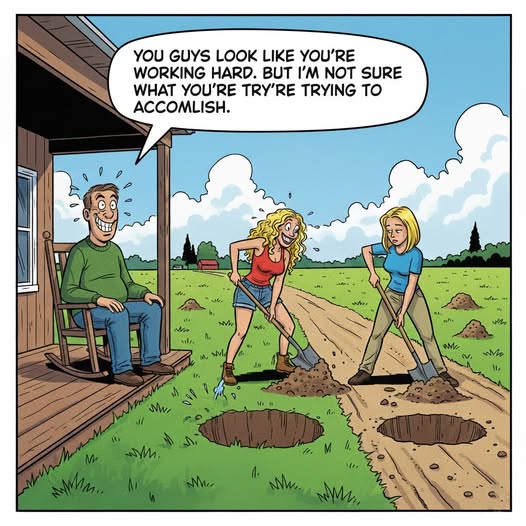
A man was sitting on his porch one quiet afternoon, rocking gently in his chair, when movement down the road caught his attention. Two blondes were working side by side in a vacant lot. Both had shovels. One would dig a hole, step back, and almost immediately the other would step forward and fill it in. No pause. No discussion. Just a steady rhythm: dig, fill, dig, fill.
At first, he smiled and went back to his newspaper. After an hour, curiosity crept in. After two hours, confusion followed. By the third hour, the man set his paper aside and leaned forward, watching closely. They were sweating, clearly putting in real effort, yet the ground looked exactly the same as when they started.
Finally, unable to resist any longer, he stood up and walked down the road.
“Excuse me,” he said politely, trying not to sound judgmental. “I’ve been watching you both for quite a while. You certainly look like you’re working hard, but I can’t figure out what you’re actually trying to accomplish.”
The blondes stopped, leaned on their shovels, and exchanged a look as if the answer were obvious.
“Well,” one of them said matter-of-factly, “there’s usually three of us.”
The man nodded slowly. “And?”
“The one who plants the trees is sick today.”
She shrugged and went back to digging. The other blonde immediately filled the hole back in.
The man returned to his porch with more questions than he started with.
Not far from there—at a military base buzzing with early-morning routines—a young private nervously stood outside his commanding officer’s office. He straightened his uniform, took a breath, and knocked.
“Enter,” the officer called.
The private stepped inside and saluted. “Sir, I’d like permission to leave camp this weekend.”
The officer raised an eyebrow. “Reason?”
“My wife’s expecting, sir.”
The officer softened immediately. “Ah. I understand. Go ahead. And tell your wife I wish her the best.”
The following week, the same private appeared again.
“Sir,” he said, saluting, “request permission to leave camp this weekend.”
The officer squinted. “Let me guess. Your wife’s expecting?”
“Yes, sir.”
“Still expecting?” the officer asked, surprised. “Well, my boy, that must be stressful. Of course. Granted.”
By the third week, the private stood in the doorway once more.
The officer didn’t even look up. “Don’t tell me,” he snapped. “Your wife is still expecting.”
“Yes, sir,” the private replied confidently.
The officer slammed his pen down. “Good grief! What in heaven’s name is she expecting?”
The private stood a little taller. “Me, sir.”
Elsewhere on the same base, the day began like any other. The sun barely cleared the horizon as troops lined up in formation. Boots scuffed gravel. Coffee cups were hastily discarded. The first sergeant stepped forward with a clipboard and cleared his throat.
“Alright, listen up. Work party assignments.”
He began calling names with sharp precision.
“Ames.”
“Here!”
“Jenson.”
“Here!”
“Jones.”
“Here!”
“Magersky.”
“Here!”
“Seeback.”
Silence.
The sergeant frowned and looked up. “Seeback!”
No response.
“SEEBACK!”
The formation stayed perfectly still, eyes forward, mouths shut. The sergeant’s jaw tightened.
Just then, a soldier leaned in and whispered something into his ear. The sergeant blinked, glanced back down at the clipboard, and his face shifted from irritation to understanding.
Without a word, he flipped the page over and continued reading names from the back.
The troops held their composure, though several shoulders shook quietly.
Across town, in a dusty diner just off the highway, laughter echoed from a corner booth. A long-haul trucker wiped syrup from his beard while a waitress shook her head, grinning after learning that “blowouts” meant pancakes and not tires. The cook laughed so hard he nearly burned the bacon. Someone slapped the counter and said, “That’s one for the road.”
The life of an administrative assistant in a small-town insurance office is rarely the stuff of legend. For years, my world was measured in paperclips, printer jams, and the frantic shuffling of policy renewals. It was a monochromatic existence, punctuated only by the vibrant chaos of my home life. As a single mother of two young children, aged five and seven, I lived in a state of perpetual motion—a frantic sprint between the demands of a scowling boss and the needs of my “little squirrels,” as my mother fondly called them. My ex-husband had checked out of the family narrative years ago, leaving behind a vacuum that my mother, a retired nurse with a heart of tempered steel, helped me fill. We were a tiny, overworked team, navigating a sea of bills and obligations with a leaking boat and a single oar.
The day that would eventually dismantle my life began like any other. The winter sky had bruised into a deep, icy violet by the time I pulled into the grocery store parking lot. I was exhausted, my mind a cluttered list of “single-mom survival kit” items: mac and cheese, juice boxes, and frozen chicken tenders. As I emerged from the store, clutching heavy bags against a wind that felt like a razor against my skin, I saw him.
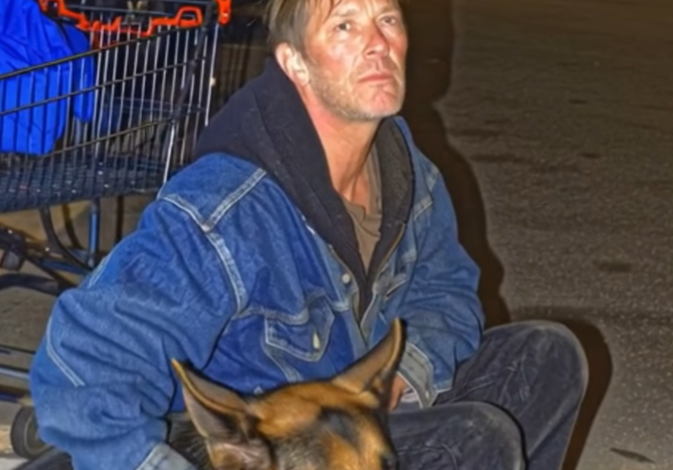
He was a man who seemed to be composed entirely of shadows and sharp angles, huddled against a cart corral. Beside him sat a German Shepherd, a magnificent animal whose alert eyes and well-groomed coat stood in stark contrast to its master’s tattered appearance. The man looked like he was trying to apologize for occupying space on the planet. When he spoke, his voice was a sandpaper rasp. He didn’t ask for money; he simply stated that he was a veteran, and that he and his dog hadn’t eaten since the day before.
In that moment, the cautious instinct that governs every woman in a dark parking lot was overridden by a sudden, sharp clarity. I saw the way he rested his hand on the dog’s head, a gesture of mutual anchors in a storm. I turned back into the store, ignoring the internal clock that screamed about my kids’ bedtime. I bought a feast of hot chicken, roasted potatoes, and vegetables—the kind of meal that reminds a person they are still part of the human family—and a massive bag of kibble for his companion. When I handed the bags to him, his eyes didn’t just well up; they shone with a light I hadn’t seen in a long time. I drove home feeling a quiet warmth that the car’s heater couldn’t provide, unaware that I had just dropped a stone into a very deep well.
A month passed. The encounter faded into the background noise of school projects and office politics. I was at my desk, wrestling with an insurance glitch, when Mr. Henderson, my boss, emerged from his office. Mr. Henderson was a man who wore a permanent scowl like a badge of office, his face etched with the bitterness of forty years spent denying claims. He looked unusually pale, a vein throbbing in his temple as he barked my name.
Inside his office, the air felt thin and cold. He slid a thick, cream-colored envelope toward me as if it were contaminated. It was an official commendation from a prominent national veterans’ organization. Apparently, the man I had fed had found his way to their offices. My simple act of kindness had been the catalyst he needed to seek help. He had told them my name and where I worked—easy enough to glean from the lanyard I’d been wearing. The organization was so moved by the story that they sent a formal letter to my employer, praising my integrity and suggesting that such an exemplary employee was surely destined for a promotion.
To any reasonable person, this would have been a moment of pride. To Mr. Henderson, it was an act of war. He didn’t see a commendation; he saw a “pathetic stunt.” He was convinced I had orchestrated the entire thing—hired a “homeless actor” to stage a scene just so I could manipulate him into a raise. His cynicism was so profound that it had blinded him to the possibility of genuine human decency. Despite my pleas and my frantic explanation that I had two children to support, he fired me on the spot for “undermining his authority” and “fraudulent behavior.”
I walked out of that office with my belongings in a cardboard box and the floor of my world falling away. That night, after the kids were tucked in, I opened the envelope and read the letter. It was beautiful—embossed with a gold seal, a symbol of a world that valued what Mr. Henderson despised. The next morning, fueled by a mixture of desperation and indignation, I called the number on the letterhead.
The woman who answered, Stephanie, didn’t just listen; she stayed on the line while I cried. When she heard about the firing, her tone shifted from warm to steel. “Can you come in tomorrow?” she asked. “We need to talk.”
Walking into the veterans’ organization headquarters was the opposite of walking into Henderson’s insurance firm. The building buzzed with a sense of urgent, noble purpose. In a glass-walled conference room, they told me the rest of the story. The veteran, whose name was David, had been on the literal edge of giving up. The meal I bought him hadn’t just filled his stomach; it had restored his sense of visibility. It gave him the courage to walk through their doors and ask for the help he earned during his service. They had since placed him in stable housing, provided medical care for his injuries, and were helping him find work.
When they learned I had lost my livelihood because of his attempt to thank me, they didn’t just offer sympathy. They offered a legal team. For two grueling months, we fought a wrongful termination suit that eventually saw Mr. Henderson’s board of directors remove him for gross misconduct and professional bias. I received a settlement that cleared my debts and provided a safety net for my children, but the true reversal of fortune came on a Tuesday afternoon in that same conference room.
The director of the organization looked at me and told me they didn’t need people who just followed rules; they needed people who saw the human beings behind the files. They offered me a position as a liaison, helping transitioning veterans find the very resources that had saved David.
I took the job.
Today, my life looks remarkably different. I no longer count the minutes until I can escape my desk. I spend my days ensuring that people who feel invisible are seen. I work in a place where “integrity” isn’t a threat to authority, but the foundation of it. My kids see a mother who comes home energized by her work, rather than drained by it. Looking back at that freezing night in the parking lot, I realize that when I gave that man a hot meal, I thought I was helping him survive. In reality, he was the one who handed me a brand-new life. I lost a job that was soul-crushing, only to find a career that made me whole. Kindness, I’ve learned, is never a lost investment; it is a seed that, even when trampled by the likes of Mr. Henderson, has a way of breaking through the concrete to find the sun.
The morning of the divorce felt less like an ending and more like an erasure. The registry office was a place of cold, institutional efficiency, draped in the grey light of a November sky that seemed to mirror Anna’s internal landscape. She sat on a plastic chair, her gaze fixed on a crack in the linoleum floor, unable to process the legal finality of the words being exchanged around her. Beside her sat Mark, the man who had been her primary orbit for nearly a decade. He was composed, his posture straight and his expression unreadable, looking more like a businessman closing a routine contract than a man dismantling a marriage. There were no shouts, no dramatic accusations of infidelity, and no shattered glass—only the hollow, echoing fatigue of a man who had simply decided he was tired of the weight of another person’s life.
When the signatures were dry and the state officially declared them strangers, Mark stood up first. He adjusted the lapels of his jacket with a mechanical precision that made Anna’s stomach churn. She followed him out of the building in a trance, the biting autumn air hitting her face like a physical reprimand. She began to walk away, desperate to put distance between herself and the wreckage of her past, when his voice cut through the sound of distant traffic.
“Anna, wait.”
She stopped, but she didn’t turn around. She couldn’t bear to see the pity she knew would be etched into the corners of his mouth. She heard his footsteps approach—steady and confident—until he was standing directly in front of her. He reached into his coat pocket and held out a plain, silver bank card.
“Take this,” he said, his voice devoid of its usual sharp edge. “There is money on it. A cushion for the beginning, so you don’t have to worry while you’re starting over. The PIN is your birth date.”
Anna felt a bitter, jagged smile pull at her lips. The gesture felt insulting—a final payment to clear his conscience, a way to buy his exit from the emotional debt he owed her. She snatched the card from his hand, not as an act of acceptance, but as a way to end the conversation. She wanted to throw it into the gutter, but the pragmatism of a woman who now faced the world alone forced her to tuck it into the darkest, most forgotten sleeve of her wallet. In that moment, she made a silent vow to herself: she would work two jobs, she would skip meals, and she would live in a closet before she ever touched a cent of Mark’s “pity money.”
For two years, Anna kept that promise. She moved into a cramped studio apartment where the heater rattled like a dying breath and the walls were thin enough to hear her neighbor’s television. She took a grueling job in logistics, working long hours until her eyes burned from the blue light of the monitor. She learned the geography of a life built on independence, finding a strange, masochistic pride in the struggle. The silver card remained buried beneath old receipts and expired coupons, a relic of a previous civilization that she refused to excavate.
Then came the telephone call that changed the trajectory of her pride. It was from the city hospital. Her mother, the only anchor Anna had left in the world, had collapsed. The diagnosis was a sudden, aggressive cardiovascular blockage that required immediate, high-risk surgery. The medical system, in its cold and calculated reality, presented Anna with a list of costs that felt like a death sentence. Even with her meager savings and the liquidation of every small asset she possessed, she was hundreds of thousands of dollars short. The desperation was a physical weight, a suffocating pressure in her chest as she sat in the hospital cafeteria, staring at the total on the invoice.
The vow she had made on that November morning crumbled under the weight of her mother’s life. With trembling hands, she walked to a lone ATM in the hospital lobby. The air in the building felt sterile and heavy. She pulled the silver card from its hiding place; it looked pristine, untouched by the two years of hardship she had endured. She inserted it into the machine, her heart hammering against her ribs as she punched in the digits of her own birth date. The screen flickered, a “Please Wait” message spinning with agonizing slowness.
When the balance finally appeared, Anna didn’t scream; she simply stopped breathing. She blinked, certain that the fluorescent lights were playing tricks on her eyes or that the machine was suffering from a catastrophic software error. The number on the screen was not a “cushion.” it was a fortune. It was an amount so large that it transcended the cost of a surgery—it was enough to buy a house, to fund a retirement, to change the very fabric of her existence. It was as if a ghost had reached out and handed her the keys to a different life.
She stepped away from the machine, leaning her forehead against the cold brick wall of the lobby. The resentment she had carried like armor for two years suddenly felt heavy and useless. She pulled out her phone, her thumb hovering over a contact she had never deleted but had never dared to call. Mark answered on the second ring.
“You checked the card,” he said. It wasn’t a question; there was a weary, knowing tone in his voice, as if he had been waiting by the phone for seven hundred days.
“Mark, what is this?” Anna’s voice was a ragged whisper. “Where did this money come from? This isn’t ‘starting over’ money. This is… this is impossible.”
There was a long, heavy silence on the other end of the line. When Mark finally spoke, the corporate veneer was gone. “After we stood in that registry office, I went home to a house that was too quiet,” he admitted slowly. “I realized that our marriage didn’t end because of a grand disaster. It ended because I was a man who only knew how to choose himself. I was a man who took and took until there was nothing left of you. I didn’t know how to apologize with words, so I decided to apologize with the only thing I had left that had any value.”
“You’ve been adding to it,” Anna realized, her mind racing. “For two years.”
“Every month,” Mark confirmed. “It was a ritual. A way to live with the guilt of how I left you. I never expected you to use it, Anna. I honestly thought you’d throw it away. But I needed it to be there, just in case the world was as hard on you as I was.”
Anna closed her eyes, hot tears finally spilling over. The anger she had nurtured, the belief that he had discarded her without a second thought, began to dissolve. She realized that while he had been incapable of being the husband she needed in the house, he had spent two years being the guardian she needed in the shadows.
“You saved her, Mark,” she said, her voice finally steadying. “My mother… she needs surgery I couldn’t afford. You saved her life.”
Mark let out a long, shaky breath that sounded like a prayer. “Then it was worth every cent. I’m glad you finally looked, Anna.”
“I’m grateful,” she said, and for the first time in two years, the words didn’t taste like ash. “But Mark, this has to be the end of the secret. No more monthly transfers. No more guilt-ridden rituals. If we are to move forward, even as strangers, I need to know that the debt is settled. I am taking this for her, but I am not taking your guilt anymore. You are forgiven.”
The conversation ended with a quiet understanding, a final tether being cut not with a knife, but with a bandage. Anna walked back toward her mother’s hospital room, the silver card clutched in her hand. The surgery was scheduled for the next morning. As she watched the steady rise and fall of her mother’s chest, Anna realized that the money wasn’t the real gift. The real gift was the realization that human beings are rarely as one-dimensional as our grievances make them out to be. She had spent two years defined by her ex-husband’s absence, only to be saved by his hidden presence. She looked out the window at the city lights, knowing that her mother would live, and that she, finally, was free to stop looking back.
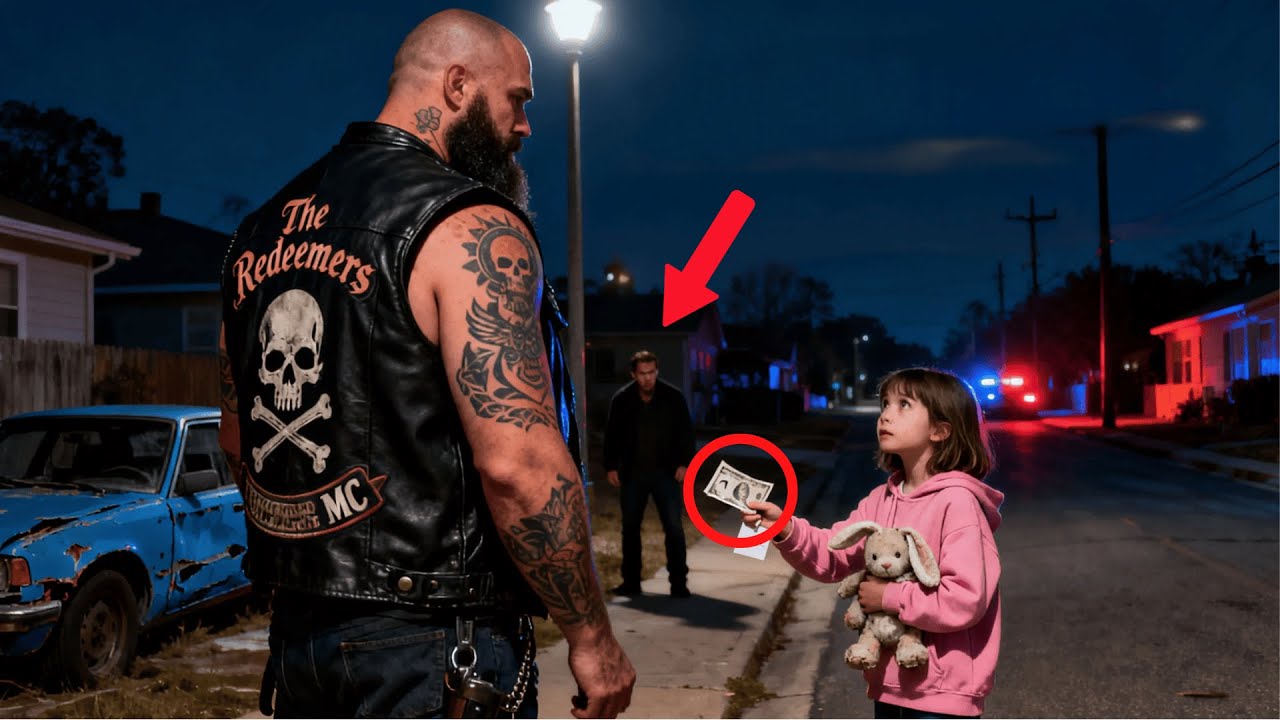
A 9-year-old girl once tried to hire my entire motorcycle club for $7. She slid the money into my hand and whispered, “You scare everyone else. Can you scare him for me?” Before I tell you how that night ended, do me a favor. If you’re listening to this right now, drop a comment and tell me where you’re watching from.
Hit like if you believe the strong should protect the weak. Share this story with someone who needs it. And don’t forget to subscribe so you can ride with us on the next one. All right, let me tell you about Lily and the $7 that changed a lot more than she realized. Most people only see the leather first. They see the black sleeveless vest with Hell’s Angel stretched across the back, the Phoenix patch, the full sleeve tattoos, the skull inked into my bicep, the beard, the scars, and they decide what I am before I say a word. They decide I’m the villain.
That’s fine. Sometimes the world needs a monster in the room, as long as it’s pointed at the right people. It was a gray afternoon on Highway 17. Sky the color of an old t-shirt. The wind pushed dust across the cracked parking lot and made the rusty gasp price signs squeal on its hinges.
The diner was half full, truckers arguing about football, some locals nursing coffee like they were stalling real life. And in the far corner at the same sticky booth she always sat in, was Lily. tiny thing. Pink hoodie two sizes too big. Hair pulled back in a loose ponytail that was halfway undone. A workbook open in front of her and a pencil moving slow like every answer was heavier than it should have been.
Plate of fries going cold next to her. Her mom weaved between tables with a coffee pot and that rushed tired energy you only see in people who can’t afford to sit down. We’d seen Lily a lot. The homework kid. Always quiet. Too quiet. Hell’s Angel rolled in like we always did. Six black Harleys in a line, engines grumbling as they cooled.
I was leaning against my b
ike, arms crossed, listening to the highway hum and the click of hot metal. That’s when I felt it. You spend enough years in bars, back alleys, and bad parking lots. You develop a sixth sense for eyes on your back. I looked up. She wasn’t in her booth anymore. Lily was standing in the diner doorway, framed by a flickering neon open sign.
One hand clutched a worn out stuffed bunny by the ear, fur rubbed thin, one button eye hanging by a thread. The other hand was balled into a fist so tight her knuckles were white. Nine years old maybe, but the look in her eyes wasn’t nine. It was older. The kind of old you only get when life shows up too early and too rough.
Our eyes met across the parking lot. Most kids see me and duck behind their mom. Lily’s gaze shook, but it held like she’d already made a decision, and there was no running it back. She stepped out onto the asphalt. Her sneakers scraped gravel. The wind tugged at her hoodie and inflated it around her skinny frame.
She hesitated for half a heartbeat, then took another step, and another as if whatever was behind her in that diner was scarier than a row of bikers outside. I straightened slowly so I wouldn’t tower over her too much, hands dropping to my handlebars. Through the diner window, I caught a glimpse of her mom back turned, grabbing plates, chatting with a customer, completely unaware her daughter had just walked out into a storm of leather and ink.
The guys went quiet as they noticed her crossing the lot. Conversations trailed off, boots scraped, engines ticked. She stopped in front of me. Up close, I could see the dark circles under her eyes and a little scar near her eyebrow. The bunny dangled from her hand, its one eye bouncing with every small tremor in her fingers.
For a moment, we just existed there. The only sounds were a semi rolling by out on 17, the low buzz of the diner’s vent fan, and the soft tick of cooling engines. Hey kiddo,” I said, lowering my voice. “You okay? You lost?” She shook her head quick, sharp. Then she did something I absolutely didn’t expect. She opened her fist.
In her palm lay a crumpled $5 bill and two equally crumpled singles, $7 soft from too many times in and out of the same pocket. On top of the small stack was a folded scrap of paper, creased so many times the edges had started to tear. She held her hand out toward me, arm shaking just enough for the bills to tremble in the breeze.
No words, just those big, serious eyes locked on mine like this was some kind of test and I was the one being graded. Behind me, I heard someone from the club shift position. Chair legs scrape on concrete. Then silence. The world turned the volume down for us. I pushed off the bike and crouched a little so we were closer to eye level.
“What’s this?” I asked, holding my hand out, but not taking the money yet. “You selling cookies or something?” Her throat moved as she swallowed. When she finally spoke, her voice sounded like it had been worn down by crime, crying into pillows. This is This is all my money, she said.It’s $7. I counted. Her fingers were ice cold when she placed the money and the folded note into my palm.
Not the kind of cold the weather gives you, the kind that seeps in when you’ve been scared for too long. I closed my hand around it, feeling how small that bundle was, how light. On the outside of the folded paper, in shaky pencil, it said, “Please don’t tell my mom.” My chest tightened. That one line told me almost everything I needed to know.
There was a secret. There was shame. And there was danger. I unfolded the note carefully. The paper was soft from being opened and refolded a hundred times in some small pair of hands. The handwriting was cramped, uneven, like the writer had been rushing and trying not to cry. This is all my money.
Can you please make Darren go away? He says he’s taking me tonight. I’m really scared. I read it twice. Darren. Didn’t know the man, but I knew his type. There are too many Darren in this world. Small-time predators who think fear is something they’re owed. Men who like to pick targets who are young, tired, broke, or trapped.
I looked back at Lily. Her eyes were shiny with tears she wouldn’t let fall. She squeezed the bunny so hard it seems pulled. She took a breath that seemed to fill her whole narrow chest, then whispered, “You scare everyone else. Can you scare him for me?” Right there, that sentence, that was the moment everything shifted.
Up until then, we were just some bikers grabbing dinner on the way through town. After that, we were hired. $7 and a note. That’s all it took. Before that day, Lily was just background to us. The quiet kid with the cold fries and the two big hoodie. But you can learn a lot from the background if you actually pay attention.
I’d seen the way she flinched when the bell over the diner door slammed too hard. The way she sat where she could see both the entrance and the window. How her shoulders relaxed a little whenever her mom brushed her arm as she passed and tensed right back up the second she walked away again. Kids don’t move like that by accident.
I folded the note up slowly, buying myself a second to keep my temper from boiling over right there in the parking lot. There’s no point in scaring the kid who came to you for help. Lily,” I said, trying the name I’d heard the waitress use. Her eyes flicked up fast when she heard it. “Who’s Darren?” She glanced back at the diner, checking for shadows in the window, like just saying his name might pull him out.
“He used to live with us,” she whispered. “With mom before he went to jail.” I didn’t interrupt. Sometimes kids need space to lay the dominoes out one by one. He comes back now, she said. When mom works at night, he bangs on the door. He shouts a lot. He says mom owes him money. Says I owe him too cuz he bought me shoes once.
Her fingers tightened on the bunny until the fabric bunched. He said tonight he’s done asking. She finished. If mom doesn’t give him the money, he’s going to take something more valuable. She swallowed hard. He looked at me when he said it,” she added. There it was, not just fear, a deadline. Behind me, boots crunched on gravel.
“Everything good out here, Bear?” Rook’s voice. One of my brothers, tall shaved head, eyes like radar. I handed him the note without a word. He read it, jaw tensing, then lifted his gaze to Lily. I watched the shift in his face. Rook has a daughter he doesn’t see as much as he wants. He knows what it looks like when a kid’s carrying something too heavy. That him? He asked Lily quietly.
The guy the waitress was worried about. She nodded barely. Turned out Darren’s name had already floated through that diner in late night whispers. Broken glass one morning, shouting through the front door. A bruise on mom’s arm brushed off as I’m clumsy. People notice. They just don’t always act. We do. When did he say? I asked.
Tonight, she repeated. When it’s dark. How many hours was tonight? Two, six? Didn’t matter. It was a countdown either way. I slipped the note into the inside pocket of my vest right over my heart. The $7 went into my wallet, not because we needed it, but because it meant something. Payment, a contract, her trust.
Why’d you come to me, Lily? I asked. out of everyone. She hesitated, then looked at my tattoos, my vest, the line of bikes, the other men standing quietly behind me. You You scare everybody else, she said simply. The truckers, the boys at school, even the sheriff guy gets mad when you park here.
I thought if you can scare them, maybe you can scare him. simple math. A child doing the kind of calculus they should never have to do. I nodded once. Okay, I said. Here’s the deal. You go back inside. You act like nothing’s wrong. You eat your fries, do your homework, and don’t worry about the door tonight. That’s our job now.
Her brow furrowed. You’re not going to tell my mom? She asked. Not yet, I said. Not until we’ve got something useful to tell her. You asked me not to, remember? She searched my face like she was lookingfor cracks in my promise. Whatever she saw there must have been enough. She hugged the bunny tighter, gave one small nod, and turned back toward the diner.
Her steps weren’t steady, but they were braver. As soon as the door swung shut behind her, the air changed. Rook let out a slow breath. “So he said, “We babysitting or are we handling a problem?” “We’re handling a problem,” I answered. “And the clock’s already ticking.” Inside, the guys took one look at my face and slid into church mode without me saying much.
We crowded around a back booth under a buzzing light. From the outside, it probably looked like a gang planning trouble. In a way, it was. I put the note on the table. No jokes, no half smiles. Scarred hands and tattooed arms folded as they leaned in to read. “Ghost, our quiet one.” Tapped the paper with one finger. “Jailbird X?” he asked. “Fresh out?” I said.
“No contact order on file. Sheriff half mentioned it last month.” Tank grunted. Years ago, he’d watched his sister go through hell with a man not so different from Darren. He still carries that failure like a brand. Heard a woman? You’re trash? Tank said. Heard a kid? You’re something worse. We all nodded.
What’s the play? Someone asked. We start smart, I said. We find him. We let him know we exist before he ever sees that front porch. And we make sure when we stand in front of her door tonight. The law is standing behind us. First stop, his place. The trailer park sat on the edge of town like a collection of bad decisions and overdue payments.
We rolled in slow gravel rattling under our tires, dogs barking behind chainlink fences. A couple of guys on a porch froze mid laugh when they saw us, their grins evaporating. There, ghost murmured over the helmet calm. A dented blue sedan sat crooked in front of a rusted trailer. Plate matched the one the waitress had scribbled for us the week before when she’d vented about that jerk who won’t stay away from Lily’s mom.
The trailer leaned like it was tired of supporting his weight. window shades drawn in midday. One of them bent where a fist had punched through at some point. We didn’t need to knock. We just idled past in a slow, loud procession. Six black Harleys, six black vests, six pairs of eyes taking inventory. A curtain twitched and snapped shut. Good, I said.
Let him know we’re real. Next stop, the sheriff. Now, the sheriff and I, we’re not exactly drinking buddies. He doesn’t like my ink. Doesn’t like our patch. Doesn’t like that sometimes we show up places before his deputies do, but he’s not stupid and he’s not blind. I walked into the station alone. The room smelled like stale coffee and printer toner.
A deputy at the front desk stiffened when he saw me, hand hovering near his belt. If I wanted trouble, I told him, I wouldn’t come through the front door. A minute later, the sheriff stepped out. Mustache, receding hairline, permanent line between his brows that had my name on it. Bear, he said. What now? I slid a photocopy of Lily’s note across the counter, kept the original on me.
He read it, his face changed. “You got a last name for this, Darren?” he asked. “Cole,” I said. “Perolei, right?” He nodded slowly. “Parole,” he confirmed. “And yeah, there’s a no contact order. Mother got scared. dropped the charges before they stuck. But the paper trail’s still there. Then we’ve got leverage, I said.
He told a 9-year-old he’s taking her tonight. That’s more than a bad vibe. The sheriff sighed. I can’t lock him up on a note written by a kid and your gut feeling, he said. But I can have a cruiser sit on her street, log his presence if he shows. You and I both know a cruiser half a block away isn’t much use if he’s already at her door, I replied.
We’re going to be there, too. You get your logs, your parole violation. We’ll make sure he doesn’t get close enough to say hello. We stared at each other for a long second. Two different versions of justice sizing each other up. I don’t want broken bones, he said. Then tell him to keep his hands to himself, I answered.
His mouth twitched almost, but not quite a smile. Fine, he said. You stand on the porch. We’ll stand on the street. Maybe between us, the paperwork and the patches will get the job done. By the time we rolled into Lily’s neighborhood, the sun was sliding down, turning the sky the color of old coins. It was the kind of street where kids bikes lay on their sides in patchy yards and someone always had a TV too loud behind a thin wall.
We didn’t line up like a parade. Two bikes out front, a couple spaced down the block, one across from the house. To a nervous neighbor, we probably looked like trouble. Good. Lily’s house was small, paint peeling in places, but the front step swept clean. Thin curtains were drawn almost shut. Through the gap, I saw her silhouette move, setting plates, carrying something to the table.
Her mom’s shape passed behind her, pacing that endless loop between kitchen and living room. Theyhad no idea we were there for them. That was fine. Not every shield needs to be obvious. Time dragged. Street lights blinked on. Crickets started up their nightly chorus. Somewhere, a dog barked at a squirrel like it was a war crime.
We waited. He said, “Tonight,” Rook muttered from his spot across the street. “Think a clown like him shows early or late?” “Doesn’t matter,” I said through the calm. “We’re here either way.” Then we heard it. That cough sputter of a bad muffler. The squeal of cheap tires hitting the corner too fast.
Headlights swung across mailboxes like a search light as the dented blue sedan crawled onto the street. He killed the lights before he killed the engine. Like darkness was a disguise. It wasn’t. He stepped out. Late30s cheap jacket. Three days of stubble. Jaw clenched tight. You could smell cigarettes and cheap whiskey on him from 10 ft away.
His eyes swept the street. They landed on the bikes first, the vests, the patches, then on me, standing under a street light, arms loose at my sides, skull tattoo catching the glow. For a heartbeat, his stride hitched. Then he put the mask on. Smirk, swagger, chin up. Evening, gentlemen,” he called, heading toward Lily’s house like he had a right to.
“Nice night for a family visit.” He tried to walk past me on the sidewalk. I stepped into his path. Not fast, not aggressive, just there. Darren Cole, I asked. He let out a short, brittle laugh. Who’s asking? He said. I’m the man standing between you and that front door, I replied. Behind me, I could feel the redeemers adjusting slightly, just enough to let their vests catch the street light.
Family games
Down the block, a cruiser pulled up and parked, engine idling, silhouette of the sheriff behind the wheel. Darren’s gaze flicked that way, then back to me. “You got no business here, man,” he said. That’s my house, my family. The word family tasted wrong coming out of his mouth. Family doesn’t threaten to take a kid when it doesn’t get paid, I said.
Family doesn’t pound on doors so hard a 9-year-old learns all the different ways wood can shake. His jaw ticked. She been talking? He snapped. She’s been writing, I countered. I tapped my chest where the note was. Every word the sheriff needs to hear is right here. The tough guy smirk thinned. I watched the calculations start behind his eyes.
Ego, fear, entitlement, the whole ugly mix. You think a bunch of bikers scare me? He said, I did time, old man. I stepped in a fraction closer, enough that he had to tilt his head back a little to keep eye contact. I don’t need you to be scared of me,” I said quietly. “I need you to be scared of what happens next if you take one more step toward that house.
” I nodded toward the cruiser. “You’re on parole,” I reminded him. “There’s a no contact order with the woman who lives here. You knock on that door, you so much as yell her name in the front yard, that’s a violation. that car down there. They’re not just sightseeing. I let the silence stretch, then added, “And here’s the thing, Darren.
We don’t have to lay a hand on you. All we have to do is stand here and watch what you do. You give us any excuse, we hand you to thou them with a bow on top.” He scoffed, but his voice didn’t have much weight behind it. “She owes me,” he said. money, respect. After everything I did, she owes you nothing. I cut in.
You lost that when the court stamped that order. You lost that when a kid was more afraid of your car than the dark. Behind him, Tank shifted, folding his huge arms. Ghost leaned against a mailbox. The skulls and phoenix’s on our backs might as well have been warning signs. Here’s your choice, AI said. You turn around. You get in that car.
You leave this street and this town behind you. You don’t call. Don’t text. Don’t accidentally bump into them at the store. You become a ghost. I paused. Or you try to go through me, through us, through the sheriff, through parole, through every set of eyes on this block. He stared at me breathing hard. The porch light clicked on behind me.
Ancestry DNA Kits
In the window, a shadow moved. A small head, a bunny ear. Lily was watching. You don’t get to scare me off my own family, he muttered one last time. Too late, I said. She already hired us. Something in him broke then. Not in a noble way, just in a tired, mean little collapse. He spat on the pavement, tossed a curse in our direction, then turned and stomped back to his car.
The door slammed. The engine coughed. For a second, I thought he might gun it and try to scare us with a fake rush. He didn’t. He peeled away, tires squealing, tail lights shrinking and shrinking until they were just two red specks in the dark. We watched until even those were gone. The cruiser rolled a little closer.
The sheriff leaned out the window. “He gone?” he called. “For tonight,” I said. “You’ll probably see his name on another report soon enough if he’s as dumb as he looks. But he won’t come back here, not knowing who’s standing on this street now.”When I turned toward the house, the front curtain fluttered. A small face and the outline of a bunny ducked back out of sight.
I lifted a hand to my chest and tapped the pocket with the note, then gave a small nod toward the window. We kept our end. Here’s the thing, though. Making a man like that leave for one night is one kind of job. Making sure he doesn’t come back is another. We weren’t done. I walked up the short path to the front door and knocked.
Just once, firm, not angry. There was some clinking inside, the scrape of a chair, quick footsteps. The door opened a crack, chains still on. Lily’s mom peered out, hair down now, eyes tired, a dish towel knotted in her hands. Her gaze bounced from my vest to the bikes to the cruiser down the block. I could practically hear every alarm bell in her head going off.
We’re closed,” she blurted, muscle memory from the diner kicking in. “I’m not here to order food, ma’am,” I said, keeping my voice low. “I’m here because a man named Darren just tried to come by.” All the color left her face. “He’s not supposed to be here,” she whispered. “There’s a I filed.
They said you did the right thing.” I interrupted gently. Paper works in your favor, but paper doesn’t stand on the porch. Tonight, we did. I told her what had happened in the street, the sheriff, the parole, how close he’d gotten, and how far we made him go back. Her eyes shown, not just with fear, but with a kind of exhausted shame, like she was embarrassed it had come to this at all.
Why? She asked finally. Why would you get involved? Behind her, Lily hovered in the hallway, Bunny clutched, listening. “Because your kid asked us to,” I said simply. “And because nobody should have to deal with a man like that alone.” “We didn’t stay long. Just long enough to outline the next steps.
” Sheriff filing a violation report. A legal contact we knew from a charity ride who could help strengthen her no contact order. A cousin of one of the guys who could come by in the morning and change every lock on the place for free. This isn’t charity, I told her when she tried to refuse.
Call it professional courtesy from one family protecting another. Before I left, I handed her a small brown bag we’d grabbed at the allnight mart on the way over. bread, milk, eggs, basics. You’ve got enough to worry about, I said. You shouldn’t have to count slices of bread on top of it. She covered her mouth, inhaled sharply.
No dramatic breakdown. Just that tiny, honest crack in the armor of someone who’s been holding on too long. When we stepped back out on the porch, Lily followed. bare feet on old wood, hoodie sleeves pulled over her hands, bunny under one arm. She walked up to me, hesitated, then looked up. “Did Did you use it?” she asked.
“Use what?” I said, though I already knew. My $7. I let the smallest smile pull at one corner of my mouth. The job was done. I could afford it. Yeah, I said. We did. Bought you something. I pulled out my wallet, took out the same $7 she’d given me, creased familiar, and slid them into her hand. Then I added a crisp 20 on top. We bought you time, I said.
Turns out we were running a special $27 worth. She stared at the money, then at me. But that’s more than I paid you,” she whispered. “That’s how this works sometimes,” I replied. “You gave us your trust. We pay interest.” Her fingers closed slowly around the bills. For the first time since I’d met her, I saw something other than fear in her eyes. Hope. Fragile, but real.
We walked back to the bikes. Ghost swung his leg over his Harley. “Think she’ll be okay?” he asked quietly. I looked back at the house. Lily stood in the doorway, pink hoodie framed by warm light, bunny under one arm, other hand still wrapped around the money. Her mom was behind her, one hand on her shoulder, eyes on the street.
“She’s got a shot now,” I said. Tonight that’s enough. Engines roared to life. The sound rolled down the block like distant thunder. Neighbors peaked out from behind curtains, judging, whispering, clutching their assumptions a little tighter. Let them. That night wasn’t about them. It was about a kid who looked at the scariest people she knew and saw a way out.
People ask me sometimes why we wear what we wear, the leather, the ink, the patch. They think it’s about playing the monster. Truth is, the world has plenty of monsters already. What it doesn’t have enough of are people willing to stand between those monsters and the ones who can’t fight back. A few days after that night, I took Lily’s note.
the original with the shaky handwriting and the creases and framed it, hung it on a nail in a quiet corner of the clubhouse right above the bar. $7 folded behind the paper. Every now and then, someone new walks through our door looking like the world has chewed them up. They’ll glance at the tattoos, the vests, the skulls, and I can see the fear wrestling with the need for help.
Sometimes they ask, “How much do you charge?” I just nod toward that frame.That, I say, is the going rate. $7 and enough courage to walk in and ask. You don’t need a Harley or a patch to be that for someone. By the way, maybe in your world, you’re not the biker. Maybe you’re the co-orker who speaks up, the neighbor who calls, the friend who shows up at midnight with a spare couch and a listening ear.
Being scary isn’t about how you look. It’s about what you’re willing to stand in front of. Hell’s Angel. We don’t ride around looking for trouble. We ride around looking for the people trouble has already found. And on one gray afternoon at a roadside diner, a 9-year-old girl hired us with seven crumpled dollars and a note that said, “Please don’t tell my mom.
” She asked us to scare the monster that scared her. And that’s exactly what we did. If this story hit you even a little, don’t keep it to yourself. Share it with someone who needs to be reminded they’re not alone. Drop a comment and tell me where you’re watching from. Hit like if you believe real strength is for protecting the vulnerable and subscribe if you want to ride with us on the next story. Until then, ride safe.
The wind howled, a predatory beast tearing through the skeletal branches of the ancient oaks that lined the desolate stretch of Route 17.
Snow, thick and merciless, whipped across the narrow road, reducing visibility to mere feet. It was the kind of storm that made grown men question their resolve, a blizzard that clawed at the very soul of the landscape, promising to swallow anything foolish enough to defy it.
But for Anya, a Siberian Husky whose coat was the color of fresh-fallen snow and whose eyes held the piercing blue of glacial ice, surrender was not an option.
Clutched in the thick, warm fur of her neck, a small hand held fast. Five-year-old Lily, bundled in a snowsuit that felt woefully inadequate against the savage cold, buried her face deep into Anya’s flank, each breath a shaky puff of white vapor.
Lily’s father, Mark, had been a careful man, meticulous in his preparations. A full tank of gas, emergency blankets, a thermos of hot cocoa for Lily, and a bag of Anya’s favorite salmon treats. He had even, on a whim, charged his satellite phone, a device he rarely used. But no amount of preparation could account for the treachery of black ice hidden beneath a sudden, blinding squall.
The truck had spun in a sickening, slow-motion ballet, a violent pirouette that ended with a jarring crash against a snow-laden embankment.
Mark, a sturdy man, had been momentarily stunned, his head hitting the steering wheel with a sickening thud. He remembered Lily’s terrified scream, the scent of burning oil, and Anya’s frantic barks.
When he came to, the world was a dizzying blur of white and red—the glow of a warning light, the crimson stain spreading across his temple. He had managed to unclip Lily, push her towards the back seat where Anya was already frantic, nudging her with her nose. “Anya! Go! Find help! Stay with Lily!” he had choked out, his voice hoarse, his vision tunneling. He barely registered the dog’s desperate lick to his face before darkness claimed him.
Anya didn’t hesitate. Her instincts, honed over generations of Arctic survival, screamed for action. The scent of danger, the metallic tang of blood, the piercing cold—all ignited a primal directive. Her pack, her tiny human pack, was broken. One was in peril, immobile in the twisted metal.
The other, small and vulnerable, needed guiding. She nudged Lily, her soft muzzle pressing against the child’s cheek. “Ruff!” a low, urgent bark. Lily, numb with shock and cold, had instinctively wrapped her arms around Anya’s neck, a desperate anchor in a swirling white nightmare.
The first few minutes were a blur of instinct. Anya pulled, guided by an innate sense of direction, a magnetic pull towards the faint, almost imperceptible glow on the horizon—the distant promise of human habitation.
Her powerful legs, built for endurance, churned through the deepening snowdrifts. Lily’s weight was a constant, warm pressure against her, a precious cargo. Anya remembered Mark’s voice, the last coherent command, “Find help!” It echoed in her mind, a mantra.
Hours blurred into an eternity. The storm intensified, battering them with icy projectiles. Anya’s usually keen eyesight was hampered, the world a canvas of swirling white. She relied on scent, on the subtle shift in the wind, on the faint vibrations of the ground beneath the snow. She tucked her tail, a protective gesture against the elements, and kept her ears flattened, listening intently to Lily’s shallow breathing.
The child had stopped whimpering, her small body growing heavy and dangerously still. Anya knew the signs of hypothermia. Every fiber of her being urged her onward.
They had been walking for what felt like days. Anya’s paws ached, burning with an internal fire that fought against the external cold.
Her muscles screamed for rest, for the warmth of a den. But there was no rest. Not yet. Lily’s grip was loosening, her breathing barely a whisper. Anya paused, her body trembling. She nudged Lily again, a frantic whine escaping her throat. “Ruff! Ruff!”
Lily stirred, her eyes fluttering open.
They were glassy, unfocused. “Anya… I’m cold… so cold…” Her voice was barely audible above the storm’s roar.
Anya pressed her body against Lily, trying to transfer her own warmth. She licked Lily’s face, a desperate, insistent gesture.
She knew they were close. She could smell the faint, tantalizing scent of woodsmoke, the distant echo of human voices carried on a stray gust of wind. But Lily was fading. Anya had to do something more.
It was then, in that moment of desperate clarity, that something ancient, something primordial stirred within Anya. A connection. A bond forged not just of training and companionship, but of love and sheer, unyielding will.
She looked into Lily’s dazed, half-closed eyes, and a profound, resonating thought, not a bark, not a whine, but a clear, distinct word formed in her mind, a word Lily somehow understood.
“Hold on.”
Lily’s eyes widened, a flicker of awareness returning. “Anya?” she whispered, a tear freezing on her cheek.
Anya nudged her head, a silent affirmation. “We’re almost there. Just a little further.” The words weren’t spoken aloud, not with a human voice. But they resonated in Lily’s mind, a warm, comforting presence. It was as if Anya’s very spirit had reached out, a lifeline in the icy abyss.
Emboldened, Lily, with a strength she didn’t know she possessed, tightened her grip. “Okay, Anya. I’ll hold on.”
The words, a direct response to Anya’s unspoken command, sent a jolt of renewed determination through the Husky. She pushed forward, her powerful chest breaking through the drifts, her nose to the wind. The woodsmoke scent grew stronger, the faint murmur of voices resolving into the unmistakable sound of a snowmobile engine.
Anya spotted it first: a flickering light through the swirling snow, a beacon in the whiteout. She barked, a joyous, desperate sound that tore through the storm’s din. “Ruff! Ruff! Help! Here!” The barks were accompanied by the same clear, resonating thought, projected with all her will.
The light paused. A figure on a snowmobile cut its engine, straining to hear over the storm. Anya barked again, louder, more insistent, pulling Lily with renewed vigor.
The figure, a burly man named Jeb, a local search and rescue volunteer, finally saw them. A flash of white through the gloom, a child clinging to a dog. He couldn’t believe his eyes. He quickly dismounted, shouting into the wind. “Hello! Is anyone there?”
Anya responded with a flurry of barks, nudging Lily forward. “Yes! Here! My human! She needs help! And Mark! He’s back there!” The urgency of her unspoken words, the vivid mental image of the crashed truck and Mark’s still form, was overwhelming.
Jeb, startled, felt a strange, inexplicable certainty. It wasn’t just the sight of the child and the dog that spoke to him; it was an urgent feeling, a communicated certainty that went beyond words. He knew, with absolute clarity, that not only was this child in danger, but there was someone else.
He raced towards them, his powerful flashlight beam cutting through the snow. He scooped up Lily, his heart aching at her small, frozen form. “My goodness, little one! You’re safe now!” He checked her pulse, her breathing, wrapping her tightly in his emergency blanket.
Then he looked at Anya, whose blue eyes, usually so wild, were fixed on him with an intense, almost human plea. “Woof! He’s back there! My pack leader! He’s hurt! The truck!” The images flooded Jeb’s mind, a startlingly clear mental picture of the crashed vehicle, the specific location, Mark’s condition.
Jeb, a man of logic and reason, shook his head, trying to clear the inexplicable certainty from his mind. It was the shock, the adrenaline. But the dog’s eyes were too insistent, too knowing. “Okay, girl, okay. Show me,” he said, speaking to the dog as if she understood every word.
Anya turned, a frantic bark escaping her, and began to run back into the storm, looking over her shoulder to make sure Jeb followed. The man, though bewildered, couldn’t ignore the dog’s urgency. He placed Lily gently onto the back of his snowmobile, securing her, and then followed Anya, his powerful machine churning through the snow.
Anya led him unerringly back through the storm, retracing their long, arduous journey. Every few minutes, she would pause, looking back, her unspoken words clear: “Faster! He’s fading! He needs us!”
Minutes later, which felt like an eternity, they found the truck, half-buried in a massive snowdrift, its front end crumpled against the embankment. Mark was still inside, unconscious, his face pale and caked with frozen blood.
Jeb worked quickly, using his emergency tools to pry open the door enough to assess Mark. He called for backup on his radio, his voice urgent. “Found the truck! One adult male, unconscious, head trauma, significant blood loss. Hypothermia. And… get this, he’s got a five-year-old and a Husky who led me right to him. Unbelievable.”
As the rescue team arrived, a convoy of snowmobiles and a specialized rescue vehicle, Anya finally allowed herself to collapse beside Mark, nudging his face with her muzzle, a soft whine escaping her. “You’re safe now, Mark. We found help. We did it.”
Lily, now conscious and wrapped in multiple blankets, was crying softly, calling for her dad. As they loaded Mark onto a stretcher, Anya stayed by his side, licking his hand, until the paramedics gently led her away.
Days later, in the sterile warmth of the hospital, Mark slowly recovered. Lily, though suffering from mild frostbite, was mostly fine, her vibrant spirit already returning. She would often talk about the storm, about Anya’s incredible strength, and about a strange, comforting voice that had told her to “hold on.”
“It was Anya, Daddy,” Lily insisted, her eyes wide. “She talked to me. She told me we were almost there. She said, ‘Hold on,’ and I did.”
Mark, still groggy, would smile, attributing it to a child’s imagination, a coping mechanism for trauma. But he looked at Anya, curled protectively at the foot of Lily’s bed, and saw something ancient and wise in her blue eyes. He remembered her desperate lick, the almost human plea in her gaze as he faded, the raw urgency of her barks when Jeb found them. He remembered the unshakeable certainty that Anya had communicated, the feeling that she wasn’t just barking, but telling him something vital.
One afternoon, as Mark was finally strong enough to walk, he sat beside Anya, stroking her thick fur. Lily was asleep. The hospital room was quiet. He looked into Anya’s eyes, a silent thank you in his own.
Anya met his gaze, and then, a familiar, deep resonance filled his mind, a voice that was not a bark, but a clear, distinct thought, brimming with love and a quiet pride.
“I told you I’d find help, Mark. We’re family. We always find our way home.”
Mark froze. He wasn’t hallucinating. The words were as clear as if spoken aloud, yet they originated from Anya’s mind, not her mouth. He stared at her, a profound realization dawning. Lily hadn’t imagined it. Anya truly had spoken. Not with human words, but with a communication that transcended species, a bond so deep it could bridge the silent chasm between human and animal.
He reached out, pulling Anya into a tight embrace, burying his face in her fur. “You did it, girl. You saved us. You really did.”
Anya licked his face, a happy, rumbling purr vibrating in her chest. She had spoken. And in the language of love and loyalty, her message had been heard. The storm had tested them, threatened to break them, but it had also revealed a bond far deeper, far more miraculous than any of them could have ever imagined. The Husky had run through the storm with a child, and in the crucible of their struggle, she had finally, truly, spoken. And in doing so, she had revealed the extraordinary heart of a silent guardian.
A woman. A quiet moment. A simple bite of fruit held close to her face. No dramatic lighting. No staged pose. No obvious message. Just an ordinary snapshot taken in a private space, likely without much thought.
And yet — it lingers.
Something about this image makes people pause longer than they expect to.
Her eyes are turned slightly toward the camera, aware but not performative. There’s no exaggerated smile, no attempt to impress. The expression feels natural, unguarded, almost caught between thoughts. It’s the look people have when they forget they’re being watched — and then realize it a second too late.
That’s where the power comes from.
This isn’t a photo about beauty in the conventional sense. It’s about closeness. About proximity. About the feeling of being just one step inside someone else’s quiet world. The camera isn’t distant. It’s near. Personal. Close enough to notice small details — the texture of skin, the softness of the moment, the way her hand instinctively covers the fruit as she takes a bite.
It feels human.
In a world where images are often polished to perfection, this one resists that urge. The lighting is imperfect. The background isn’t curated. The moment wasn’t planned to be shared — and that’s exactly why it works.
People respond strongly to authenticity, even when they can’t explain why.
Eating is one of the most ordinary human acts, but it’s also deeply personal. We usually do it without an audience. Capturing that moment creates a sense of vulnerability — not dramatic vulnerability, but everyday vulnerability. The kind that exists when you’re comfortable enough to be yourself without editing the moment for approval.
Her gaze doesn’t ask for attention. It doesn’t invite judgment. It simply acknowledges presence.
And that subtlety matters.
There’s no story being forced here. No tragedy. No triumph. No moral lesson spelled out. Instead, the image allows viewers to project their own feelings onto it. Some see comfort. Others see softness. Some see confidence. Others see intimacy.
That openness is rare.
The fruit itself becomes symbolic — not because it’s special, but because it’s ordinary. A reminder that not every moment worth noticing is loud or meaningful on paper. Sometimes, the moments that stay with us are the quiet ones we weren’t supposed to remember.
The photo doesn’t demand likes. It doesn’t chase validation. It simply exists.
And that’s why it feels real.
In contrast to images built for performance, this one feels like a pause in between. A breath. A moment before moving on with the day. The kind of moment most people live through but never capture — and yet recognize instantly when they see it.
It’s not about who she is. It’s not about what she’s eating. It’s about the feeling of being present.
The soft focus, the natural expression, the closeness of the frame — they all work together to create something quietly magnetic. Not because it tries to be memorable, but because it doesn’t try at all.
And maybe that’s the takeaway.
In a digital world obsessed with spectacle, sometimes the most powerful images are the ones that feel like they weren’t meant to be shared — but were anyway.
Just a bite. Just a glance. Just a moment that reminds us how human simplicity can still stop us cold.
Before we venture into the sterile corridors of horror, I ask for your attention for a moment. What we are doing here is fighting against oblivion. These stories are difficult, but they must be told so that the past never repeats itself. If you support our work of remembrance, subscribe now, click on the bell.
It’s a free gesture for you, but invaluable to us. And tell me in the comments where you are watching this video from? From France, Algeria, Canada, Russia or elsewhere. I would like to know how far the voice of these victims resonates. Now, take a deep breath. We are going to meet Dr. R. The man who smiled before he cut.
Doctor, don’t do that. Be patient, my dear. Part 1. The selection of the smile and the promise of healing. Ravensbruck July 1942. Summer in Germany can be sweet with the scent of bread and the sound of birds. But at Ravensbruck, the women’s concentration camp located 90 km north of Berlin, summer was just another season to die.
The heat made the garbage rot faster, and the fat, black flies were the only free creatures in the camp. In the midst of this hell of exhaustion and hunger, there was an angel, or at least that’s what everyone said about Elsa. Elsa was 16 years old. She was Polish, originally from Lubelin. Before the war, she was a piano prodigy.
She had slender hands with long, delicate fingers, hands made for lists and Debussy. She also had insolent health, a peasant robustness inherited from her grandmother which had allowed her to survive the tifus. the previous winter. That morning, the call was not like the others. Usually, SS doctors would come to collect the sick, the useless, to send them to the gas chamber or the black transport.
They looked for weakness. But today, Dr. H was searching for strength. H was an elegant man, in his thirties, with a clean-shaven face. He wore his white coat not as work clothes, but as a prestigious uniform. It smelled of clean soap and cologne. A smell that overwhelmed the prisoners, who were used to the stench of the latrines.
They walked along the rows of young Polish women. He didn’t shout, he didn’t hit, he smiled. It was a fatherly, reassuring smile, a terrifying anomaly in this place of hatred. He stopped in front of Elsa. He delicately took her hand, the one that used to play nocturnes, and examined it. He felt his wrist, checked the strength of the tendons.
“You have beautiful hands,” he said in German with a soft voice. “You were playing an instrument, weren’t you, Elsa?” Terrified but mesmerized by this unexpected gentleness, he nodded his head. “The piano, Doctor.” HH sighed as if he were saddened by her situation. “It’s tragic. An artist shouldn’t have to carry stones.
Look at your legs, my child. You have inflammation. I can see it in your gait.” This was false. Elsa was fine. She only had a few scratches from the brambles. But H continued, placing a warm hand on her shoulder. “If we do n’t treat this right away, the infection will spread. You could lose your legs. And how will you use the pedals of your piano without legs?” Elsa’s heart raced.
An SS doctor was worried about her future as a pianist. It was a miracle. ” I want to help you, Elsa!” he murmured. ” I have a place at the clinic; it’s clean. There are Real beds, white food. We’re going to do a little procedure to clean up your muscles. Nothing serious, just to secure your future.
Elsa looked at her companions. They were jealous. They saw Elsa being chosen for paradise, the clean infirmary, the rest, the food. “Come with me!” said H, holding out his hand. “You have nothing to fear.” I am a doctor, I take the Hippocratic Oath. She took a step forward. She left the line to follow the man in white.
She didn’t know she wasn’t walking towards a hospital. She was walking towards an experimental laboratory. Dr. Her did not want to treat her. He worked for Professor Gbart, Himler’s personal physician . They needed healthy human guinea pigs to test treatments for gas gangrene that was killing German soldiers on the Eastern Front.
They needed healthy legs to break, infect, and observe. But in order to keep the subject calm, in order to keep the heart rate stable before the incision, it was necessary to lie. And H was a master of lies. Elsa entered the infirmary building. The smell of the herbs caught in her throat. It was the scent of hope, she thought.
She didn’t know that in a few hours, that smell would become the smell of her nightmare. The operating room was dazzlingly white. After the mud of the camp, this harsh light reflected by the immaculate tiles hurt Elsa’s eyes. She was laid down on a cold metal table. The air smelled of disinfectant. Dr. Holler was busy near a tray of steel instruments, a Wagnerian rumble.
A massive nurse nicknamed Schwester Clara lifted Elsa’s right leg, her healthy leg, and smeared it with orange diode. Why the right leg, doctor? I thought the pain was coming from the left. HH turned around, a mask covering his face. Only her laughing eyes were visible. “It’s symmetry, my child,” he lied.
The infection sometimes hides on the opposite side. We’re going to make a small preventative incision. This is modern medicine. Elsa, she wanted to believe it. Then Clara fastened the straps: chest, pelvis, ankles. They were tight, brutal. Elsa tried to move. Impossible. It’s too tight. I can not move.
She moaned. H approached. His gloved hand rested on Els’s forehead. Calm down. The straps are for your safety. Sometimes muscles react when they are treated. Wouldn’t you like to kick and knock over my instruments? He leaned over very close. Are you afraid of the pain, Elsa? Yes, doctor. He smiled beneath his mask.
Don’t worry, we have excellent products. You won’t feel anything. Just a little pressure, like a slightly firm caress. He signaled to the nurse. Clara handed him a syringe. The liquid inside was clear. Water, an anesthetic. In reality, stocks of morphine and anesthesia were reserved for soldiers at the front.
For the female prisoners, the ” canine rabbits” as the SS called them, diluted doses or mild sedatives were often used which paralyzed the body, but did not extinguish the pain or sometimes nothing at all, just the lie. Ur injected the product into Elsa’s arm. “There,” he said softly. Count to 10.
It won’t hurt, I promise. It’s just a little cleaning. Elsa began to count, her eyes fixed on the large sialitique above her. 1 2 3 She felt a little heavy. Her eyelids blinked. It was the effect of a cheap muscle relaxant. She felt blurry, but she could still feel the coldness of the table, the bite of the straps. She could smell everything.
4 C where the scalpel resumed. A 10x centrimeter blade sharpened like a razor. He did not check if she was asleep. He knew she wasn’t asleep. He didn’t care . The relaxant would prevent him from struggling too much and the straps would do the rest. For him, these cries were not a problem.
The block was soundproofed. Six Hur placed the tip of the blade on her calf, her skin taut and healthy, tanned by the camp sun. He pressed the button. The promise shattered in a fraction of a second. It wasn’t a mosquito bite, it was fire. The blade sliced through the epidermis, the dermis, the fat and plunged directly into the red, living muscle.
Elsa never stops counting until she’s fast. She let out a scream, an absolutely inhuman cry that came from the depths of her gut, a cry of betrayal as much as of pain. Her eyes widened in horror. She tried to sit up, to pull herself away from the table, but the leather straps were digging into her skin.
His body arched violently, causing the metal table to rattle. “Here, take it,” he ordered the nurse sharply. His gentle voice vanished instantly. He didn’t stop . He continued cutting. He opened the leg, making a 15-centimeter incision. Blood spurted out, hot and red, splattering the savior’s immaculate white coat. Elsa wept, screamed, begged: “You promised.” You promised.
“That hurts, stop.” He looked up at her for a second. The fatherly smile was gone. There was a cold, scientific look, irritated by the noise. “Stay still,” he said calmly, as if speaking to a defective object. “You’re making my job difficult, it’s for your own good.” He spread the plaice’s lips with metal retractors.
He could see the healthy muscle, the white tibia. It was the perfect testing ground. He reached for the tray. “Give me the cultures.” And the shards of glass were just the beginning. The incision was only the opening of the door. Now he was going to let the evil in. He was going to introduce gangrene, tetanus, and foreign bodies to simulate a dirty war wound.
Elsa, half- conscious, saw the nurse bring in a jar containing fragments of wood and worm. Then, in a terrifying flash of lucidity, she understood that this had never been discussed. to treat her. He was destroying her from the inside out. In the next part, we will witness the perverted medical act. Ur will introduce the deadly bacteria directly into the open wound.
We will see Elsa’s post-operative ordeal as she wakes up with a raging fever, realizing that her pianist’s leg has become a piece of rotting meat. Tell me, is there a greater betrayal than a doctor becoming an executioner? Elsa’s calf was ripped open like an anatomy book. Blood continued to flow, soaking the green surgical drapes that had long since ceased to be sterile. Elsa had stopped screaming.
She had fallen into a state of shock, a protective semi-coma where the pain was a distant but ever- present wave. Dr. Holler, unperturbed, reached for his assistant. The samples, Chouester. The nurse handed him a long pair of forceps. At the end of the forceps was a piece of wood, a dirty, rough splinter of chain about three meters long.
Hur plunged the forceps into the open fold. He didn’t just set the wood down; he drove it in. He forced the foreign object deep between the muscle fibers of the inner gastrocnemius until it reached the periosteum, the membrane covering the bone. Asa’s body jerked violently on the table. A purely animal reflex spasm. The leather straps creaked.
H adjusted the piece of wood with his gloved fingers. Perfect, like a splash of water in a muddy trench. Then he took shards of glass, irregularly sharp pieces. He slid them alongside the wood. The idea was to see if the glass aggravated the infection or prevented healing. For Nazi science, Elsa’s leg was just a living specimen.
But the worst was yet to come, the highlight of the show. The nurse brought a A small glass vial contained a cloudy, yellowish liquid. It was a pure bacterial culture, a concentrated cocktail of Clustridium persingenes, the agent of gas gangrene, and Staphylococcus aureus. Our doctor dipped a wick of gas into the culture broth. The gas neutralizes the poison.
He inserted the infected wick deep into the wound, right up against the bone. It was a cellular death sentence. He was introducing billions of killer bacteria directly into the body’s sanctuary, bypassing all the skin’s natural barriers. “Phil,” he ordered, “This was the crucial step.” For gas gangrene to develop, it needs an oxygen-free, anaerobic environment.
” So the wound had to be sealed tightly.” Our began to stitch. He didn’t use loose stitches to allow the infection to drain, as a surgeon might do to save a patient. Instead, he used tight stitches, very tight stitches. He sealed the skin over the horror he had just deposited there. He imprisoned the monster inside.
Elsa’s calf was now a time bomb sewn with black silk thread. “Done,” he declared, his gloves covered in blood. It was a beautiful, clean, quick operation. He looked at Elssa’s pale face, covered in cold sweat and dried tears. “You see!” he whispered in her unconscious ear. “You’re alive.” “I told you I’d take care of you.
” The straps were untied. Elsa’s ankles bore the purplish marks of her struggle. She was loaded onto a stretcher and taken out of the sterile ward. She wasn’t taken back to the women’s barracks. She was taken to a special room in the river. A dark room with windows painted white so no one could see inside.
It was the rabbit room. There were 12 beds there. On each bed, a young Polish woman moaned or was delirious. A dreadful stench filled the room: the sickeningly sweet smell of rotting flesh on a living body. Elsa woke up four hours later. The awakening wasn’t gradual. It was a brutal shock, as if she had been plunged into boiling water.
Her leg—her leg was no longer a leg, it was a blazing inferno. It felt like embers Burning sutures had been sewn under her skin. The pressure was unbearable. Bacteria, nourished by her body heat, were already beginning to multiply, producing gas that stretched the tissues until they burst. She tried to sit up, but her head spun.
She had a fever, a raging, rapidly rising fever . She lifted the gray drac. Her right leg was tightly bandaged, but she could see that her calf had doubled in size. The bandage was already stained with a thick, dark fluid. Another girl in the next bed turned her head toward her. Her name was Maria. She had had surgery three days earlier.
Her face was gray, waxy. “Welcome to the club,” Maria whispered, barely able to see. “He told you he was going to take care of you, didn’t he?” Elsa shook her head, tears streaming down her cheeks again. “He lied,” Maria continued. He doesn’t heal us, he watches us rot. We are his lab rabbits.
Elsa fell back onto the pillow. The pain pulsed in time with her heartbeat. Boom boom boom. Each heartbeat sent a wave of pure suffering through her entire body. Dr. Holler had promised it wouldn’t hurt. It was the biggest lie in history because the real pain was only just beginning. The gangrene would soon begin its work of digestion and would return not to give morphine, but to measure the diameter of the swelling with a tape measure.
He noted the temperature and watched death rise centimeter by centimeter. The rabbits’ room did not have a clock. Time was measured only by the rise in fever and the expansion of the black spot on Elsa’s leg. Since the operation, Elsa’s leg was no longer a human limb. It was a swollen, shiny monster, stretched to the breaking point.
The skin, once golden and healthy, had turned purple and then bottle green marbled with black streaks. It was gas gangrene. The bacteria, trapped without oxygen by the tight stitches of the herleur, devoured the muscles and produced gas. When she moved, even by a millimeter, she could feel bubbles moving under her skin.
If she pressed on her shin, it made a frightening noise, a dry crackling like snow being crushed or parchment paper being crumpled. Jack! It was the sound of its own decomposition. On the morning of the 4th day, the door opened. Doctor Ur entered. He was fresh, clean-shaven, and impeccable in his white tuft of hair.
He was holding a black notebook and a gold pen. He was accompanied by two other doctors in grey uniforms who were laughing and discussing an evening at officers’ mass. They stopped at the foot of Elsa’s bed. Our doesn’t say hello. He didn’t ask how you are? He lifted the sheet with the tip of his pen, wincing slightly at the foul odor emanating from the wound. The smell was unbearable.
It was a sweet, heavy smell, a mixture of blood, notebooks, and spoiled meat. A smell that clung to clothes and hair. Subject number 104th post-operative day dictated by Ur to one of his colleagues who was taking notes. Massive infection confirmed, significant. He took a ribbon out of his pocket.
He approached Elssa. She was burning with fever. His temperature had risen to 41 degrees . Her lips were cracked, her eyes glassy. She watched him approach, still hoping in her delirium that he would save her. “Water, please, it’s burning,” she whispered. He completely ignored it. He wrapped the master ribbon around the monstrous calf.
He squeezed, driving the ribbon into the swollen flesh. Elsa screamed, a cry that broke her spirit. “Circumference 48 cm,” Hur announced calmly. An increase of 12 since yesterday. The progress is excellent. Excellent. That word echoed in Elsa’s skull like a final insult. His death was excellent.
His suffering was a scientific success. One of the young doctors asked, “Should we administer sulfamamides, doctor, to test their effectiveness?” Hur sequou la tête. No, this group is the control group. We need to see how long the body can resist without help. If we give medication, we are misleading the way we give it.
Allow the infection to run its natural course until septicemia develops. She heard. Through the fog of fever, she understood. She was not one of those they were trying to cure. She was one of those people watched die to see how long it took. She was a biological clock that was left running until it stopped, and for the pain, a passing nurse timidly asked .
She screams all night. She keeps others awake. Hur ha os shrugged, noting an observation in his notebook. Pain is a nervous reaction. Morphine alters the heart rhythm. No morphine, what a death from his pillow. They left, discussing the lunch menu, leaving Elsa alone with her monster. The night that followed was the longest of his life.
The fever made her delirious. She could no longer see the grey walls of the river. She was back in Loublin, in her parents’ living room. There was his piano, a large black piano. She sat down to play Chopin. She placed her hands on the keys, but the keys were not in them, they were razor-sharp. Each time she pressed, her fingers bled, but she couldn’t stop. Dr.
Herr was there, keeping time with a scalpel. Play, Elsa, play for science. She was playing and the music was a howl. She woke with a start, drenched in sweat. She had bitten her lip until it bled. His leg was pulsating. She could feel the poison creeping up her thigh. Red streaks rose towards the ine.
Septicemia, the poisoned blood that would soon stop his heart. Next to her, Maria, her bed neighbor, was no longer moving. She died silently during the night so as not to disturb the doctors. His body was already cold. Elsa looked at the ceiling. She knew she was next. She was no longer afraid of dying. She was afraid of dying without anyone knowing what they had done.
She looked at her hand, that pianist’s hand that would never play again. She grabbed a small piece of plaster that was falling from the stucco wall. She began to scratch at the wooden board of her bed, hidden under the rotten straw mattress . She couldn’t write a letter. She had no papers.
She just engraved a date and a name, so as not to forget the name of the one who had smiled before killing. But Elsa had underestimated her own strength. This robust peasant heart refused to stop. She would survive that night and the next, and capricious fate would offer her an incredible chance, a chance not to end up in the crematorium, but to become living proof.
In the 5th and final part, we will see the unthinkable, the survival, how Elsa escaped the final liquidation of the witnesses, how she dragged her mutilated leg to liberation. And most importantly, how she later found Dr. Erné again, not in a hospital, but in a courtroom where she was finally able to show him her scar.
Prepare yourself for the verdict. Elsa should have died. According to the cold calculations of Dr. Roller. The septicemia should have prevailed within 5 days. But the human body has resources that Nazi science could not quantify. The will to live. His body fought the infection with incredible ferocity.
The fever burned everything, but the heart held strong. The gangrene ate away at the muscle, leaving a gaping cavity in his calf, but it stopped before reaching the femoral artery. She remained there for 6 months, 6 months rotting alive, hidden by Polish comrades who stole medicine from the infirmary to keep her alive.
When the order to liquidate the rabbits, the inconvenient witnesses of the experiments, came in February 1945, Elsa was hidden under the boarding floor in the mud and cold, huddled against other mutilated survivors. On April 30, 1945, the Red Army liberated Ravensbrook. When Soviet soldiers found Tela, she weighed only 33 kg.
She could no longer walk. His right leg was stiff. deformed, a dead stick of wood attached to a living body. She returned to Poland, but there was no longer a piano for her. The muscles in his leg were destroyed. She could no longer use the pedals and her hands were shaking too much. The nervous trauma had destroyed his art.
The music had been played the day it was cut off. Number 9 December, the trial of the doctors opened. three defendants among them the leading medical figures of the Reich and in the third row seated with an impassive face the doctor he pleaded not guilty his defense was monstrously cynical. “It was war,” his lawyer declared. His wives were condemned to death.
In any case, the doctor was indispensable in saving thousands of German soldiers. It was a patriotic and scientific act where the head was raised in a dignified pose. He was talking about protocols, statistics, and infection curves. He transformed horror into abstract data. Then came the accusation.
We call the witness Elsaka. Elsa entered the courtroom. She walked with two crutches, dragging her right leg with painful heaviness. Silence fell. The sound of her crutches clacking on the parquet floor resonated like an accusation. She sat down at the bar. She looked and recognized him. He took a slight step back.
Topic 104 had returned. The statistical error was alive and well. The prosecutor asked, “Madam, the accused claims that these operations were carried out humanely and according to the rules of medical practice. What do you have to say?” Elsa did not answer right away . She put down her crutches. Slowly, she stood up, holding onto the edge of the bar so as not to fall.
She grabbed the hem of her long skirt and pulled it up . A look of horror swept through the room. The judges, though accustomed to the gruesome tale, averted their eyes. It wasn’t a leg, it was a wreck. The calf had disappeared. All that remained was the bone covered with a thin, parchment-like skin, healed in a deep, purple crater.
You could see the marks of the glass shards, the marks of the stitches that were too tight and had strangled the flesh. It was a geographical map of pain. “Here is your humanity, doctor,” said Elsa in a voice that no longer wavered. She pointed her finger towards the time. “You told me it won’t hurt.
You told me I’m going to take care of you.” You smiled. She turned towards the judges. He did not use anesthesia because he wanted to see if the pain influenced the infection. He put wood and glass into my body like you fill a garbage can. He’s not a doctor, he’s a butcher. Our white wine. These statistics could do nothing to counter this image.
Elsa’s scar screamed the truth louder than all those falsified medical records. He lowered his head. For the first time, the mask of scientific arrogance fell away. He was no longer the savior in a white coat. He was just a small and cruel man who had taken advantage of his power. The verdict. On August 20, 1947, the court delivered its verdict. Dr.
Holler was found guilty of war crimes and crimes against humanity. He was sentenced to hang. He went to the gallows at Landsberg prison a few months later. It is said that he no longer smiled. Elsa lived until she was 10. She never played piano professionally, but she did become a music teacher. She taught children to love beauty as a form of revenge against the ugliness she had witnessed. She limped all her life.
Each step was a reminder. Each change in the weather aggravated the pain in her phantom leg, but she was standing. Epilogue. The story of Elsa and the rabbits of Ravensbrook is the most terrifying example of science without conscience. Doctors have betrayed their most sacred oath. First, do no harm. They lied.
They said, “It won’t hurt while preparing hell.” Today, the Nuremberg Code, which governs global medical ethics and prohibits experimentation on humans without consent, exists thanks to women like Elsa. Thanks to those who dared to show their scars to the world. Your duty to remember. This story is hard to hear, I know.
Facing the truth hurts, but it’s necessary. If you have the courage of Elsaché, do not leave without leaving a trace. Subscribe so that these voices never fade away. Share this video to remind everyone that trust should never be blind. And write these words in the comments for all the victims of pseudoscience.
The boy’s terror had begun with a singular, vivid nightmare that refused to dissipate with the dawn. In the twisted logic of his subconscious, a nebulous danger—shadowy, silent, and predatory—hovered perpetually over his brother Toby’s crib. In the dream, Leo was the only barrier between the infant and this nameless threat. For a child, the line between the waking world and the world of sleep is often dangerously thin, and for Leo, the dream had become a mandate. He felt that if he were to stop his vigil, even for a moment, the worst would happen. He was a small boy carrying the weight of a sentinel, his shoulders hunched under the perceived responsibility of a life that was far smaller and more fragile than his own.
The turning point did not come through frustration or the clinical dismissal of his fears. Sarah and David had initially tried to guide him back to bed with gentle corrections, telling him that Toby was fine and that he needed his rest. But they soon realized that to dismiss Leo’s fear was to dismiss his love. One particularly cold Tuesday morning, Sarah found Leo sitting on the hardwood floor of the nursery, his back against the crib, his eyes wide and glazed with exhaustion. Instead of picking him up to carry him back to his room, she simply knelt beside him. She didn’t offer a lecture; she offered a sanctuary. She pulled him into her lap, letting his shaking body vibrate against her own until the tension began to leak out of his muscles. She listened as he whispered about the “darkness that moved,” and she didn’t tell him he was imagining things. She acknowledged that the world can be a scary place, even in a room filled with stuffed animals and soft blue wallpaper.
When David joined them shortly after, he brought with him a perspective of calm, grounded logic. He sat on the floor with them, forming a circle of warmth in the dim morning light. He explained to Leo that while dreams can feel like they have teeth, they are actually like the wind—they can make a lot of noise and shake the branches of our thoughts, but they cannot reach through the glass to harm the people we love. He spoke about the difference between being a “rescue worker” and a “big brother,” gently suggesting that while Toby was safe, Leo’s desire to protect him was the greatest gift he could ever give his sibling.
Over the following weeks, the parents transformed the nursery from a site of anxiety into a landscape of shared responsibility. They realized that the only way to conquer Leo’s fear was to demystify the baby’s vulnerability. Night after night, they invited Leo into the intimate rituals of Toby’s world. He was no longer a silent observer watching for ghosts; he became an active participant in the light. He was tasked with the “important mission” of selecting the tiny, soft socks for Toby’s feet, learning how to tuck the corners of a flannel blanket so they were “just right,” and choosing the lullabies that would play on the small speaker.
By involving him in the tangible care of his brother, they grounded his imagination in reality. It is difficult to be terrified of a shadow when you are busy ensuring a diaper is fastened correctly or laughing at the way a baby’s hand curls around your thumb. To help bridge the gap during the darkest hours, David installed a small, warm-toned lamp by Leo’s bed—a “sentinel’s light” that cast a soft amber glow over his own room, acting as a beacon of safety. They established a quiet ritual of “the night-check,” where Leo and David would walk through the house together, checking the locks and the windows, proving to the boy’s senses that the perimeter was secure.
As the months passed, the paralyzing grip of the nightmare began to loosen. The shadows in the corner of the nursery returned to being just shadows, cast by the rocking chair or the curtains. The terror that had once sent Leo sprinting to the nursery in the middle of the night was replaced by a sturdy, quiet confidence. He stopped standing at the door with a racing heart and started walking in with a smile. The transformation was profound; he had moved from a place of reactive fear to a position of proactive devotion.
What remained, after the dreams had finally faded into the background noise of his memory, was something far more significant than the absence of a nightmare. It was a fierce, tender protectiveness that would go on to define his character for the rest of his life. The baby, Toby, eventually grew out of his crib and into a toddler who could run and climb, no longer needing a literal guard to watch over his sleep. But the bond that had been forged in the crucible of Leo’s early anxiety never wavered.
The big brother never truly stopped standing guard; he simply changed the way he did it. He became the one who would hold Toby’s hand when they crossed the street, the one who would stand up for him on the playground, and the one who would listen to Toby’s own fears when the world felt too big. Sarah and David often look back at those early mornings in the nursery and realize that they weren’t just helping their son overcome a bad dream. They were witnessing the birth of a protector. They had taught him that the best way to handle the darkness is not to hide from it, but to walk into it with a lantern and someone you love. In the end, Leo learned that he didn’t have to save his brother from the world; he just had to be the person who walked through it beside him. The Miller house remains quiet at night now, but the strength of that early vigil remains, a silent promise whispered between brothers that no shadow is ever truly permanent.
A nation awoke in shock and grief after news broke of a catastrophic accident that claimed the lives of nine people late last night. What began as an ordinary evening ended in devastation when multiple vehicles were involved in a violent collision on a stretch of roadway already known for difficult driving conditions. By the time dawn arrived, the scene had become a place of mourning, illuminated by flashing emergency lights and the quiet resolve of first responders who worked through the night.
According to early reports from authorities, the crash unfolded rapidly and with little warning. Poor weather conditions had settled over the area, reducing visibility and making the road slick and unpredictable. Drivers traveling along the route described heavy mist, sudden gusts of wind, and a darkness that seemed to swallow headlights before they could cut through it. Investigators believe these factors may have played a significant role, though they have emphasized that the full cause is still under active investigation.
Emergency crews were dispatched within minutes. Firefighters, paramedics, and police officers arrived to find twisted metal scattered across the roadway, vehicles crushed beyond recognition, and the sound of alarms cutting through the night air. Rescue teams worked methodically, pulling survivors from wreckage and administering urgent medical care while others focused on recovering those who had already lost their lives. Despite their efforts, nine people were pronounced dead, a toll that has left even seasoned responders shaken.
Among the victims was a singer whose voice had become a soundtrack to countless lives. News of the artist’s death spread quickly, rippling through social media and news outlets before many people had even finished their morning coffee. Fans struggled to process the loss, describing the feeling as unreal, as though the world had shifted overnight. For many, the singer’s music had been present during formative moments—first loves, personal struggles, celebrations, and quiet nights spent searching for comfort in familiar melodies.
Tributes began pouring in within hours. Messages of heartbreak, gratitude, and disbelief flooded online platforms, accompanied by photographs, lyrics, and personal stories. Listeners shared how a particular song helped them through grief, gave them courage during dark periods, or simply made them feel understood. Fellow musicians and industry colleagues also spoke out, remembering the singer not only for extraordinary talent, but for kindness, humility, and a generosity of spirit that extended far beyond the stage.
One colleague described the artist as “a light that never demanded attention, but illuminated everything around it.” Another recalled late-night studio sessions filled with laughter, creativity, and a shared belief in the power of music to heal. These reflections painted a picture of someone who viewed fame not as a destination, but as an opportunity to connect and give back.
As the country mourns, attention has also turned to the other lives lost in the accident. Each of the nine victims represented an entire universe to those who loved them—parents, children, siblings, friends, and partners whose absence will echo for years. Local authorities confirmed that grief counselors and support services have been made available to families affected by the tragedy. Community centers, churches, and schools opened their doors as places of comfort, where people could gather, light candles, and sit together in shared sorrow.
For the families, the hours following the accident have been a blur of shock and unimaginable pain. Officials have worked carefully to notify loved ones, offering support while navigating the necessary procedures that follow such a devastating event. Counselors emphasized that grief often arrives in waves—numbness followed by overwhelming emotion—and that there is no “right” way to process a loss of this magnitude.
Investigators remain at the scene, examining vehicle damage, road conditions, and any available footage or witness accounts. Authorities have asked the public for patience, stressing that determining the exact sequence of events takes time. They have also urged drivers to exercise extreme caution during periods of poor weather, noting how quickly conditions can change and how little margin for error exists on dark, crowded roads.
As details continue to emerge, memorials are already being planned. In several cities, fans have begun organizing candlelight vigils to honor the singer’s life and legacy, while also remembering the other victims whose names may not be known nationwide, but whose lives mattered just as deeply. Flowers, handwritten notes, and photographs have started appearing near the crash site, transforming a place of tragedy into a space of remembrance.
Radio stations altered their programming, dedicating hours to the singer’s music and inviting listeners to call in and share memories. Many spoke through tears, describing how the artist’s voice felt like a companion during lonely times. Others expressed gratitude for the way the music made them feel seen and less alone. The collective grief felt almost tangible, binding strangers together through shared loss.
Beyond the immediate mourning, the tragedy has sparked renewed conversations about road safety, weather awareness, and the fragility of life. Officials and community leaders have reminded the public that even familiar routes can become dangerous under the wrong conditions, and that slowing down, staying alert, and choosing caution can save lives.
Yet amid the heartbreak, there is also a quiet recognition of what endures. The singer’s music will continue to play, carrying emotion and meaning long after the final note was sung. The love shared by families, friends, and fans will persist, even as they learn to live with absence. And the memory of all nine lives lost will remain, urging those left behind to cherish time, speak love freely, and never assume tomorrow is guaranteed.
This tragedy has carved an irreplaceable void, one that words cannot fill. But in the gatherings, the music, the shared tears, and the collective resolve to honor those lost, there is a reminder that even in the darkest moments, humanity reaches for connection. In grief, people come together. In remembrance, they find purpose. And in honoring lives cut short, they reaffirm the value of every day still ahead.