Two Countries Revise Entry Requirements for US Travelers, Reflecting Changes in Global Travel!

Changes to international travel rules rarely make headlines. They are often tucked into embassy updates or consular advisories that only frequent travelers notice. Yet from time to time, a shift in visa policy carries a meaning far greater than paperwork and processing times. Recent decisions affecting U.S. passport holders traveling to parts of West Africa have done exactly that, revealing how access to borders has become a visible and symbolic tool of diplomacy.

What appears on the surface to be a routine administrative adjustment is, in reality, part of a broader conversation about power, reciprocity, and sovereignty. For governments, visa rules are no longer just about tourism or migration control. They are statements about respect and balance in international relationships. For travelers, humanitarian workers, researchers, and families, these policies translate into real disruptions that shape where people can go and how easily they can move.

The most direct development has come from Niger, where authorities recently announced the suspension of visa issuance for U.S. citizens. The decision quickly drew attention, not because of its scale, but because of the reasoning behind it. Nigerien officials framed the move as an act of reciprocity, responding to restrictions imposed by the United States on Nigerien officials following political changes inside the country.

Rather than presenting the policy as retaliation, Niger emphasized equality between sovereign states. The message was clear: when one country limits access for another’s officials or citizens, responding in kind is a legitimate diplomatic option. In this framing, the visa suspension was not an escalation, but an assertion of parity. It signaled that travel access should reflect balanced relationships, not one-sided decisions without consequences.

Visa reciprocity has long been part of diplomatic practice, but Niger’s move stands out because of the broader regional context. The Sahel is undergoing significant political and strategic realignment, with several governments reassessing their relationships with Western powers. In that environment, mobility has become a pressure point, a way for states to demonstrate that they are not passive recipients of external policies.

Elsewhere in the region, the situation is more nuanced. Mali and Burkina Faso have not announced formal bans on U.S. travelers. Instead, Americans traveling to these countries report longer visa processing times, increased documentation requirements, and heightened scrutiny at entry points. The rules have not changed on paper, but the experience at consulates and borders has become more complex and less predictable.

Officials in both countries cite security concerns, administrative reviews, and ongoing regional instability as reasons for tighter controls. These explanations are not without context. The Sahel faces persistent security challenges, and governments are under pressure to manage foreign presence carefully. At the same time, diplomatic relationships with Western governments have cooled in recent years, influencing how access is managed in practice.

For travelers, the result is uncertainty rather than outright exclusion. Entry is still possible, but no longer routine. Trips that once required minimal planning now demand flexibility, additional paperwork, and extended timelines. For many Americans accustomed to relatively frictionless travel, this represents a sharp shift in expectations.

From Washington’s perspective, visa policies and travel advisories are typically described as administrative tools tied to security standards, governance concerns, and compliance with international norms. U.S. officials often stress that restrictions are not meant to target ordinary citizens, but to protect national interests and maintain consistent criteria.

Yet these explanations do not always resonate abroad. In West Africa, leaders and commentators frequently point out that mobility restrictions fall unevenly across the globe. Citizens of wealthier nations enjoy broad access, while travelers from developing regions face extensive barriers. When new limits are imposed by powerful countries, they are often perceived not just as technical decisions, but as reflections of unequal treatment.

This tension is where visa policy becomes symbolic. It is no longer simply about who can cross a border, but about whose movement is valued and whose is constrained. By invoking reciprocity, countries like Niger challenge long-standing assumptions about who sets the rules of global mobility.

The impact of these policy shifts extends far beyond diplomatic signaling. For individuals, sudden changes in travel rules can be deeply disruptive. Families separated across borders face delays and uncertainty. Aid workers responding to humanitarian crises must navigate longer approval processes. Researchers, journalists, and educators encounter obstacles that complicate collaboration and information sharing. Business travelers see fragile economic ties strained by unpredictable entry requirements.

In regions like the Sahel, where international assistance and academic exchange play critical roles, restricted mobility carries real consequences. It affects how quickly aid reaches communities, how knowledge circulates, and how local voices remain connected to global conversations. Even temporary delays can ripple outward, slowing projects and increasing costs.

Historically, visa policies have proven to be among the most flexible tools in diplomacy. They can be tightened or relaxed without lengthy legislative processes, making them ideal for signaling reassessment during periods of political change. West Africa has seen this before. In past years, countries such as Chad adjusted visa rules for U.S. travelers amid diplomatic tensions, only to revise them again as relations improved.

These precedents suggest that current restrictions are not necessarily permanent. As dialogue evolves and trust is rebuilt, access often follows. For travelers and organizations affected today, this offers some reassurance, even as short-term uncertainty persists.

At the core of these developments lies a fundamental question about fairness in global movement. Who gets to travel freely, and on what terms? For decades, the imbalance has been clear. West African governments are increasingly vocal in challenging that structure, using the tools available to them to assert dignity and independence.

For U.S. travelers considering trips to the region, preparation has become essential. Monitoring embassy guidance, allowing extra time for applications, assembling thorough documentation, and remaining flexible are no longer optional steps. Travel is still possible, but it now requires a greater awareness of political context as well as practical logistics.

Looking ahead, the changes unfolding in Niger, Mali, and Burkina Faso point to a broader reassessment of relationships between West Africa and Western governments. These are not isolated incidents, but part of a larger conversation about partnership, respect, and mutual accountability in a shifting global landscape.

As diplomacy adapts, so too will the rules that govern movement across borders. Transparency, communication, and a willingness to address perceptions of imbalance will shape how quickly trust can be restored. For now, one reality is clear: international travel is no longer just about visas and stamps. It has become a mirror of political relationships and a measure of how nations choose to engage with one another in a changing world.


The Psychology Behind Helping Waiters! What This Simple Gesture Reveals

In a busy restaurant, most moments blur together. Plates arrive, glasses clink, conversations overlap, and servers weave through tight spaces with practiced urgency. Yet every so often, something small cuts through the noise: a diner quietly stacking plates, sliding an empty glass toward the edge of the table, or lifting a dish to make a server’s job easier. It’s an ordinary gesture, barely noticeable, but it often reveals far more than it seems.

Helping a waiter is not about efficiency. The server is trained to do the job and rarely needs assistance. What makes the gesture meaningful is that it is voluntary. In an environment where customers are culturally conditioned to sit back and be served, choosing to help signals a mindset that goes beyond the transaction. It reflects awareness—an understanding that the person across the table is not an invisible function, but a human being managing time, weight, pressure, and expectations all at once.

Psychologists describe these actions as micro-prosocial behaviors. They are small, spontaneous choices that reduce friction in shared spaces. People who do this instinctively tend to notice the rhythm of what’s happening around them. They see a tray already full, a server balancing plates while navigating a crowded aisle, or a moment where an extra second of effort could prevent stress. The decision to help doesn’t come from obligation or guilt. It comes from empathy that activates quickly, without needing a spotlight.

Empathy, in this context, is not abstract compassion. It’s practical. Many people who help servers have direct or indirect experience with service work. They remember sore feet at the end of a shift, the pressure of staying polite under constant demand, or the mental load of tracking multiple tables at once. Even those who have never worked in restaurants may possess a strong capacity to imagine physical and emotional strain. That ability—to mentally step into another person’s workload—is a core element of social intelligence.

There is also an element of humility embedded in these gestures. In restaurants, social hierarchy is subtly reinforced. One person pays; another serves. One relaxes; another rushes. When a diner helps, even briefly, they flatten that hierarchy. They signal that no task is beneath them and no role deserves disregard. This doesn’t mean they reject boundaries or interfere. The help is measured, respectful, and timed so it supports rather than disrupts.

Confidence plays a role here as well. People who feel secure in social settings are more comfortable acting on instinct without overthinking how they might be perceived. They don’t worry that helping will look awkward, condescending, or unnecessary. They trust their judgment. Research on emotional regulation suggests that individuals with stable self-esteem are more likely to engage in unprompted kindness because they are not preoccupied with managing their image. They act because it aligns with who they are, not because it earns approval.

Interestingly, this behavior is often quiet. Those who help servers rarely announce it. They don’t make eye contact with the table afterward to gauge reactions. They don’t expect thanks. In fact, overt praise can sometimes make them uncomfortable. The satisfaction comes internally—from the sense that they reduced someone else’s burden, even momentarily. This internal reward system is a strong indicator of values-driven behavior rather than performative politeness.

Of course, choosing not to help does not automatically imply indifference. Cultural norms differ widely. In some places, assisting staff is discouraged or seen as intrusive. Some diners worry they might interfere or slow things down. Others may be dealing with physical limitations, social anxiety, or distraction. Behavior in public spaces is shaped by many invisible factors. What matters is not comparison, but intention.

When intention is thoughtful, the impact can be significant. Service work is emotionally demanding. Servers absorb frustration, impatience, and entitlement far more often than appreciation. A single moment of cooperation—a hand steadying a plate, a table cleared without being asked—can interrupt that pattern. It reminds the worker that not every interaction requires emotional armor. That reminder carries weight, especially across long shifts and busy nights.

These gestures also shape the emotional tone of the environment. Restaurants are shared spaces, and moods are contagious. When one person acts with awareness, it subtly gives permission for others to do the same. Tension eases. Interactions soften. The experience becomes less transactional and more human. Psychologists studying group dynamics note that small acts of cooperation often have ripple effects, influencing behavior beyond their immediate target.

There is also a deeper pattern at play. People who help in these moments often display similar behaviors elsewhere. They return shopping carts instead of leaving them in parking lots. They hold doors without checking who benefits. They notice when someone looks lost and offer directions without being asked. These are not dramatic gestures, but they form a consistent thread: a belief that shared spaces work better when individuals take small responsibility for the collective experience.

This mindset contrasts sharply with entitlement, which thrives on invisibility. Entitled behavior assumes service without acknowledgment, effort without respect, and compliance without gratitude. Helping, by contrast, recognizes labor. It acknowledges that comfort is being actively created by someone else, not magically produced. That recognition alone can shift how people treat those around them.

In psychological terms, this reflects an externalized sense of responsibility balanced by personal agency. The person helping does not feel burdened by the world’s problems, nor do they detach from them entirely. They respond where they can, when it makes sense, without dramatizing their role. This balance is often associated with maturity—an understanding that control and care can coexist.

In a broader sense, these moments reveal how values surface under minimal pressure. No one is watching closely. No reward is offered. The cost is negligible. And yet, a choice is made. Those choices, repeated quietly across days and settings, form the backbone of character. Not the kind announced in speeches or bios, but the kind expressed when no one is keeping score.

In a culture increasingly marked by speed, distraction, and self-focus, these small gestures matter more than ever. They don’t fix systemic issues or transform industries, but they do something equally important: they restore dignity in everyday interactions. They remind both parties that kindness does not require permission, and respect does not need to be loud.

Helping a waiter is not about plates or glasses. It’s about recognizing shared humanity in a moment designed to obscure it. It’s about choosing cooperation over detachment, awareness over autopilot. And while the gesture itself may vanish as quickly as it appears, its impact lingers—quietly shaping how people feel, work, and connect long after the table is cleared.

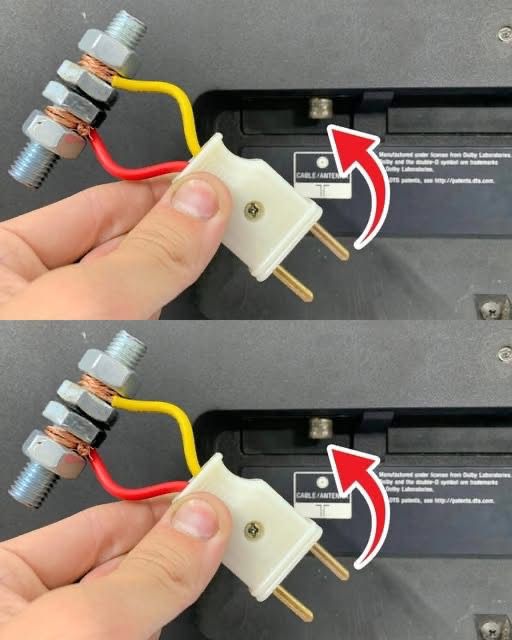
Say Goodbye To Antennas! The Secret To Watching All The TV Channels For Free With Screws!

What many people don’t realize is that over-the-air television remains fully active and completely legal. Local news, public broadcasting, weather, emergency alerts, and even major national networks still transmit signals that can be received without paying a cent. The only thing required is a compatible digital antenna. And contrary to popular belief, that antenna does not need to be expensive or store-bought.

As cable bills climb higher and streaming services quietly add new fees, many households are rediscovering a simple truth that once defined television: a surprising amount of content is still broadcast for free. Long before subscriptions, passwords, and monthly charges, local stations sent their signals straight through the air, available to anyone with the right equipment. That system never disappeared. It simply faded into the background as technology raced ahead.

With a basic understanding of how broadcast signals work and a few common materials, it’s possible to build a simple indoor antenna at home. This is not a loophole, a hack, or a way to bypass paid services. It’s a legitimate method of receiving publicly available broadcasts that stations are required by law to provide free of charge.

Over-the-air television operates on radio frequencies transmitted from local towers. These signals travel through the air and can be captured by metal elements designed to resonate at specific wavelengths. Commercial antennas are engineered versions of this concept, but the underlying principle is straightforward. Metal conducts electromagnetic signals, and when arranged correctly, it can receive them efficiently enough for a television to decode.

The Federal Communications Commission explicitly allows individuals to receive these broadcasts using any compatible antenna, including homemade ones. As long as the antenna is used solely to receive free-to-air signals and does not interfere with other communications or attempt to access encrypted or subscription-based content, it falls well within legal and regulatory boundaries.

The renewed interest in do-it-yourself antennas is partly driven by cost, but it’s also about control. Building your own antenna gives you a clearer understanding of what you’re receiving and why. It removes the mystery around “free TV” and replaces it with something tangible and transparent.

A basic indoor antenna can be constructed with a handful of easily accessible materials. A small wooden board serves as a base to hold everything steady. Several long metal screws act as the signal-receiving elements. A coaxial cable connects the antenna to your television, carrying the captured signal for decoding. Basic tools like a screwdriver, pliers, and tape or adhesive are used to assemble and secure the components.

The screws are arranged in a specific pattern, spaced evenly so they function as receiving arms for different signal wavelengths. The exposed wire from the coaxial cable is wrapped or fastened securely to the screws, allowing the metal to conduct the incoming signal into the cable. The other end of the cable plugs directly into the television’s antenna input.

Once assembled, the antenna is placed near a window or higher location inside the home, ideally facing the direction of local broadcast towers. Televisions are then set to scan for channels, a built-in function that detects available over-the-air broadcasts. In many areas, this can result in access to dozens of channels, including local affiliates of major networks, public broadcasting stations, and regional programming.

Results vary based on geography, distance from towers, building materials, and interference, but many users are surprised by how effective even simple designs can be. Some experiment with minor adjustments, such as repositioning the antenna, altering screw spacing, or adding reflective materials like aluminum foil behind the setup to enhance signal directionality. These tweaks are optional and purely experimental, allowing users to fine-tune reception based on their environment.

What’s important to understand is that this approach doesn’t replace streaming services entirely, nor does it attempt to. It fills a specific gap: access to live, local, free content that people often assume is locked behind paywalls. Emergency alerts, live sports broadcasts on major networks, local weather coverage, and community programming remain widely available through over-the-air transmission.

There’s also an educational aspect to building your own antenna. It demystifies modern technology by revealing how much of it still relies on fundamental physical principles. In a world dominated by software and subscriptions, interacting directly with hardware can feel surprisingly empowering. It reminds people that not everything valuable requires ongoing payment or corporate mediation.

For households looking to cut costs, supplement existing services, or maintain access to information during internet outages, a DIY antenna offers a practical solution. During severe weather or emergencies, when cable or broadband services fail, over-the-air broadcasts often remain operational. That reliability is one of the reasons governments continue to require stations to maintain free public access.

It’s worth noting that this method is intended for personal, educational, and household use. It is not designed for redistribution, commercial exploitation, or interference with broadcast systems. Responsible use ensures that the system continues to function as intended for everyone.

The resurgence of interest in over-the-air television reflects a broader shift in how people think about media consumption. As costs rise and options fragment, many are reevaluating what they truly need versus what they’ve been conditioned to pay for. Free broadcasts, once taken for granted, are being rediscovered as a reliable, lawful, and often overlooked resource.

Building a simple antenna doesn’t require advanced technical skill, only patience and curiosity. It’s a reminder that sometimes, solutions to modern frustrations aren’t hidden behind secret tricks or complicated workarounds. They’re rooted in systems that have existed all along, quietly doing their job while attention drifted elsewhere.

In an era of endless subscriptions, rediscovering free over-the-air television isn’t about rejecting technology. It’s about using it wisely. And sometimes, all it takes is a few screws, a cable, and the willingness to look beyond the assumption that everything worth watching must come with a monthly bill.