What This Farmer Wrote in the Fresh Snow Turned Heads!

In the heart of South Dakota, where the horizon stretches into an endless canvas of prairie and sky, the arrival of winter usually signals a period of quiet hibernation for the region’s agricultural hubs. However, for the Prunty family, a ten-inch blanket of fresh snow was not an obstacle to be cleared, but an opportunity to share a bit of rural magic with the rest of the world. Prunty Farms, a sprawling fifth-generation operation that has weathered over a century of changing seasons, recently became the center of a global viral sensation. They achieved this not through a traditional harvest, but by using a two-ton tractor as a paintbrush and an expansive, snow-covered field as their easel.

The project, which the family aptly titled “Deere Tracks,” began on a crisp morning when the air was still and the snow lay undisturbed across the acreage. Dan Prunty, a veteran farmer whose hands are more accustomed to the grit of soil and the grease of machinery than the delicate strokes of calligraphy, climbed into the cab of his trusty John Deere 6400. To the casual observer, it might have looked like a routine chore, but Dan had a different objective in mind. Guided by a vision of holiday cheer and a surprising amount of artistic finesse, he began to navigate the tractor through the deep powder, carving out massive, flowing cursive letters that eventually spelled out “Merry Christmas” across the frozen landscape.

The sheer scale of the undertaking was immense. Writing in cursive is a challenge for many with a pen and paper; doing so with a massive piece of agricultural machinery requires a level of spatial awareness and precision that few possess. There was no room for a rough draft or an eraser; a single wrong turn would leave a permanent scar in the pristine snow, ruining the symmetry of the message. Dan had to maintain a steady speed and a perfect turning radius to ensure that the “M” flowed seamlessly into the “e,” and that the loops of the “r”s were consistent and legible from the sky.

Capturing this fleeting moment of seasonal art fell to Dan’s son, Adam Prunty. For several years, Adam has acted as the digital storyteller of the family farm, using drone technology to document the day-to-day realities of rural life. He recognized that while his father’s work was impressive from the ground, the true beauty of the message could only be appreciated from an aerial perspective. As Dan maneuvered the tractor through the field, Adam piloted a drone high above, filming the process in high definition. The resulting footage is a mesmerizing blend of power and grace, showing the bright green tractor looking like a small toy as it etches deep, dark lines into the brilliant white crust of the earth.

The process behind “Deere Tracks” was surprisingly organic. Adam later explained that the entire message was executed freehand. There were no GPS coordinates fed into an automated steering system and no markers placed in the snow to guide the path. Before the cameras rolled, Adam had practiced the route himself, walking the curves and loops to visualize the spacing. Once they were ready, Dan took the wheel, relying on his decades of experience behind the controls of the 6400 to bring the vision to life. The result was a stunning display of “tractor snow art,” a medium that few knew existed until the Pruntys shared their work online.

The video quickly transcended the boundaries of South Dakota, racking up millions of views and sparking conversations about the intersection of tradition and modern technology. For many viewers, the footage offered a nostalgic look at the resilience and creativity of the American farmer. In an era where large-scale agriculture is often viewed through the lens of industrial efficiency, “Deere Tracks” reminded people that the heart of a farm is still the family that tends to it. It showcased a father and son collaborating not for profit or production, but for the simple, altruistic goal of spreading a little bit of joy during the holiday season.

Beyond the aesthetics, the project highlights a significant shift in how modern farming is perceived. By incorporating drone footage and social media into their legacy, the Pruntys are effectively bridging the gap between the heritage of the past and the possibilities of the future. Fifth-generation farms like theirs are rare, surviving through a mixture of stubborn perseverance and a willingness to adapt. Adam’s hobby of documenting the farm provides a window into a world that many city-dwellers rarely see, humanizing the industry and showing that even the most traditional of occupations can embrace innovation.

The “Deere Tracks” message was, by its very nature, temporary. A strong wind or the next flurry of snow would inevitably soften the edges of the cursive and eventually erase the greeting entirely. Yet, the impact of the gesture has proven to be far more durable. In the comments sections of the video, people from different cultures and backgrounds found common ground in the beauty of the South Dakota winter. The message resonated because it was a labor of love—a gift from a family who knows the value of hard work and the importance of taking a moment to celebrate the season.

As the tractor finally completed the final “s” in “Christmas” and headed back toward the barn, the drone captured the full scale of the achievement. The words spanned hundreds of feet, a giant, snowy card addressed to the world. It was a powerful testament to the fact that creativity is not confined to galleries or studios. Sometimes, it is found in the middle of a frozen field, powered by diesel and driven by a man who wanted to send a message from his home to yours. Prunty Farms may produce corn and cattle most of the year, but on that quiet December morning, their most important harvest was the smiles of millions of people who saw a little bit of hope etched in the South Dakota snow.


SHE WAS THE MOST BEAUTIFUL GIRL IN THE WHOLE USa!

In the pantheon of television history, few faces have shimmered with as much radiant promise as that of Heather Locklear. For decades, she was the golden girl of the American small screen, a performer whose presence could transform a fledgling soap opera into a cultural juggernaut. With her sun-kissed blonde hair, piercing blue eyes, and a smile that seemed to capture the very essence of California light, she was more than just an actress; she was a visual shorthand for the American dream. Yet, as the years have unfolded, the narrative of Heather Locklear has shifted from one of meteoric triumph to a complex, bittersweet saga of resilience in the face of immense personal shadows.

Born on September 25, 1961, in the sprawling heart of Los Angeles, Heather appeared to have the perfect pedigree for stardom. Her mother was a production executive, and her father, a disciplined Marine Corps colonel, provided a stable, structured environment. However, the internal life of the young Heather Locklear was a stark contrast to her burgeoning beauty. In interviews, she has often looked back at her teenage self with a surprising lack of vanity, describing an awkward girl struggling with self-esteem, acne, and the sting of rejection. The girl who would eventually become a worldwide beauty icon was once deemed too thin for the high school cheerleading squad, a minor rejection that left a lasting imprint on her psyche.

 Scrapbooking supplies

Worse than the social stings of adolescence were the profound tragedies that struck the Locklear household. At just sixteen, Heather navigated the harrowing loss of her uncle to suicide. A decade later, the cycle of grief repeated when her twenty-seven-year-old cousin also took his own life. These events introduced a somber reality to her life long before the pressures of Hollywood took hold, perhaps creating a foundational vulnerability that would later be tested by the relentless scrutiny of fame.

That fame arrived with the force of a tidal wave in the 1980s. Heather’s breakthrough as Sammy Jo Dean Carrington on the hit series “Dynasty” turned her into an overnight sensation. She possessed a rare alchemy of sweetness and steel that producers couldn’t resist. When Aaron Spelling cast her in “Melrose Place” to save the show from sagging ratings, she earned the nickname “The Merch,” a testament to her ability to sell a story and captivate an audience. She became the definitive face of the 1990s, a six-time Golden Globe nominee who seemed to have the world at her feet.

However, the glittering spotlight of the Los Angeles social scene brought its own set of complications. Heather’s romantic life became a fixture of tabloid fascination, a whirlwind of high-profile suitors ranging from Tom Cruise to Mark Harmon. But it was her penchant for the “bad boys” of rock and roll that would truly define her public image. In 1986, she married Mötley Crüe drummer Tommy Lee. It was a collision of worlds—the polished television princess and the anarchic rock star. While their chemistry was undeniable, the chaotic lifestyle of a heavy metal touring circuit eventually eroded the foundation of their marriage, leading to their divorce in 1993.

A year later, she sought a more grounded connection with Bon Jovi guitarist Richie Sambora. For a time, it appeared Heather had finally found the equilibrium she craved. They welcomed their daughter, Ava, in 1997, and the family became a symbol of Hollywood domesticity. Yet, even this seemingly stable union was not immune to the pressures of life in the public eye. By 2006, after twelve years of marriage, the couple filed for divorce amidst rumors of infidelity and differing visions for their future.

The dissolution of her second marriage seemed to act as a catalyst for a harrowing downward spiral. The woman who had once been the picture of poise began to struggle openly. Reports of substance abuse and erratic behavior started to circulate with alarming frequency. In 2008, the world watched in concern as news broke of a 911 call suggesting Heather was a danger to herself. While her representatives worked to manage the narrative, it became clear that the actress was locked in a fierce battle with anxiety and clinical depression.

The decade that followed was a grueling cycle of public incidents and private pain. There were multiple arrests for domestic disputes and altercations with first responders—episodes that highlighted the raw, unpolished reality of addiction and mental health struggles. Through it all, the bond with her former husband Richie Sambora remained a rare constant; he often stepped in to fund long-term treatment and provide the specialized care she needed to find her footing. The tabloids, once her greatest champions, became a cruel ledger of her lowest moments, documenting every stumble with predatory precision.

In recent years, however, a new chapter has begun to emerge—one characterized by a quiet, persistent resilience. There have been long stretches of sobriety and stability, moments where the old Heather, vibrant and focused, seemed to return to the light. These periods of recovery are a testament to her inherent strength and the discipline instilled in her by her father. Even when troubling images surfaced in 2023, sparking fresh waves of concern among her dedicated fanbase, the overwhelming sentiment was one of hope rather than judgment.

Heather Locklear’s legacy is not merely a collection of television credits or a gallery of beautiful photographs. It is the story of a human being who lived out the most difficult moments of her life in a glass house and refused to stay shattered. She represents the millions of people who struggle with “invisible” illnesses—depression, anxiety, and addiction—proving that these battles do not discriminate based on fame or fortune. Her journey is a poignant reminder that beauty is often a mask for profound complexity, and that the path to healing is rarely a straight line.

As we look at her life today, we see a woman who has survived the highest peaks of adulation and the deepest valleys of despair. Her fans continue to root for her, not just because they remember the girl on the posters, but because they respect the woman who keeps getting back up. Heather Locklear remains a beloved icon, an all-American girl who grew into a woman of substance through the fire of experience. Her story continues to serve as an inspiration to anyone facing their own shadows, reminding us that no matter how dark the night, the potential for a new dawn is always present. We celebrate her talent and her tenacity, sending her the best wishes as she continues to write a story of recovery, grace, and enduring hope.

I Raised My Best Friends Children, Years Later, a Hidden Truth Came to Light!

I had always believed that the measure of a person’s life could be found in the promises they kept. For me, that promise was etched into the quiet, sterilized air of a hospice room where my best friend, Rachel, spent her final days. We had been inseparable since the third grade, moving through life in a synchronized dance of shared classrooms, first heartbreaks, and the chaotic joy of motherhood. When Rachel lost her husband to a sudden accident and was subsequently diagnosed with a terminal illness, the world felt as though it were collapsing. In those final, whispered conversations, she gripped my hand with a strength that defied her frailty and made me swear that her four children would never be separated. I gave her my word without a second of hesitation. To me, it wasn’t just an obligation; it was the ultimate act of love for the sister I had chosen.

When the funeral ended and the casseroles stopped arriving, my husband and I folded Rachel’s four children into our own family of two. Our modest house suddenly groaned under the weight of six children, but over the years, the sharp edges of grief were worn smooth by the relentless march of routine. The tears at bedtime eventually turned into laughter over burnt pancakes, and the sprawling chaos of school schedules and soccer practices became our new normal. I took pride in the fact that we had built a fortress of stability. I thought I knew every corner of Rachel’s heart, and I believed our family was built on a foundation of absolute truth.

That belief shattered on a Tuesday afternoon, ten years after Rachel had passed.

The woman standing on my porch was around my age, dressed in a sharp coat that looked out of place in our suburban driveway. She looked exhausted, her eyes rimmed with a redness that suggested she had been rehearsing this moment for a very long time. When she handed me a thick, cream-colored envelope, I recognized the handwriting instantly. It was Rachel’s—the familiar, loopy cursive that had once filled my birthday cards and grocery lists.

I retreated to the kitchen, my heart thumping against my ribs like a trapped bird. As I unfolded the letter, the room seemed to grow cold. Rachel’s voice poured off the page, desperate and confiding. She confessed that Leo, the youngest of the four children I was currently raising, was not biologically hers. Years earlier, a woman Rachel worked with had found herself in a desperate situation, overwhelmed by a life that was falling apart and unable to care for a newborn. Rachel, whose heart had always been too big for her own good, had agreed to take the baby in and raise him as her own, bypassing the formal channels to protect the biological mother from the judgment of her family.

The letter detailed a pact: Rachel had promised that if the mother ever found her footing and could provide a stable life, they would “revisit the arrangement.” Rachel had written the letter just before she died, intending to give it to me, but she had ultimately hidden it away, perhaps paralyzed by the fear that I would refuse to take Leo if I knew the truth, or that the siblings would be torn apart.

The woman on my porch, whose name was Sarah, spoke with a voice that trembled but held a terrifying resolve. She told me about a decade of recovery, of a life painstakingly rebuilt from the ashes of addiction and poverty. She spoke of the hollow ache that had followed her every day since she handed her baby to Rachel. She told me she was ready now. She wanted her son back.

I looked past her, through the window to the backyard where Leo was currently wrestling with his older brother in the grass. I saw the way he laughed—that deep, belly-shaking sound that filled our house with light. I thought of the night terrors I had soothed, the math homework we had puzzled over together, and the way he reached for my hand whenever he felt unsure. To Sarah, Leo was a possibility, a chance at redemption for a past mistake. To me, Leo was the boy whose favorite color was orange, who hated peas, and who had been my son in every way that mattered for ten years.

“I understand your pain,” I told her, my voice surprising me with its steadiness. “And I can’t imagine the strength it took to get where you are today. But Rachel’s promise wasn’t the only one made. For ten years, I have been the one to kiss his scraped knees. I am the only mother he remembers. Biology is a fact, Sarah, but it isn’t a family. Leo is legally my son through the adoption we finalized after Rachel’s death, and more importantly, he is part of a pack of siblings who are his entire world.”

The conversation that followed was agonizing. Sarah spoke of legal rights and the “truth” that Leo deserved to know. I spoke of psychological stability and the cruelty of uprooting a child from the only home he had ever known. When she finally left, she left a warning—a threat of lawyers and courtrooms that lingered in the air like a coming storm.

That night, after the house had finally gone quiet, I sat at the kitchen table with Rachel’s letter. I felt a surge of anger toward my friend for leaving me with such a jagged secret, for the burden of a choice she should have made while she was still alive. But as the anger subsided, I realized that Rachel had been acting out of the same fierce, protective instinct that was currently surging through me. She had been a woman trying to navigate an impossible situation with the only tool she had: love.

I realized then that some truths arrive late not to destroy us, but to test what we are made of. Rachel’s hidden truth didn’t change the last ten years. It didn’t change the fact that Leo’s siblings were his best friends, or that my husband was the man he looked to for guidance. Love is often a messy, complicated tapestry of mistakes and desperate choices, but the warmth it provides is real.

The legal battle that followed was long and draining, a series of cold rooms and clinical evaluations that threatened to pull our family apart at the seams. But through it all, we remained a united front. We eventually reached a mediation that allowed Leo to remain in our home while gradually being introduced to Sarah—not as a replacement mother, but as a part of his history that he had a right to understand when he was ready.

Standing in the hallway now, watching the children head off to school, I feel the weight of the burden I carry, but I also feel an immense, quiet certainty. Rachel gave me her children, and in doing so, she gave me a life I never expected. The truth didn’t rewrite our future; it only made the foundation of our family stronger. We are not bound by blood, but by the promises we keep and the fierce resolve to protect the home we built from the wreckage of the past.

I Paid for a Poor Mans Groceries – and Noticed He Was a Carbon Copy of My Late Husband!

I stopped believing in ghosts three years ago, the day my husband died. After fifty-five years of marriage, Edward was gone in a single afternoon. The doctor said his heart failed quickly, that he didn’t suffer. People said that like it was supposed to help. It didn’t. What it did was leave a silence so dense it felt physical, like living underwater.

I’m Dorothy. I’m seventy-eight. Widowhood stretches time in strange ways. Some days crawl. Others vanish. You forget meals. You forget dates. You forget why you walked into a room. But you never forget the shape of the person you loved.

Edward had habits that drove me mad. Socks on the bathroom floor. Long silences during arguments. Opinions about everything from politics to lawn care. And yet, I loved him with a devotion so deep it felt permanent. I believed our life together was solid, complete, finished exactly as it was meant to be.

That belief shattered in the produce aisle of a grocery store on a bitter January morning.

I hadn’t gone shopping in too long. The refrigerator was bare except for condiments and expired milk. I grabbed a cart and moved slowly, my joints stiff, my mind elsewhere. That’s when I heard a man’s voice—strained, gentle, trying not to break.

“I promise, Mark,” he said softly. “Daddy will get you something special next time.”

A child’s voice answered, thin with tears. “You said Mommy would come back. How long is she with the angel?”

My hands froze on the cart handle. Grief recognizes grief instantly. I turned the corner and saw him kneeling on the linoleum floor in front of three children—two boys and a little girl. He pulled the youngest close, murmuring reassurances that sounded practiced, exhausted, sincere.

Then he stood.

And my heart stopped.

The jaw. The eyes. The posture. Even the way his mouth set when he listened. It was Edward. Not similar. Not reminiscent. Identical.

I told myself it was shock. Loneliness. A trick of grief. But then he turned fully toward the light, and I saw it—the small birthmark above his lip. The one I had kissed for decades. The one I would have recognized anywhere.

I should have walked away. Instead, I followed.

I trailed them through the aisles, pretending to shop, watching the way he spoke to his children, the way they leaned toward him instinctively. At the checkout, the cashier totaled the bill. Milk, pasta, cereal. Nothing indulgent.

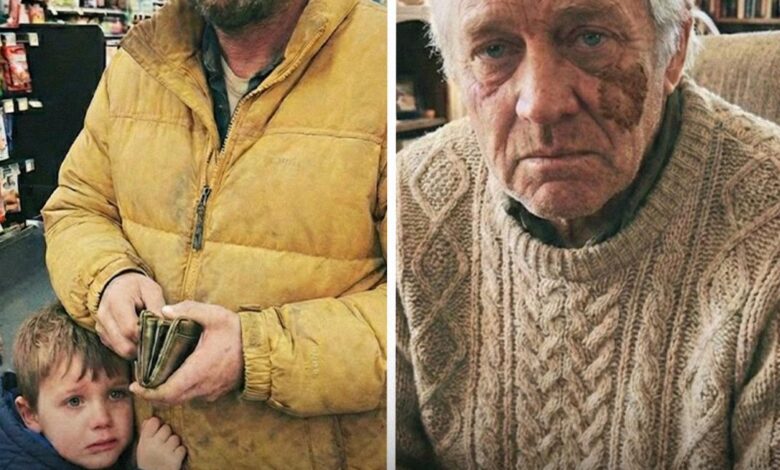
The man counted bills, his face falling. “I’m five dollars short,” he said quietly. “Could you take off the milk?”

Before I could think, I stepped forward and paid. He thanked me, introduced himself as Charles, concern flickering across his face when he noticed how pale I’d gone. I barely heard him. All I could see was that face. That mark.

He left with his children, and I stood shaking while the cashier waited.

That night, I pulled out photo albums I hadn’t opened since Edward’s funeral. I traced the familiar lines of his face. The birthmark. The smile. I didn’t sleep.

The next morning, I went looking.

I found Charles getting off a bus a few streets from the store. I followed at a distance, hating myself, needing answers. He lived in a small, worn house behind a chain-link fence. After sitting in my car far too long, I knocked.

He recognized me instantly. When I blurted out that he looked exactly like my husband and showed him Edward’s photograph, the color drained from his face.

“I think you should come inside,” he said.

The house was modest but clean. Children’s drawings covered the refrigerator. Toys lined the hallway. He sent the kids to their room and sat across from me, staring at Edward’s photograph like it might burn him.

“This man,” he said slowly, “ruined my mother’s life.”

Her name was Lillian. She met Edward years before I knew him. He never told her he was married. When she became pregnant, she believed he would leave me. He didn’t. Instead, he paid her to stay quiet. Sometimes he spoke to Charles. Sometimes he argued with Lillian outside his workplace. When Charles was sixteen, his mother told him Edward was his father—and that I was the reason he never had a real family.

I couldn’t breathe. I had lived a lie without knowing it. Edward had lived two lives. I had loved a man capable of abandoning a child and lying to me for decades.

“I never knew,” I whispered. And I meant it.

Charles believed me. He said his mother’s bitterness colored many things. He’d always suspected the truth was uglier and more complicated.

We sat in silence, grief folding in on itself. Finally, he stood and said we could return to our lives. That I owed him nothing.

But I couldn’t do that.

My marriage was not what I thought it was. That hurt more than I could describe. But standing in that house, surrounded by proof of life continuing despite betrayal, I realized something else.

I didn’t want to be alone anymore.

I invited them to dinner. Sunday dinner. Something I’d kept cooking out of habit, serving to no one.

They came.

The children were shy at first. Charles barely spoke. But the house felt alive again. Loud. Messy. Human.

They came the next Sunday. And the next.

Edward is gone. His mistakes belong to him. But Charles and his children are here. So am I. And grief, I’ve learned, doesn’t end when truth arrives—but neither does the capacity to build something new from the wreckage.

Some losses don’t leave you empty. They leave you changed.

I returned from my deployment to find my 7-year-old daughter shut away in the garage, weak and covered in mosquito bites!

Staff Sergeant Daniel Burns pulled into the driveway of his Riverside home, the dry, biting dust of a fifteen-month deployment in Afghanistan still clinging to his uniform and his memories. He was thirty-two, but he felt a decade older, his body mapped with the invisible scars of Army intelligence work. Throughout the long, sweltering nights overseas, one thought had acted as his North Star: his seven-year-old daughter, Emma. He had noticed a growing coldness in his wife Mara’s voice during their recent video calls, but he had dismissed it as the weary resentment of a woman raising a child alone.

The moment Daniel stepped out of his truck, the professional instincts he had honed in combat zones screamed a warning. The lawn was a graveyard of tall weeds and yellowed newspapers. Emma’s bicycle, once her most cherished possession, lay abandoned in the dirt, its chrome handlebars beginning to pit with rust.

He didn’t knock as a guest; he used his key, but the click of the tumbler felt like a tripwire. Inside, the house was a hollowed-out version of the home he remembered. The air was thick with the acrid stench of cigarettes and stale beer. “Mara? Emma?” his voice boomed, trained to carry across chaotic battlefields, but here it only met an eerie, suffocating silence.

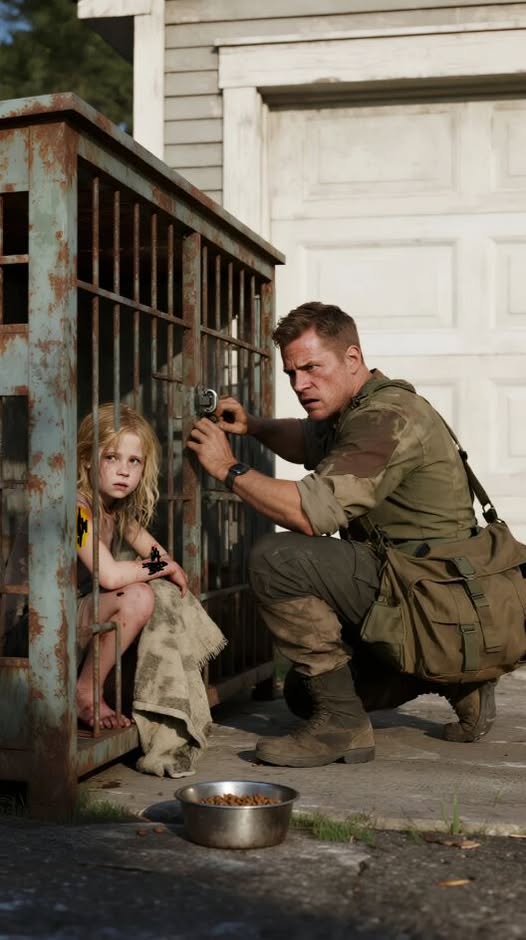
A faint, rhythmic whimpering drifted from the backyard. Daniel followed the sound, his boots crunching on the neglected floorboards. When he stepped onto the porch, his blood turned to ice. Tucked behind the garage in the oppressive heat sat a rusted, heavy-gauge dog kennel. Inside, curled on a filthy, threadbare blanket, was Emma.

She was skeletal, her vibrant blonde hair matted into a single, dirty knot. Her skin was a mosaic of angry red mosquito bites and fading yellowish bruises. Beside her sat a metal bowl containing the dried, crusty remnants of cheap dog food.

“Daddy?” The voice was a ghost of a sound. When she looked up, her eyes were hollow, reflecting a trauma that no seven-year-old should ever comprehend.

Daniel’s hands shook with a terrifying, primal rage as he fumbled with the kennel’s lock. “I’m here, baby. Daddy’s got you.” As he lifted her, he was horrified by how light she was—she felt like a bundle of dry sticks.

“Mom’s boyfriend, Wayne, said this is where bad girls belong,” she whispered into his neck, her small frame shivering despite the California heat. “He made me eat from the bowl when I cried for you.”

In that moment, the rage in Daniel crystallized into a cold, lethal clarity. His military training overrode his grief: secure the victim, gather intelligence, eliminate the threat. He learned that Mara was out with Wayne, leaving the child in a cage. Daniel didn’t wait. He called Miguel Alexander, a former Navy corpsman, who arrived within minutes to provide emergency medical care. Miguel’s face went pale as he assessed the dehydration and the clear signs of physical restraint.

Knowing the local system could be slow or compromised, Daniel reached out to an old contact, Colonel Eleanor Bernett of the Criminal Investigation Division. He needed resources, but he needed them handled with the precision of a black-ops mission.

While Emma was whisked away to a secure medical facility, Daniel began his own reconnaissance. He sat in his truck that night, watching through a night-vision scope as a beat-up Camaro pulled into his driveway. Wayne Finley stumbled out—a man whose body was a roadmap of prison ink and whose eyes carried the predatory glint of a sociopath. Mara followed, stumbling and intoxicated. Daniel watched them enter his home, his finger hovering near a trigger, but he held back. He didn’t just want Wayne behind bars; he wanted to know how deep the rot went.

Over the next three days, Daniel operated as a ghost. Using his intelligence background and a few “off-the-books” favors from Detective Adrian Dodd, he uncovered a nightmare. Wayne Finley wasn’t just a local thug; he was the primary operator of a sophisticated network that targeted military wives during deployments. They used spouse support groups to find vulnerable women, isolated them through psychological manipulation, and then used the children as collateral for a variety of criminal enterprises—ranging from social security fraud to selling sensitive deployment data to foreign interests.

Daniel visited Emma at the hospital, where she flinched at every shadow. “Wayne said you didn’t want me,” she told him, her voice trembling. “He said that’s why you went away.” The psychological breaking of his daughter was a calculated tactic, part of a “textbook” isolation method used by the network to ensure the mothers stayed silent.

The mission changed from a rescue to a full-scale dismantling. Daniel listened through directional microphones as Wayne bragged to his associates at a local dive bar about “stashing military brats” in “rotation houses” to keep them away from CPS welfare checks. He heard Wayne laugh about the “accident” Emma might have if Daniel got too curious.

Daniel assembled a team of men who had nothing left to lose: Miguel, the corpsman; and Sergeant Major Damon Freeman, whose own son had vanished under similar circumstances. They were joined by Tammy, a mother whose children were currently being held in one of the network’s rural outposts.

The turning point came when Wayne, realizing the net was closing, made a final, desperate play. He appeared at the hospital, attempting to intimidate the staff into releasing Emma. He even left a note on Daniel’s door: 48 hours to stop, or she disappears permanently.

“They just made this a war,” Damon growled.

“It was always a war,” Daniel replied.

At 0200 hours, under the cover of a new moon, Daniel and a handpicked squad from Colonel Bernett’s special operations unit executed a synchronized strike on four properties simultaneously. They moved with the silent, deadly efficiency of men who were fighting for their own blood.

The main compound fell in minutes. Daniel himself breached the nerve center, securing the encrypted servers that held the network’s financial records and foreign intelligence contacts. Across the city, his teams reported in: “Farmhouse secured. Children recovered.” “Warehouse cleared.”

Seventeen children were rescued that night. The evidence seized was a death knell for the organization. It revealed a conspiracy that reached into the local judiciary and even the military’s family liaison office.

Six months later, Daniel stood in a federal courtroom, his hand on Emma’s shoulder. He watched as Wayne Finley was sentenced to life without parole, followed by the corrupt Judge Fernandez and the disgraced Captain who had sold out his fellow soldiers’ families.

Emma’s recovery would take years, but the light was returning to her eyes. She lived now in a world where the garage was just a place for her bike, and the backyard was a place for laughter. Daniel had returned from a war in a foreign land only to fight the most important battle of his life on his own doorstep. He had kept his promise: the bad men were gone, and for the first time in fifteen months, the Staff Sergeant finally felt he was truly home.