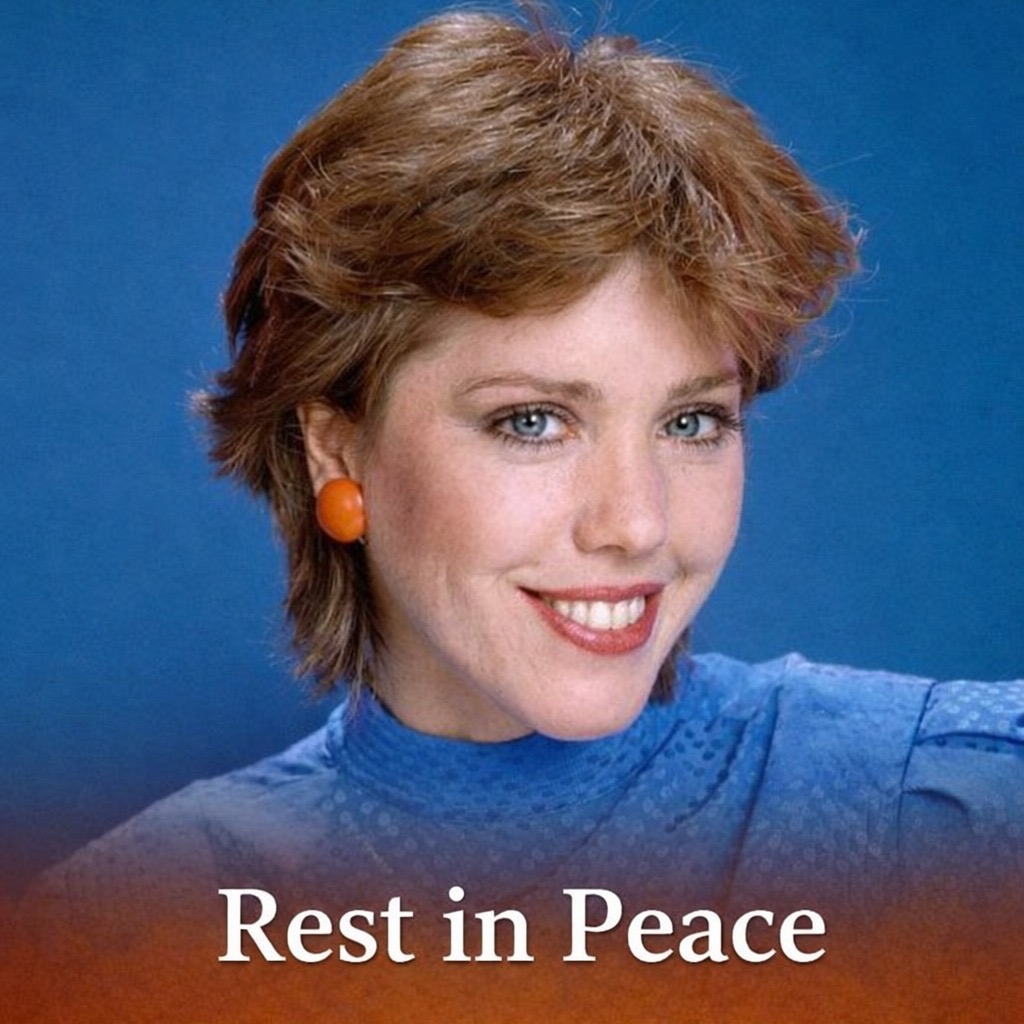
Beloved Heathers Star Passes Away at 77!

Penelope Milford, an Oscar-nominated actress whose quiet intensity left a lasting mark on film, theater, and audiences who valued subtlety over spectacle, has died at the age of 77. Her death was confirmed by family members, who said she passed away on October 14 while living in a rehabilitation facility in Kingston, New York, where she had been recovering from injuries sustained in a car accident earlier this year.

Milford’s sister, Candace Saint, and brother, Douglas Milford, said the accident occurred in July and required extended care. Though she had been making progress, her health ultimately declined. Her passing closes the chapter on a career defined not by constant visibility, but by depth, discipline, and a devotion to craft that never wavered.

Born in St. Louis, Missouri, Milford came of age far from Hollywood’s center but carried with her an early sense of curiosity and seriousness about performance. She attended New Trier High School in Illinois, an institution known for producing artists across disciplines. After graduating, she moved to New York City, where she immersed herself in the study of acting at the American Place Theatre, a creative incubator that emphasized character work, emotional truth, and experimental storytelling.

Her earliest film appearance came in 1970, when she worked as an extra in Maidstone. It was a modest beginning, but one that placed her in the orbit of independent cinema at a time when the boundaries between stage and screen were fluid. Rather than chasing immediate stardom, Milford focused on building a foundation in theater, where her work quickly gained respect.

Throughout the 1970s, she became a familiar presence on New York stages, performing in off-Broadway and Broadway productions that demanded emotional range and stamina. Her work in plays such as Lenny and Shenandoah demonstrated her ability to inhabit complex roles without exaggeration. Colleagues from that period often described her as meticulous, reserved, and deeply committed to rehearsal, someone who listened as much as she spoke.

Her transition to more prominent film roles came naturally. Milford appeared in Valentino, followed by performances in Endless Love and other notable projects. But it was her role in Coming Home that would define her legacy in cinema.

In that film, Milford delivered a performance marked by restraint and emotional clarity, standing out in a cast that included some of the era’s most celebrated actors. Her portrayal earned her an Academy Award nomination for Best Supporting Actress, a recognition that acknowledged her ability to convey vulnerability and strength without drawing attention to the mechanics of performance. She did not dominate the screen; she anchored it.

Despite the nomination, Milford never pursued the kind of visibility that often follows such acclaim. She continued to choose roles selectively, appearing in films that interested her artistically rather than those guaranteed to raise her profile. One of those films was the cult classic Heathers, where she played a supporting role that resonated with audiences decades later. Though the film became a pop-culture touchstone, Milford remained largely outside the spotlight, content to let the work speak for itself.

By the mid-1980s, she began to step away from acting as her primary focus. In Los Angeles, she opened and ran an art gallery, immersing herself in the visual arts and supporting emerging artists. Friends recall that this period brought her a different kind of fulfillment—one rooted in curation, mentorship, and quiet observation rather than performance.

She also taught acting, passing on her philosophy to younger performers. Her teaching style was described as direct and unsentimental. She emphasized preparation, honesty, and respect for the material, discouraging shortcuts and superficiality. For students, her guidance carried weight precisely because it came from someone who had navigated both success and obscurity without becoming bitter about either.

Later in life, Milford returned to New York State, settling in Saugerties. There, she undertook the restoration of a historic home, a project that mirrored her approach to acting: patient, detail-oriented, and grounded in respect for what already existed. Those close to her said she found peace in that work, enjoying the balance of solitude and purpose.

Milford’s personal life was private by design. She was briefly married to poet Michael Lally, a relationship rooted in shared artistic values, though the marriage did not last. She did not remarry and had no children, but maintained close relationships with her siblings and extended family.

She is survived by her brother, Douglas Milford, her sister, Candace Saint, and three nieces and nephews. In their statements, family members emphasized her independence, her intelligence, and her refusal to define herself solely by professional achievements.

In an industry that often rewards volume over substance, Penelope Milford built a career on the opposite principle. She did not chase constant relevance. She did not reinvent herself for trends. She worked when the work mattered to her and stepped back when it didn’t. As a result, her performances have aged well, retaining their emotional precision long after flashier roles have faded.

Her death prompted quiet reflection among those who knew her work best. Not the loud mourning reserved for megastars, but the deeper recognition that comes when a steady presence is suddenly gone. Milford belonged to a generation of performers who believed that acting was not about being seen, but about seeing—understanding people well enough to represent them honestly.

Penelope Milford leaves behind a body of work that rewards revisiting. Her performances do not demand attention; they earn it. And in that way, her legacy endures not through constant remembrance, but through moments of recognition when audiences realize how much she contributed, often without asking for credit.

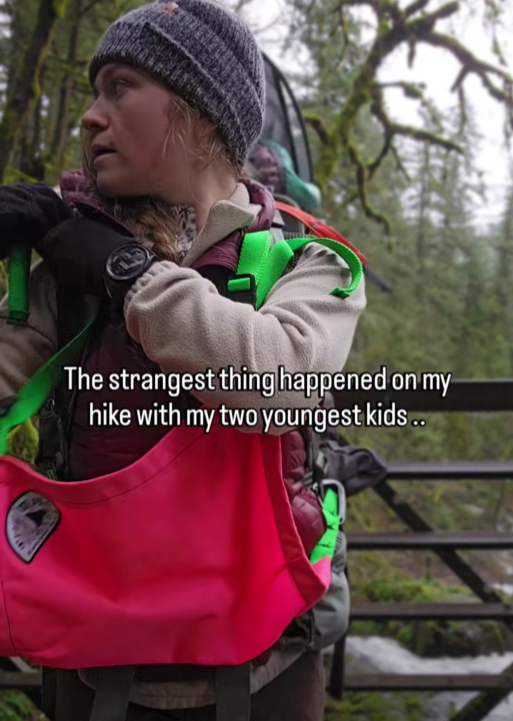
“I Took My Two Youngest on a Hike — What Happened Next Still Gives Me Chills”

What began as a peaceful family hike through the forest turned into one of those moments you can’t stop replaying in your head. The kind that doesn’t explode with drama, but settles quietly into your memory — unsettling, strange, and impossible to fully explain.

The image shows a parent mid-hike, bundled up against the cold, a child secured closely in a carrier, another tucked safely behind. Moss-covered trees frame the path, and a wooden bridge stretches over rushing water. It looks like a scene straight out of a nature magazine — calm, grounded, and wholesome. But the caption tells a different story: “The strangest thing happened on my hike with my two youngest kids…”

That sentence alone is enough to make anyone lean in.

According to the story shared with the image, the hike was supposed to be simple. Fresh air. Movement. Let the kids nap while being carried. A chance to reset. Parents who hike with young children know the rhythm — constant awareness, frequent pauses, listening for every sound, always scanning your surroundings.

And that’s when it happened.

Somewhere along the trail, something felt… off. Not loud. Not threatening. Just different. The parent describes a sudden awareness — the kind where your body reacts before your mind does. A pause. A glance over the shoulder. The instinctive tightening of your hold on your child.

Nothing obvious was wrong. No one else on the trail. No sudden noise. But the feeling didn’t go away.

Many parents reading this immediately understood. When you’re responsible for small children, your senses sharpen. You notice changes in sound, movement, even silence. And sometimes, you can’t explain why something feels wrong — only that it does.

As the hike continued, the parent noticed subtle details that hadn’t registered before. The forest seemed quieter. The usual background sounds faded. Even the kids, normally restless, were unusually still. That calm, instead of being reassuring, added to the unease.

The moment didn’t end in danger. There was no dramatic confrontation or clear explanation. Eventually, the feeling passed, and the family made it home safely. But that’s what made it linger. There was no closure. No answer. Just a shared experience that couldn’t be fully explained.

Online reactions to the story were immediate and intense. Many shared similar experiences — moments in nature where everything looked normal, but something felt deeply wrong. Others described it as instinct, intuition, or the body’s ancient warning system kicking in.

Psychologists note that humans are wired to detect subtle environmental changes, especially when protecting children. A shift in sound patterns, light, or movement can trigger an unconscious alert. It doesn’t always mean danger was present — but it does mean awareness was heightened.

For this parent, the experience changed how they hike. More frequent check-ins. More trust in intuition. More willingness to turn back early if something doesn’t feel right.

And maybe that’s the quiet lesson here.

Not every strange moment needs a dramatic ending to matter. Some experiences stay with us because they remind us how deeply connected we are to our surroundings — and how powerful instinct becomes when we’re protecting the people we love most.

The forest returned to normal. Life moved on. But that hike? That feeling? It stayed.

Sometimes, the strangest things aren’t what happen — they’re what you feel… and can never fully explain.

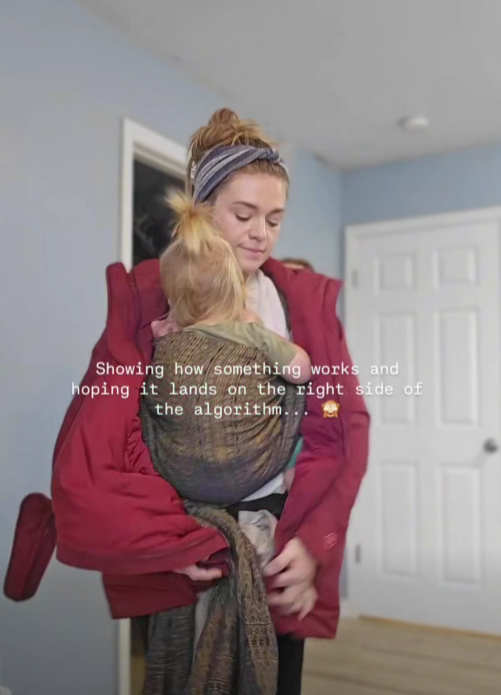
“She Just Wanted to Explain This — But the Algorithm Had Other Plans”

At first glance, the moment looks simple, calm, and deeply personal. A young mother stands in a softly lit room, gently adjusting a baby carrier while her child rests peacefully against her chest. No drama. No chaos. Just quiet care. But the text overlaid on the image tells a very modern story: “Showing how something works and hoping it lands on the right side of the algorithm.”

That single sentence is why this moment resonated so widely.

In today’s world, even the most ordinary, human experiences are filtered through invisible systems that decide what gets seen — and what disappears. This mother isn’t just demonstrating how to use a baby carrier. She’s navigating a digital landscape where education, parenting, and authenticity must somehow align with platform rules, engagement metrics, and algorithmic preference.

Many parents immediately recognized the struggle. Social platforms have become one of the main ways caregivers share tips, support each other, and normalize the realities of parenting. But creators often find themselves walking a tightrope — trying to teach something useful while avoiding being flagged, buried, or misunderstood by automated systems.

The image captures that tension perfectly. The baby is secure, close, and calm. The mother’s expression is focused and gentle. There is nothing controversial here. And yet, the caption hints at a quiet anxiety: Will this be allowed? Will this be shown? Will it reach the people who need it?

For many parenting creators, especially mothers, this has become routine. Videos explaining feeding, soothing, babywearing, or postpartum recovery are often shadowed, restricted, or miscategorized — not because they’re harmful, but because algorithms struggle to understand context. What is care can be misread as something else. What is education can be buried as “low engagement.”

Viewers praised the image for how real it feels. No studio lighting. No perfect aesthetic. Just a lived-in room, a jacket still on, and a baby held close. It reflects the reality of parenting — learning as you go, adjusting constantly, and doing your best with what you have.

The phrase “hoping it lands on the right side of the algorithm” struck a nerve because it applies far beyond parenting. Teachers, small business owners, artists, and everyday people all feel it. You can do everything right — be kind, be informative, be authentic — and still be invisible.

At the same time, many commenters saw quiet resistance in the image. By posting anyway, by explaining anyway, the mother is choosing to share knowledge regardless of the system’s unpredictability. It’s a reminder that behind every piece of content is a real person, not just a data point.

There’s also something powerful about the physical closeness shown. In a digital world obsessed with reach and numbers, the most meaningful connection in the frame is happening offline — a baby held securely, regulated by warmth and movement, completely unaware of algorithms or platforms.

That contrast may be why the image lingered with people. The algorithm decides who sees the post. But love, care, and learning happen regardless of whether the video goes viral.

In the end, this isn’t just a post about babywearing. It’s about modern life. About trying to share something good in a system that doesn’t always reward goodness. About hoping that clarity, care, and honesty still have a place online.

And maybe that’s the quiet message behind the image: even if the algorithm doesn’t get it — the people who matter will.

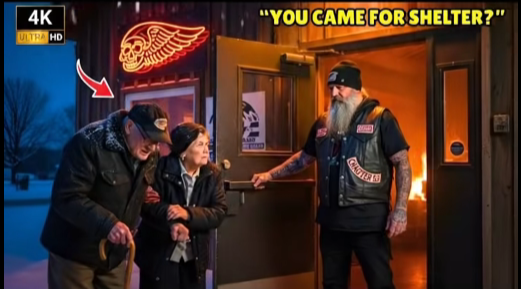
“We Can’t Walk Anymore, Can We Stay One Night?” Old Couple Said–What Hells Angels Did is Speechless

The mountain road stretched empty under a sky painted in fading gold. The last light of day brushing the snowy peaks. Down below the small town of Ridge Point glowed faintly, a handful of homes on gas station and a neon sign flickering outside a biker clubhouse called the Iron Haven.

 Inside, laughter mixed with the crackle of old vinyl rock. But outside on that lonely stretch of road, an elderly couple moved slowly through the dusk, their hands clasped tightly together. Before we start this story, tell me where in the world are you watching from? We love seeing how far these stories travel. And if you enjoy our stories, please consider subscribing to our channel and don’t forget to hit the hype button.

 Henry and Marjorie Whitlock had been walking for miles. Their old pickup had died 10 miles back, and with no cell signal, they’ chosen to walk toward the faint hum of distant engines. Marjgerie’s breathing had grown shallow, her lips pale. Henry’s walking stick sank deep into the gravel with every step. “Just a little further, sweetheart,” he whispered.

 “I see lights up ahead. By the time they reached the edge of town, the temperature had dropped sharply. The couple stopped outside the Iron Haven, the faint sound of laughter spilling into the cold air. Marjgerie leaned against the wall, whispering through trembling lips. “Henry, I don’t think I can walk anymore.

” He brushed snow from her shoulders and looked at the sign above the door. A skull wings and the words Hell’s Angels chapter 63. He hesitated. Then he knocked inside. The room fell silent. The kind of silence that carries weight. Boots stopped tapping. Pulcus froze mid-strike. The heavy door creaked open and the cold night poured in.

 Every head turned toward the doorway. And what they saw wasn’t a rival gang or trouble. It was an old man holding up a frail woman, both covered in frost. Henry’s voice was quiet but clear. We can’t walk anymore. Can we stay one night? For a moment, nobody spoke. Then Rex Dalton, the local chapter president, a mountain of a man with a gray beard and a heart that no one outside the club really knew, stood up slowly.

 His voice rumbled like thunder, softened by compassion. Get them by the fire, he said. Now, no one argued. Two bikers, Hawk and Trigger, moved fast, guiding the couple inside. The heat hit them like mercy itself. Marjgery’s legs buckled, but Hawk caught her gently, his tattooed arms surprisingly careful. Rex took one look at her blue lips and barked, “Blankets, hot tea now.

” Within seconds, the angels, men who the town whispered were outlaws, moved with military precision, wrapping the couple in warmth, setting a chair by the fire. Marjorie whispered, “We didn’t mean to intrude.” Rex crouched beside her, voice low and kind. “Ma’am, you’re not intruding. You’re home till morning.” As the fire roared higher, color returned to Marjgery’s face.

 She reached out to Henry, who hadn’t said much since they came in. His hands trembled as he clutched the mug hawk handed him. “You boys part of that biker gang folks talk about?” he asked with a faint smile. Rex grinned. “Depends who’s talking, sir.” “We call it family,” the room softened with laughter. One of the younger bikers, Diesel, knelt by the fire, rubbing his hands together.

 “Where were you two headed this late?” Henry looked into the flames. Our daughter’s place in Birch Valley. Haven’t seen her in 3 years. She called last week. Said she had a new baby. We were going to surprise her. His voice cracked, but the truck gave up halfway. Guess it wasn’t meant to be. The room went still again, but this time not from suspicion, from something deeper.

 Rex’s expression shifted. He nodded once to Trigger, who quietly stepped outside. Well, sir,” Rex, said, his voice steady. “Sounds to me like that trip ain’t over yet.” As the couple rested by the fire, the angels moved quietly in the background, fixing coffee, eating soup, draping extra coats over chairs. Jax, a tattooed biker with a soft spot for old country songs, tuned his guitar and began playing a slow tune.

 Marjorie’s eyes fluttered open at the sound, and for the first time all night, she smiled. Rex stood by the window, staring at the snow falling outside. His phone buzzed. Trigger’s voice came through the static. Trucks toast. Transmissions gone. But I got an idea, pres. Rex turned, glancing at the old couple asleep by the fire.

Yeah. We could take them ourselves. There was silence for a long moment. Rex looked at the patch on his vest, the same one that had earned him judgment his whole life, and then back at the frail faces before him. “How far is Birch Valley?” he asked. “80 mi,” Rex smirked. “Then we ride at sunrise. Morning came slow, quiet, and silver.

” Frost covered the bikes like armor, waiting for battle. When Henry opened his eyes, he saw men loading saddle bags with thermoses, blankets, and food. “What are you doing?” he asked, confused. Rex walked over, his leather jacket creaking, breath misting in theair. “We’re taking you home, sir.” Marjorie blinked.

 “Home? Your daughter’s place in Birch Valley,” Rex said. “We’ll make sure you get there safe. You two’ve done enough walking,” Henry tried to protest. We can’t ask you to. You didn’t. Rex interrupted softly. We offered. Outside. The rumble of Harley’s came alive. One by one. Engines growling awake, echoing off the mountains. The sound was roar, powerful, unstoppable.

The sound of loyalty. As the couple were helped into the back of the support truck, Rex mounted his bike, turned to his crew, and said simply, “Let’s show the world what real angels look like.” And with that, the Hell’s Angels roared down the frozen highway. Leather, chrome, and compassion blazing against the cold.

 The convoy rolled out just as dawn split the horizon. Six roaring Harleys and a support truck cutting through the mist like steel ghosts. Steam rose off the asphalt, the air sharp with cold and promise. Rex road point, his jacket snapping in the wind, the words Hell’s Angels. Ridgepoint chapter blazing across his back. Behind him, Diesel and Hawk flanked the truck carrying Henry and Marjgerie, who sat wrapped in blankets, eyes wide at the sight of a dozen bikers, escorting them like royalty.

 Marjgerie whispered, “Henry, I never thought men like that would do this for strangers.” Henry squeezed her hand. voice husky. Maybe they ain’t strangers, Marge. Maybe angels just wear different colors these days. Inside the clubhouse that morning, the town sheriff had stopped by for his usual coffee run and found the place empty.

 When Maria, Rex’s old friend, who ran the diner next door, told him what happened. He just stared at her in disbelief. They’re taking an elderly couple where? She smiled proudly. Home. Because that’s what men of honor do. The mountain roads were treacherous. Narrow switchbacks hugging cliffs, patches of ice glinting like hidden blades. But the angels rode like they were born for this terrain.

 Engines rumbling in rhythm, tires steady and sure. The truck struggled behind them, but every few miles, one biker would fall back to check on it. Riding alongside to make sure the couple was warm and safe. At a fuel stop in a small crossroads town, locals peered from behind curtains. The sight of patched leather jackets still made people tense, but then they saw the old woman in the truck’s passenger seat smiling and waving, and the atmosphere changed.

 A teenage boy at the gas pump asked, “Ma’am, are they bothering you?” Marjorie laughed softly. “No, son. They’re protecting me.” The boy nodded, stunned, watching the angels as they refueled each other’s bikes, shared coffee, and helped her husband stretch his stiff legs. By the time they left, every stranger at that station stood silently by the curb, watching the convoy disappear down the road, realizing they had just witnessed something rare. Respect in motion.

Halfway to Birch Valley, the convoy hit trouble. A rock slide had blocked part of the pass. Massive boulders and twisted branches cutting the road in two. Diesel killed his engine, kicked down the stand, and whistled low. “Ain’t no getting through that easy.” Rex dismounted, surveying the wreckage. “We’ll make a path.

” For hours they worked. Men who could have walked away instead, hauling stones, clearing debris, digging through ice with their bare hands. Marjorie watched from the truck, tears glistening in her eyes. She turned to Henry. “Look at them. They don’t even know us. Henry nodded slowly. They don’t need too, Marge. They just know we need help. That’s enough.

 By midafternoon, the road was clear. Diesel’s hands were bleeding. Hawk’s jacket torn. But the way they grinned at each other told the real story. Brotherhood forged in doing what’s right, not what’s easy. When the engines roared back to life, Marjgerie whispered a quiet prayer of gratitude, not for rescue, but for witnessing goodness that the world too often forgot existed.

 As night approached, the sky burned orange over the snowdusted pines. The convoy reached a ridge overlooking Birch Valley, the small town glowing below like a promise kept. Henry’s voice broke when he saw the lights. That’s her town, Marge. That’s our girl. They pulled over at an overlook to rest, and Rex brought over a thermos of coffee.

 He crouched by the truck window. You ready to see her? Henry’s eyes shimmerred. I don’t know what to say after all these years. Rex smiled faintly. Say what matters. I love you. The rest works itself out. Marjorie reached through the window, touching his rough, scarred hand. You boys carry a lot of stories, don’t you? Rex met her gaze. Yeah, ma’am.

Gift baskets

 Some heavy, some worth the wait. But tonight, this one’s worth more than any of them. The angels mounted their bikes again. Below them, Birch Valley waited, unaware that a convoy of leatherclad saviors was about to roll down its main street. The town was quiet when they arrived. People stepped out of diners and hardwarestores as the rumble of Harley’s filled the air.

 The angels moved slow, respectful, engines purring low as they turned onto Maple Lane, where a modest blue painted house stood at the corner. Rex stopped his bike and killed the engine. The others followed, silence spreading like a tide. Henry gripped Marjgerie’s hand, tears pooling in his weathered eyes. That’s her place.

 One of the bikers jogged up the porch and knocked. Moments later, the door opened and a young woman holding a baby appeared, tired, confused, then utterly still as recognition hit her. “Mom, Dad.” Marjorie broke first, sobbing as Henry helped her out of the truck. She stumbled toward her daughter, and they collided in an embrace so full of years, regrets, and forgiveness that even the bikers turned away to hide the emotion, tightening their throats.

Rex stood at the gate, helmet under his arm, eyes shining in the porch light. The young woman looked up and whispered, “Who are they?” Marjorie smiled through her tears. The hell’s angels, honey. But I call them angels for a different reason. The porch light flickered in the cold, catching on tears that refused to stop.

 Marjgerie’s daughter, Grace, held her mother as if afraid she’d vanish if she let go. Henry stepped forward, hat in hand, voice trembling. Didn’t think we’d make it, baby girl. Grace’s lips quivered. You shouldn’t have tried. It’s freezing out there. Marjorie turned, nodding toward the row of bikes lined up under the street lamp.

 We didn’t make it alone. Grace looked past her parents, and that’s when she saw them properly for the first time. Big men with roadworn faces and wind chapped hands, jackets patched with the words, “Hell’s angels.” Yet there was no menace in them now, only quiet pride and relief. The biggest one, Rex, gave a small nod. Grace felt her fear melt into something else. Respect.

 The baby in her arms let out a tiny laugh, breaking the silence. Diesel chuckled softly. “Smart kid knows good company when he sees it.” Laughter rippled through the group, warm against the chill. Inside the house, the smell of stew and coffee replaced the cold air. Grace insisted they all come in, but Rex shook his head.

 “We don’t want to intrude, Mom. Just wanted to make sure your folks made it safe. Grace frowned. Intrude. You brought my parents home. You saved them. She pushed the door open wider. The least I can do is offer a seat and a hot meal. One by one, the angels stepped inside, boots thudding softly on the wooden floor, steam rising from their jackets.

 The house felt alive in a way it hadn’t in years. Henry sat with his grandson on his lap, laughing for the first time in months. Marjgerie poured coffee with shaking hands, murmuring thanks she couldn’t put into words. Rex stood near the window, watching the snow drift past the porch light.

 Grace walked up beside him. “I don’t know what people say about you,” she whispered. “But tonight I saw the truth.” Rex smiled faintly, his eyes still on the falling snow. People see leather and noise. They don’t see what’s under it. Family. Outside. The town’s folk had started gathering. Word had spread fast.

Family history book

 A dozen Hell’s Angels had rolled into Birch Valley, not for trouble, but escorting an elderly couple home. Neighbors who’d once crossed the street to avoid bikers now stood in awe. watching through the frosted windows at the gas station across the street. Sheriff Miller holstered his sidearm and shook his head.

 “I’ve seen them raise hell,” he muttered, but never raise hope. Back inside, laughter filled the living room. Hawk balanced the baby on his massive arm. Diesel played peekabboo and Marjgery wiped tears from her cheeks. Grace stepped back, taking in the scene. Men who looked like outlaws acting like protectors. Then Henry raised his mug.

 To the brothers who didn’t have to stop but did. To men who reminded an old fool that kindness still rides the open road. The bikers lifted their cups in quiet salute. The clink of porcelain and metal sounded like a promise. When it was finally time to leave, the night was calm and clear. Grace wrapped a scarf around her mother’s shoulders. then turned to Rex.

“You sure you won’t stay the night?” He smiled. “We’ve got a long ride ahead, ma’am. And some things you do, you just ride home after.” Before he could mount his bike, Marjgerie pressed something into his gloved hand. A small wooden cross Henry had carved years ago. “For protection,” she said softly.

 “You gave us back our family. The least we can do is give you a little faith for the road. Rex looked at the gift for a long moment, then nodded. We’ll carry it with us, ma’am. Every mile. He tucked it carefully into his vest pocket over his heart. Engines roared to life one by one, chrome catching the porch light. Neighbors came out onto the street, some clapping, others simply standing in quiet wonder.

 Grace held her baby close as the angels rolled out, headlights glowing like a river of fire cutting through the dark. They rode in silencefor miles, the hum of engines echoing through the valleys. The stars burned bright overhead, no longer cold, but alive with warmth. Diesel broke the silence first. Pres, reckon the world will ever see us the way that family did? Rex’s eyes stayed on the road.

Family games

Maybe not, but that ain’t why we do it, Hawk grinned beneath his helmet. Then why? Because, Rex said quietly, the roads full of people just trying to make it home. And if we can get even one of them there, then we’re exactly what our patches say we are. Behind them, the mountains faded into darkness.

 Ahead, the road stretched endlessly, waiting. Somewhere out there, another story was already beginning. Another chance for the angels to prove that mercy still rides on two wheels. The sun was just beginning to rise when the convoy rolled back toward Ridge Point. The night’s chill had lifted, replaced by the pale gold of dawn, stretching over the mountains.

 The engines purrred low, steady, not like a storm this time, but like a heartbeat. Rex rode in front, wind brushing against his face, Marjgery’s wooden cross pressing gently against his chest with every turn. Behind him, the boys were quiet, not the usual loud, reckless laughter, just reflection, the kind that comes after you’ve done something good, something right.

 As they reached the ridge overlooking the town, Rex slowed down and stopped. The others pulled up beside him. Below them, Ridge Point shimmerred, small, peaceful, unaware the 12 men had just rewritten a thousand wrong assumptions. Diesel lit a cigarette, exhaled a cloud into the morning air. Funny thing, presle town probably still thinks we’re trouble.

 Rex smirked. Let him think. We don’t do it for headlines. We do it cuz it’s right. Hawk nodded. Still feels good, don’t it? Rex’s lips curled into a rare smile. Yeah, feels real good. Back at the Iron Haven, the neon sign flickered awake again as they parked their bikes. Maria, the diner owner, was already outside waiting with fresh coffee and biscuits.

You boys been out all night?” she asked, eyes narrowing with suspicion. Rex took the cup she offered, steam curling in the cold air. “Had a delivery to make,” she crossed her arms. What kind of delivery needs 12 Harleys? Rex grinned, glancing at his brothers. The kind that restores faith.

 Maria studied their faces, exhausted, but glowing with something she hadn’t seen in years. Pride. Peace. You helped someone again, didn’t you? She said softly. Rex didn’t answer, but his silence told her everything. Inside the clubhouse, the fire from the night before still smoldered in the hearth. Diesel hung his jacket.

 Hawk poured coffee. And for a long time they sat quietly, not needing words. Just the hum of engines cooling, the comfort of knowing that sometimes the road leads you exactly where you were meant to be. Two days later, the town paper hit every doorstep in Ridge Point. The headline read, “Local biker club helps elderly couple reunite with family in Birch Valley.

 Witnesses say angels is the right word after all.” Rex found the paper on the bar counter, [snorts] folded neatly by Maria. He read it once, twice, then tucked it under the cross on the mantle. The others gathered around pretending not to care, but their eyes lingered on the photo. The old couple waving from their daughter’s porch, surrounded by bikers with smiles that looked like redemption.

 Diesel broke the silence. Never thought I’d see our name in the paper without a mugsh shot next to it. Rex chuckled. Don’t get used to it. Then his tone softened. But maybe, maybe it’s a start. He reached for the wooden cross, thumb tracing the rough grain. “She said this was for protection,” he murmured.

 “Guess it worked both ways.” That evening, as the sun bled into the horizon, the rumble of bikes echoed down Main Street once again. Only this time, no one looked away. Shopkeepers waved. Kids on bicycles mimicked engine sounds and threw up mock peace signs. Even Sheriff Miller tipped his hat as they passed.

 The Hell’s Angels had always been part of Ridge Point, feared, respected, misunderstood. But after what happened, they became something else entirely. Guardians of their town. Rex slowed near the churchyard, where the road widened and wind carried the smell of pine. He stopped his bike, the others following suit. From his pocket he pulled out the wooden cross Marjgery had given him.

 He planted it gently beneath the sign that read, “Welcome to Ridge Point.” Diesel frowned. “Pres, you sure? Thought you were going to keep that.” Rex smiled faintly. “I am. Just figured the whole town could use a reminder, too.” He turned the ignition and the engines came alive once more. 12 hearts beating as one.

 Weeks later, word spread far beyond ridge point. Truckers told the story on highways. New stations picked it up. Even rival clubs passed it along with quiet respect. The Hell’s Angels of Ridge Point had escorted an old couple home in the dead of winter. At the Iron Haven, a small wooden plaquehung on the wall.

 Now, right above the bar, beside the chapter’s emblem, it read, “Some ride for freedom, some for brotherhood. But the greatest ride is the one that brings someone home.” Rex stood there one night after closing, the fire crackling low, whiskey glass untouched. Outside, the wind whispered across the road, and in it he could almost hear Marjgery’s voice.

 “You gave us back our family.” He smiled quietly. “Guess you gave us back ours, too.” The next morning, the angels rode out again, engines roaring against the dawn, heading nowhere in particular, just forward. And in that small mountain town, every time a Harley echoed through the valley, people no longer hid behind curtains.

 They stepped outside, smiled, and waved. Because sometimes angels don’t fall from heaven. Sometimes they ride in on two wheels. If this story touched your heart, take a second to hit like, share, and subscribe. It helps us keep these powerful real life stories alive. Until the next ride, keep your heart open and your wheels turning.

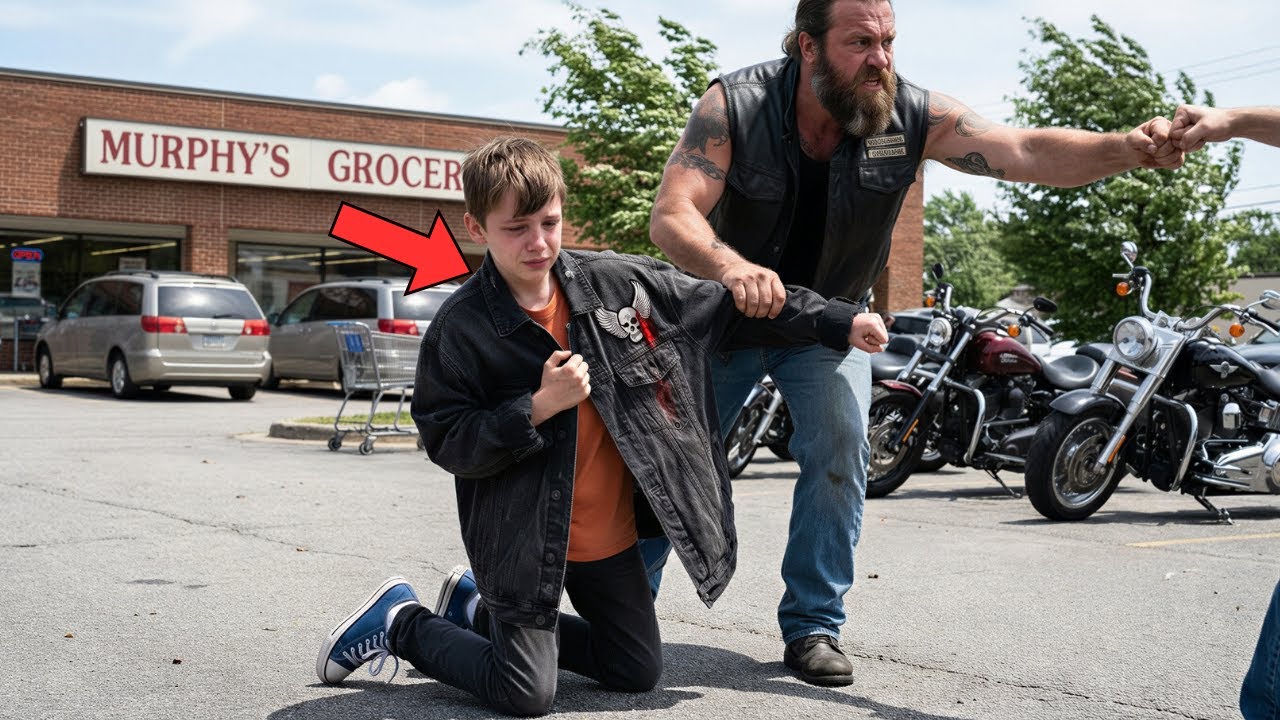
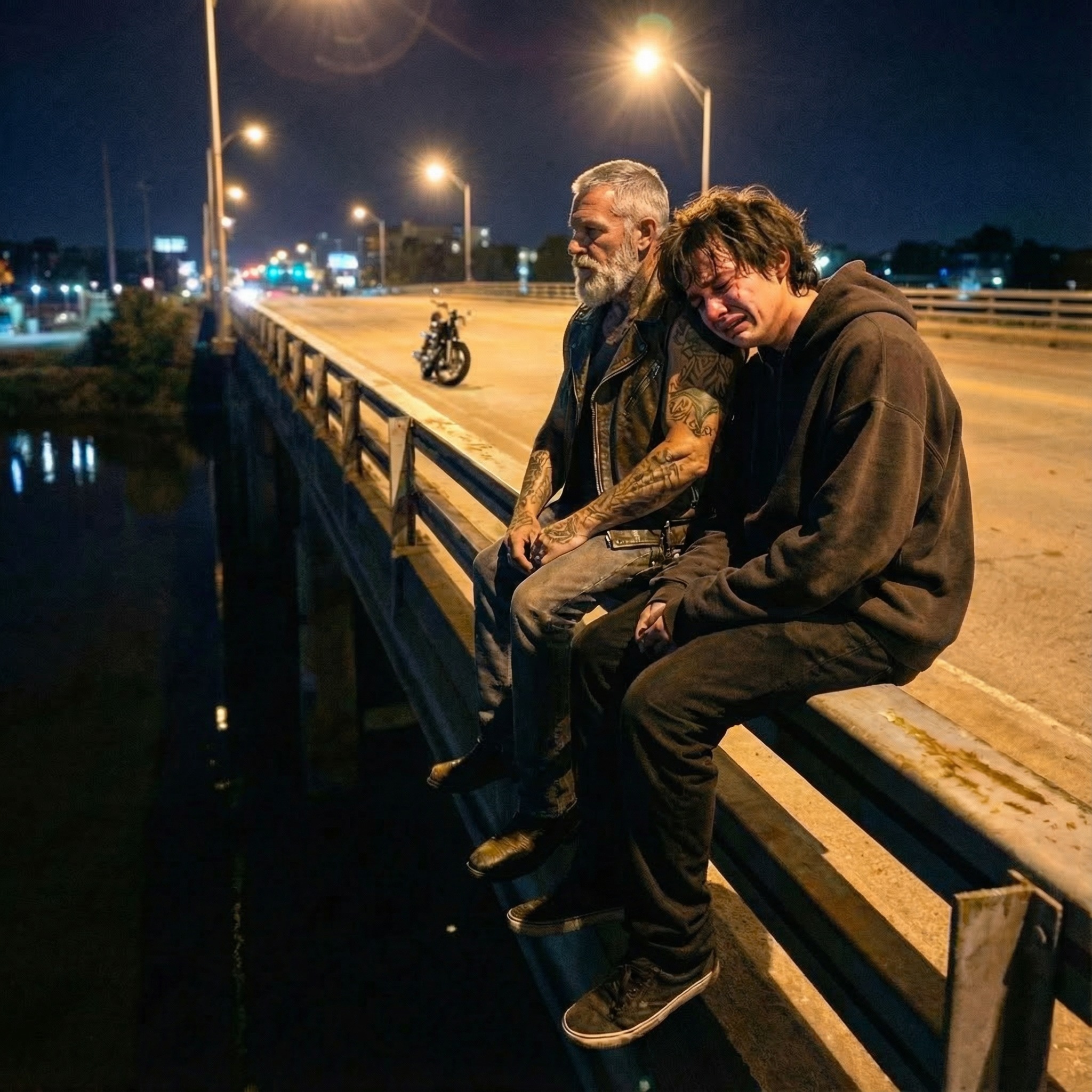
Foster Kid Was Beaten for Wearing “Biker Trash” Jacket — It Belonged to His Dead Father

On a windy Thursday afternoon in late October 2024 on Cedar Street in the Miltown of Ash Ridge, Colorado, the parking lot outside Murphy’s Grocery smelled like frier grease and cold asphalt. Mom’s loaded minivans. A leaf blower whed somewhere down the block and a line of third graders shuffled past clutching Halloween worksheets.

Near the cart corral, a skinny 13-year-old in a faded black denim  jacket hit the pavement hard, breath knocking out of him. The back of the jacket flashed a winged skull and red rocker letters worn almost white. Take it off, you little biker trash, the man above him hissed. Frank, his foster father, knuckles already pink.

 You’re hell’s angel. Daddy’s dead. You want to end up like him? People looked and then looked away. Across the lot, three Harleys cut their engines in unison. The club president, Jack Turner, swung off his black road glide, boots scuffing gravel, eyes fixed on the boy’s jacket and the blooming bruise around his eye.

 “Hey,” Jax called, voice flat, but carrying. you done hitting a kid in front of my bike or you want to make this a bigger problem? Later, folks would say that was the moment a foster kid with nothing but a jacket to his name stopped being invisible and started becoming somebody’s. By September 9th, 2024, Ash Ridge looked like most faded mountain towns off I7.

cheap motel hugging the highway, a shuttered sawmill on the river, and one main drag lined with pawn shops, and a dollar king. In room 214 of the Ridge View Motel, the carpet smelled like old smoke and lemon cleaner. 13-year-old Ethan Cole sat on the bed’s edge, jacket folded in his lap. Black denim cut too big in the shoulders, the back patch frayed, a winged skull and a red rocker worn almost white.

Underneath smaller letters, half gone. Legion. The social worker says we got to be out by noon. His foster mom, Paula, called from the bathroom. Frank’s trucking gig got cut. We’re moving to the trailer off Cedar. Ethan traced the stitching with his thumb. The jacket had been his father’s, Nate Ghost Cole, dead since a Highway 6 crash in 2021.

Street rumors said Ghost rode with a 1enter club out of Denver. Court records just called him a known associate. As he shrugged the jacket on, sleeves hanging past his wrists, Paula frowned. You know that thing makes people talk, right? They already talk, he muttered. Loneliness didn’t always look like tears.

Sometimes it looked like a kid wearing a dead man’s jacket because it was the only thing that still smelled faintly like belonging. On the chilly morning of September 18th, 2024, the air at the Cedar Street bus stop tasted like exhaust and damp leaves. The yellow number 12 bus groaned as it pulled up, brakes squealing.

 Ethan stood at the back, jacket zipped, hood up, rocket blue Walmart backpack slung over one shoulder. You see what he’s wearing? Sneered Tyler, an eighth grader with a Broncos beanie. Biker trash. Bet his dad oded in a ditch. He’s dead, Ethan said flatly. Bike wreck. Same thing,” Tyler smirked, flicking the winged skull.

 “You’re not in a gang, poser.” Ethan’s cheeks burned. Inside his head, he saw his father’s funeral, more bikes than cars, men in cuts standing with helmets under their arms, one pressing the folded jacket into his small hands without a word. That afternoon, he sat in Vice Principal Dawson’s office. The room smelling like coffee and toner.

 A  dress code printout lay between them. Gang affiliated  attire isn’t allowed, Dawson said. That jacket makes other students uncomfortable. “It’s my dad’s,” Ethan muttered. “That’s all I have of him.” Dawson’s expression softened, then hardened. I understand, but we have policies. Policies didn’t have to go home to the Cedar Street trailer or stare at a jacket folded on a chair like a memorial.

Ethan did. On September 27th, 2024, late afternoon sun turned Ash Ridg’s stoplight at Maple and Fourth a hazy orange. Ethan walked home past the Sinclair station, backpack digging into his shoulders. As he passed, three Harleys rolled in, the air filling with rumble and the smell of gasoline. He pretended to ignore them, but his eyes flicked sideways.

 Big touring rigs, Road Glide, Street Glide, Old Electrolide. Their riders wore black leather cuts with a silver patch, Iron Reaper, MC, Ashridge. The center patch showed a hooded figure with a spanner instead of a scythe. In town, the reapers were a rorchack test. Church ladies called them gang members. The tire shop guy called them the only ones who ran off the methheads.

Two years back, they’d organized a toy run that flooded the Salvation Army. A year before that, a fight outside Murphy’s bar put two men in the hospital. No one could agree who started it. “Stay away from that clubhouse,” Paula had warned. “Nothing but felons.” But as Ethan watched, one reaper, tall, late30s, gray in his beard, patted a little girl’s helmet before she climbed into a minivan.

 Another handed a 20 to an older man without a word. They lookeddangerous. They also looked in some twisted way, like the funeral line from three years ago. Sometimes stories about a patch said more about the storyteller’s fears than about the men wearing it. By October 24th, 2024, the air over Ashridge had gone thin and sharp. First snow dusting the peaks.

 At 4:11 p.m., Murphy’s grocery lot on Cedar Street was busy with afterwork shoppers. The smell of rotisserie chicken and diesel mixing in the cold. Ethan walked beside the cart,  jacket zipped. Paula pushed, eyes on her phone. Frank followed. Stale beer and motor oil clinging to his car heart. Take that damn thing off before we go in.

 Frank muttered, flicking the back patch. I’m not getting banned cuz my foster kid thinks he’s some hell’s angel. It’s not, Ethan started. Frank’s hand snapped out, grabbing the collar. What did you say? It’s my dad’s. Ethan’s voice cracked. You mean your dead junky biker who left you with nothing.

 The words were loud enough that a woman loading her SUV glanced over then away. When Ethan’s fingers clung to the jacket, Frank’s face flushed. He swung. The blow wasn’t hard, just a flat, sharp smack that knocked Ethan sideways into the cart. Metal rattling. Pain bloomed along his cheekbone. Three engines cut off at the lot’s edge. Jack’s Turner, president patch on his chest, watched from his roadlide.

He saw the boy hit the cart, saw the patch on the two big jacket, saw how nobody stepped in. He walked forward, boots grinding grit. You done, man? This is none of your business, Frank snapped. My kid, my rules. You’re fostering, Jack said. Big difference. He looked at Ethan, taking in the darkening bruise.

You okay, kid? Ethan’s throat felt too tight. I’m fine, he lied. In that moment, a line was crossed. Not just a fist through air, but the invisible boundary between someone else’s problem and something Jax couldn’t unsee. If you’ve ever seen something wrong and wondered if you should speak up, hit that subscribe button.

Sometimes the hardest thing is just refusing to look away. On the morning of October 25th, 2024, the Ashridge Police Station smelled like old coffee and copier toner. Officer Maria Klene leaned against the desk watching grainy footage on a cracked iPhone. A grocery lot, a raised hand, a kid in a black jacket hitting metal.

“Are you recording vertically now?” she asked. “Don’t start,” Jack smuttered without his helmet. Gray showed at his temples. “You going to tell me I should have stayed out of it?” Klein sighed. “No, I’m going to tell you. We’ve had three calls on that placement in 6 months. I’ve knocked on that door more than once. She picked up a card.

 County Child Protective Services. This video gives us probable cause. Later that day, a CPS worker knocked at 3:07 p.m. The air smelling like frying onions. Ethan sat at the kitchen table, jacket on, backpack at his feet, a yellow purple bruise along his cheek. I tripped, he offered. The case worker, Lena Han, set her clipboard down. I saw the video, Ethan.

Paula’s hands shook, lighting a cigarette. Frank just lost his temper. His hours got cut. Losing your temper doesn’t mean you get to hit a kid, Lena said. She slid a card toward Ethan. If you ever feel unsafe, call. Outside through thin curtains, Ethan saw a black roadlide idling at the curb. Jax’s silhouette just visible behind his visor.

 Being seen wasn’t always comfortable. Sometimes it was the first step toward being safe. By 10:46 p.m. on October 25th, 2024, the Cedar Street trailer had gone quiet, except for a  TV game show, and the fridge hum. The living room smelled like stale beer and microwave popcorn. Ethan lay on his thin mattress, jacket balled under his head, listening.

Through the wall, Frank’s voice came in waves. Yeah, they sent CPS again. Video. Some biker clown. A text tone pinged. Silence. Then Frank’s voice dropped. I’m not losing that check, man. Kid opens his mouth. We’re screwed. Little punk walks around like some gang prince. Another ping. Yeah, I know someone.

 A guy who can make problems go away. Scare him? Maybe worse. Nobody’d miss him. It’s just fostering. Blood roared in Ethan’s ears. He clutched the denim fabric stiff under his fingers. At 11:13 p.m., his track phone buzzed. Unknown number. This is Lena from CPS. Are you safe tonight? He stared, thumb hovering.

 A second message. If you’re in danger, text back any letter. His hand shook as he typed. Why? 10 minutes later, a cruiser rolled slowly past Cedar. Officer Klein’s silhouette behind the wheel, radio crackling. When she swung by Seventh and Maple, she saw three bikes outside the Iron Reaper clubhouse, pipes still warm.

She pulled over. “You still got that video?” she asked when Jack stepped outside, cigarette smoke curling. “Yeah, keep your guys on Cedar tonight within the law, eyes open. CPS will move, but it won’t be fast.” Ethan didn’t know any of that. He just knew the  jacket smelled faintly of oil and cold air, and that for the first time, he was more afraidof staying than leaving.

Realizing you’re a target isn’t cinematic. It’s the slow understanding that your own living room might be the most dangerous place you stand. On October 28th, 2024, gray clouds hung low over Ashridge, spitting light rain that smelled like cold metal. At 9:22 a.m., Ethan climbed the narrow back stairs of a brick building on 7th Street, a rocket blue backpack over one shoulder.

 The sign downstairs read, “Reaper’s garage, customs and repair.” Upstairs, a small apartment held a sagging couch, twin bed, and kitchenet with a humming fridge. “This is temporary,” Lena from CPS said, legal pad in hand. “Given current risk factors, the court’s willing to consider a short-term safety environment.

” “Community support?” Jack snorted, leaning against the stove. That’s what we’re calling it. Don’t make me regret this. Lena shot back. Ground rules. Ethan would stay above the clubhouse under Jax’s supervision, attend school, meet with a counselor twice weekly, check in with CPS every Monday. No parties upstairs, no illicit activity.

Two reapers on the street when Ethan was home. one inside from 10:00 p.m. to 6:00 a.m. “You still got to do homework,” Liz, the road captain, said, dropping notebooks on the coffee table. “This ain’t summer camp.” Ethan ran a hand over the couch’s worn fabric. It smelled like old leather and cleaning spray, better than Cedar ever had.

 He hung his jacket on a chair, patch facing the room. “You knew my dad?” he asked quietly. Jax hesitated, then nodded. Yeah, different clubs, same roads. He could ride. He loved you. For whatever that’s worth. It was worth more than Ethan knew how to say. Protection wasn’t just about who watched the door. It was also about who refused to look away from the parts of you everyone else decided were too complicated.

 On November 2nd, 2024, late afternoon light slanted through the clubhouse windows, catching chrome and dust modes. The room smelled like coffee, motor oil, and cinnamon air freshener. At 3:37 p.m., a white van with the Channel 7 logo pulled up. A reporter in a navy  coat stepped out, cameraman and tow.

 “You called them,” Ethan whispered from the upstairs window. “Lena did,” Jax replied. Sunshine makes it harder for bad things to grow. Ground rules. Ethan’s face blurred. Last name withheld. No direct shots of full patches. The reporter’s breath puffed white as she rehearsed. Ethan stood inside the clubhouse door when the camera rolled.

 The smell of concrete and cold metal grounding him. He told his story in short sentences. the jacket, the slap, the threatened problem talk. His hands shook, but his voice held. The reporter turned to Jax. Some see your patch and think gang, not guardian. Why get involved? Jax shrugged. We’re not saints, but we have rules. You don’t hit kids.

 You don’t threaten them to keep your check. And you don’t punish a boy for loving his old man. no matter what patch that man wore. That night at 6:09 p.m., the segment aired. Security footage, blurred faces, red and silver patches. Lena explaining foster home shortages. Klein talking about community partnerships.

At Murphy’s Bar, someone snorted, “Look at the Reapers playing heroes.” At Second Baptist’s potluck, church ladies pursed lips, but a few nodded. At Cedar Street, Frank threw a beer bottle at the screen and missed. Upstairs, Ethan watched himself on  TV, hearing his own distorted voice talk about fear.

 Being a headline made it harder for anyone to make him disappear without questions. On the rainy night of November 10th, 2024, 7th Street glistened under street lights. At 1:18 a.m., most of Ashridge slept. Upstairs, Ethan dozed on the couch, math textbook on his chest, TV muted, his  jacket hung by the door. Liz sat in the armchair, flipping through a motorcycle mag.

 Peppermint gum smell in the room. A truck engine crawled past. Too slow. Headlights swept the ceiling, then cut. Too early for deliveries, Liz muttered, moving to the window. Silver F-150. Mud on the plates. The first brick hit a second later. Glass shattered, sharp and loud, shards skittering across the floor. Ethan jerked awake, ducking.

 A second brick bounced off the garage window, leaving a spiderweb crack. Liz was already on her radio. We got a hit. Two bricks, plates blocked. Below, three bikes roared to life. Jax’s roadlide and another Street Bob surged out, pulling up behind the idling truck. “Got you on camera, friend,” Jax called over the rain, phone in hand.

 The truck hesitated, then took off, fishtailing, tail lights smearing red. “10 minutes later, Officer Klein arrived. She photographed glass, bricks, tire tracks. Could be a random drunk,” she said, though her tone said she didn’t believe it. Either way, we log it. Three angles, Jax replied, nodding toward security cameras.

Ethan stood in sucked feet amid glass, breathing fast. You’re all right, kid, Liz said quietly. Scared is normal. Staying scared is optional. He looked at the jacket on its hook,glass shards glinting below like tiny, dangerous stars. Being protected didn’t mean nothing bad happened. It meant when it did, he wasn’t the only one standing in the broken glass.

 On November 21st, 2024, Ash Ridge County Courthouse smelled like wet wool and old wood polish. Fluorescent lights buzzed. It was 9:03 a.m. and the docket in courtroom 2B read, “State Veress Frank Richards.” Ethan walked through the doors, flanked by two reapers, impressed jeans and collared shirts under their cuts, rocket blue backpack on his shoulder, jacket zipped.

In the front row, Paula sat ringing her hands. Frank stood at the defendant’s table in an ill-fitting sport coat, eyes darting to the row behind Ethan, where six men and one woman sat with hands folded. Iron Reaper’s patches, visible but toned down. The judge’s gaze lingered. This is a court of law. Everyone will conduct themselves accordingly.

On the stand, Ethan’s mouth went dry. The prosecutor asked about the events of October 24th. He talked about the slap, the words, how his head hit the cart. He talked about the text overheard later about making problems go away. He did not cry. His voice shook once, then steadied. The defense attorney suggested he was influenced by bikers.

They didn’t tell me what to say. Ethan replied quietly. They just told me I didn’t deserve to be hit. Lena testified about bruises, prior reports. Klene played Murphy’s video, The Room Going Silent. The judge denied Frank’s foster license, issued a suspended sentence with mandatory counseling, and barred contact with Ethan indefinitely.

Outside, reporters hovered. Lena shielded Ethan. The Reapers hung back at the curb by their bikes. “You did good,” Jack said when Ethan reached them. “Whatever happens now, that needs saying.” Justice wasn’t dramatic, but it was heavy, and it sat easier when you weren’t carrying it alone. By December 18th, 2024, snow had settled into Ash Ridge, softening broken curbs.

The garage stayed busy. Upstairs, the apartment felt smaller daily. At 6:19 p.m., Ethan sat at a worn wooden table in a small house on Birch View Lane. Not a trailer, not a motel, but a real house with a sagging porch and a yard buried in snow. The place smelled like chili, cornbread, laundry detergent. This is temporary, Jax’s wife, Amanda, said, ladling chili.

 But a different kind. She taught second grade, hair pulled back, cardigan sleeves pushed up. We’re applying for kinship guardianship. You’ll still be at the shop after school, Jax added, sliding cornbread toward Ethan. Homework first, then sweep, run parts, earn honest cash. On the fridge, a calendar had his counseling appointments in green, midterm due date in blue.

 An unopened envelope about lunch account forgiveness stuck under a motorcycle magnet. Ethan glanced at his  jacket by the back door next to two adult  coats and a small pink one. The patch looked less like a target here, more like a photograph. Are you okay with this? Amanda asked. Ethan shrugged, unfamiliar warmth in his chest. Feels weird. Good. Weird.

 Like I keep thinking someone’s going to tell me to pack up. Nobody’s packing you up tonight, Jack said. Or tomorrow. We ain’t perfect, but we’re not going anywhere. belonging wasn’t the thunder of engines or a patch on your back. It was this a place at a table where someone bought your favorite cereal on purpose.

 Have you ever found family in unexpected places? Drop a comment about where you’re watching from. Sometimes the people who show up aren’t the ones you’d expect, but they’re exactly who you need. On an April afternoon in 2025, snow melt turned Ash Ridg’s gutters to rivers. At 3:47 p.m.

Family games

, the garage smelled like hot metal and chain lube. Ethan sat on a stool, jacket spread on the workbench. The old back patch, winged skull almost white, faced up. Beside it lay a smaller patch Amanda had ordered, a bike silhouette under a mountain. Ghost’s kid stitched around the edge in white. You sure? Jax asked. Once we stitch over this, it’s not coming off clean.

 I’m not covering it, Ethan said. Just adding to it. He wasn’t all good, but he wasn’t all bad. This is mine now. They worked slowly, sewing the new patch below the old rocker, not erasing, but reframing. Each pull of thread felt like a heartbeat. People will still see what they want, Ethan said. Yeah, Liz replied.

 But the ones who matter will see the kid who kept the piece of his dad that meant something and made it his own. That night at the Birch View table, he laid the jacket over his chair, a new patch catching light. Dany from next door, who used to cross the street, traced the letters. It’s kind of cool, she admitted. Grief could be like a jacket, heavy, too big, stained with stuff you didn’t choose.

But with the right hands, you could alter it. Still yours, still carrying history, but cut for who you were becoming. On a clear Wednesday morning in late May 2025, Birch View Lane smelled like damp grass and burnt toast. The sky was bright,washed out blue. At 7:12 a.m., Ethan stood at the corner, jacket zipped, backpack easy on his shoulder.

 He felt the rumble before he heard it. Vibrations through his sneakers as two Harleys turned onto Birch View, not roaring, just rolling slow, pipes low. Jax on his Road Glide, Amanda behind him with coffee. Liz on her Sportster, braid tucked in. No full colors, just small support patches. Some parents tensed, others watched.

Mrs. Lopez, who’d once muttered about gang trash, nodded at Amanda. The bikes pulled up opposite, engines idling. Jax raised two fingers in casual salute. Nothing pushy, just there. The bus groaned up the block, yellow paint brights hissed. “You good?” Jax called across the street. Ethan touched his jacket, fingers brushing the old patch and the new one. Yeah, I’m good.

 He climbed the steps, felt eyes on his back. But this time, the words were different. That’s the kid from the news. Lives with the mechanic, works at the shop. As the bus pulled away, Ethan looked out the window. The bikes shrank, two points of chrome against the street. But the sound, low, steady, followed for a few seconds before blending into the day.

The same noise that once meant fights and fear, now meant something quieter. Someone had his back. The engines faded. The bus rattled toward Ashridge Middle. Beside him, his  jacket creaked softly as he shifted. Fabric warm from sun.
SOTD – One of the greatest songs ever recorded!

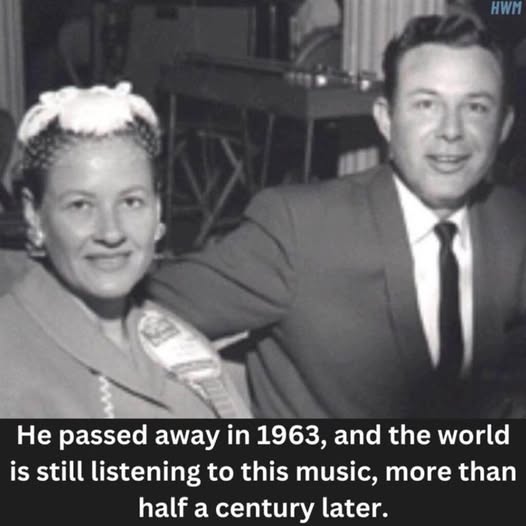
In 1960, Jim Reeves released a song that quietly but permanently changed the direction of country music. “He’ll Have to Go” didn’t arrive with explosive drums or dramatic flair. It didn’t need to. It slipped into radios and jukeboxes with a smoothness that felt almost conversational, and before anyone fully realized what was happening, it had crossed borders—musical, cultural, and generational.

At the center of it all was Reeves’ voice. Rich, controlled, and impossibly warm, it sounded less like a performance and more like a private confession. Where many country singers of the era leaned into twang and rawness, Reeves offered polish and restraint without losing emotional weight. That balance became his signature, and nowhere was it more effective than on this record.

By the time “He’ll Have to Go” was released, Reeves was already a respected name in country music. Known widely as “Gentleman Jim,” he carried himself with a calm sophistication that set him apart. Born in Texas, Reeves had worked as a radio announcer before fully committing to music, a background that shaped his impeccable diction and relaxed delivery. He understood pacing. He understood silence. Most importantly, he understood how to make listeners lean in.

The song itself had an unusually intimate origin. Written by Joe Allison and Audrey Allison, it was inspired by a moment Joe Allison overheard in a bar. A man, speaking urgently into a telephone, asked the woman on the other end to come closer so he could hear her better. The line was ordinary, even mundane—but emotionally loaded. That single moment became the song’s opening plea: “Put your sweet lips a little closer to the phone.”

It was a masterstroke of simplicity. No metaphors, no dramatic exposition—just longing, vulnerability, and the quiet fear of losing someone you still love. When Reeves delivered that line, it didn’t feel written. It felt overheard, like the listener had stumbled into a moment they weren’t meant to hear.

The production played a critical role in making the song timeless. Overseen by Chet Atkins, the arrangement was deliberately understated. Soft backing vocals, gentle strings, and a restrained rhythm section created space rather than filling it. The song breathed. Nothing competed with Reeves’ voice, and that restraint was exactly what allowed the emotion to land so powerfully.

When “He’ll Have to Go” hit the charts, its impact was immediate and undeniable. It soared to number one on the Billboard Country Chart and crossed over to the pop charts, peaking at number two. That crossover success was not common at the time, especially for a country ballad that refused to chase pop trends. The song proved that country music could be refined, emotionally subtle, and still connect with a mass audience.

More than its chart performance, the song became a cultural touchstone. Its theme—pleading for one last chance, asking someone to choose you—was universal. It didn’t matter where listeners came from or what genre they preferred. The emotional truth was unmistakable. Reeves didn’t dramatize the heartbreak. He trusted it.

That trust paid off. “He’ll Have to Go” became a staple on radio stations and jukeboxes across the country. It was played late at night, in diners, in living rooms where people sat quietly and listened. It wasn’t background music. It demanded attention without demanding volume.

The success of the song transformed Reeves’ career. He became an international star, touring extensively and bringing country music to audiences far beyond the United States. In many ways, he served as an ambassador for the genre, showing that country music could be elegant without losing its emotional core. His style challenged outdated perceptions and expanded what country music could be.

The song also helped solidify what became known as the Nashville Sound—a smoother, more orchestrated approach that blended traditional country elements with pop sensibilities. This wasn’t about abandoning roots; it was about refinement. And “He’ll Have to Go” became one of the clearest examples of how powerful that approach could be when done right.

Reeves’ influence didn’t stop with his own success. His approach laid the groundwork for future artists who would navigate the space between country and pop. Decades later, performers like Shania TwainTaylor Swift, and Keith Urban would benefit from the doors Reeves helped open—artists who proved that crossover didn’t have to mean compromise.

Tragically, Reeves’ life was cut short in 1964 when he died in a plane crash at just 40 years old. His death shocked the music world and left an enormous void. Yet even in his absence, his voice endured. “He’ll Have to Go” continued to play on the radio long after his passing, its quiet plea echoing through generations.

Reeves was later inducted into the Country Music Hall of Fame, a recognition not just of his success, but of his lasting influence. His recordings, especially this song, remained reference points for vocalists studying phrasing, control, and emotional honesty.

Today, “He’ll Have to Go” remains one of the most beloved songs in country music history. It continues to appear in films, television shows, and commercials, often used to evoke intimacy and nostalgia. New listeners discover it every year, drawn in by its simplicity and the calm authority of Reeves’ voice.

What makes the song endure is not production tricks or lyrical complexity, but restraint. It trusts silence. It trusts emotion. And it trusts the listener to feel what’s being said without being told how to feel.

Jim Reeves proved that country music could be sophisticated, universal, and deeply human. “He’ll Have to Go” wasn’t just a hit—it was a defining moment that reshaped the genre’s future. More than sixty years later, it still feels personal, still feels honest, and still reminds us why the simplest songs often last the longest.

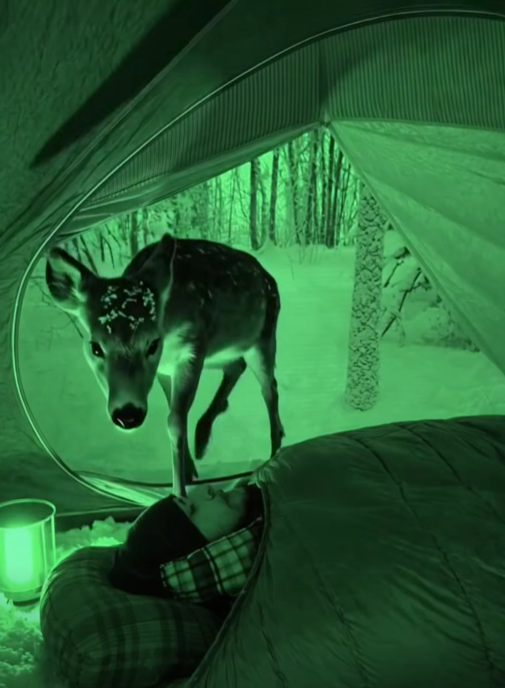
I decided, out of curiosity, to place a night-vision camera in my tent to observe the forest at night, A fawn entered during the night, and its actions left me horrified!

I’ve always chased the edge of things. The moments where your pulse spikes and the world feels sharp and alive. Skydiving, climbing sheer rock faces, solo hikes miles from the nearest road—those were the experiences that made me feel awake. Silence never scared me. Isolation never bothered me. If anything, the deeper I went into the wild, the calmer I felt.

Until one night in the forest quietly rewrote that confidence.

It was mid-winter when a group of friends and I planned a single overnight trip deep in a snow-covered woodland. No cabins, no heaters, no shortcuts. Just tents, sleeping bags rated for brutal cold, and whatever warmth our bodies could generate. The air was clean and sharp enough to sting. Every step through the snow made a dry, hollow crunch that echoed farther than it should have.

We pitched our tents just before nightfall, spreading out enough for privacy but close enough that we could shout if something went wrong. The forest settled into that eerie calm that only comes after dark—no birds, no insects, just the wind pushing through bare branches like a slow breath.

I decided to experiment. Mostly out of curiosity, partly because I thought it would make for a cool video later.

I mounted a small night-vision camera inside my tent, angling it toward the entrance. I left the flap slightly open, just enough to capture the outside world without letting too much cold in. I imagined footage of drifting snow, maybe a fox darting past, maybe glowing eyes in the distance. Nothing dangerous. Nothing personal.

I zipped myself into my sleeping bag, pulled my hat low, and let the forest fade me out.

For the first few hours, the camera recorded exactly what I expected. Shadows shifting as branches swayed. The faint shimmer of falling snow. Occasional sounds—something stepping through brush, something snapping a twig—but nothing that made my heart race. Watching the footage later, it was almost boring.

The first sign was movement at the edge of the frame. Slow. Careful. A pale shape drifting into view like it wasn’t sure it belonged there. When the camera’s infrared adjusted, the image sharpened.

It was smaller than I expected, thin-legged, its winter coat still soft and uneven. Its eyes reflected the night-vision glow, wide and cautious. It froze when it noticed the tent, standing perfectly still like prey hoping invisibility might work

Even knowing I was watching a recording later, my chest tightened. Something about seeing a wild animal so close, so alert, triggered a primitive awareness I didn’t know I still had.

The fawn sniffed the air. Took a step forward. Then another.

It wasn’t panicked. It wasn’t aggressive. It was curious—and calculating. It could smell me. It knew something was inside. But whatever instincts told it to run were losing ground to something else: comfort.

Cold does that to animals. It makes them pragmatic.

The fawn circled the entrance once, nudging the tent fabric with its nose. The material shifted slightly. No reaction from me. I was asleep, buried in layers, breathing slow and steady.

That’s when it made a decision.

It pushed its head inside.

The tent flap lifted just enough for its body to slip through, careful and quiet. Snow fell from its coat onto the tent floor. It paused again, ears twitching, listening for danger that never came.

Then it stepped fully inside.

Watching that moment later made my skin crawl. Not because the animal was threatening—but because it was so close. A wild creature, inches from my face, studying me while I slept.

The fawn stood there, motionless, head tilted slightly as if trying to understand what I was. My sleeping bag rose and fell with my breathing. My face was relaxed, oblivious. At one point, I even smiled in my sleep.

Instead, it shifted its weight, turned slightly, and did something so ordinary—and so deeply unsettling—that I actually recoiled from the screen.

Calmly. Casually. Right there.

Small, dark pellets dropped onto the floor of the tent. Onto my sleeping bag. Onto the clothes I’d folded beside me. A few landed close enough that they brushed my cheek.

The fawn lingered a moment longer, as if satisfied. Then it turned, slipped back through the opening, and vanished into the trees as quietly as it had come.

When the footage ended, I just sat there staring at the paused screen.

It wasn’t the mess that disturbed me. It wasn’t even the invasion of space. It was the realization of how completely vulnerable I had been—and how indifferent nature was to that vulnerability.

I hadn’t been brave. I hadn’t been dominant. I hadn’t been in control.

I’d simply been tolerated.

That tent, which I thought of as a barrier, had been nothing more than a suggestion. To the fawn, it was shelter. A pocket of warmth. A place out of the wind. I wasn’t a threat—I was furniture.

The forest hadn’t been watching me with awe or respect. It had been assessing usefulness.

I’d always romanticized nights like that. The idea of being alone in the wilderness, mastering fear, proving resilience. But that night stripped away the fantasy. I wasn’t a fearless explorer communing with nature. I was a warm object in an ecosystem that doesn’t care about courage or ego.

The forest doesn’t announce danger. It doesn’t warn you when you’re crossing a line. It simply continues, quietly, while you assume you understand it.

Since that night, I haven’t stopped adventuring. But something shifted.

I’m more aware now. More humble. Less interested in pushing limits just to feel something. Because adrenaline isn’t wisdom, and confidence isn’t protection.

That fawn didn’t hurt me. It didn’t mean to horrify me. It just acted according to instinct, and in doing so, reminded me of a truth I’d forgotten.

Out there, you’re never as alone as you think. And you’re never as important as you feel.

Sometimes the forest doesn’t roar. Sometimes it just steps into your tent, looks you in the face while you sleep, and leaves you a quiet, unforgettable message about your place in the world.

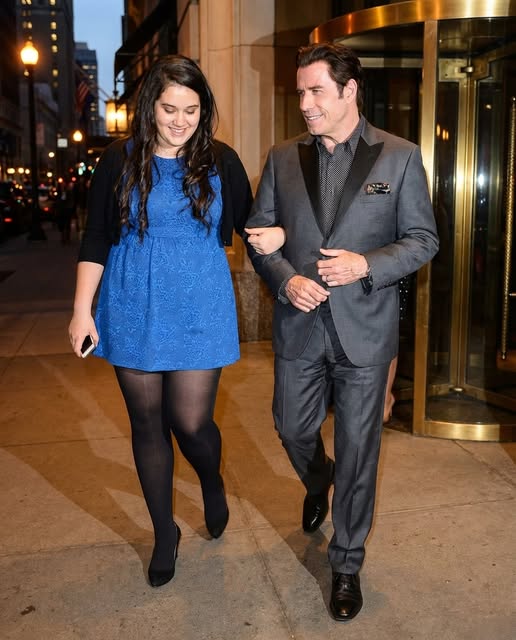
Cruel people called John Travolta’s daughter ”chubby” when she was little, but today she is probably the prettiest woman that ever existed

From the moment Ella Bleu Travolta entered the world, attention followed naturally. Not because she chased it, but because she was born into a family already woven into the fabric of popular culture. As the daughter of John Travolta and Kelly Preston, Ella’s childhood unfolded in a space that balanced creativity, privacy, and genuine warmth. Fame existed around her, but it never seemed to define her. Instead, she grew up in a household where storytelling, imagination, and emotional connection mattered more than headlines.

Kelly Preston often spoke about Ella’s birth as a moment that reshaped her understanding of love and purpose. That sense of grounding carried through Ella’s upbringing. She was raised alongside her older brother Jett and later her younger brother Benjamin, learning early what it meant to care deeply for others while also developing her own identity. Family rituals mattered. So did laughter, shared meals, and the quiet reassurance of parents who worked in an industry known for chaos but built stability at home.

From a young age, Ella gravitated toward creative expression. She put on performances at home, experimented with acting, and absorbed the rhythm of life on and off movie sets without being consumed by it. When she appeared in films alongside her parents, it felt less like a strategic career move and more like a natural extension of the environment she’d grown up in. She wasn’t chasing fame; she was exploring her interests, learning how stories are told, and discovering how she fit into that process.

As she entered her late teens and early twenties, Ella began carving out a sense of self that felt distinctly her own. One unexpected turning point came in 2022, sparked not by a major life event but by a simple challenge suggested by a friend. The idea was straightforward: try a plant-based diet for two weeks and see how it felt. There were no grand expectations attached to it, no intention of making a permanent change. It was curiosity, nothing more.

What surprised her was how quickly subtle shifts began to appear. She felt lighter, more energized, and more aware of how food affected her body and mood. That initial experiment didn’t end when the two weeks were up. Instead, it opened a door. Ella began reading, learning, and asking questions—not just about nutrition, but about sustainability, compassion, and how everyday choices ripple outward. Over time, that curiosity evolved into commitment, though never into rigidity.

Ella’s approach to a plant-based lifestyle is notably unpreachy. She doesn’t frame it as a moral high ground or a universal solution. Instead, she talks about it as something that works for her, something that brought balance and clarity during a formative period of her life. That tone—inviting rather than instructive—has become a defining part of how she shares her journey with others.

Nowhere is that sense of joy more evident than in her kitchen. Cooking became one of the most natural ways for Ella to blend creativity with wellness. She began experimenting with plant-based versions of familiar comfort foods, turning the process into something playful and expressive. Pumpkin-spice peanut-butter toast, vegan banana bread, and carefully adapted desserts became staples. One recipe that drew particular attention was her plant-based take on a coconut bundt cake long associated with Tom Cruise, reimagined through her own lens.

In 2023, she brought that creativity into the public eye by launching her Instagram account, @ellableubakes. The page quickly became more than a collection of recipes. It reflected her personality: relaxed, curious, and inclusive. Alongside baking ideas, she shared café visits, small daily rituals like morning matcha, and glimpses into a lifestyle rooted in balance rather than perfection. The focus wasn’t on flawless execution, but on enjoyment, exploration, and connection.

That emphasis on gentleness is especially striking given the personal loss Ella has experienced. In 2020, the death of her mother, Kelly Preston, marked a profound shift in her life. Grief arrived early and deeply, reshaping family dynamics overnight. In the years that followed, Ella and her father grew even closer, leaning on one another through shared memories, creative projects, and quiet moments of reflection. The bond they formed during that time wasn’t performative; it was survival through love.

Rather than retreating inward, Ella found ways to process grief through creativity and routine. Cooking, acting, travel, and mindful living became tools not of escape, but of healing. Her plant-based lifestyle took on new meaning—not as a trend, but as an anchor. It represented care for herself at a time when the world felt unsteady.

As she continues to grow, Ella Bleu Travolta occupies a rare space. She carries a famous name, but she doesn’t rely on it. She honors her family’s legacy without being trapped by it. Her confidence isn’t loud or performative; it’s steady, built from self-awareness and intention. Whether she’s acting, baking, or simply sharing pieces of her daily life, there’s a sense that she’s moving forward on her own terms.

Her story isn’t about reinvention or rebellion. It’s about alignment. About choosing paths that feel honest, nourishing, and sustainable—emotionally as much as physically. In a culture that often celebrates extremes, Ella represents something quieter and arguably more difficult: consistency, kindness, and growth that doesn’t need spectacle.

In that way, her journey resonates beyond celebrity curiosity. It speaks to anyone trying to live thoughtfully in a loud world. She shows that change doesn’t have to be abrupt, that healing can happen through small, repeated acts of care, and that confidence often grows from listening rather than proving.

Ella Bleu Travolta continues to evolve, not as a headline, but as a person. And in doing so, she offers something rare: a reminder that grace can be learned, strength can be gentle, and living with intention is its own form of quiet power.

Show Him Your Badge!

The officer arrived at the ranch already convinced the outcome was settled. He had the posture of someone who expected doors to open without knocking and arguments to end the moment he cleared his throat. His suit was crisp, his boots barely dusty, and the badge clipped to his belt caught the sun every time he shifted his weight. It wasn’t just identification to him—it was leverage. Proof that rules bent when he said they should.

The rancher watched him approach from the shade of the barn, leaning against a post worn smooth by decades of hands. He didn’t hurry. He didn’t scowl. He simply waited, the way men do when they’ve learned that rushing rarely improves anything.

“I need to cross that field,” the officer said, pointing past the fence line toward a wide stretch of grass shimmering in the heat.

The rancher followed his finger with his eyes. Then he shook his head once. Slow. Final.

“Can’t do that,” he said. “That field’s off-limits.”

The officer smiled the kind of smile that wasn’t friendly. It was practiced, tight at the corners, sharpened by years of being obeyed. “You don’t understand,” he said, tapping the badge with two fingers. “I’m authorized.”

The rancher didn’t argue. He didn’t explain. He didn’t raise his voice. “That field’s got a bull in it,” he said. “A mean one. Best go around.”

That should have been the end of it. But pride doesn’t listen well, and authority hates being warned by people it assumes are beneath it.

The officer straightened, chest lifting as if he’d been challenged. “I don’t take instructions from civilians,” he said. “Especially not about where I can and can’t go.”

He unclipped the badge and held it up, letting it gleam. “This says otherwise.”

The rancher studied the badge for a moment. Then he looked back at the officer’s face—at the confidence, the impatience, the certainty that the world would rearrange itself to accommodate him.

“All I’m saying,” the rancher replied evenly, “is that bull doesn’t care much for shiny things or big speeches.”

The officer laughed. A short, dismissive sound. “Animals respond to authority like anything else,” he said. “They sense confidence.”

The rancher pushed off the post and stepped closer to the fence. “That bull senses movement,” he said. “And challenge.”

The officer waved him off and unlatched the gate.

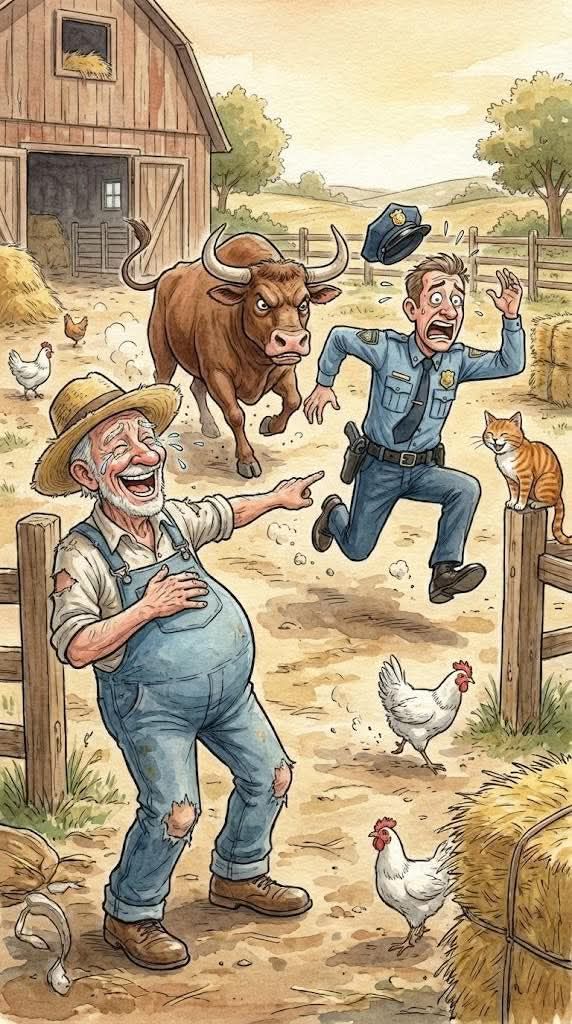
For a moment, nothing happened. The field lay quiet, grass rolling gently in the breeze, insects humming lazily. The officer took a few steps in, shoulders squared, badge still in hand as if it were some kind of talisman.

Then the ground seemed to shift.

At first it was just a sound—low, rumbling, more vibration than noise. The rancher felt it through his boots before he saw anything. He knew that sound. Every rancher does. It’s the sound that says you’re no longer in charge of the situation.

The officer heard it too. His stride faltered. He looked up.

From the far end of the field, the bull rose into view like something pulled out of the earth itself. Massive shoulders. Thick neck. Eyes fixed and unblinking. It didn’t charge immediately. It stood there, assessing, deciding whether the thing that had entered its space was worth correcting.

The officer froze.

Confidence drains fast when it meets something bigger that doesn’t recognize rank. The badge trembled in his hand. He took a step back, then another.

The bull snorted.

That was enough.

The officer turned and ran.

Whatever dignity he’d arrived with stayed behind him in the dust. His suit jacket flapped open, one shoe slipped, and the badge—so powerful moments earlier—bounced uselessly against his leg. He didn’t look like an agent of the law anymore. He looked like prey.

The bull charged.

The rancher watched it all unfold without surprise. He’d seen this kind of thing before. Men who thought titles were armor. Men who believed authority was universal. Men who forgot that the world doesn’t always care what you think you deserve.

The officer vaulted the fence with an awkward desperation, tearing fabric and skin in the process. He landed hard on the other side, rolling into the dirt, gasping like a man who’d just discovered his own limits.

The bull stopped at the fence, snorted again, and turned away, satisfied.

The rancher walked over slowly. No rush. No lecture. Just the quiet weight of inevitability.

The officer scrambled to his feet, face pale, chest heaving. His badge was scratched, his suit ruined, his certainty gone. He opened his mouth, probably to threaten, to complain, to demand accountability.

The rancher didn’t give him the chance.

He cupped his hands and called out, voice carrying easily across the yard. “Next time,” he said, “you might want to show your badge to the bull first.”

The officer stared at him, stunned. There was no comeback for that. No regulation. No statute. No appeal.

Because some lessons don’t come from books or training or power. They come from the sudden understanding that authority ends where reality begins—and that not everything in the world is impressed by a piece of metal.

This biker sat with me on a bridge for six hours when I was going to jump, and he never once told me not to do it, That is what saved my life

The night I decided to die didn’t feel dramatic. It felt quiet and final, like checking off the last item on a long list. I was seventeen, exhausted in a way sleep never fixed, and convinced I had already used up whatever chances I was given. I wasn’t looking for attention. I wasn’t trying to scare anyone. I just wanted the noise in my head to stop. I planned everything carefully. I gave away the things that mattered. I wrote a note I never reread. I chose a bridge high enough to remove uncertainty, high enough to make survival impossible.…

The night I decided to die didn’t feel dramatic. It felt quiet and final, like checking off the last item on a long list. I was seventeen, exhausted in a way sleep never fixed, and convinced I had already used up whatever chances I was given. I wasn’t looking for attention. I wasn’t trying to scare anyone. I just wanted the noise in my head to stop.

I planned everything carefully. I gave away the things that mattered. I wrote a note I never reread. I chose a bridge high enough to remove uncertainty, high enough to make survival impossible. I picked a Tuesday morning because fewer people would be around, and I climbed over the railing just before dawn so I could watch the sun rise one last time.

Cars passed. One after another. Headlights swept over me and disappeared. Some drivers slowed. Most didn’t. No one stopped. Sitting there with my legs hanging over open air, I felt exactly how I’d always felt in life—unseen, unimportant, already gone.

Then I heard a motorcycle.

The sound cut through the early morning silence, deep and unmistakable. I watched the single headlight approach, already assuming it would pass like everything else. Instead, it slowed. Pulled over. The engine shut off. Heavy boots hit the pavement.

A man’s voice followed. Calm. Unhurried.

“Mind if I sit with you?”

I turned my head. He was big, older, rough around the edges. Gray beard. Leather vest covered in patches. Arms full of tattoos. The kind of man people cross the street to avoid.

“I’m not looking to be talked out of it,” I said flatly. “So don’t waste your time.”

He nodded like I’d just told him the weather. “Wasn’t planning to.”

Then he did the one thing nobody else had done. He climbed over the railing and sat down beside me, letting his legs dangle over the same drop.

“What are you doing?” I asked, startled despite myself.

“Keeping you company.” He pulled out a cigarette, paused, then asked, “You smoke?”

“No.”

“Good.” He lit it for himself. “Name’s Frank.”

“I don’t care.”

“That’s fine,” he said easily. “You got a name, or should I make one up?”

I don’t know why I answered. I hadn’t planned to tell anyone anything. “Emma.”

He nodded, looking out toward the horizon. “Nice name. Hell of a view.”

“That’s why I chose it.”

“Yeah,” he said quietly. “I get that.”

He didn’t tell me it would get better. Didn’t tell me my family would be devastated. Didn’t tell me I was young or selfish or confused. He just sat there and listened while the sky slowly changed color.

When I finally asked why he was doing this, he showed me the scar across his throat. Told me he’d been in my place decades earlier. Different bridge. Same plan. Same sunrise.

He talked about war, about guilt he couldn’t outrun, about losing his family and believing he was beyond repair. He told me how a stranger on a motorcycle had once sat with him for hours, never trying to fix him, never telling him what to do. Just staying.

“That man asked me one question,” Frank said. “Changed everything.”

“What question?”

“What would you do if you weren’t in pain?”

I didn’t answer. I couldn’t. The idea felt foreign, almost offensive. My life had been built around pain. Removing it felt impossible.

We sat there as the sun came up. Police arrived. Then barricades. Then voices shouting through megaphones. My mother arrived at some point, hysterical, breaking down behind flashing lights.

Frank never moved.

He told me about the life he built slowly, painfully, one decision at a time. A second marriage. Sons. A granddaughter. A motorcycle club made up of people who’d all stood on their own ledges at some point and chosen to keep going.

He didn’t promise happiness. He didn’t sell hope like a product. He talked about work. About therapy. About days when survival felt like failure and days when it felt like victory.

Six hours passed.

By the time the sun was high, I was drained. Empty. But for the first time in months, I wasn’t alone.

“I don’t want to die,” I said finally.

Frank nodded once. No celebration. No drama. “Okay. Ready when you are.”

He helped me climb back over the railing. My legs gave out the second my feet hit solid ground. He caught me without hesitation and held me while I cried harder than I ever had.

I spent weeks in a hospital after that. It was brutal. Necessary. Frank visited every day. So did people from his club. They didn’t treat me like a patient or a project. They treated me like someone worth sticking around for.

Eight years have passed.

I’m twenty-five now. I’m in veterinary school, specializing in senior and hospice care—the animals nobody wants, the ones people give up on. I understand them. I know what it’s like to be written off.

Frank is walking me down the aisle next month. His wife helps me plan the wedding. His granddaughter calls me family.

Every year, Frank and I go back to that bridge. We sit on the safe side now and watch the sunrise. And sometimes, when someone else climbs over the railing, we climb over too. We don’t lecture. We don’t command. We just sit.

That’s how lives are saved sometimes. Not by force. Not by speeches. By presence.

Frank didn’t save me by stopping me. He saved me by staying.

By asking one question at the exact moment I needed it.

What would you do if you weren’t in pain?

I’m living the answer.