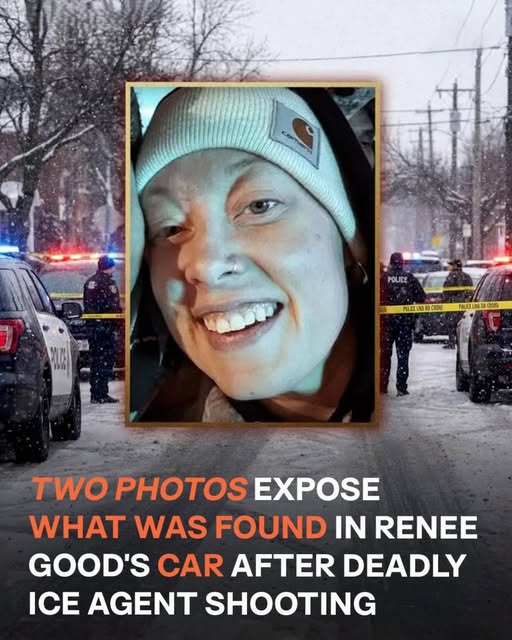
37-Year-Old Woman, Renee Nicole Good, Shot Dead by ICE Agent – Tragedy in 30 Photos
The death of Renee Nicole Good is a tragedy that has left a Minneapolis community fractured and a family inconsolable. On the morning of January 7, 2026, the thirty-seven-year-old mother, poet, and neighbor was shot and killed during a confrontation with federal agents from U.S. Immigration and Customs Enforcement (ICE). While the event has since become a focal point for intense political debate and conflicting official narratives, those who knew her remember a woman whose life was defined by creativity, faith, and a deep devotion to her family.
Renee lived just blocks from the site of her death, deeply rooted in the daily rhythms of her neighborhood. She was a woman described by those who knew her as someone who was constantly “looking out for others.” A graduate of Old Dominion University, Renee was a gifted writer who had won an undergraduate poetry prize in 2020. Her creative spirit extended to art and music; she was a guitar strummer who co-hosted a podcast and had spent her youth singing in choirs. Her Instagram bio offered a humble glimpse into her world: a poet, a writer, a wife, and a mother experiencing life in Minneapolis.
Central to her life were her children. She was raising a teenage daughter and son from her first marriage, as well as a six-year-old son from her second marriage to her late husband, Timmy Ray Macklin Jr. Friends and family emphasize that she was a U.S. citizen with no criminal record, a woman of quiet faith who had participated in youth missionary trips and focused primarily on providing a stable, loving home for her children. Her former husband was quick to note that she was not an activist or an agitator, but someone who sought peace and focused on the well-being of those around her.
The morning of the incident began with the mundane routine of a parent. After dropping her youngest son off at school, Renee was driving home with her partner when they encountered a heavy federal presence in their neighborhood. Residents had already become concerned by the sight of multiple SUVs obstructing roadways near the local elementary school. Video footage of the encounter shows Renee inside her vehicle as a federal agent approached and attempted to open her driver-side door. In the confusion and tension of the moment, Renee reversed her vehicle suddenly before moving forward. An officer was positioned in front of the car, and within seconds, shots were fired through the windshield. The vehicle continued down the block before crashing.
The aftermath was a scene of chaos and profound distress. Witnesses described hearing three distinct gunshots followed immediately by the sound of the collision. Renee’s partner was seen near the wreckage, her cries echoing through the snowy street as she told bystanders that her wife had been shot and that their child was still at school. The suddenness of the violence left neighbors in a state of shock, as they watched a familiar face from their community become the victim of a fatal encounter with law enforcement.
In the wake of the shooting, a stark divide emerged between the accounts of witnesses and those of federal officials. Homeland Security Secretary Kristi Noem defended the agent’s actions at a press conference, claiming that Renee had been stalking and impeding the officers and had used her vehicle as a weapon. The department’s rhetoric escalated to characterizing the incident as an act of domestic terrorism. This narrative was echoed by President Donald Trump, who asserted that the officer acted in self-defense and criticized the scrutiny placed upon law enforcement.
These characterizations have been fiercely disputed by Minneapolis city leaders and Renee’s family. Local officials described the federal response as inflammatory and misleading, framing Renee not as a threat, but as a resident concerned for the safety of her neighborhood. Her mother, Donna Ganger, found the allegations of “domestic terrorism” absurd and heartbreaking. She described her daughter as a compassionate and gentle person who had spent her entire life taking care of others. The idea that she was involved in organized protest or seeking confrontation was, in the eyes of her family, a total fabrication that ignored the reality of her character.
The community response has been one of collective mourning and a demand for accountability. In the days following her death, vigils were held where neighbors lit candles and shared stories of Renee’s kindness. They recalled her walking with her children, stopping to chat on the sidewalk, and offering a helping hand whenever it was needed. Organizations such as CAIR-MN spoke out against the fear that such an incident instills in ordinary citizens, particularly when federal operations occur in residential areas near schools. For the people living on those blocks, the death of Renee Nicole Good was not a political abstract; it was the loss of a mother who had just finished a school drop-off and a neighbor who made the community feel safer.
The tragedy has left a void that is most acutely felt by her youngest son, who went to school that morning and never saw his mother again. While the national conversation focuses on the legality of federal operations and the limits of law enforcement authority, the family is left to navigate a future defined by an impossible absence. They remember a woman who loved words and used them to find beauty in the world, a woman who strums a guitar and cares for her children with an affectionate and forgiving heart.
As the investigation continues and the debate over justice persists, the memory of Renee Nicole Good remains a powerful reminder of the human cost behind every headline. Her life was not a series of political statements, but a collection of quiet, meaningful acts of love and creativity. To her family, she was the bedrock of their home; to her neighbors, she was a trusted friend. In the cold January air of Minneapolis, her name is chanted by those who refuse to let her identity be reduced to a department report or a defensive press release. They remember the poet, the mother, and the neighbor, and they mourn the light that was extinguished just blocks from her home.