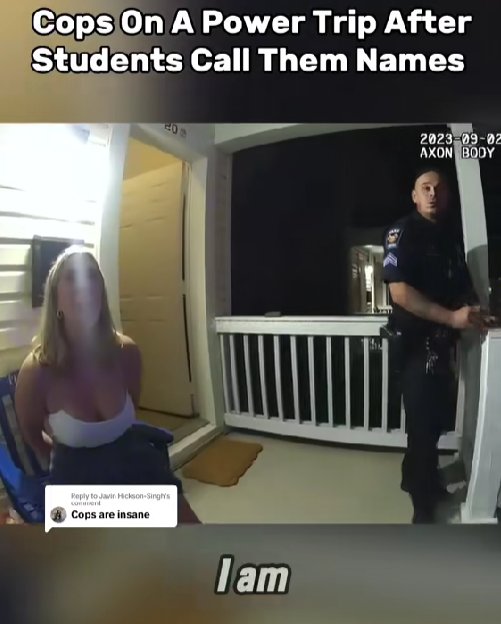

“Bodycam Sparks Outrage Debate: Late-Night Student Encounter Leaves Viewers Divided!”
A late-night bodycam video is causing a massive wave of online debate after capturing a tense interaction between police officers and a group of students outside an apartment complex. The uploader framed the clip with the provocative caption “Cops On A Power Trip After Students Call Them Names,” a line that has fueled heated arguments across TikTok, Instagram, and YouTube. But as with many viral clips, the footage shows only a fraction of what happened, leaving viewers piecing together the context on their own.
The video opens on a dimly lit porch, where a young woman sits in a patio chair with her hands restrained behind her back. Her expression is a mix of frustration and disbelief. She appears to be trying to explain herself as officers stand nearby. The porch light casts sharp shadows across the area, adding to the intensity of the moment. One officer stands near the doorway, maintaining a calm but firm posture as he speaks to someone off-camera.
The clip suggests that the confrontation began after several students allegedly used insulting language toward officers, but the footage does not show the earlier part of the interaction. That missing context has become a major point of discussion online. Without seeing what led up to this moment, viewers are left to interpret the situation based on body language, tone, and snippets of dialogue.
Throughout the footage, the officers appear measured and procedural. They issue instructions without raising their voices, and there is no visible physical conflict. Still, the decision to detain the young woman has sparked intense reactions. Some viewers believe the officers were responding to behavior they deemed disorderly, while others interpret the video as an overreaction to verbal insults.
Experts in police-community relations note that situations involving alcohol, late-night gatherings, and emotional students can escalate quickly. What begins as verbal frustration can sometimes cross into behavior officers feel obligated to address. At the same time, critics argue that officers must show restraint and avoid allowing emotion to influence their decisions. Because the full interaction isn’t shown, both interpretations continue to circulate simultaneously.
The young woman in the clip appears upset but not aggressive. At one point, she leans slightly forward, speaking rapidly as if trying to clarify her side of the story. Her tone is urgent but not confrontational. This has led many viewers to express sympathy, emphasizing the stress and embarrassment a college student might feel in such a moment.
Meanwhile, the comment sections have exploded with strong opinions. Some defend the officers’ professionalism, saying they appeared calm and followed protocol. Others accuse the uploader of exaggerating the situation for views. The lack of beginning-to-end context has only amplified the controversy.
As more bodycam videos surface from the same night, viewers hope to understand what prompted the officers’ response and whether the students’ comments played a significant role. For now, the clip stands as yet another example of how quickly narratives form online—and how one short moment can ignite a nationwide debate about authority, responsibility, and the power of edited footage.