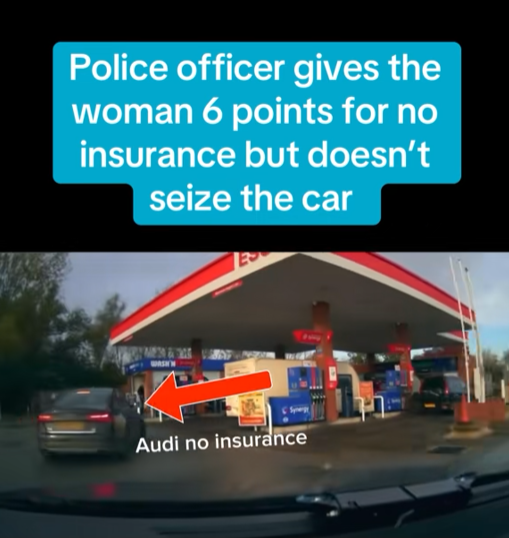

Police Officer Issues 6 Points for No Insurance — But Leaves the Car on the Road, Sparking Major Backlash
A routine traffic stop has ignited widespread debate after a police officer issued a woman six penalty points for driving without insurance — yet chose not to seize the vehicle. The incident, captured on dashcam footage near a busy petrol station, has left many questioning how traffic laws are enforced and whether discretion is being applied consistently.
According to the information shown in the footage, the woman was driving an Audi that was confirmed to be uninsured. Under standard road traffic regulations in many jurisdictions, driving without insurance is considered a serious offense. In most cases, police have the authority not only to issue penalty points and fines, but also to immediately seize the vehicle to prevent further unlawful driving.
In this case, however, the officer opted for a different approach. The driver received six points on her license — a significant penalty that can push some motorists dangerously close to a driving ban — but the car itself was not taken off the road. Instead, she was allowed to remain at the petrol station with the vehicle still in her possession.
The decision has triggered strong reactions online. Many viewers argue that the enforcement appeared incomplete, pointing out that an uninsured vehicle left accessible can still pose a risk to other road users. Critics say the purpose of seizing uninsured cars is to stop repeat offenses immediately, not simply to punish them on paper.
Others, however, have defended the officer’s actions. Supporters suggest that situational discretion may have played a role, such as the driver being parked safely off the main road or making arrangements for insurance or vehicle recovery. Some also point out that officers often have to make judgment calls based on available resources, safety concerns, and the specific circumstances at the scene.
Legal experts note that while six points is a heavy penalty, enforcement policies can vary depending on location and departmental guidelines. In some regions, seizure is mandatory, while in others it is strongly recommended but still left to officer discretion. This gray area is what often leads to public confusion — and controversy — when similar cases are handled differently.
The footage has also reopened discussions about fairness and consistency in policing. Social media users have questioned whether the outcome would have been the same if the driver had been younger, driving a cheaper car, or stopped in a different area. While there is no evidence of misconduct, the perception of unequal enforcement has fueled frustration.
Driving without insurance is not a victimless offense. If an accident occurs, uninsured drivers can leave others facing massive financial losses, medical bills, and legal battles. That reality is why many believe strong, immediate enforcement is necessary.
Police departments regularly emphasize that discretion is a key part of law enforcement, but incidents like this highlight the tension between flexibility and public expectations of strict rule application. When discretion is used, transparency becomes crucial to maintaining trust.
As the clip continues to circulate, it serves as a reminder that even seemingly small roadside decisions can quickly become viral flashpoints. Whether the officer’s choice was reasonable or a missed opportunity to enforce the law more firmly remains a matter of public debate — one that shows no sign of slowing down.