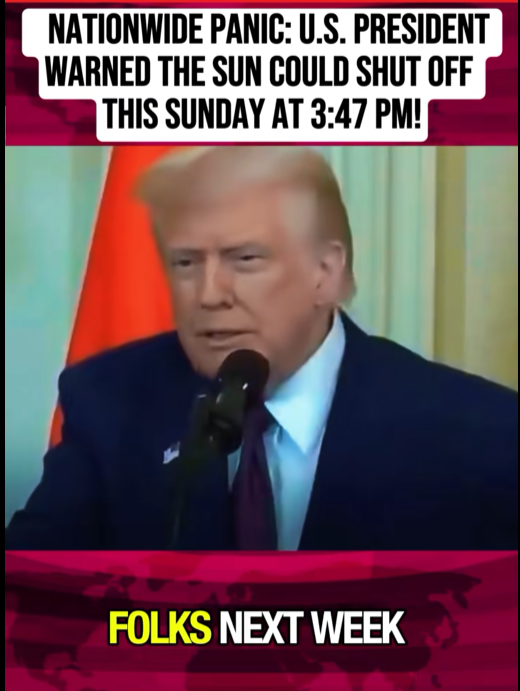

Nationwide Panic Erupts After Claim the Sun Could “Shut Off” at a Specific Time This Sunday
A shocking claim spreading rapidly online has sparked confusion and fear, after a viral post suggested that the U.S. president warned the public that the sun could shut off this Sunday at exactly 3:47 PM. The dramatic headline, paired with official-looking footage, caused many viewers to panic before stopping to question the science behind the statement.
The clip circulating on social media appears to show a presidential speech, edited with bold graphics and urgent language designed to provoke alarm. The message implies an impending global event so severe that it would affect all life on Earth. Unsurprisingly, the post quickly gained traction, with users sharing it alongside messages expressing fear, disbelief, and even preparation for the end of the world.
However, scientists and experts were quick to shut down the claim.
Astrophysicists confirm that the sun cannot simply “turn off”, nor can any human authority predict or control such an event. The sun is a massive nuclear fusion reactor, burning hydrogen into helium over billions of years. Its lifecycle is measured in astronomical timescales, not minutes, hours, or days.
“There is no scenario in which the sun suddenly shuts off on a Sunday afternoon,” one expert explained. “If the sun were to fail, which it won’t for billions of years, life on Earth would already be long gone. This claim is pure fiction.”
The clip appears to be a misleading edit, combining unrelated speech footage with sensational text meant to generate clicks, fear, and engagement. This tactic has become increasingly common, especially on short-form video platforms where attention-grabbing headlines often matter more than accuracy.
Despite the claim being scientifically impossible, the emotional impact was real. Comment sections filled with worried users asking if they should stay home, stock supplies, or warn loved ones. Others expressed anger, accusing leaders of hiding information or preparing for disaster behind closed doors.
Misinformation experts warn that posts like this are dangerous not because they are believable to experts, but because they exploit fear and uncertainty. “When people see authoritative imagery paired with dramatic claims, critical thinking often gets bypassed,” one analyst noted.
This incident highlights a growing problem: viral panic content designed purely to shock. By using urgent countdowns, exact times, and authoritative figures, these posts tap into primal fears and spread faster than fact-based corrections.
Platforms and fact-checkers have since flagged the claim as false, urging users to verify information before sharing. Many science educators also took the opportunity to explain how the sun actually works, turning panic into a teachable moment.
In reality, Sunday will come and go like any other day. The sun will rise, function normally, and continue doing what it has done for over 4.5 billion years.
The real lesson from this viral scare is not about space or astronomy, but about media literacy. In an age where anyone can edit a video and add a dramatic headline, the responsibility to question, verify, and pause before reacting has never been more important.
While the headline may have promised catastrophe, the truth is far less dramatic — and far more reassuring.