
“‘Sovereign Citizen’ Tries Courtroom Wordplay — The Judge Shuts It Down Instantly”
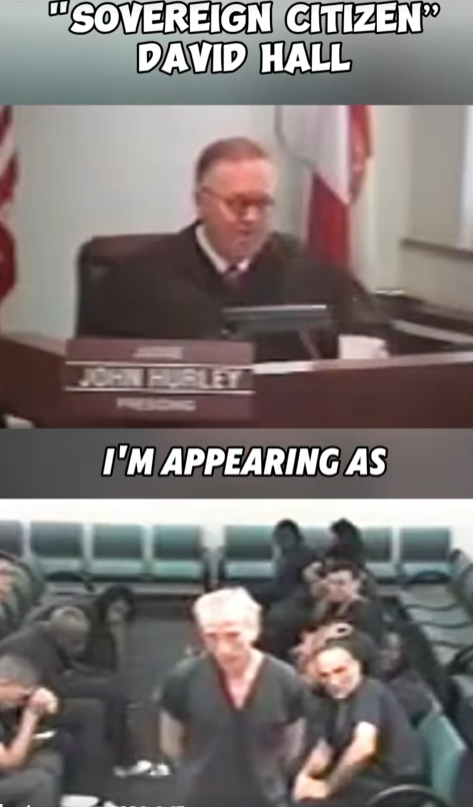
A courtroom clip featuring a self-described “sovereign citizen” is going viral once again, and viewers can’t stop watching the moment when legal fantasy collides head-on with reality. The image shows a judge seated at the bench, visibly unimpressed, while the defendant below appears confident, even defiant, as he begins one of the most familiar lines associated with sovereign-citizen ideology: “I’m appearing as…”
That phrase alone was enough to set the tone.
The man, identified in the clip as David Hall, appears to believe that carefully chosen words can exempt him from the court’s authority. Sovereign-citizen arguments often rely on technical language, imagined distinctions between a “person” and a “corporate entity,” or claims that courts lack jurisdiction unless certain conditions are met. In online videos, these tactics are often portrayed as clever loopholes. In real courtrooms, they rarely last more than a few seconds.
This clip is no exception.
As the defendant begins his statement, the judge listens briefly, then interrupts. The expression on the bench shifts from neutral patience to firm finality. Viewers familiar with these cases immediately recognize what’s coming next: a blunt reminder that the court does not recognize made-up legal identities, alternative citizenship claims, or semantic tricks.
Online commenters have labeled the moment “painfully satisfying.” Many noted how calmly the judge shuts down the argument without raising his voice or engaging in debate. There is no back-and-forth, no philosophical discussion — just a clear assertion that the court has jurisdiction and the case will proceed whether the defendant agrees or not.
The lower portion of the image shows the defendant standing among other detainees, a stark contrast to the confident posture seen moments earlier. That visual contrast has fueled much of the clip’s appeal. To viewers, it represents the exact second when illusion collapses and consequences take over.
Legal experts have long warned that sovereign-citizen beliefs can lead people into serious trouble. Courts across the country have repeatedly ruled that such arguments have no legal basis. Judges are trained to recognize them immediately, and persistence often results in contempt charges, additional penalties, or simply a faster path to conviction.
Still, the movement persists online, fueled by viral clips that selectively show moments of confusion or delay, rather than outcomes. That’s why clips like this resonate so strongly — they show the ending most videos leave out.
Comment sections are filled with reactions ranging from humor to frustration. Some viewers laugh at the predictability of the exchange. Others express concern, noting that many people genuinely believe these ideas and are misled by misinformation. A common refrain appears again and again: “The law isn’t a magic spell — you can’t just say the right words and walk free.”
What makes this clip particularly compelling is how quickly it unfolds. There’s no dramatic outburst, no yelling. Just a short attempt at asserting imaginary authority, followed by the judge’s refusal to entertain it. In that silence, the reality of the justice system becomes unmistakably clear.
As the video continues to circulate, it serves as both entertainment and cautionary tale. The courtroom is not a debate stage, and legal consequences are not optional. No matter how confidently someone declares themselves outside the system, the system does not return the favor.
For viewers, the takeaway is simple and sobering: in court, reality always wins — and wordplay won’t save you.