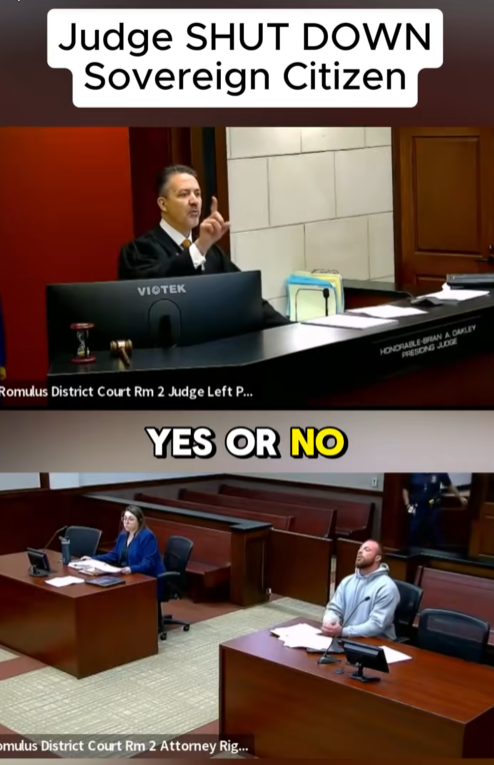

“Judge Shuts Down ‘Sovereign Citizen’ in Seconds — One Question Ends the Argument”
A courtroom clip is gaining traction online after a judge decisively shut down a self-described “sovereign citizen” with a single, no-nonsense approach. The video, labeled “Judge SHUT DOWN Sovereign Citizen,” shows a moment many viewers say perfectly captures how quickly legal theories fall apart when they meet real court procedure.
The scene opens with the judge leaning forward at the bench, finger raised slightly, speaking with firm clarity. Across the screen, bold text reads: “YES OR NO.” That phrase becomes the turning point. Viewers familiar with sovereign-citizen arguments immediately recognize what’s happening — the judge is refusing to engage in wordplay, philosophy, or circular logic.
Sovereign-citizen tactics often rely on avoiding direct answers. Defendants may claim they don’t “consent” to jurisdiction, assert alternative identities, or attempt to redefine basic legal terms. In many viral clips, these exchanges drag on, creating the illusion that the court is unsure. This clip is different.
Here, the judge doesn’t debate. He narrows the issue and demands a direct response.
The lower half of the video shows the defendant seated at a table, posture tense, eyes forward. An attorney sits nearby, while court staff wait. When faced with the judge’s repeated insistence on “yes or no,” the defendant appears cornered. There’s no room for speeches. No escape into semantics.
Online commenters praised the judge’s method. “This is how you stop the nonsense,” one wrote. Another added, “Courts don’t need to argue — they need answers.” Many viewers said the clip was satisfying precisely because it stripped the situation down to its core: comply with procedure or face consequences.
Legal experts echoed that sentiment. Courts operate on rules, not beliefs. Jurisdiction is established by law, not agreement. When a judge asks a direct procedural question, refusal to answer can result in contempt, waiving rights, or adverse rulings. The system doesn’t pause to accommodate alternative legal theories.
What makes the clip compelling is how fast the shift happens. At the start, the defendant appears confident, possibly expecting a prolonged exchange. Within moments, the dynamic changes. Authority is reasserted, and the path forward becomes unavoidable.
Viewers also noted the judge’s tone. There’s no yelling, no sarcasm. Just firm repetition. “Yes or no.” It’s a reminder that control in a courtroom doesn’t come from volume — it comes from structure.
The video has sparked renewed discussion about misinformation online. Many people adopt sovereign-citizen ideas after watching edited clips that omit outcomes. This clip, however, shows the part often left out: the shutdown. The moment when the court makes it clear that belief systems do not override law.
As the clip continues to circulate, it’s being shared as both entertainment and warning. For some, it’s cathartic to see confusion replaced with clarity. For others, it’s a reminder that trying to out-argue the legal system with internet theories can make situations far worse.
The takeaway is simple and unmistakable: in court, answers matter. When a judge asks a direct question, there are only two acceptable responses — and neither of them involves rewriting the law.
Sometimes, all it takes to end an argument is three words spoken calmly and repeatedly: yes or no.