
“Everyone Else Flooded — One Homeowner Built a Berm and Saved the Entire House”
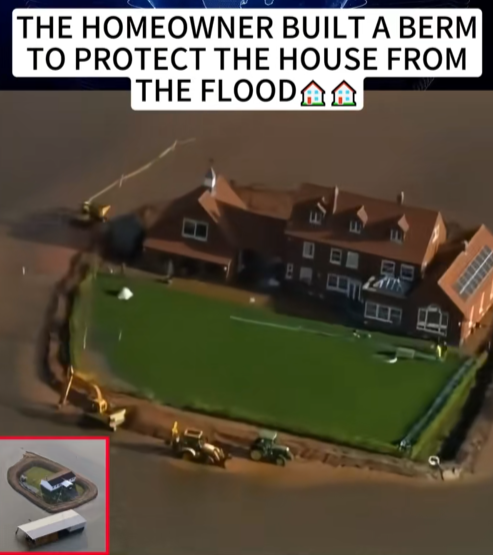
An aerial image spreading across social media has left viewers stunned. In the middle of widespread flooding, where muddy water swallowed roads, fields, and neighboring properties, one house stood dry — perfectly intact — surrounded by a carefully built earthen barrier. The caption says it all: “The homeowner built a berm to protect the house from the flood.” And the result looks almost unreal.
From above, the property resembles an island. Brown floodwater stretches in every direction, yet inside the ring of compacted soil lies a bright green lawn and an undamaged home. Construction equipment appears frozen in place along the berm’s edge, suggesting a race against time that this homeowner clearly won.
A berm, for those unfamiliar, is a raised embankment made from earth or other materials designed to block or redirect water. It’s not a new concept — farmers, engineers, and flood-control planners have used berms for centuries. What makes this case remarkable is the scale, speed, and precision with which it was deployed around a single residential property.
According to commentary shared with the image, the homeowner acted early. As flood forecasts worsened, heavy machinery was brought in to carve a continuous ring around the house. Soil was compacted, shaped, and reinforced to withstand rising water levels. While others evacuated or hoped for the best, this homeowner chose preparation.
The contrast is striking. Outside the berm: destruction, isolation, uncertainty. Inside: dry ground, standing structures, and a sense of control. Viewers online have called it “genius,” “next-level planning,” and “the definition of working smarter.” Others joked that the house looks like it has its own moat — minus the castle.
But beyond admiration, the image has sparked serious discussion about flood resilience and personal responsibility. Climate events are becoming more intense and less predictable. Flood maps change. Infrastructure struggles to keep up. This case shows what proactive mitigation can look like when resources, timing, and knowledge align.
Experts point out that berms aren’t a universal solution. They require space, equipment, proper engineering, and — critically — permits in many regions. Poorly built berms can fail catastrophically or redirect water toward neighboring properties, creating new problems. Still, when done correctly, they can be highly effective as temporary flood defenses.
Some commenters raised ethical questions: is it fair for one property to stay dry while others flood? Others countered that preparedness shouldn’t be punished, and that governments encourage private mitigation precisely to reduce overall damage. If more homes had similar protections, the argument goes, total losses could be lower.
What’s undeniable is the visual impact. The image tells a clear story without words: anticipation beat reaction. Action beat hope. While many people were at the mercy of rising water, one homeowner changed the outcome with dirt, machinery, and planning.
The inset image circulating alongside the main shot — showing a small structure similarly ringed by a berm — reinforces the idea that this wasn’t luck. It was a deliberate strategy executed with intention.