
“Inside Japan’s Prisons — The Strict System That Breaks Even the Toughest Inmates”
Japan’s prison system has long been described as one of the strictest — and most psychologically demanding — in the world. While the country is often praised for its low crime rate and orderly society, what happens behind prison walls tells a very different story, one that many former inmates describe as relentless, rigid, and unforgiving.
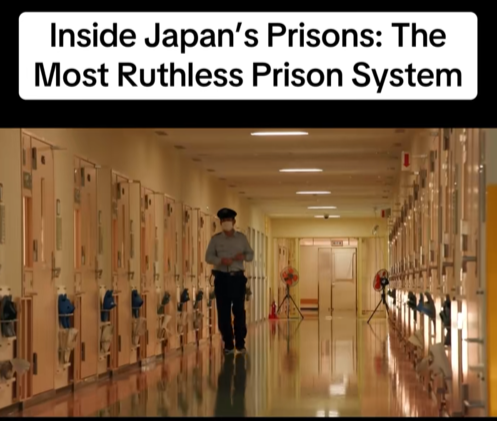
At first glance, Japanese prisons look clean, quiet, and meticulously organized. Long, polished corridors stretch between identical cells. Guards walk in measured steps. Everything appears calm. But that calm is enforced — and that’s where the system’s severity begins.
Unlike many Western prison systems, Japan places an extreme emphasis on discipline, obedience, and routine. Inmates are expected to follow rules down to the smallest detail. How you sit. How you walk. Where your eyes face. When you speak — and more importantly, when you don’t.
Silence is one of the most defining features. Prisoners are often forbidden from talking, even to each other, outside of strictly regulated times. Looking around unnecessarily can result in punishment. Speaking out of turn can lead to isolation or loss of privileges. Former inmates have said the constant suppression of basic human expression is more punishing than physical hardship.
Daily life runs on a rigid schedule that never changes. Wake-up times, meals, work, exercise, and sleep happen at exact moments. There is no flexibility. Even standing slightly out of posture during work duty can be considered disobedience.
Work itself is mandatory. Inmates are assigned repetitive, often monotonous labor — folding, assembling, or manufacturing the same items for hours on end. The work is not optional, and refusal or slow performance is treated as a serious violation. Mistakes are not corrected casually; they are disciplined.
Punishments in Japanese prisons are often psychological rather than violent. Solitary confinement is commonly used for rule-breaking. In some cases, inmates are required to sit motionless in a fixed position for hours or even days. Moving, stretching, or speaking during these periods can extend the punishment.
Former prisoners have described the system as designed not just to incarcerate, but to reshape behavior through pressure and control. The goal is total compliance. Authorities believe strict discipline reduces repeat offenses — and statistically, Japan does have one of the lowest recidivism rates in the world.
But critics argue that the cost is high.
Human rights organizations have repeatedly raised concerns about mental health impacts, lack of autonomy, and limited access to legal advocacy once incarcerated. Foreign inmates, in particular, report extreme isolation due to language barriers and cultural differences, making the experience even harsher.
Medical care has also been a point of controversy. Reports have surfaced over the years alleging delayed treatment and dismissal of inmate complaints, sometimes with tragic consequences. While reforms have been introduced, critics say progress is slow and oversight remains limited.
Supporters of the system argue that its strictness is exactly why it works. They point to Japan’s low crime rates, high public trust, and emphasis on responsibility. From this perspective, prison is not meant to be comfortable — it’s meant to correct.
Opponents counter that discipline should not come at the expense of dignity.
What’s clear is that Japan’s prison system operates on a fundamentally different philosophy than most. It relies less on physical force and more on psychological pressure, routine, and absolute control. For some inmates, it leads to reform. For others, it leaves lasting scars.
Behind the spotless corridors and perfect order lies a system that demands total submission — and for many who’ve lived through it, that’s what makes it one of the most ruthless prison systems in the world.