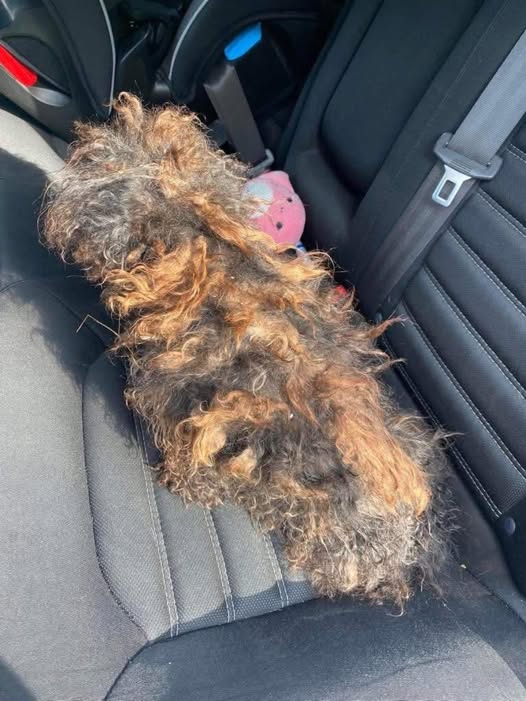
Hidden Beneath the Matted Fur!!
Long before she ever reached safety, the dog had already lost herself.
On the shoulder of a quiet Missouri road, she existed as little more than a moving mass of neglect—a dragging silhouette made of matted fur, hardened mud, and debris so thick it disguised her shape entirely. From a distance, she looked indistinguishable from the trash scattered along the roadside: discarded tires, broken branches, remnants of things forgotten. Only when she moved did it become clear that this was not refuse, but a living creature still trying to survive.
To the people who finally stopped, she was barely recognizable as a dog. Her body was entombed beneath years of compacted fur, each layer pressed tighter by rain, dirt, and time. The weight of it bent her posture and slowed her steps, as though she were carrying the physical manifestation of every day she had been ignored. She did not bark. She did not run. She simply existed—quiet, exhausted, and resigned.
When she was brought to Mac’s Mission, the transformation did not begin with hope or comfort or even a name. It began with release.
The team at the rescue had seen extreme cases before, dogs deemed “uncollectible,” written off as too broken to save. They approached her not with shock, but with a calm precision shaped by experience. In the grooming bay, the low hum of clippers filled the air—not as a cosmetic gesture, but as a form of rescue surgery.
The matting was far more than surface neglect. It had fused into dense plates that restricted blood flow and movement, pulling painfully at her skin with every step she took. Embedded within it were stones, burrs, dried clay, oil residue from the road, and traces of a life spent exposed to the elements. Removing it was slow, careful work. Every cut had to be deliberate. Every pass of the blade carried risk.
As the clippers worked through the layers, something remarkable happened. The dog did not resist. She did not growl or thrash or panic. Instead, her body softened in small, almost imperceptible ways. With each chunk of matted fur that fell to the floor, the tension she had been holding for years began to loosen.
What emerged underneath was not just a smaller dog—it was a history written in scars. Her skin was fragile and pale, unused to air or touch. Her muscles trembled as though they had forgotten what it felt like to move freely. One eye was missing entirely, a hollow reminder of an injury she had survived alone. Her frame was thin, her ribs too visible, her stance cautious, as if the ground itself could not be trusted.
Only after the burden was gone did they give her a name.
They called her Pear.
That first night, Pear revealed what years of deprivation had done to her instincts. When food was placed in front of her, she ate with urgency bordering on fear. Every bite was taken as if it might be the last. Her eyes flicked constantly around the room, tracking invisible threats, guarding the bowl even as her body shook from exhaustion.
When the food was gone, she did not pace or whine. She collapsed.
It was not sleep as most dogs experience it. It was surrender. Her body gave in completely, dropping into rest with a depth that suggested she had never truly slept before. For the first time in her memory, there was no need to stay alert. No cold pavement. No passing cars. No hunger clawing her awake. Just quiet, warmth, and safety she did not yet fully understand.
Later, the world would see the photos.
The “after” images showed a clean dog in a pink harness, her fur trimmed, her posture lighter, her tail beginning to wag. Online, the pictures spread quickly. People commented on the transformation, the beauty of rescue, the power of a haircut and compassion.
But those who were there knew the truth.
The real change wasn’t visible in photographs. It was internal. It was the slow, microscopic shift that happens when a being who has been discarded decides—cautiously, painfully—to try again.
Trust did not come easily to Pear, nor should it have. For weeks, she lived in a state of constant vigilance. She observed from a distance, memorizing patterns, flinching at sudden movements, watching hands carefully before allowing them near. She had to relearn what touch meant. She had known only the sharpness of neglect—the kind that cuts by absence rather than violence.
She needed time to understand that this new kind of “cut”—the clippers, the medical care, the exams—was not meant to harm her.
The breakthrough did not happen during grooming or feeding or walks. It happened quietly, one afternoon, in a moment so small it could have been missed.
A volunteer sat on the floor near Pear’s bed, doing nothing at all. No reaching. No coaxing. Just presence. Pear watched from her safe spot, her body rigid, her one remaining eye searching for danger.
Then, slowly, she stood.
Each step toward the human was deliberate, measured, as though the air itself were uncertain. When she reached the volunteer, she did not lick or jump or wag wildly. She leaned.
Her scarred side pressed gently against the volunteer’s leg, her weight shifting just enough to say, “I’m here.” It was a fragile, trembling gesture, but it carried more courage than any dramatic display of affection. In that moment, Pear chose vulnerability over isolation. She chose to believe that the hands that had freed her would not betray her.
From there, progress came in quiet increments. Pear learned how to move through space with one eye, trusting sound and scent to guide her. She learned that floors were solid, that food would come again, that names mattered. She learned that pain was no longer constant, and that rest did not require fear.
Her recovery was not a fairy tale. It was slow, structured, and demanding. Nutrition healed her body. Medication soothed old infections. But rebuilding her spirit was a task only Pear could do herself. The rescue provided safety; Pear provided resilience.
Today, she runs.
Not away from danger, not dragging the weight of neglect behind her, but forward—through grass, into open space, with a body finally unburdened. Her scars remain. Her missing eye remains. They are no longer symbols of shame, but proof of survival.
Pear is no longer a shadow on the roadside. She knows her name. She knows her worth. And she stands as a reminder that beneath even the most overwhelming neglect, something vital can still be waiting—quietly, patiently—for the moment it is finally seen.
Her miracle is not that she was saved.
Her miracle is that once she was free, she chose to stay.