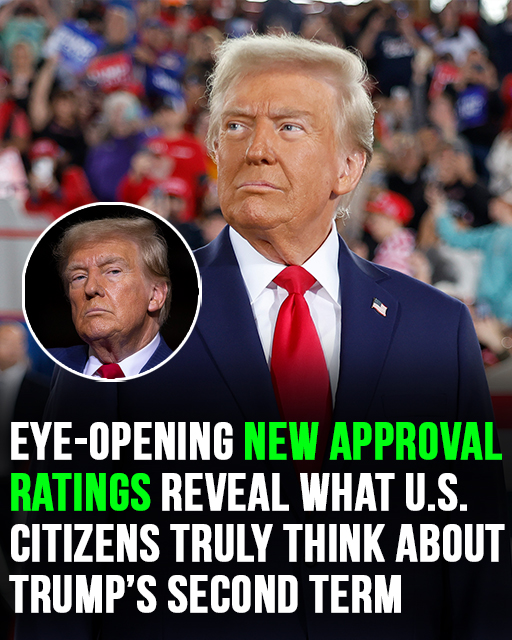
Eye-opening approval ratings reveal what Americans truly think about Trumps second term!
The prevailing narrative from the White House since January 2025 has been one of unmitigated triumph and historical restoration. To listen to President Donald Trump or his senior advisors is to hear a chronicle of a nation transformed: a landscape where aggressive tariff structures have replenished the federal treasury, energy costs have plummeted to historic lows, and the foundational pillars of American prosperity are being rebuilt at a pace that exceeds even the most optimistic campaign promises. This version of the American story is one of rapid-fire executive action and the assertive reclamation of national strength. However, as the administration enters the second year of its second term, a persistent and widening chasm has emerged between the President’s self-authored success story and the cold reality of public sentiment.
Donald Trump has long been a figure defined by his ability to bend the political narrative to his will, often utilizing a blend of hyperbole, selective data, and grand rhetorical gestures to project an image of invincibility. His administration is staffed by loyalists who have tethered their professional legacies to his populist movement, creating a cohesive internal front that insists the “Make America Great Again” agenda is functioning flawlessly.1 Yet, this unified front frequently operates in a vacuum, isolated from a public that remains profoundly skeptical of the administration’s methods and outcomes. The polarization that defined his first term has not only persisted but has calcified, creating a political environment where every policy victory claimed by the Oval Office is met with deep-seated doubt by a majority of the electorate.
This disconnect is most visible when analyzing the President’s exercise of executive power. Since returning to office, Trump has moved with a sense of urgency that his supporters view as decisive leadership and his critics view as an alarming expansion of imperial authority. His foreign policy, in particular, has taken on a tone that oscillates between isolationist “America First” rhetoric and surprisingly aggressive interventionist posturing. The President has frequently claimed that his presence alone serves as a global deterrent, preventing the outbreak of new international conflicts. Nevertheless, recent diplomatic maneuvers have sent shockwaves through the international community and domestic circles alike.
The renewed discourse surrounding the potential annexation of Greenland—a sovereign territory of Denmark, a key NATO ally—has resurfaced as a point of contention, reviving debates over the President’s respect for international norms.2 Simultaneously, the administration’s rhetoric regarding the capture of Venezuelan leader Nicolas Maduro has signaled a shift toward a more confrontational stance in the Western Hemisphere. These moves, while celebrated by his base as evidence of a “strongman” foreign policy, have left many Americans concerned about the long-term stability of traditional alliances and the risk of overextension.
On the domestic front, the administration has doubled down on its most controversial pillars, most notably immigration and trade.3 The hardline approach to border security and mass deportations has remained a focal point of Trump’s daily operations, drawing fierce legal challenges and sparking civil unrest in several states.4 Furthermore, the President’s penchant for remaining entangled in unresolved controversies—such as the lingering questions surrounding the full disclosure of the Epstein files—continues to provide fodder for his detractors. For many, these issues act as a ceiling on his popularity, making it nearly impossible for him to expand his appeal beyond his core demographic.
The statistical reality of this public divide was recently brought into sharp focus by a comprehensive AP-NORC poll conducted in early January 2026.5 The findings offer a sobering counterpoint to the administration’s claims of overwhelming public mandate. Despite a year of high-velocity policy changes and constant media saturation, the President’s approval ratings have remained remarkably stagnant. According to the data, only about four in ten Americans approve of his job performance. Specifically, as of January 8, 2026, 59 percent of U.S. adults expressed disapproval of his presidency, while only 40 percent viewed his performance favorably.
Perhaps most damaging for an administration that prides itself on economic “miracles” is the public’s assessment of the financial state of the union. While the President frequently touts a booming economy fueled by deregulation and trade protectionism, the American public is not feeling the prosperity.6 Only 37 percent of respondents approved of his handling of the economy, while 62 percent disapproved, suggesting that the “kitchen table” issues of inflation and cost of living continue to haunt the administration despite its optimistic messaging.7 This skepticism extends across nearly every major policy area: immigration approval stands at 38 percent against 61 percent disapproval; foreign policy sits at 37 percent approval; and his much-vaunted trade negotiations also hover at a 37 percent approval rating.
These figures illustrate a president who is effectively “stuck.” While Trump possesses an uncanny ability to dominate the news cycle and maintain the unwavering loyalty of a significant minority, he has failed to build the broad-based consensus usually required to sustain long-term national shifts. The data suggests that for every person who views his trade wars as a necessary defense of American labor, there are nearly two who view them as a source of economic instability. For every supporter who sees his immigration policies as a restoration of the rule of law, there are others who see them as a departure from American values.
This stalemate defines the current American political landscape. The President continues to broadcast a reality of “winning” and “unprecedented growth,” using his platform to bypass traditional media and speak directly to a base that views him as a singular savior. Conversely, the majority of the country perceives a nation in flux, characterized by aggressive executive overreach and economic uncertainty. The lack of movement in his approval ratings since March 2025 indicates that the American mind is largely made up; the first year of his second term has neither converted his enemies nor significantly deepened the pool of his supporters.
As the administration moves further into 2026, the question remains whether any shift in policy or global event can break this deadlock. Trump has never been a leader who seeks middle ground, preferring instead to lean into the friction that his policies create.8 He operates on the instinct that confidence is its own form of truth, believing that if he projects success loudly enough, the reality will eventually align with the rhetoric. However, with disapproval ratings holding steady near 60 percent, the administration is navigating a narrow path.
Ultimately, the story of Trump’s second term is not one of a unified nation moving toward a shared goal, but of a deeply fractured society watching two different versions of the same presidency. On one side is a White House convinced of its historic greatness; on the other is a public majority that remains unconvinced, skeptical, and increasingly critical of the direction in which the country is being led. The gap between these two realities is not just a matter of political disagreement—it is the defining characteristic of the modern American era, a period where the perception of truth is as divided as the electorate itself.