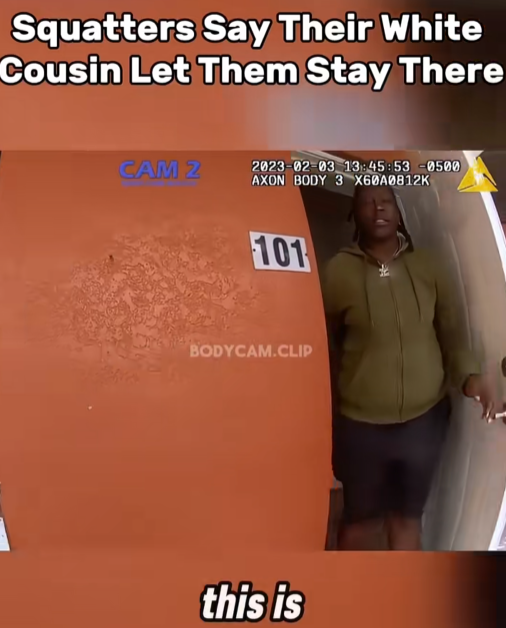

Squatters Confront Police, Claim Relative Gave Them Permission to Live There
Authorities were called to a residential property after reports surfaced that several individuals were occupying a unit without the homeowner’s consent. When officers arrived, they encountered a tense and confusing situation as the occupants insisted they had every right to stay—claiming a “white cousin” had given them full permission to live there. The exchange quickly escalated into a heated debate about legitimacy, ownership, and who truly had authority over the home.
According to the footage, officers approached the door of Unit 101, where one of the alleged squatters opened the door and immediately began defending their presence. She stated that a relative—who she described as the legal connection to the property—had allowed them to stay temporarily. However, officers explained that unless the homeowner directly confirmed this agreement or presented documented approval, the group’s story wouldn’t hold up legally.
The individuals inside the residence insisted they weren’t trying to break the law and claimed they had nowhere else to go, but the responding officers emphasized that occupying someone’s property without verified permission is still unlawful. Over recent years, squatting cases have surged across various states, leaving homeowners struggling with lengthy legal processes to reclaim their spaces. In many areas, squatters’ rights laws have made it even more challenging for property owners to remove unauthorized occupants once they’ve stayed beyond a certain period.
During the interaction, officers asked repeatedly for the name, contact information, and direct communication from the supposed cousin who allegedly granted them access. The group hesitated and failed to produce a phone number, written agreement, or any evidence to validate their claim. This only heightened suspicion and prompted officers to probe deeper into how long they had been staying there and whether they were aware the owner had reported them.
Neighbors later told authorities they had noticed unfamiliar people entering and leaving the property over the past weeks, raising concerns about safety and whether the home was being properly maintained. Some neighbors reported seeing lights on late at night or hearing loud conversations, elements that contributed to suspicion that the occupants were not legally residing there.
Officers attempted to handle the situation calmly, explaining that property disputes like this must be resolved through proper legal channels. If the owner chose to press charges or file an eviction, the individuals could face criminal trespassing accusations. Despite their insistence that they weren’t causing harm, their inability to prove authorization placed them in a precarious situation.
This incident highlights a growing national issue: the clash between housing instability and property rights. Many families facing hard times turn to relatives or acquaintances for temporary shelter, but without signed approval or legal documentation, they risk being labeled as trespassers. At the same time, homeowners grapple with the fear of losing control of their properties, sometimes spending months navigating eviction procedures.
As the investigation continues, authorities will determine whether the occupants will be formally removed or if the supposed relative will step forward to clarify the situation. Until then, this incident stands as yet another reminder of how quickly misunderstandings about property rights can spiral into full-blown legal disputes.