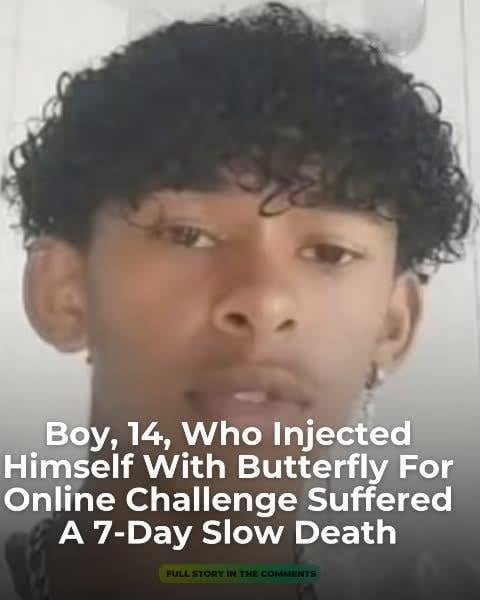

Boy, 14, who injected himself with butterfly for online challenge suffered a 7-day slow death!
In a quiet Brazilian city, the death of a 14-year-old boy unfolded not as a spectacle, but as a slow, deeply unsettling tragedy marked by silence, fear, and a devastating lack of understanding.
Davi Nunes Moreira was an ordinary teenager by every outward measure. He lived with his family, attended school, and navigated the same online world as millions of other young people his age. That digital world, however, would quietly shape a decision that ultimately cost him his life.
It began with symptoms that seemed confusing rather than catastrophic. Davi complained of intense pain. He vomited repeatedly. Walking became difficult, then nearly impossible. Alarmed, his family rushed him to the hospital. When doctors asked what had happened, Davi said he had been injured while playing. It was a plausible explanation, one that bought him time—but also delayed the truth.
Over the following days, his condition deteriorated. Pain intensified. His body weakened. Medical teams ran tests, searching for answers that didn’t quite add up. Nothing about his symptoms aligned cleanly with a simple injury. Something was poisoning his system, but no one yet knew what.
Only later—when the damage was already severe—did Davi admit what he had done.
He had injected himself with a substance made from a dead butterfly.
The admission stunned his family and left doctors scrambling. By the time the truth emerged, the opportunity for early, targeted intervention had likely passed. Whatever entered his bloodstream had already spread through his body, triggering a cascade of reactions medicine could no longer fully control.
Davi spent seven days in the hospital. Seven days of pain, confusion, and rapidly failing health. Despite intensive care, his condition worsened. His organs began to struggle. Treatments were administered without certainty of what they were fighting against. In the end, his body could not recover. He died quietly, far from the viral attention that may have influenced his actions in the first place.
After his death, medical specialists spoke carefully. The precise mechanism that killed Davi was difficult to pinpoint. Several possibilities were considered: a severe bacterial infection, a toxic reaction to organic compounds, septic shock, or an embolism caused by foreign material entering the bloodstream. What they agreed on was this: injecting an unknown organic substance directly into the body is extraordinarily dangerous, especially for a child.
Butterflies, like many insects, contain complex biological compounds. Some species carry toxins as a defense mechanism. Even when not overtly poisonous, decomposing organic matter can harbor bacteria capable of overwhelming the immune system when introduced directly into the bloodstream. Unlike ingestion, which allows the digestive system and liver to filter and neutralize threats, injection bypasses the body’s natural defenses entirely.
In Davi’s case, whatever entered his body did not belong there—and his system reacted violently.
What makes this story particularly painful is not only how Davi died, but why he delayed telling the truth. Fear played a central role. Fear of punishment. Fear of embarrassment. Fear of disappointing his family. Like many teenagers, he believed he could manage the consequences on his own. By the time he realized he couldn’t, the window for effective help had narrowed dangerously.
Authorities later confirmed that Davi’s action was linked to an online challenge circulating on social media. These challenges often thrive on shock value and secrecy, encouraging participants to perform increasingly extreme acts for attention, validation, or curiosity. They are rarely framed with context, consequences, or medical reality. For adolescents—whose brains are still developing impulse control and risk assessment—this combination can be lethal.
Davi’s death did not happen instantly. It unfolded over days, each one marked by suffering that might have been mitigated had full information been available earlier. Doctors were not negligent. His family was not indifferent. The tragedy lay in the gap between action and disclosure—a gap widened by shame and fear.
In the aftermath, his community was left grappling with grief and disbelief. Parents questioned how something so extreme could happen unnoticed. Educators and health professionals renewed calls for open conversations about online behavior, bodily autonomy, and the dangers of misinformation. Social media platforms faced renewed scrutiny over how quickly dangerous trends spread and how slowly safeguards are implemented.
Yet beyond policy debates and warnings lies a quieter lesson—one that does not rely on outrage or spectacle.
Teenagers do not always understand that curiosity can be fatal. They often underestimate how fragile the human body truly is. They may believe that pain is temporary, that consequences are exaggerated, or that adults simply “don’t get it.” Davi’s story shows how quickly that illusion can collapse.
His death was not dramatic. It was not instant. It was prolonged, confusing, and devastating.
And it did not need to happen.
Introducing unknown substances into the body—especially through injection—is not experimentation. It is a direct gamble with life. Medicine is precise for a reason. Sterility, dosage, and biological compatibility are not suggestions; they are safeguards built on centuries of hard-learned knowledge.
Davi was a child navigating a world that often rewards recklessness with attention and punishes honesty with shame. His final days reflect not only a medical emergency, but a broader failure to equip young people with the tools to recognize danger and speak up without fear.
His story is now a warning written in loss rather than words.
Not every online trend is harmless. Not every secret stays small. And not every mistake can be undone.
Davi Nunes Moreira did not die chasing fame. He died trapped between curiosity and fear, in a moment where silence proved more dangerous than truth.