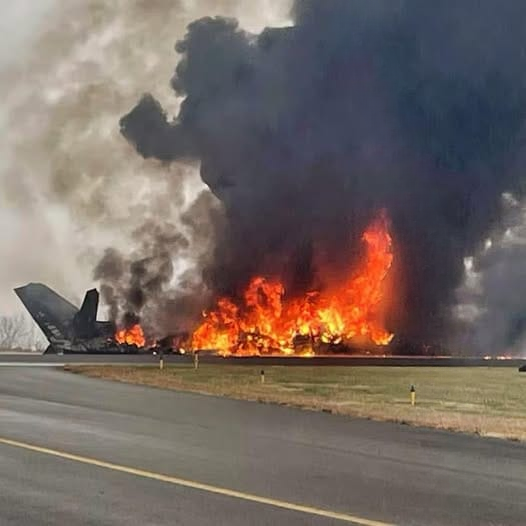

Cargo Aircraft Accident in Kentucky Prompts Federal Investigation and Statewide Response
On a quiet winter evening in Kentucky, operations at one of the nation’s most important logistics hubs were abruptly interrupted by a devastating aviation incident. A cargo aircraft operating for United Parcel Service (UPS) was involved in a catastrophic accident shortly after departure from Louisville Muhammad Ali International Airport, triggering a large-scale emergency response and a comprehensive federal investigation.
The incident has drawn national attention due to the aircraft involved, the scale of the response, and the broader implications for aviation safety and cargo operations. While investigators caution that it is too early to draw conclusions, the event has already had a profound impact on families, first responders, airport operations, and the surrounding community.
Overview of the Incident
The accident occurred in the early evening hours, shortly after 5:00 p.m., when a UPS-operated MD-11 cargo aircraft was attempting to depart Louisville Muhammad Ali International Airport on a scheduled flight. According to preliminary information released by aviation authorities, the aircraft encountered a serious malfunction during the takeoff phase.
Witnesses in the vicinity reported seeing the aircraft struggle to gain altitude before descending rapidly near the runway area. Emergency alarms were activated immediately, and airport personnel initiated established emergency protocols.
The aircraft was transporting standard commercial cargo and a substantial quantity of aviation fuel for a long-haul flight. Officials have emphasized that no hazardous materials were listed on the manifest.
Emergency Response and Initial Actions
Within minutes of the incident, multiple emergency units converged on the scene. Fire and rescue crews from Louisville Metro Fire and EMS were among the first responders, supported by airport emergency teams and mutual aid agencies from surrounding jurisdictions.
The response also included assistance from the Kentucky National Guard and state emergency management officials, who helped secure the area and support firefighting efforts. Due to the volume of fuel involved, the resulting fires required extensive resources and coordination to bring under control.
Authorities quickly established a secure perimeter around the site to ensure public safety and allow responders to work effectively.
Transition from Rescue to Recovery
As emergency crews worked through the night, officials gradually shifted from rescue operations to recovery efforts. This transition was made only after exhaustive searches confirmed that no additional survivors could be located.
State officials acknowledged the difficult nature of this phase, emphasizing respect for those affected and gratitude for the professionalism of emergency personnel.
The focus turned toward accounting for all individuals involved, stabilizing the area, and preparing for a detailed investigation.
Casualties and Victim Identification
UPS confirmed that the aircraft was crewed by experienced aviation professionals. All crew members on board the aircraft were confirmed deceased as a result of the accident.
In addition to the flight crew, authorities confirmed fatalities and injuries among individuals in nearby industrial facilities impacted by the crash. As of official updates released the following day:
- Fourteen fatalities have been confirmed
- Fifteen individuals were transported to medical facilities with injuries
- Two injured persons remain in critical condition
- Several individuals were initially listed as unaccounted for, pending verification
Officials stressed that casualty numbers are subject to confirmation as identification efforts continue.
Family assistance centers were established to provide support, information, and counseling services to loved ones of those affected.
Impact on Nearby Businesses and Infrastructure
The crash site was located near industrial properties adjacent to the airport. Two businesses sustained significant damage, including structural impacts and fire-related destruction.
While no residential neighborhoods were directly affected, the incident disrupted nearby transportation routes and temporarily affected air quality in surrounding areas. Authorities coordinated traffic rerouting and issued advisories as a precaution.
Environmental assessment teams were deployed to evaluate potential impacts related to fuel runoff, debris, and air particulates. Initial testing indicated that water systems and air quality remained within safe parameters.
Airport Operations and Travel Disruptions
Louisville Muhammad Ali International Airport temporarily suspended all flight operations immediately following the accident. This measure allowed emergency responders full access to the area and ensured safety for airport staff and passengers.
Within 24 hours, some runways were reopened following inspections. However, delays and cancellations persisted as safety checks continued.
Airport officials urged travelers to monitor airline communications and allow additional time for travel. Cargo operations, which represent a significant portion of the airport’s activity, were gradually restored under enhanced oversight.
Role of Federal Investigators
The National Transportation Safety Board (NTSB) assumed leadership of the investigation, working in coordination with the Federal Aviation Administration (FAA). These agencies are responsible for determining the probable cause of the accident and issuing safety recommendations.
Investigators recovered the aircraft’s flight data recorder and cockpit voice recorder, commonly referred to as “black boxes.” These devices were transported to a secure laboratory for analysis.
Officials emphasized that investigations of this nature are complex and methodical, often requiring months of technical review.