Mamdani Issues First Executive Order, Vows To Deliver On Socialist Promises!

New York City’s new mayor wasted no time easing into the job. Within hours of taking office, Zohran Mamdani put pen to paper and signed his first executive orders, making it clear that his campaign promises were not rhetorical flourishes but a governing blueprint. The message was unmistakable: the era of cautious, incremental housing reform was over, and City Hall was choosing sides.

At the center of Mamdani’s opening moves was housing—specifically, the crushing cost of rent that has reshaped life in New York for decades. For millions of tenants, housing has become a monthly gamble between stability and displacement. For landlords and real estate investors, it has long been a lucrative system protected by complexity, influence, and political inertia. Mamdani’s first day suggested that balance was about to be disrupted.

One of his earliest actions was the revival and expansion of the Mayor’s Office to Protect Tenants, an agency that had existed in diluted form but never with real teeth. Mamdani didn’t just restore it; he redefined its purpose. No longer a symbolic mediator, the office would act as an aggressive advocate for renters, offering legal support, enforcement muscle, and political backing against predatory practices. By appointing longtime housing organizer Cea Weaver to lead it, Mamdani signaled that lived experience and activism—not corporate ties—would guide policy.

Weaver’s appointment sent ripples through the city’s real estate world. Known for years of organizing tenants and pushing aggressive housing legislation, she represents the opposite of the technocratic, industry-friendly appointments that have historically populated City Hall. To supporters, her leadership means accountability. To critics, it’s a declaration of war.

Alongside the tenant protection office, Mamdani announced the creation of two task forces with bluntly functional names: LIFT and SPEED. The LIFT Task Force is charged with identifying every underused parcel of city-owned land that could be transformed into housing. Parking lots, vacant buildings, forgotten lots—nothing is off the table. The idea is simple and radical: if the city owns the land, the city should use it to house people, not sit on it while rents skyrocket.

The SPEED Task Force tackles a different problem—the bureaucracy that has slowed housing construction to a crawl. Permits, zoning reviews, environmental assessments, and overlapping agencies have turned even modest housing projects into decade-long ordeals. Mamdani’s directive is to cut through those delays, not by weakening safety standards, but by eliminating redundancy and political bottlenecks that serve no purpose beyond protecting entrenched interests.

Together, these initiatives form the backbone of Mamdani’s housing agenda: protect tenants where they live now, and flood the market with new, permanently affordable housing built on public land. It’s a strategy that challenges the assumption that private developers alone should control the city’s housing future.

The response was immediate and polarized. Tenant advocates and housing activists celebrated in the streets and online, calling the first executive orders a long-overdue correction. For them, Mamdani’s actions validated years of protest, organizing, and warnings that the city was becoming unlivable for anyone without wealth.

On the other side, landlords’ associations, real estate executives, and billionaire investors reacted with alarm. Some warned of capital flight, claiming that aggressive tenant protections would scare away investment and freeze development. Others framed the moves as an ideological crusade—proof that democratic socialism, once dismissed as symbolic, had arrived with governing power.

The stakes extend far beyond New York. Mamdani is not just a mayor; he is now the most prominent example of an openly democratic socialist governing America’s largest city. With figures like Bernie Sanders and Alexandria Ocasio-Cortez standing beside him, his administration is being watched as a national experiment. Supporters see a chance to prove that progressive economic policies can function at scale. Opponents see a warning sign of what could spread if the experiment succeeds.

What makes Mamdani’s approach especially controversial is not just the policies themselves, but the tone. He has rejected the language of compromise that often defines urban governance, instead speaking plainly about power. In his first remarks as mayor, he framed housing as a moral issue rather than a market problem, arguing that a city cannot claim to be thriving while its residents are one rent hike away from eviction.

That framing resonates deeply with tenants but unsettles those accustomed to City Hall treating housing as a negotiation between equally weighted interests. Mamdani has made it clear he does not see tenants and landlords as equals in need of balance; he sees one side as vulnerable and the other as dominant.

Critics argue that this approach risks backlash. They warn that aggressive regulation could lead landlords to defer maintenance, convert rental units to other uses, or challenge the city in court. Others point to New York’s reliance on property taxes and development fees, suggesting that antagonizing the real estate sector could strain city finances.

Mamdani’s supporters counter that these warnings are recycled threats used every time reform is proposed. They argue that decades of deference to developers produced a city where luxury towers rise faster than affordable homes, and where working families are pushed farther from the communities they built.

What happens next will determine whether Mamdani’s first-day momentum turns into lasting change or stalls under political and legal pressure. Lawsuits are expected. State-level conflicts may follow. And the practical challenge of actually building large amounts of affordable housing remains enormous.

Still, the opening chapter is unmistakable. Mamdani did not enter office cautiously, testing the waters or softening expectations. He moved immediately, deliberately, and publicly, signaling that his administration intends to govern with the same urgency it campaigned on.

For tenants struggling to stay in their homes, these actions represent hope translated into policy. For critics, they represent a turning point that could redefine urban governance in America. Either way, New York City has become the front line of a larger ideological battle—one that will test whether bold promises can survive the realities of power, resistance, and consequence.

The question now is not whether Mamdani meant what he said during the campaign. His first executive orders answered that. The question is whether New York—and the country watching it—are ready for what comes next.

BREAKING NEWS Just hours ago, a tremendous fire broke out in Ca…See more

BREAKING NEWS: Massive Fire Erupts in California, Forcing Evacuations and Prompting Statewide Response

Just hours ago, a tremendous fire broke out in California, rapidly spreading across dry terrain and sending thick plumes of smoke into the sky. The fast-moving blaze, fueled by strong winds and dry conditions, has already forced evacuations in nearby communities and triggered a large-scale emergency response from local and state authorities. As of this moment, officials say the situation is still developing, and crews are racing against time to contain the flames.

According to early reports, the fire ignited in a remote area before quickly advancing toward residential zones. Witnesses described scenes of chaos as flames leapt across hillsides and embers were carried far ahead of the main fire line. “It moved so fast,” one resident said. “Within minutes, the sky turned orange, and ash was falling like snow.” Emergency alerts were issued shortly after the fire was detected, urging residents to evacuate immediately and avoid major roadways to allow emergency vehicles to pass.

Firefighters from multiple departments were dispatched to the scene, supported by aircraft dropping water and fire retardant. Despite their efforts, challenging weather conditions have made containment difficult. Gusty winds continue to fan the flames, while low humidity has dried vegetation to a dangerous level. Fire officials warned that these factors could allow the blaze to grow significantly before crews can gain the upper hand.

Authorities have established evacuation centers for displaced residents, offering shelter, food, and medical assistance. Schools in the affected areas have been closed, and several major highways were temporarily shut down due to poor visibility and safety concerns. Power companies also shut off electricity in certain zones as a precaution, leaving thousands without power.

Local hospitals are on high alert, treating individuals for smoke inhalation and minor injuries related to the evacuation. While no fatalities have been confirmed at this time, officials stress that the risk remains high. “Our priority is protecting lives,” a spokesperson said during a brief press conference. “We urge everyone to follow evacuation orders and stay informed through official channels.”

The fire has already burned a significant stretch of land, threatening wildlife habitats and critical infrastructure. Environmental experts warn that the long-term impact could be severe, including soil damage, increased risk of mudslides, and air quality issues that may affect regions far beyond the immediate fire zone. Air quality advisories have been issued, recommending that residents limit outdoor activities and use masks if necessary.

California’s governor released a statement acknowledging the seriousness of the situation and confirming that state resources have been mobilized. Additional firefighting crews and equipment are being deployed, and coordination with federal agencies is underway in case further assistance is needed. “We are doing everything possible to support our firefighters and keep communities safe,” the statement read.

This latest fire comes amid growing concerns about the frequency and intensity of wildfires across the state. Experts have long warned that climate change, prolonged droughts, and expanding development in fire-prone areas are creating conditions for more destructive fires. Each new incident reignites debates over prevention, forest management, and emergency preparedness.

Residents who escaped the fire’s path described heartbreaking scenes of leaving their homes behind with little more than what they could carry. “You don’t know if you’ll come back to anything,” said one evacuee at a local shelter. Volunteers and relief organizations have stepped in to provide support, while community members are sharing updates and offering help through social media.

As night approaches, firefighters face an even more dangerous battle. Reduced visibility and shifting winds can complicate containment efforts, but crews are expected to work through the night to protect homes and critical structures. Officials say the next 24 hours will be crucial in determining whether the fire can be brought under control.

Authorities continue to urge the public to stay away from affected areas, follow evacuation orders promptly, and rely on verified updates rather than rumors. With conditions still volatile, the situation remains fluid, and more information is expected as emergency teams assess the fire’s progress

My doorbell rang at 7 AM on a freezing Saturday morning, I was ready to give someone a piece of my mind!

The doorbell had rung at exactly seven in the morning, sharp and insistent, cutting straight through the quiet of a freezing Saturday. At the time, I was furious. Saturdays were sacred—especially in winter—one of the few chances to sleep in after a long workweek. I remember pulling on a sweatshirt, already rehearsing the irritated words I planned to deliver to whoever thought that hour was acceptable.

When I opened the door, no one was there.

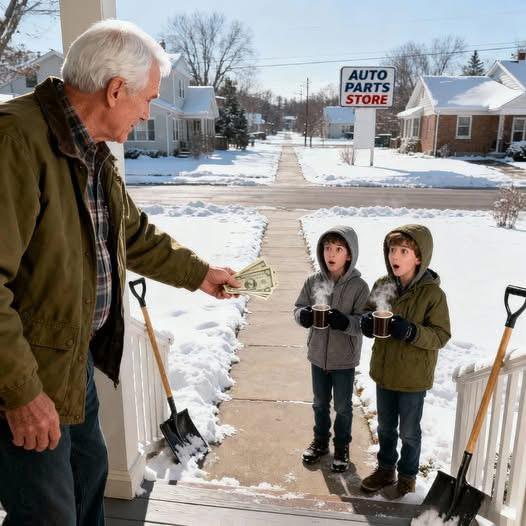
Just cold. Bitter, biting cold that rushed inside like it had been waiting for permission. Snow covered the ground in thick, uneven sheets, the kind that squeak under your boots and sting your fingers within seconds. At the edge of my driveway stood two boys—maybe thirteen and ten—holding shovels nearly as tall as they were. Their cheeks were red, noses running, breaths coming out in fast white bursts.

Before I could say anything, the older one blurted out, “We can shovel your driveway, sir. Real quick. We don’t need much.”

I looked at the time, looked at them, and sighed. I was still half-asleep and not in the mood to negotiate. I told them I didn’t need the help and that they should go home before they froze. They nodded politely, said “Yes, sir,” and trudged off down the street, boots sinking into the snow.

I thought that was the end of it.

But when I finally sat down with my coffee an hour later and looked out the window, my driveway was spotless. Not just cleared—clean. Every inch shoveled, edges sharp, even the walkway done. It was the kind of job most adults rush through and still leave half-finished.

The boys were gone.

I felt a twinge of guilt then, but life moved on. I assumed they’d been paid by someone else or that it was just kids being kids.

The next morning was even colder. The kind of cold that settles into your bones and doesn’t let go. I stood by the window again, coffee in hand, admiring the driveway, when something caught my eye near the front door. A folded piece of paper was wedged between the storm door and the frame, edges damp from frost.

Inside was six dollars. Three crumpled bills and a handful of coins.

And a note.

“Sir,
We came up $6 short for the battery.
We are very sorry.
We will pay you back every dollar we owe.
—Marcus and Leo”

I read it three times.

Six dollars.

It wasn’t the amount that hit me. It was the weight of it. The responsibility. The apology. The fact that two kids thought they owed a grown man money for work he never asked for—and felt so strongly about it that they left what little they had.

I stood there longer than I care to admit, staring at that note like it had cracked something open in me.

I grabbed my coat and headed back out into the cold.

I didn’t know where Marcus and Leo lived, but I had a feeling I knew where they’d gone. In a small town, there aren’t many places open early on a Saturday. The auto parts store was my best guess.

The bell above the door jingled as I stepped inside. Fluorescent lights hummed softly. A man behind the counter looked up and smiled with recognition.

“You looking for the Johnson boys?” he asked before I even spoke.

That surprised me. “You know them?”

He nodded. “Everybody does. Their mom’s a night nurse at the hospital. One of the hardest-working people I know. Helps anyone who needs it. Those boys? They’re cut from the same cloth.”

I swallowed. “Did they… did they get what they needed?”

The clerk leaned back, arms crossed. “Barely. They came in here shaking from the cold, dumped everything they had on the counter. Coins, wrinkled bills, even a couple of laundry tokens. They were short.”

My stomach dropped. “So what happened?”

“We covered it,” he said simply. “Couldn’t let them walk out empty-handed.”

I nodded, then asked the question that had been sitting heavy in my chest. “What did they say?”

The clerk smiled, shaking his head. “The older one—Marcus—looked me dead in the eye and said, ‘Sir, we’ll work it off. We shovel. We rake. We clean. Anything.’ Kid looked like he’d stand in front of a train for his family.”

That was it.

I thanked him, turned around, and sat in my truck for a minute before starting the engine. I didn’t trust myself to drive right away.

Later that afternoon, I found their house. It was small, worn, but neat. Snow piled up against the fence, toys scattered in the yard. I knocked.

Marcus opened the door, eyes widening when he saw me. Leo peeked out from behind him.

“I—sir—we’re really sorry about the money,” Marcus started, words tumbling over each other. “We didn’t mean to—”

I held up the note and smiled. “You don’t owe me anything.”

They froze.

I handed Marcus an envelope. Inside was the six dollars they’d left… and a lot more.

“This is for the work you did,” I said. “And for the next battery. And maybe a little extra.”

Marcus tried to hand it back. “We can earn it.”

“You already did,” I replied.

From behind them, their mother appeared. Tired eyes. Hospital badge still clipped to her jacket. She took in the scene quickly, understanding more than I said.

She thanked me quietly. I told her she didn’t need to.

That winter, Marcus and Leo shoveled half the neighborhood. But not for money—at least not always. Sometimes it was for elderly neighbors. Sometimes just because.

And every time I see that clean driveway after a storm, I think about six dollars. About pride. About honesty. About two kids who reminded me that character isn’t something you age into.

Sometimes it shows up at your door at seven in the morning, in the cold, with a shovel and a handwritten note—and changes how you see the world.

A Millionaire Gave Me a House for My Kids—But the Note He Left Behind Changed Everything

The day the eviction notice showed up, I didn’t cry right away. I stood in the hallway with the paper in my hand, staring at the bold letters like they belonged to someone else. The building smelled like old carpet and fried onions from the downstairs unit. A baby was crying somewhere behind a door. Someone’s TV blared a game show. Life kept moving while mine tilted off its axis.

That was what the notice said. Thirty days to get out.

I brought it into the kitchen and set it on the table like it might burst into flames. The room was already loud—five kids can turn a small apartment into a storm system. The twins were arguing over the last waffle. My youngest, Owen, was racing the dog in circles, shrieking with laughter. Jacob was trying to pour juice and missing the cup by an impressive margin. And Lily, my oldest, stood at the stove, stirring oatmeal with the grim concentration of a tiny adult.

“Mom,” she said without looking up, “you’re doing it again.”

“Doing what?” I asked, though I already knew.

“Going quiet,” she replied. She waved the spoon in front of my face, like she was trying to snap me awake. “You’re here, but you’re not here.”

I blinked and forced a smile. “I’m fine, sweetheart.”

Lily’s eyes narrowed. She’d inherited her father’s ability to spot a lie at twenty paces.

I wasn’t fine. I hadn’t been fine for two years—not since Ben died and the world quietly informed me it didn’t care. It didn’t care that he was only thirty-nine. It didn’t care that he’d been the steady part of our life, the calm voice, the paycheck that made groceries less of a math problem. It didn’t care that I’d watched his chest rise and fall slower and slower, begging the universe to take anything else instead.

After he was gone, everything became smaller: our budget, our options, my patience, my sleep. I stretched every dollar until it snapped. I sold the jewelry Ben gave me on our tenth anniversary. I took on extra shifts. I skipped meals so the kids wouldn’t notice there wasn’t enough. I became a woman who could smile while calculating how many days were left until the next bill was due.

And now we were being pushed out of the one place we could still call ours.

I shoved the eviction notice into a drawer before anyone else could see it. That’s what I’d gotten good at: hiding the sharp edges. But the weight of it sat on my shoulders all day. While I packed lunches. While I hunted for coupons. While I answered school emails and pretended I wasn’t terrified.

Three days before we were supposed to start packing our lives into trash bags, another envelope showed up in the mail.

It was plain white. No return address. My name written carefully across the front, like someone had taken their time.

Rebecca Thomas.

I stood in the hallway again, holding it like it might bite me. Most mail had become a slow drip of dread—past-due notices, final warnings, polite threats. This envelope looked different. Clean. Quiet. Almost… intentional.

I opened it.

Inside was an invitation to a gala at the Carlton Grand Hotel. Black tie. Formal. The kind of event I’d only seen on TV, where people laughed softly and held drinks like they were born holding them.

Hosted by Nicholas Devlin.

Even I knew the name. Tech billionaire. The kind of rich that made other rich people look ordinary. Reclusive, but famous for unpredictable charity—tuition paid off for strangers, medical bills erased, entire playgrounds built overnight. Half the stories sounded like myths, the kind people share online because it feels better to believe in magic.

At the bottom of the invitation was a single line that made my stomach turn.

This evening holds a gift for someone in need.

I read it twice. Then again. Like maybe the words would rearrange into something more reasonable.

“Mom?” Lily called from the kitchen. “What’s wrong?”

I walked in slowly, the invitation still in my hand. “I got invited to a gala.”

Jacob looked up, chewing. “A what?”

“A fancy party,” Lily said immediately, already translating. Her eyebrows lifted as she took the invitation from me and scanned it. “This is real?”

“I don’t know,” I said honestly. “But it has my name.”

My mother came by that night to help with the kids, and when I showed her the invitation, she stared at it for a long time. Then she looked at me like she was seeing the woman I used to be.

“Go,” she said. “Whatever this is, go.”

“I don’t even have a dress,” I muttered.

She smiled, small and stubborn. “You’ll find one. You always do.”

On the night of the gala, I squeezed into the one black dress I’d kept from a better life. It fit a little tighter than it used to and smelled faintly like storage. I pinned my hair back, put on mascara with a hand that shook, and stared at my reflection like I was watching someone attempt a role she didn’t deserve.

My mother hugged me at the door. “Maybe this is the beginning of something,” she whispered.

I wanted to believe her. I also wanted to not get my hopes up and then have them crushed like everything else.

The Carlton Grand looked like another planet. Valets in crisp uniforms, chandeliers that glittered like frozen fire, velvet ropes and polished marble and the kind of quiet that comes from people who don’t worry about money. I walked in and immediately felt like a mistake.

But then the room hushed.

Nicholas Devlin stepped onto the stage.

He wasn’t flashy. No loud smile, no politician’s charm. He had a stillness that made people lean forward. Tall, composed, eyes that didn’t wander. He spoke like someone used to being listened to.

“Thank you all for being here,” he said. “This evening isn’t about champagne. It’s about change.”

The crowd murmured approvingly.

“As part of a new initiative,” he continued, “I’ve decided to gift homes to a select few individuals—people who have carried heavy burdens and kept going anyway. Tonight, we start with one.”

My pulse started racing, even though it made no sense. I told myself to stop being dramatic.

Nicholas paused and looked straight into the crowd. Straight at me.

“Rebecca Thomas.”

For a moment, I couldn’t move. My brain refused the words. Then someone behind me whispered, “That’s you,” like they were confirming it out loud.

Nicholas’s voice carried cleanly through the room. “A widowed mother of five. A woman who has held her family together through loss and hardship. Rebecca, tonight, I’m offering you a home.”

The sound that followed was applause, but it felt far away, underwater. My throat tightened so hard I could barely breathe. I walked toward the stage on legs that didn’t feel like mine.

When I reached him, I finally managed, “Is this real?”

“It’s real,” he said, and there was something steady in his tone—no performance, no smirk. “You’ve done the impossible for your children. Let this be the ground beneath your feet again.”

I nodded because it was all I could do. Tears slipped down my face and I didn’t bother wiping them.

Two days later, I stood in front of a house I didn’t recognize as something that could belong to me.

A porch wide enough for a swing. Sunlight pouring through big windows. A backyard with a fence and a garden that looked cared for. The kids exploded into motion the moment we walked inside, racing down halls, opening doors, screaming like they’d found buried treasure.

“Mom!” Jacob yelled from the back. “There’s a pool!”

Owen shrieked and took off after him. The twins argued over who got which room. Lily stood beside me, quiet, her eyes taking in every detail like she didn’t trust it to stay.

“This is ours?” she asked softly.

I swallowed hard. “Yes. It’s ours.”

For the first time in years, my lungs felt full.

Then I went into the main bedroom and saw another envelope on the bed.

Same handwriting.

My stomach dropped.

I opened it with shaking hands.

Dear Rebecca,
This home is only the beginning. My project isn’t about giving away houses—it’s about giving people a voice. I’d like you to be the face of this initiative. Tell your story. Share your truth. Inspire others.
If you’re willing, the journey continues from here.
Warmly,
Nicholas Devlin

A cold part of my mind snapped awake. Of course there was more. Of course. Nothing comes free. Not really.

I walked back to the living room holding the note like evidence.

Lily looked up instantly. “What is it?”

“He wants us to go public,” I said. “He wants me to tell our story. Be the face of his campaign.”

Her mouth parted. “Like… TV?”

I nodded.

The room felt too quiet suddenly, like the house itself was listening.

Lily stared at the note, then at me. “Would it help other people?”

That question hit harder than the eviction notice ever did. Because she wasn’t thinking about pride or privacy. She was thinking about the families who were still trapped where we’d been.

“I think so,” I said, voice rough.

Lily nodded once, like she’d already decided. “Then do it. Tell them what it’s really like.”

So I said yes.

The next months moved fast. Nicholas launched the initiative—Second Start—and our family became the opening chapter. Cameras came to our new home. Reporters asked careful questions that still felt like knives. I sat in studio chairs under bright lights and talked about the nights I pretended to be asleep so the kids wouldn’t hear me cry. I described stretching pasta into three meals. The silence after Ben died—how grief doesn’t just hurt, it rearranges everything.

And people listened.

Not the way they listen to tragedy like entertainment, but the way they listen when something in them recognizes the truth. Letters poured in by the hundreds, then the thousands. Single moms. Single dads. Grandparents raising grandkids. People sleeping in cars. People rebuilding after violence. People drowning quietly.

One afternoon, Jacob ran into the kitchen waving a tablet. “Mom! You’re on again!”

I looked at the screen and saw myself standing in front of the house, Nicholas beside me, the kids pressed close. But something had shifted. The story wasn’t about a billionaire saving a poor family anymore. It was about what happens when people stop looking away.

Late at night, Lily joined me at the table with a stack of envelopes, her face serious.

“This one’s from Maine,” she said, opening it carefully. “A woman started volunteering at a shelter because of you.”

I read it and felt tears rise again—not from fear this time, but from the strange weight of being seen.

Another letter was from a single father who’d started a fundraiser for displaced families. A teen from Chicago wrote that she wanted to become a social worker. A retired teacher sent a hand-knit blanket with a note that simply said, You made me remember the world can change.

Lily looked at me, eyes shining. “Look what you did.”

I pulled her into my side. “No,” I said, and for once the words came without doubt. “Look what we did.”

We didn’t just get a house. We got our breath back. We got community. We got proof that surviving wasn’t the end of the story.

And somewhere along the way, I stopped feeling like a widow, a burden, a cautionary tale.

I started feeling like a person with a voice.

A person who mattered.

All because one envelope arrived when I had nothing left—and I found the courage to open it.

Boy, 14, who injected himself with butterfly for online challenge suffered a 7-day slow death!

In a quiet Brazilian city, the death of a 14-year-old boy unfolded not as a spectacle, but as a slow, deeply unsettling tragedy marked by silence, fear, and a devastating lack of understanding.

Davi Nunes Moreira was an ordinary teenager by every outward measure. He lived with his family, attended school, and navigated the same online world as millions of other young people his age. That digital world, however, would quietly shape a decision that ultimately cost him his life.

It began with symptoms that seemed confusing rather than catastrophic. Davi complained of intense pain. He vomited repeatedly. Walking became difficult, then nearly impossible. Alarmed, his family rushed him to the hospital. When doctors asked what had happened, Davi said he had been injured while playing. It was a plausible explanation, one that bought him time—but also delayed the truth.

Over the following days, his condition deteriorated. Pain intensified. His body weakened. Medical teams ran tests, searching for answers that didn’t quite add up. Nothing about his symptoms aligned cleanly with a simple injury. Something was poisoning his system, but no one yet knew what.

Only later—when the damage was already severe—did Davi admit what he had done.

He had injected himself with a substance made from a dead butterfly.

The admission stunned his family and left doctors scrambling. By the time the truth emerged, the opportunity for early, targeted intervention had likely passed. Whatever entered his bloodstream had already spread through his body, triggering a cascade of reactions medicine could no longer fully control.

Davi spent seven days in the hospital. Seven days of pain, confusion, and rapidly failing health. Despite intensive care, his condition worsened. His organs began to struggle. Treatments were administered without certainty of what they were fighting against. In the end, his body could not recover. He died quietly, far from the viral attention that may have influenced his actions in the first place.

After his death, medical specialists spoke carefully. The precise mechanism that killed Davi was difficult to pinpoint. Several possibilities were considered: a severe bacterial infection, a toxic reaction to organic compounds, septic shock, or an embolism caused by foreign material entering the bloodstream. What they agreed on was this: injecting an unknown organic substance directly into the body is extraordinarily dangerous, especially for a child.

Butterflies, like many insects, contain complex biological compounds. Some species carry toxins as a defense mechanism. Even when not overtly poisonous, decomposing organic matter can harbor bacteria capable of overwhelming the immune system when introduced directly into the bloodstream. Unlike ingestion, which allows the digestive system and liver to filter and neutralize threats, injection bypasses the body’s natural defenses entirely.

In Davi’s case, whatever entered his body did not belong there—and his system reacted violently.

What makes this story particularly painful is not only how Davi died, but why he delayed telling the truth. Fear played a central role. Fear of punishment. Fear of embarrassment. Fear of disappointing his family. Like many teenagers, he believed he could manage the consequences on his own. By the time he realized he couldn’t, the window for effective help had narrowed dangerously.

Authorities later confirmed that Davi’s action was linked to an online challenge circulating on social media. These challenges often thrive on shock value and secrecy, encouraging participants to perform increasingly extreme acts for attention, validation, or curiosity. They are rarely framed with context, consequences, or medical reality. For adolescents—whose brains are still developing impulse control and risk assessment—this combination can be lethal.

Davi’s death did not happen instantly. It unfolded over days, each one marked by suffering that might have been mitigated had full information been available earlier. Doctors were not negligent. His family was not indifferent. The tragedy lay in the gap between action and disclosure—a gap widened by shame and fear.

In the aftermath, his community was left grappling with grief and disbelief. Parents questioned how something so extreme could happen unnoticed. Educators and health professionals renewed calls for open conversations about online behavior, bodily autonomy, and the dangers of misinformation. Social media platforms faced renewed scrutiny over how quickly dangerous trends spread and how slowly safeguards are implemented.

Yet beyond policy debates and warnings lies a quieter lesson—one that does not rely on outrage or spectacle.

Teenagers do not always understand that curiosity can be fatal. They often underestimate how fragile the human body truly is. They may believe that pain is temporary, that consequences are exaggerated, or that adults simply “don’t get it.” Davi’s story shows how quickly that illusion can collapse.

His death was not dramatic. It was not instant. It was prolonged, confusing, and devastating.

And it did not need to happen.

Introducing unknown substances into the body—especially through injection—is not experimentation. It is a direct gamble with life. Medicine is precise for a reason. Sterility, dosage, and biological compatibility are not suggestions; they are safeguards built on centuries of hard-learned knowledge.

Davi was a child navigating a world that often rewards recklessness with attention and punishes honesty with shame. His final days reflect not only a medical emergency, but a broader failure to equip young people with the tools to recognize danger and speak up without fear.

His story is now a warning written in loss rather than words.

Not every online trend is harmless. Not every secret stays small. And not every mistake can be undone.

Davi Nunes Moreira did not die chasing fame. He died trapped between curiosity and fear, in a moment where silence proved more dangerous than truth.

‘Your Son Isn’t Dead’ Whispered Homeless Girl to Biker — What He Discovered Changed Everything…

The man kneeling at the small grave in Elmwood Cemetery looked like every parent’s nightmare. 6’3, covered in Hell’s Angels patches, sobbing into his tattooed hands. But the teenage girl watching him from behind an oak tree knew something impossible. His son wasn’t dead. For 3 days, Mia Carter had been sneaking food to an 8-year-old boy hiding in Detroit’s abandoned Packard plant.

 A boy who kept whispering a name that matched the gravestone 20 ft away. The date on that grave said Lucas James Reynolds died 6 days ago. The boy Mia found with rope burns on his wrists and his feet wrapped in plastic bags. He’d been alive 3 days ago. In the next 18 minutes, one homeless girl’s whispered confession would expose a trafficking ring operating inside Detroit’s emergency services and mobilize 220 bikers who were about to prove that sometimes justice doesn’t carry a badge.

 It carries a Spider-Man toy and the truth nobody wanted to hear. Hit subscribe and drop a comment telling us where you’re from because this story will change how you see the people society overlooks. Now, let me tell you how Mia Carter saved a boy who was buried alive by the system. Sir, he’s behind the factory. He’s alive. He’s been waiting for you.

The words hung in the freezing January air between Mia Rose Carter and the massive man kneeling at the grave. Her voice barely carried over the wind whistling through bare cemetery trees. 19° F. Snow crunching under her worn boots. The right soul flapping with every step, making that distinctive sound. Tap scrape. Tap scrape.

She’d been watching him for almost 2 hours, watching this giant of a man, 6’3, covered in tattoos and leather patches that read, “Hell’s Angels and Sergeant-at-Arms, cry like a broken child at a small grave marker.” She’d almost left three times. Her fingers were numb, even inside her fingerless gloves, tucked deep into the sleeves of her oversized, donated coat.

The holes in both pockets let the cold straight through to her ribs. But she’d made a promise to a little boy who’d given her his only treasure, a small plastic Spider-Man figure, and whispered, “Show daddy. he’ll know it’s me. Now, you might be thinking a 15-year-old homeless girl approaches a hell’s angel at a cemetery, and nothing good comes from that.

 That’s not the story you expected, is it? But Mia wasn’t thinking about stereotypes. She was thinking about Lucas’s face 3 days ago when she’d found him in that maintenance closet. His lips blew from cold, his small body shaking so hard the newspapers he’d buried himself under rustled like autumn leaves. The man’s head snapped up.

 His face was wet with tears, eyes red and swollen. For 3 seconds, Mia counted them the way her father had taught her to count through fear. He just stared at her. Then his expression shifted to something darker. Get lost, kid. His voice was rough gravel, dismissive. He turned back to the grave. Mia’s hands shook. Every instinct screamed, “Run!” But she saw Lucas in her mind, heard his wheezing cough, remembered the rope burns around his tiny wrists.

 “Sir, I need to tell you something.” Her voice cracked. She swallowed, tried again. about your son. The man froze slowly. Like a predator deciding whether to pounce or ignore. He stood to his full height. The patches on his vest caught the fading afternoon light. Hell’s Angels. Detroit. Sergeant at arms. A skull with wings. Names she couldn’t read from this distance.

 He was terrifying. Standing up. Mia took an involuntary step back. Her boot caught on ice. She stumbled but didn’t fall. What did you say? The words came out low. Dangerous. Mia forced her frozen fingers to dig into her coat pocket. They closed around the small plastic toy. She pulled it out, held it forward with a shaking hand. It was a Spider-Man figure.

 small worn paint chipped on the mask. One leg slightly bent from years of play. Your son Lucas, Mia whispered. He gave me this. Said to show you. Said you’d know it was real. The man stared at the toy. His face went white. Actually white. Like blood had drained from his skin in an instant. his massive hand, scarred knuckles, faded tattoos between the fingers, reached out, then stopped halfway, trembling.

 “Where did you get that?” His voice was barely audible now. Behind the Packard plant. The words tumbled out of Mia now, urgent, desperate. “There’s a broken window that leads to a subb. There’s a little boy there. He’s 8 years old. He’s been hiding for 2 weeks. He’s sick and freezing and he won’t leave because he thinks you don’t want him anymore.

 The man stumbled backward. His hand found a stone bench near the grave. He sat hard like his legs had given out. The Spider-Man figure fell from Mia’s hand into his palm. He held it like it might shatter. This isn’t possible. But even as he said it, Mia saw something in his eyes. Not just disbelief, recognition, horror, hope.

He has rope burns on his wrists, Mia continued, her voice stronger now. Cigarette burns on his arm. His fingersare broken. They healed wrong. He’s so skinny I can see his ribs through three layers of clothes. He sleeps in Spider-Man pajamas. He has a birth mark on his neck shaped like Michigan. The man’s breathing changed.

 Sharp, shallow gasps. His free hand came up to his face, covering his mouth. He knows your address, Mia said. 8:47 Maple Street. He knows your phone number. He recited all 10 digits to me. He calls for you in his sleep. Daddy, I’m cold. Daddy, find me. He thinks you don’t want him because the bad people showed him a newspaper that said he died. Lucas.

The word broke coming out of the man’s mouth. That’s Lucas. Every detail, the birthark, the way he memorizes things. But Lucas is dead. We buried him. I saw the photos. I His voice fractured completely. I held his funeral. He told me about the accident, Mia said, words coming faster now.

 6 months ago, right? He said the ambulance man gave him a shot and everything went dark. When he woke up, he was in a basement with other kids. They told him you didn’t want him, that you moved on. They hurt him when he wouldn’t stop asking for you. He escaped on New Year’s Day, but he’s too scared to go to police because they said they’d kill you if he told anyone.

The man was shaking now. This massive biker shaking like a leaf. He’s been eating rats to survive, Mia whispered. He’s coughing so hard I think his ribs are broken. He’s dying, sir. He’s dying waiting for you to find him. For 5 seconds, nothing moved. The man sat on the bench, the toy Spider-Man clutched in his fist, tears streaming down his face.

 The wind picked up, sending Snow Devils swirling across the cemetery grounds. Then he surged to his feet, grabbed Mia by both shoulders. She flinched, but he was gentle despite the urgency. Where exactly where? Packard Plant, East Side, building 3. Mia’s voice came out steady now. She’d practiced this, rehearsed it in her head during the 2-hour walk here.

 There’s a steam tunnel entrance with a broken fence. Follow the tunnel to the subb. Turn left at the junction. Third door. It’s blocked with debris, but there’s a gap at the bottom. He’s in the maintenance closet behind that door. The man released her, pulled out a phone with hands that shook so badly he almost dropped it, dialed, put it to his ear.

V-Rex. His voice was command now. Urgent but controlled. I need every brother we’ve got. Full patch, prospects, hangarounds, everyone. Packard plant, east side now. A pause. Mia could hear a voice on the other end questioning. V-Rex, listen to me. The man’s voice cracked again. My son might be alive. I know how it sounds. I know.

 But I’m looking at his Spider-Man right now. The one that was supposed to be buried with him. And this girl is telling me things only Lucas would know. We need everyone. We need them now. Please. Another pause. Shorter this time. Thank you. I’m heading there now. I’ll explain everything when you arrive. He ended the call, looked at Mia with eyes that held a thousand emotions she couldn’t name. Get on the bike.

 You’re taking me there right now. Mia had never been on a motorcycle before. She’d certainly never been on one driven by a Hell’s Angel who’d just learned his dead son might be alive. But she climbed on behind him, wrapped her arms around his leather vest, and held on as the Harley roared to life beneath them. The cemetery gates disappeared behind them at a speed that should have terrified her.

 But all Mia could think about was Lucas’s face. How he’d looked at her three days ago with those huge green eyes and whispered, “If you find my daddy, tell him I’m sorry I ran away. Tell him I didn’t mean to disappear. Tell him I love him.” She was about to deliver all three messages. The ride took 7 minutes. 7 minutes of Mia clinging to this stranger.

The winter wind cutting through her inadequate coat like knives. The engine vibration numbing her already frozen legs. They flew through red lights wo between cars. The man drove like the road belonged to him, which given the patches on his back, maybe it did. Building three of the Packard plant rose before them like a skeletal giant. 3.

5 million square ft of abandoned automotive history, Detroit’s most famous ruin. Broken windows gaped like missing teeth. Graffiti covered every surface that could hold paint. The setting sun cast long shadows through the empty window frames, making the whole structure look like it was on fire with darkness. The Harley skidded to a stop near the east side fence.

 The man, Mia realized she didn’t even know his name, was off the bike before the engine fully died. But he paused, turned back to her. What’s your name? His voice was different now. Not gentle exactly, but human like he’d remembered she was a person, not just a messenger. Mia. Mia Carter. I’m Jax. He extended his hand. She shook it.

 His palm dwarfed hers. Jax Reynolds. And if you’re right about this, I don’t have words for what you’ve just done. He’s there. Mia promised. I brought him food yesterday.hot soup and a thermos I stole from the community center. He could barely hold it. His hands were shaking so bad from cold. Jax’s jaw tightened.

 He turned to the fence, found the break Mia had described, and ducked through. She followed. Her boots, too small, toes cramped, slipped on ice inside the fence line. Jax’s hand shot out, steadied her. Then they were running. The steam tunnel entrance was exactly where Mia had said. Broken concrete steps leading down into darkness.

 Jax pulled out his phone, used the flashlight function. The tunnel stretched ahead, pipes overhead dripping water that had frozen into icicles. Their breath came out in white clouds. Left at the junction, Mia said, her voice echoing off tile walls. Then third door. They reached the junction, turned left. The corridor here was narrower, more claustrophobic.

Mia counted doors. 1 2 3. The third door was partially blocked, just as she’d described. Someone had pushed an old filing cabinet against it from the outside, but there was a gap at the bottom, maybe 2 ft high. Mia had squeezed through three times before. Jax was significantly larger. Lucas. Jax’s voice cracked on the name.

Lucas, buddy, it’s Daddy. Can you hear me? Silence. Just the drip drip drip of water somewhere deeper in the building. Then, so soft Mia almost missed it. Daddy. Jax made a sound Mia had never heard a grown man make. something between a sob and a gasp. He grabbed the filing cabinet with both hands and shoved.

 Metal screamed against concrete. The cabinet moved 6 in, then a foot, then toppled sideways with a crash that echoed through the entire subb. The door swung open. The maintenance closet was exactly 8 ft by 8 ft. Mia knew because Lucas had counted the tiles out loud to calm himself. One small window, broken, covered with cardboard, concrete floor, pipes overhead.

And in the far corner, buried under newspapers and one thin blanket, the one Mia had given him, was a small shape. Jax dropped to his knees at the entrance. didn’t go in. Didn’t crowd the space. Lucas. His voice was gentle now, barely above a whisper. Buddy, it’s really me. It’s Daddy. The shape moved. Newspapers rustled.

 A small face emerged from the makeshift nest. pale, gaunt, cheekbones too prominent, lips tinged blue, dark hair matted against his skull, and eyes, green eyes that looked too big for his face that stared at Jax with confusion and desperate, dangerous hope. “You’re not real,” the boy whispered. His voice was broken. “Daddy’s at home.

Daddy thinks I’m dead. You’re not real. The bad people said you won’t come. They showed me the newspaper. It said I died. Jax pulled off his leather vest. The one with all his patches, his identity, his rank. Held it out toward the boy. Lucas James Reynolds, Jack said, voice steady now despite the tears streaming down his face. Born May 14th, 2015.

 You love Spider-Man. You hate broccoli, but you’ll eat it if I cover it in cheese sauce. Your favorite song is Thunder by Imagine Dragons. You can count to 100 in Spanish because Mommy taught you. You have a birthark on your neck shaped like Michigan, and you used to tell everyone Michigan chose you special. The boy’s breathing changed faster, shallower.

When you were five, Jax continued, I bought you a two pack of Spider-Man figures. You named them Spidey and Pete. You said they were best friends like you and me. You took them everywhere. You? His voice broke. You were holding one when we crashed. When I woke up in the hospital, they told me you were gone.

They told me you were with mommy now. Mommy. The word came out of Lucas like a wound opening. Where’s mommy? The bad people won’t tell me where mommy is. Jax’s face crumpled, but he held it together. Mommy’s in heaven, buddy. The accident. Mommy didn’t make it. But you did. You survived.

 And I’ve been looking for you. I’ve been missing you. I’ve been dying without you. Lucas stared at him, [clears throat] at the vest, at Mia standing behind Jax. Back to Jax’s face. Say the thing, Lucas whispered. If you’re real, say the thing we always say. Jax didn’t hesitate. Bear hugs are the best hugs because bears are strong, Lucas continued, voice shaking.

 “And keep their cubs safe,” Jax finished. “For 3 seconds, nobody moved.” “Then Lucas was scrambling out of his newspaper nest, dragging Mia’s blanket with him. plastic bags still duct taped to his feet, making crinkling sounds on the concrete. He stopped two feet from Jax, swaying like he might fall. Jax opened his arms. Waited. Let Lucas choose.

Daddy. Lucas’s voice was so small. Are you real? I’m real, buddy. I’m here, and I’m never letting you go again. Lucas fell forward. Jax caught him, wrapped him in the leather vest first, then in his massive arms. The boy disappeared against his father’s chest, his small body racked with sobs that sounded like they’d been locked inside for 6 months.

Jax buried his face in his son’s matted hair and wept. Mia stood in the doorway watching, her own eyes burned.She’d done it. She’d actually done it. Behind them, from somewhere above ground, came the sound of motorcycles. Not one or two, dozens. The rumble growing louder, closer, filling the air like approaching thunder.

 The brothers were arriving. Jax stayed kneeling with Lucas for a full 5 minutes, neither letting go. Maya could see Lucas’s small hands clutching his father’s shirt. Could hear the boy’s rasping breath and broken sobs. Could see Jax’s shoulders shaking as he held his child. His child who was supposed to be dead, who he’d buried, who he’d mourned for 6 months, safe in his arms for the first time since July.

Above them, the sound of motorcycles cut off one by one. Silence, then voices. Men calling to each other. Heavy boots on concrete floors above. Flashlight beams cutting through darkness. Jax. A voice echoed down the steam tunnel. We’re here. Where are you? Jax pulled back just enough to look at Lucas’s face, cupped it gently in his massive hands. Lucas flinched at first.

Mia saw it. That instinctive recoil from touch. 6 months of abuse didn’t disappear in 5 minutes, but Jax kept his movements slow, gentle, waiting for permission. Lucas, buddy, a lot of my friends are here. They’re here to help keep you safe. They’re going to make sure the bad people never touch you again.

 Is that okay? Lucas’s eyes went wide with fear. There’s lots of them. About 200 by the time everyone shows up, Jack said gently. But they’re good guys. Every single one. They’re my brothers, my family. And now they’re your family, too. your protectors. 200. Lucas’s voice cracked. That’s That’s a lot. That’s how much you matter, buddy.

That’s how much we protect our own. Footsteps echoed closer in the tunnel. Flashlight beams appeared. Then men, big men in leather vests, faces hard and scarred, looking exactly like what they were, outlaw bikers. But when they saw Lucas, this tiny broken child wrapped in his father’s vest, plastic bags on his feet, barely able to stand, every single one of them stopped.

Mia watched their expressions shift, saw hardness become gentleness in real time. The first man to reach them was older, maybe 60, gray beard down to his chest, patches that read, “President and V-Rex.” Jesus Christ, Jax. His voice was rough with emotion. Is that this is my son? Jax’s voice was fierce, protective.

 This is Lucas, and someone’s going to pay for what they did to him. V-Rex knelt slowly, putting himself at Lucas’s eye level. Hey there, Lucas. I’m Victor, but everyone calls me V-Rex. I’ve known your daddy for 15 years. We’re going to get you somewhere warm and safe. Okay. Somewhere the bad people can’t reach. Lucas looked at his father. Jax nodded.

Only then did Lucas nod back. Another man appeared. This one younger, but with the calm, assessing eyes of medical training. His patches read, “Doc.” Jax, I need to look at him. Not a woman’s voice. That came from behind him. Mia blinked as a woman in her 50s pushed through the crowd of men. her patches reading Sergeant at arms and Doc Patricia.

I’m a former ER nurse, Doc Patricia said, her voice gentle but professional. Lucas, honey, I’m going to check to make sure you’re okay enough to move. Is that all right with you? Lucas clutched his father tighter. Mia watched him bury his face against Jax’s chest. Can daddy stay? Lucas’s muffled voice. Daddy’s not going anywhere, Jax promised.

 He’s going to hold you the whole time. Doc Patricia nodded. Mia watched as the woman examined Lucas without asking him to let go of his father, checked his pulse at his neck, looked at his fingernails, his lips, his eyes. When he finally glanced at her, asked quiet questions about pain, noticed the rope burns, the cigarette burns, the bent fingers.

 Her face stayed professionally calm, but Mia saw her jaw tighten with each new injury she documented. “He needs a hospital,” Patricia said finally. “Pneumonia developing, definite malnutrition, possible frostbite on his toes, and these injuries need proper examination and treatment, but he’s stable enough to move. We should do it now before the cold gets worse.

” “I’m calling an ambulance,” another biker said. This one with patches reading reaper and what looked like former law enforcement in his bearing. No. Jax’s voice was sharp. No ambulances. Not until we know who’s involved. Everyone looked at him. Mia. Jax turned to her. She startled at her name. Tell them what Lucas told you about the accident.

Mia swallowed. 20 plus bikers were staring at her now, waiting. She was 15, homeless, wearing a coat with holes. She looked like nothing, but they were listening like she mattered. Lucas said, she began, voice shaking. That after the car crash, a paramedic gave him a shot. That’s the last thing he remembers before waking up in a basement.

 He said they showed him a newspaper saying he died. They told him his dad didn’t want him anymore. They kept him for She looked at Lucas. How long did they keep you? Lucas’s face was still pressedagainst Jax’s chest, but he held up his fingers. All 10. Then all 10 again. Then all 10 again. Then all 10 again.

 Then all 10 again. Then all 10 again. Approximately. 6 months. Jack said, his voice hollow. They’ve had him for 6 months since the accident. V-Rex’s expression went dark. Jax, are you saying I’m saying someone in emergency services declared my living son dead and gave me someone else’s body to bury? Jax’s voice was cold now.

Controlled rage. I’m saying there’s a trafficking network operating in this city using official channels, and I’m saying we’re going to find every single person involved and make sure they never see daylight again. Reaper stepped forward. I used to be Detroit PD. If what you’re saying is true, we need to be smart about this evidence, documentation.

 We need everything airtight before we bring this to authorities we can trust. Then we document everything, V-Rex said. His voice carried authority, the kind that made everyone stand straighter. Patricia, you photograph every injury on that child, every mark. You write down his testimony exactly as he gives it. Reaper, you start pulling records, the accident report, the death certificate, the autopsy report, all of it. Smoke.

 He gestured to a younger biker with techsavvy written all over him. You start digging digital, find out who was on duty that night, who signed what paperwork. He turned to the assembled brothers. More had arrived while they talked. Mia could see them filing down into the tunnel, filling the corridor. Easily 40 or 50 now with more coming.

Brothers, V-Rex’s voice echoed off tile walls. This is what we do. This is why we exist, to protect those who can’t protect themselves. This boy was stolen from his father and held captive for 6 months by people who were supposed to save him. That ends tonight. a rumble of agreement from the assembled bikers.

 But we do this right, V-Rex continued. We do this smart. We follow the law until the law gives us reason not to. We gather evidence. We build a case. And we make sure every single person involved in this goes to prison for the rest of their natural lives. Clear? Clear came the unanimous response. Jax stood slowly, Lucas still wrapped in his vest, held against his chest like something infinitely precious.

The boy was so small against his father’s frame, so breakable, but alive, breathing, home. Mia, Jack said quietly. Thank you doesn’t cover it, but thank you for finding him, for feeding him, for risking yourself to tell me you saved my son’s life.” Every biker in that tunnel turned to look at Mia. She felt her face heat despite the cold.

She’s been bringing him food for 3 days. Lucas mumbled against his father’s shirt. She gave me her blanket. She’s the only one who helped. V-Rex studied Mia for a long moment, took in her oversized coat with holes, her two small boots, her gaunt face, and chapped lips. How old are you, kid? 15. Where are your parents? My mom works three jobs. We live in our car.

 I was just Mia’s voice trailed off. She didn’t want to explain that she’d been looking for copper wire to sell when she’d heard Lucas crying. You were just surviving, V-Rex finished. And while surviving yourself, you saved someone else’s child. That takes a special kind of strength. He paused. We’re going to help you, too.

You and your mother. But first, we need you to help us a bit more. Can you do that? Mia nodded. I need you to tell Reaper everything Lucas told you. every detail, dates, times, descriptions of the people who held him, anything you remember. And then, Jax added, his eyes meeting hers with an intensity that made her feel seen for the first time in months.

You’re going to let us help you. No arguments. You saved my son. I owe you everything. And Hell’s Angels pay their debts. The motorcycles kept coming. By the time Patricia had finished her preliminary examination of Lucas, documenting 17 separate injuries with her phone camera. Each photograph timestamped and geoagged.

The rumble of engines had grown from a distant thunder to a constant roar that shook the remaining windows in the Packard plant’s upper floors. Reaper stood at the tunnel entrance, counting 87 from Detroit Chapter. Flint’s here. That’s 52 more. Grand Rapids just pulled in. 48. Lancing’s 10 minutes out. Another 33. He looked at V-Rex.

 We’re going to hit over 200 brothers within the hour. V-Rex nodded once, sharp and satisfied. Good. We’re going to need every single one. Lucas had fallen asleep against his father’s chest, exhaustion and relief finally overwhelming the adrenaline that had kept him alert for two weeks. Jax held him like something that might vanish if he loosened his grip even slightly.

Patricia had wrapped both of them in thermal blankets from someone’s saddle bag. Every biker carried emergency supplies, habits from years of long-d distanceance riding. “We need to move him,” Patricia said quietly. “The hospital? Not yet,” Jax’s voice was firm. “Not until we know who to trust.

“”Then we bring the hospital to him,” Patricia said. She turned to the tunnel entrance, raised her voice. “Wrench, get Doc Miller on the phone. Tell him we need a house call. Tell him it’s Jax’s son and we’re paying cash. A voice called back. On it. Mia sat against the concrete wall, watching everything unfold with a strange sense of unreality. 72 hours ago, she’d been alone, anonymous, invisible.

 Now she was at the center of something massive, something that felt like justice taking physical form in leather and chrome. Reaper crouched beside her. Up close, she could see the signs of his former profession. The way he moved with controlled precision. The way his eyes constantly scanned for threats. The cop training that never fully left even after the badge came off.

Mia, I need you to walk me through everything Lucas told you. Every conversation, every detail about the people who held him, the places he was kept. Can you do that? Mia nodded and for the next 20 minutes she recited everything. Lucas’s fragmented stories about the basement, about the man in the ambulance who’d given him the shot.

 About the caretakers who’d moved him between houses, about the threats if you tell we kill your daddy. about the escape on New Year’s Day. Running through snow in just pajamas, feet going numb, [clears throat] lungs burning, Reaper recorded everything on his phone. His expression stayed neutral, professional, but Mia saw his jaw tighten with each new detail.

 When she finished, he was quiet for a long moment. The paramedic supervisor who responded to that accident, Reaper said finally. His name is Victor Castellano. 27 years with Detroit Fire Department. Multiple commendations. Respected. Trusted. He paused. And if what Lucas is saying is true, he’s been using that trust to traffic children for over a decade.

Can you prove it? V-Rex asked from across the small space. We’re going to Reaper stood. But we need to be smart. If Castellano has been doing this for years, he’s got a network, people covering for him. We go after him directly without evidence. They all scatter. Then we build the case first. VR said, “Smoke, where are you with the digital?” A younger biker appeared in the tunnel entrance, mid20s, laptop bag over his shoulder, the kind of techsavvy that marked him as the club’s digital specialist. Already pulling everything I

can access legally, Smoke said. Accident reports, death certificates, autopsy records. But here’s what’s interesting. The accident report from July 12th lists Victor Castellano as first responder. He declared both Jennifer and Lucas Reynolds dead at the scene. But the official time of death for Lucas in the medical examiner’s report, that’s January 8th, 6 days ago.

 Two death dates for the same child. Everyone went silent. Why would there be two death dates? Patricia asked. Jax spoke up, his voice hollow. Because I wouldn’t let go. For six months, I kept I kept having dreams where Lucas was calling to me, saying he was cold, asking me to find him. My therapist said it was grief.

 The club said it was guilt, but I couldn’t shake it. So, on January 8th, I held a second funeral, a final goodbye ceremony to force myself to accept that he was gone. His voice broke. Someone created a second death certificate dated January 8th to match my second funeral. To make it look real, to keep me from asking questions.

Jesus Christ, Reaper breathed. They were monitoring you. Knew you were struggling to accept his death, so they manufactured proof to help you move on. Smoke’s fingers flew across his keyboard. I’m looking at the medical examiner who signed both death certificates, Dr. Raymond Pierce. He’s been with Wayne County Medical Examiner’s Office for 19 years.

 Solid record. But he paused, scrolling. He’s got a pattern. Statistical anomaly. Higher rate of closed casket recommended cases than any other me in the department. How much higher? V-Rex [clears throat] asked. 38% above average over the past 12 years. The number hung in the air like poison. 12 years, Jack said quietly.

 How many children in 12 years? Smoke kept typing. I’m cross-referencing closed casket child death cases with single parent families, low-income families, cases where there might be fewer people asking questions. His face went pale. Conservatively, could be anywhere from 25 to 40 children. The silence in that tunnel was absolute.

 Even the sound of motorcycles above had faded as engines cut off, brothers dismounting, waiting for orders. V-Rex’s voice, when he spoke, was colder than Mia had ever heard a human voice go. We’re not just taking down one corrupt paramedic. We’re dismantling an entire trafficking network that’s been operating under official cover for over a decade.

We need witnesses, Reaper said. People who saw something and didn’t speak up. people who suspected but stayed quiet. We need them on record. I know someone, Patricia said quietly. Linda Torres, she’s an ER nurse at Detroit Receiving,was on duty the night of Jax’s accident. She mentioned to me months ago that something felt off that night.

 That Victor kept insisting they couldn’t let Jax see the body. Said it was too traumatic. She said she should have pushed back. Bring her in, V-Rex ordered. Anyone else? Robert Hayes, another voice called from the tunnel. Social worker. He handled Lucas’s case, or should have. I saw him at a bar last week drunk, talking about how the system failed some kid.

 How paperwork got shuffled and a child fell through the cracks. Get him, too. And Thomas Brennan, wrench added, retired firefighter, worked with Castellano for 15 years. He’s been saying for years that something about Vick’s saves didn’t add up. That the numbers were too good. Nobody listened. Vrex looked at Reaper.

 How fast can you get these witnesses here? Within 2 hours if they’re willing. Faster if we’re persuasive. Be persuasive, but legal. Everything we do from here on out has to be airtight. The witnesses arrived in stages over the next 90 minutes. Linda Torres came first. 55 years old emergency room nurse for 23 years.

 Hands that still shook slightly when she talked about that July night. Mia watched as Reaper interviewed her in a makeshift command center the brothers had set up in one of the less damaged rooms on the ground floor. Someone had brought portable lights. Someone else had brought folding chairs and a card table.

 The bikers worked with military efficiency, assigning roles, establishing protocols, documenting everything. I was the charge nurse that night, Linda said, her voice steady but pained. July 12th, around midnight. The ambulance came in with two fatalities, mother and son from a car accident. Father was critical, taken straight to surgery. Victor Castayaniano was the paramedic supervisor.

 He kept he kept insisting that the bodies were too damaged to show the family that it would be traumatic. Is that normal protocol? Reaper asked. Sometimes, yes, in severe accidents, but something about the way he said it, Linda’s hands twisted in her lap. And then later when I saw the paperwork, the death certificate was already filled out.

 Already signed by the me that fast that same night. Usually there’s a delay lab work identification confirmation, but this was immediate. Did you report your concerns? Linda’s face crumpled. I mentioned it to my supervisor. She said Victor had been doing this job for 25 years. That he knew protocol. that grief makes people paranoid. I let it go. I shouldn’t have.

If I’d pushed harder, maybe. Patricia sat beside Linda, put a gentle hand on her shoulder. You’re pushing now. That matters. Robert Hayes arrived next. 34 years old, social worker with child protective services, eyes red rimmed like he hadn’t slept in days. I got the case notification, he said, voice flat. July 15th, 3 days after the accident.

Child deceased, mother deceased, father hospitalized, I was supposed to do a welfare check, make sure the father had support systems in place. But when I pulled the file, there was already a closure notice. Signed by my supervisor, Sandra Oaks. Case marked family deceased. No action needed. That’s irregular? V-Rex asked.

 It’s not irregular. It’s procedure. deceased child cases get closed. But Hayes rubbed his face. I’d gotten three other case closures from Oaks that year. All children, all marked deceased or moved out of jurisdiction, all closed before I could do any follow-up. When I brought it up, she said I was being paranoid, that I was looking for problems where there weren’t any.

 She recommended I take a stress leave. Did you? For 2 weeks. When I came back, she’d reassigned all my pending cases. Said I was overwhelmed, needed a lighter load. I accepted it. I shouldn’t have. Reaper pulled up a file on Smoke’s laptop. Sandra Oaks, CPS supervisor, 48 years old, 15 years with the department. She bought a $650,000 house in Birmingham 3 years ago on a salary of $58,000 per year.

 Hayes’s face went white. Jesus, she’s part of it. She’s part of it. Reaper confirmed. Thomas Brennan was the last to arrive. 61 years old, retired firefighter, gray hair, and a gut that spoke of too many years sitting idle after retirement. I worked with Vic Castellano for 15 years, Thomas said. He looked at Jax with open anguish.

 I ate dinner with your family once. You came to the station with Lucas. Wanted to show him the fire trucks. He was maybe 5 years old. Kept asking if he could slide down the pole. His voice broke. I worked next to the man who stole your son for 15 years and I never saw it. What made you suspicious? V-Rex asked gently. The numbers.

 Vic’s save rate was extraordinary, highest in the department. But his fatality declarations were also high, specifically with children. Not high enough to raise flags in the system, but high enough that I noticed. And every time it was closed casket every single time. [clears throat] When I mentioned it to the captain, he said, “Vic just got the worst calls. Bad luck.Coincidence.

” Thomas looked down at his hands. I stopped asking questions. I’m part of the reason this kept happening. You’re part of the reason we’re stopping it now, Jax said quietly. By 8:47 p.m., less than 5 hours after Mia had approached Jax at the cemetery, the case was taking shape. Smoke had compiled a dossier that read like a nightmare.

Victor Castellano, first responder, trafficker. Network coordinator 7 years Detroit Fire Department estimated 28 to 35 children trafficked over 12 years current whereabouts offduty home address known doctor Raymond Pierce medical examiner falsified records $340,000 gambling debt verified through cross-referenced casino records 38% higher closed casket rate than departmental average.

 Death certificates signed within hours instead of standard 244 48hour time frame. Sandra Oaks CPS supervisor blocked investigations $650,000 home on $58,000 salary. mortgage records pulled. Pattern of premature case closures matching Castellano’s fatality declarations. 47 cases closed without standard welfare checks over 8-year period.

 Officer Derek Mson, Detroit PD evidence tampering. Three excessive force complaints to all dismissed. Partner to accident reports filed by Castellano. lost evidence in 12 cases over six years. We need to take this to the FBI. Reaper said, “This is federal trafficking, conspiracy, corruption at multiple levels.” Agreed. V-Rex said, “But first, we secure Lucas’s testimony.

Doc Miller’s on his way. He’ll examine Lucas, document everything medically.” Patricia’s photographs are timestamped and geoagged. Witness statements are recorded. We hand this to the feds as a complete package. What about Castellano? Jax’s voice was dangerous. He’s out there right now, free.

 Well, my son, he won’t be free for long. V-Rex promised. Smoke looked up from his laptop. I’ve been monitoring police scanners. APB just went out for Victor Castellano. Federal warrant. FBI is already moving. How? Mia asked, the first word she’d spoken in an hour. Reaper smiled grimly. Because I used to be Detroit PD, I still know who’s clean.

 Made a call to an old friend who made it to the FBI. Sent him everything we compiled. He moved fast. The room went quiet. Waiting. Then Smoke’s police scanner crackled to life. Unit 17, suspect in custody. 2847 Riverside Drive. Victor Castellano detained without incident. Without incident, that was the key phrase. No violence, no chase, justice moving with quiet efficiency.

Where was he? V-Rex asked. Smoke pulled up the location. Listened to scanner chatter. His expression shifted to something like disgust. His house. He was in his garage working on his truck. They said he looked confused when they showed up. Asked what this was about, like he had no idea, like trafficking children for 12 years was just normal.

Jax made a sound low in his throat. Patricia put a hand on his arm, steadying. Pierce and Oaks, Reaper asked. Pierce at his office, arrested during evening shift. Oaks at her home. Smoke paused. Mson’s in the wind. Someone must have tipped him. He won’t get far, V-Rex said. Not with every biker in Michigan looking for a dirty cop.

The FBI arrived at the Packard plant at 9:15 p.m. Three agents, including Reaper’s Contact, a woman in her 40s named Sarah Chen, 20 years with the bureau, specializing in trafficking cases. She took one look at the 200 bikers surrounding the building, the organized command center, the documented evidence, and Lucas sleeping in his father’s arms, and said simply, “You’ve done our job for us.

” “We did our job,” V-Rex corrected. “Our job is protecting our own. Your job is making sure they stay in prison.” Agent Chen nodded. “They will. What you’ve compiled here, witness statements, medical documentation, financial records, digital evidence. This is better than 90% of cases that land on my desk. The charges will be federal.

 Conspiracy to traffic miners. Multiple counts of kidnapping, fraud, corruption. Pierce and Oaks are looking at 20 to life. Castellano. She paused. Castellano is looking at multiple life sentences. There are other children, Jack said quietly. Lucas stirred against his chest but didn’t wake. Lucas said there were other kids in that basement. He said they got moved. Sold.

Where are they? That’s what we’re going to find out. Chen promised. With Lucas’s testimony and the evidence you’ve gathered, we can start dismantling the entire network. Find the other victims. Bring them home. She looked at the assembled bikers. I know what people think when they see this many Hell’s Angels in one place.

They think violence, chaos, crime. But what I’m seeing here is a brotherhood that moved heaven and earth to save one child and expose a system that failed him. That’s not crime. That’s justice. V-Rex nodded once. We know what we are. We don’t need permission to protect our own. You have my respect, Chen said, and my word that we’ll handle this right.

The room went silent. Then V-Rex turned to the assembledbrothers, over 180 of them now, filling every available space in the ground floor. Brothers, his voice carried, all in favor of turning this case over to federal authorities and trusting them to see justice through. For exactly 4 seconds, nothing.

 Just the distant sound of traffic on I 94 and the ticking of someone’s watch and the collective breath of 180 men waiting to vote on whether justice would be served through the system or outside it. Then one by one every hand went up. Not a moment’s hesitation, not a single dissenting voice. 180 men voting unanimously to trust the system they’d spent lifetimes distrusting because a father and his son deserved the protection of law, not the chaos of revenge.

Unanimous. Vre said, “Agent Chen, he’s yours. But we’re not leaving. Not until Lucas is safe in a hospital. Not until we know for certain the people who did this can’t reach him.” “Fair enough,” Chen said. And for what it’s worth, I’m glad you’re staying. Dr. Raymond Miller arrived at 9:45 p.m.

 with a medical bag that looked like it had seen three decades of house calls. He was 72 years old, semi-retired, and had been the Hell’s Angel’s unofficial doctor for 20 years. He’d stitched knife wounds in clubhouse back rooms and delivered babies in motorcycle sidecars. But when he saw Lucas, this tiny, broken child wrapped in his father’s leather vest.

His weathered face softened in a way Mia had never seen a doctor’s face soften. “Hello, Lucas,” Dr. Miller said gently, kneeling beside Jax. “Your daddy tells me you’ve been very brave. I’m going to make sure you’re healthy enough to go home. Is that okay?” Lucas nodded against his father’s chest.

 He hadn’t let go of Jack’s for over 3 hours. The examination took 45 minutes. Dr. Miller worked slowly, explaining each step, asking permission before touching, letting Lucas maintain contact with his father the entire time. Patricia assisted, her nursing training evident in the way she anticipated what was needed before Dr. Miller asked.

 When he finished, Dr. Miller pulled Jax aside. Not far, Lucas could still see his father, but far enough for privacy. Pneumonia in both lungs. Early stage, but developing. Severe malnutrition. He’s lost approximately 20 lb. Frostbite damage to toes. Non-critical, but will require monitoring. The broken fingers healed incorrectly.

 Will need surgical correction. Rope burns are infected. Cigarette burns are scarred permanently. Dr. Miller’s voice was clinical, but his eyes were furious. He needs a hospital. Intravenous antibiotics, nutrition support, proper imaging to check for internal injuries. I can stabilize him here, but he needs more than I can provide.

 Children’s Hospital? Jax asked. Children’s Hospital? Dr. Miller confirmed. I’ll call ahead. Make sure they know to expect him. Make sure the right people are waiting. Agent Chen stepped forward. We’ll have federal protection. No one gets near him without authorization. And 200 bikers, V-Rex added. We’ll establish a rotation.

 Someone from the club outside his hospital room 24 hours a day until you tell us it’s safe. Dr. Miller smiled slightly. That might be the most secure pediatric patient in Michigan history. The ambulance that came for Lucas was driven by paramedics Chen personally vetted. Jax rode with his son, refusing to be separated.

 V-Rex, Patricia, and Reaper followed on their bikes, and behind them, in a formation that would later be described by local news as unprecedented, rode 87 Hell’s Angels. The convoy moved through Detroit’s east side like a protective wall. Cars pulled over. People stopped on sidewalks to watch. By the time they reached Children’s Hospital, the parking lot was surrounded by motorcycles, brothers dismounting in organized rows, taking up positions at every entrance.

Mia watched from the back of Wrench’s bike. He’d offered her a ride, said she deserved to see this through. She’d never felt so safe in her entire life. Inside, Lucas was admitted immediately. Private room on the pediatric floor, federal agents at the elevator, Hell’s Angels at the door, nurses who’d been briefed on exactly what this child had endured, and who treated him with a gentleness that made Mia’s throat tight.

Jax never left his side, sat in a chair, pulled up to the hospital bed, holding Lucas’s hand, even when his son finally fell into real sleep. The kind of sleep that comes when your body knows it’s safe. When exhaustion can finally claim you without fear. The logistics unfolded over the next 3 days with the same efficiency the brothers had shown at the Packard plant.

 Wrench, the mechanic who ran the club’s legitimate garage, personally delivered Jax’s belongings to the hospital, clothes, toiletries, Lucas’s teddy bear from Jax’s apartment. the twin Spider-Man figure that had been on Jax’s keychain for 6 months. When Lucas woke up and saw both Spider-Man figures reunited on his bedside table, he cried.

 Not the broken sobs from the factory, but something gentler, relief, healing.Home. St. Marcus, the former Army Ranger, father of twin girls, coordinated with hospital administration, made sure Jack could stay in Lucas’s room indefinitely. Made sure meal trays came for both of them. Made sure the nursing staff knew exactly who to call if anyone suspicious showed up. Doc Patricia visited daily.

 Sat with Lucas when Jack needed to shower or make phone calls. Read him stories. taught him breathing exercises for when the nightmares came. Because they would come, she explained gently, “and that was normal, and they’d face them together.” Reaper worked with Agent Chen and Detroit PD’s internal affairs, built timelines, cross-referenced cases, found six more children over the past 12 years who’d been declared dead in similar circumstances, closed casket, rushed identification, families too traumatized to push back. Federal investigators were

now searching for those children. Two had already been located in other states, alive, recovered from adoptive families who’d had no idea they were purchasing trafficked children. Smoke set up a secure laptop in Lucas’s hospital room. Let him play games when he felt strong enough. Taught him basic coding.

 “Because smart kids like you need to keep their brains busy,” Smoke said with a wink. Lucas smiled. “First real smile Mia had seen.” and Mia. Mia was told she wasn’t leaving either. V-Rex found her on the third day sitting in the hospital cafeteria with a cup of free coffee she’d been nursing for an hour, trying to figure out where to go next.

 Her mother’s car was parked three blocks away. Her mother was at work. The community center didn’t open for two more hours. “Kid,” V-Rex said, sliding into the chair across from her. “We need to talk about you. Mia tensed. I should go. I don’t want to be in the way. You’re not in the way. Your family now. You saved one of ours. That makes you one of ours.

He paused. Jax told me about your situation. You and your mother living in a car. Her working three jobs. You dropped out of school to help her. Mia said nothing. Here’s what’s going to happen. Vrex continued. The club has a fund, Brotherhood Emergency Fund for members families in crisis. We’re extending it to you.

 First month’s rent plus security deposit on a two-bedroom apartment. I’ve already got three places lined up for your mother to look at. All east side near bus lines, safe neighborhoods. We can’t. Mia started. You can. You will. V-Rex’s voice was firm but kind. Your mother’s working three jobs and can’t get ahead because the system’s rigged against people like her.

 We’re unrigging it. One month’s breathing room, that’s all. After that, she keeps working. You go back to school and you both get the chance you deserved all along. Mia’s eyes burned. Why? Because that’s what we do. We protect our own. And you, Mia Carter, are ours now. 6 months later, Mia stood in the parking lot of East Detroit High School, her backpack slung over one shoulder.

New backpack bought with money from her first paycheck from the part-time job Wrench had given her at the garage, answering phones and doing filing. Her mother had taken the apartment V-Rex arranged. two bedrooms on the third floor of a renovated building, rent controlled, bus stop right outside. She’d quit two of her three jobs, started taking night classes for her GED, smiled more, slept more, looked like a person instead of a ghost.

 Mia had reenrolled in school sophomore year. Her teacher said she was behind, but catching up fast. She’d always been smart. Hunger and homelessness hadn’t changed that, just delayed it. She’d made honor roll her first semester back. The principal had called her mother. Her mother had cried. Today was different, though.

 Today was the day Lucas came to visit. The Harley pulled up at exactly 3:15 p.m. Jax was punctual about pickups now. Never wanted Lucas waiting. [clears throat] Lucas hopped off the back, removed his helmet. proper helmet now, child-sized Spider-Man design, and ran toward Mia with the energy of a healthy eight-year-old.

 He’d gained back the 20 pounds, plus five more. His fingers had been surgically corrected, now worked perfectly. The scars remained. Rope burns, cigarette burns, reminders of six months that would never fully fade. But they were healing, fading to white, becoming part of his story instead of the whole story. Mia.

 Lucas crashed into her with a hug that nearly knocked her over. Guess what? I’m starting little league. Dad signed me up. He’s going to be the assistant coach. Mia laughed. That’s amazing, Lucas. Jax approached more slowly, hands in pockets, wearing jeans and a t-shirt instead of his vest. He saved the leather for club business now, kept it separate from dad business.

 He’d gained weight, too. Started smiling again. The broken bear had learned to live. “How’s school?” Jax asked Mia. “Good. Really good.” “Your mom? Starting her second semester of GED classes. She thinks she might try for college after social work. Maybe. Jax nodded slowly.The world could use more people like your mom.

 People who keep fighting even when the systems designed to make them fail. They stood there for a moment, the three of them, in a high school parking lot on a Tuesday afternoon in June. Sunlight warm on their faces. Birds singing in the trees that lined the athletic fields. The sound of students laughing as they headed to after school activities.

Normal, safe, alive. Hey, Mia. Lucas tugged her sleeve. Can you come to my first game? It’s Saturday at 10:00. Dad says you can ride with us. I’ll be there. Mia promised. 3 months after that, 9 months after the cemetery, after the factory, after the impossible truth, Lucas James Reynolds stood on a small stage in the Hell’s Angels Detroit clubhouse, microphone in hand, looking out at 200 bikers and their families gathered for the annual Brotherhood barbecue.

He wore his little league uniform. His team had made playoffs. He’d hit a home run in the championship game. The trophy sat on a table beside him, almost as tall as he was. But that wasn’t why he was on stage. “I want to say thank you,” Lucas said, his voice small but steady. “To everyone, for finding me, for protecting me, for making the bad people go away.

” Victor Castellano had been sentenced to eight consecutive life terms without possibility of parole. Dr. Raymond Pierce got 25 years. Sandra Oaks got 18. Officer Derek Mson, caught trying to flee to Canada, got 15 years and would never wear a badge again. Six other children had been recovered. Three more were still being searched for, but the network was dismantled.

 The system exposed. Reforms were already being implemented. Mandatory secondary confirmation for child death certificates, independent review of closed casket recommendations, whistleblower protections for emergency responders who reported concerns. And I want to say thank you to Mia,” Lucas continued, pointing to where she sat near the back, trying to be invisible as always.

“Because she found me when I was hiding. She fed me when I was hungry, and she was brave enough to tell my dad the truth, even though she was scared.” “Every head turned toward Mia. She felt her face heat.” Mia saved my life,” Lucas said simply. “And I’m going to remember that forever.” The applause started slow, then built.

200 bikers and their families standing, clapping for a 16-year-old girl who’d been homeless and invisible 9 months ago. V-Rex stood, raised his hand. The applause stopped. Mia Carter, he said, his voice carrying across the clubhouse. The club has voted unanimous decision. We’re giving you a road name from this day forward when you’re with us.

 Your little hawk because you see what others miss. Because you act when others look away. Because you’ve earned your place in this family. Mia felt tears slip down her face. She didn’t try to hide them. Little Hawk, the Assembled brothers repeated, not a chant, a recognition, an acceptance, family. This story isn’t really about bikers or patches or motorcycles rumbling through city streets.

 It’s about a 15-year-old girl who had every reason to look away, who was fighting her own desperate battle for survival, who had nothing to give, choosing to act anyway. choosing to see another human being in need and refused to let him die alone. It’s about a father who never stopped listening to the voice that said something was wrong, even when everyone told him to move on, to [clears throat] heal, to accept, who held on to a plastic Spider-Man figure for 6 months because letting go felt like betrayal.

It’s about 200 men who could have chosen revenge and violence, but chose justice and patience instead. Who understood that real strength isn’t about how hard you can hit. It’s about how much you can protect without destroying yourself in the process. There are Lucases everywhere. Children falling through cracks that shouldn’t exist.

Children being hurt by people who are supposed to protect them. children being erased by systems that are designed to fail them. And there are mias everywhere. People barely surviving themselves who still find the courage to speak up when they see wrong. Who risk what little they have to help someone who has even less.

 You don’t need a leather vest to be a protector. You don’t need a motorcycle or a patch or a brotherhood of 200. You just need to care enough to act. Pay attention. Listen when a child hesitates. Ask the uncomfortable questions. Call the right people. Make the noise that needs to be made. Stand in the gap between a victim and the system that’s failing them.

Be the person who doesn’t look away. Because here’s what Mia proved that frozen January afternoon. Sometimes the most powerless person in a room holds the key to saving someone else’s entire world. Sometimes the person society overlooks is the only one brave enough to speak the truth nobody wants to hear.

 And sometimes, if they’re very lucky, that person finds a family waiting to catch them when they fall.If this story moved you, subscribe to Gentle Bikers and share it with someone who needs to remember that real protectors still exist. Drop a comment telling us who your protector was or who you protected when nobody else would.

 Let us know you stand with Mia, with Lucas, with every person who refuses to stay silent when they see wrong. Because this world needs more little hawks. And maybe, just maybe, that person could be you. The sun set over Detroit on a warm September evening, turning the sky orange and pink. In a two-bedroom apartment on the east side, Mia Carter sat at a small desk doing homework.

 Her mother cooked dinner in the kitchen, humming along to radio. The scent of spaghetti sauce filled the space. Mia’s phone buzzed. Text from Lucas. Game tomorrow at 1:00 p.m. [clears throat] You coming? She smiled. Typed back. Wouldn’t miss it. Through her window, she could hear the distant sound of motorcycles.

 The brothers on their evening ride. protected, protecting, living the code they’d taught her. Stand up. Speak out. Never look away. Her plastic Spider-Man figure, the one Lucas had given back to her after the reunion, saying, “You saved me. You keep Spidey,” sat on the corner of her desk, paint chipped, one leg bent, a symbol of impossible hope that turned out to be real.

She picked it up, held it for a moment, then set it back down. Tomorrow she’d go to Lucas’s game, [clears throat] sit with Jax, cheer too loud, feel like family. Tonight, she’d finish her homework, eat dinner with her mother, sleep in a real bed in a warm room in a safe place. And somewhere in Detroit, another child who needed help would hopefully find their own voice, their own protector, their own impossible salvation.

 Because Mia Carter had proven something that cold January day. Miracles don’t always come from heaven. Sometimes they come from a homeless girl with a plastic toy and the courage to speak six impossible words. He’s alive. He’s been waiting for you.

SOTD – These are the consequences of sleeping co! See now

Discovering something new on your most private skin can feel like a siren going off in your head. That sudden awareness, the shock of touch, and the rush of questions can make your pulse race. Is it normal? Is it dangerous? Could it be an STI? Fear, shame, and silence collide in a space few people ever discuss openly. The vulnerability of the genital area, combined with the cultural taboos surrounding it, often amplifies anxiety. Many people feel isolated by this experience, worrying that they are the only ones facing it, even though nearly everyone encounters unexpected changes at some point in their lives. Yet the truth is both more frightening and more reassuring than most imagined—it is possible for a small bump, rash, or spot to be nothing at all, or it could be a signal your body needs attention.

Finding an unexpected bump, rash, or spot in the genital area can trigger intense worry, but it does not automatically mean something serious or sexually transmitted. The skin there is extremely delicate and exposed to friction, moisture, shaving, hair removal, and bacteria, making it more reactive than skin elsewhere. Common minor irritations include folliculitis, ingrown hairs, and sebaceous cysts. These often appear as small, tender, or pus-filled bumps that may sting or itch. They frequently occur after shaving, waxing, wearing tight clothing, or even exercising in sweaty attire. In most cases, they improve with gentle care: using mild cleansers, avoiding harsh chemicals or scrubbing, wearing breathable fabrics, and allowing time for the skin to recover. Even small adjustments, like switching to loose cotton underwear or refraining from shaving for a few days, can prevent minor flare-ups from worsening.

However, not all changes are harmless. Some bumps, sores, or growths may indicate infections or chronic conditions that require prompt attention. Genital warts, caused by human papillomavirus (HPV), often present as small, raised bumps that may be painless but are contagious. Herpes simplex virus can cause clusters of painful blisters that recur periodically. Molluscum contagiosum, a viral skin infection, manifests as tiny, dome-shaped growths with a central dimple. Syphilis, a bacterial infection, can begin as a small, firm sore that is easy to miss. Because these infections may appear subtle at first, timely medical evaluation is critical for treatment, preventing spread, and monitoring long-term health.

Non-infectious conditions can also affect the genital area. Lichen sclerosus, for example, can cause itching, white patches, and fragile skin that may scar if untreated. Lichen planus can produce red or purple lesions, irritation, and discomfort. Hormonal changes, allergic reactions to soaps, detergents, or sexual lubricants, and even stress-related skin responses can create noticeable changes in the area. Many of these conditions look alike, which is why self-diagnosis is unreliable. Trying to squeeze, scratch, or treat a lesion without guidance can worsen the problem, cause infections, or leave permanent marks.

Paying attention to warning signs is crucial. Seek medical advice if you notice any of the following: persistent or enlarging bumps, spreading rashes, painful sores, bleeding, unusual discharge, swelling, or fever. Medical professionals can perform examinations, lab tests, and, if needed, biopsies to distinguish between benign conditions and serious infections. A timely consultation can prevent complications, reduce discomfort, and provide clarity—turning fear into knowledge.

Equally important is addressing the emotional impact of discovering genital changes. Anxiety, embarrassment, and guilt are common reactions, yet they are not indicators of wrongdoing or weakness. It can help to remember that the body often shows symptoms long before we consciously notice them. Talking openly with a healthcare provider, a trusted partner, or a mental health professional can ease the psychological weight of uncertainty. Education and reassurance can transform an alarming experience into a learning moment, fostering better self-awareness and care for one’s body.

In summary, the genital area is highly sensitive and prone to both minor irritations and more significant medical concerns. While the sudden appearance of bumps, rashes, or spots can trigger fear, it rarely means an immediate, serious threat. Understanding the range of possible causes—from harmless folliculitis and ingrown hairs to viral infections or chronic skin conditions—helps people approach the situation with calm and practical measures. Gentle self-care, observation, and professional guidance are key. Remember: noticing changes is not shameful, seeking help is responsible, and learning about your body is empowering. By paying attention without panic, individuals can navigate these moments safely, preserving both physical health and emotional well-being.

A Blind Veteran Met a Dangerous Retired Police Dog, What Happened Next Stunned Everyone!

The rhythmic tap-tap-tap of a white cane announced Ethan Walker’s arrival long before his silhouette fully emerged in the corridor. He moved with the fluid, deliberate caution of a man who had spent three years remapping the world through sound and vibration rather than light. A former Army Sergeant and decorated veteran, Ethan had survived night raids and roadside ambushes, yet as he crossed the threshold of the Canine Rehabilitation and Adoption Center, his heart hammered against his ribs with a ferocity he hadn’t felt since his last deployment.

The air inside was a dense cocktail of scents—the chemical bite of industrial disinfectant, the cold tang of steel, and the unmistakable, earthy odor of wet fur. Ethan wasn’t looking for a pet; he was looking for a lifeline. Stepping into this facility felt like entering a different kind of war zone, one where he was fighting the crushing emptiness that had pursued him home from the front lines.

“Mr. Walker, you made it,” a woman’s voice cut through the ambient noise. It was Karen, the center’s coordinator, her tone warm and steady. “Welcome. We have several highly trained service dogs ready for pairing today.”

Ethan offered a polite smile that didn’t reach his eyes. “Please, call me Ethan. And I’m not necessarily looking for ‘perfect.’ Just someone who understands.”

As they ventured deeper into the facility, the acoustic landscape shifted. The sounds of dogs bounced off concrete floors—frantic excitement, high-pitched yips, and the hollow echo of loneliness. Ethan tilted his head, cataloging the raw emotions humans so often tried to conceal. Suddenly, the atmosphere shattered. A sharp, guttural snarl ripped through the corridor, followed by an explosive bark that vibrated the very metal of the cages. Karen stopped in her tracks, her voice tightening. “Let’s keep moving. That’s one of our… more difficult cases. He isn’t available for adoption.”

Ethan didn’t move. The heavy, thunderous growl reached straight into his chest. Beneath the aggression, he heard an undercurrent of raw, wounded pain that felt hauntingly familiar. He felt a magnetic pull toward the sound, a mirror to the brokenness he carried within himself.

“That’s Thor,” Karen admitted reluctantly as Ethan pressed for answers. “A German Shepherd. He was a top-tier police dog—explosives, tracking, apprehension. But after his handler died in the line of duty, Thor changed. He became unpredictable, territorial, and violent. He’s attacked staff. He’s kept in isolation because the director believes his service record earns him the right to live out his days, even if no one can get near him.”

“I heard him earlier,” Ethan murmured. “That wasn’t just anger. He’s grieving.”

Karen shook her head. “Ethan, Thor has attacked everyone who has come within ten feet of him for a year. It’s best to avoid him.”

As they passed the isolation wing, the silence was annihilated once more. A massive weight slammed against the kennel bars with bone-rattling force. Karen gasped, instinctively pulling Ethan back. Handlers rushed forward with tranquilizer poles, their shouts adding to the chaos. But Ethan didn’t retreat. He stood rooted, listening.

Between the savage barks, Ethan heard an abrupt, sharp inhale—a flicker of confusion. The timbre of the bark changed. The aggression faltered. In a shift that froze everyone in the hallway, the fierce predator let out a low, trembling whine.

“He stopped,” Ethan whispered.

“No, he’s just gathering strength,” Karen urged, but she was wrong. Thor wasn’t pacing in a frenzy anymore. He was standing still, panting slowly, his attention locked onto the blind man.

The handlers were stunned. Thor never stopped for anyone. Ethan took a careful step toward the bars. The handlers tensed, but Ethan raised a hand. “If he wanted to attack, he’d have done it. He senses something familiar.”

Thor stepped to the bars, his nails clicking softly. He tilted his head, sniffing the air with desperate intensity. A soft, uncertain whine escaped him. Ethan touched his own chest. “He senses the loss inside me. Pain recognizes pain.”

Despite the staff’s protests, Ethan insisted on entering the kennel. He knelt on the cold concrete, guided by the rhythm of the dog’s breathing. Thor remained rigid, his muscles coiled like drawn wires, his wild eyes searching Ethan’s face. A deep growl rumbled in the dog’s chest, but it lacked the edge of violence.

“Easy, boy,” Ethan murmured, palm open.

Thor leaned in, sniffing Ethan’s hand, then his wrist, then the sleeve of his jacket. Suddenly, the dog nudged Ethan’s chest frantically, letting out a choked, broken sound. Ethan’s fingers brushed the fabric of his own vest. “My vest,” Ethan realized. “It belonged to someone in my unit. I kept it after the explosion. It smells of the field.”

The room fell into a stunned silence as the “monster” lowered his head and placed it heavily against Ethan’s shoulder. Thor closed his eyes, his body trembling as he surrendered to a trust he hadn’t felt since losing his partner. “You’re not alone anymore,” Ethan whispered.

The moment of peace was shattered by the facility director, Mr. Halvorsen. Seeing the blind veteran inside the cage with the “liability,” he roared for the staff to remove Ethan. He saw only a lawsuit and a dangerous animal. Thor, sensing the threat to his new anchor, bristled and let out a protective snarl, planting himself between Ethan and the handlers.

The situation escalated as Halvorsen ordered the tranquilizer team to advance. Thor lunged at the poles, metal clashing against teeth, as he fought to stay with Ethan. Karen finally pulled Ethan away, knowing that his presence was only fueling Thor’s defensive frenzy. As the door slammed shut, Thor hurled himself at the bars in an anguished fury, grieving the second loss of a soul he had finally recognized.

But the day wasn’t over. Suddenly, a shrill alarm cut through the facility. Smoke began to pour into the corridor—a fire had erupted in the ventilation system of Wing C. Chaos took hold as the staff evacuated the animals, but the fire doors to the isolation wing had jammed.

“Thor is in there!” Ethan shouted.

“The wing is blocked! We have to go!” Halvorsen yelled, but Ethan ignored him. He turned away from the exit, sprinting into the thickening smoke, guided by his cane and the frantic barks of a dog who refused to be left behind.

“Keep barking, boy!” Ethan yelled, his lungs burning. The heat pressed against his skin, and the roar of the fire drowned out the world. But Thor’s voice was a beacon. Ethan reached the cage, feeling the metal burning hot under his touch. Guided by sound, he fumbled with the emergency latch. With a final, desperate heave, the gate swung open.

Thor didn’t run for the exit. He lunged for Ethan, grabbing the veteran’s sleeve in his teeth. In the blinding smoke, the dog became the eyes, and the man became the heart. Thor navigated them through the inferno, leaping over fallen debris and guiding Ethan through the collapsing corridor until they burst out into the cold, crisp winter air.

They collapsed on the grass together, both coughing and covered in soot. The staff watched in silence as the “unstable” dog lay across Ethan’s chest, licking the soot from the man’s face. Halvorsen stood nearby, his face pale, the paperwork in his hand suddenly irrelevant.

In the weeks that followed, the statistics on military and police service dog outcomes became a focal point for the center. While many believed retired K9s with trauma could not be re-integrated, the pairing of Ethan and Thor proved otherwise.

Thor wasn’t just a service dog; he was a partner. Ethan didn’t need a dog that was “perfect”; he needed one that had seen the fire and made it back. Together, they mapped a new world—one defined not by the darkness of the past, but by the steady, rhythmic beat of two hearts that refused to break.

For those interested in the impact of K9 service on behavioral outcomes, the following data illustrates the rehabilitation potential for retired working dogs:

CategoryStandard Retired K9sK9s with Trauma HistoryRehabilitated Pairings
Successful Adoption Rate85%15%70% (with specialized pairing)
Incidence of Aggression Post-Retirement12%68%14% (after bond establishment)
Life Expectancy Post-Service4.2 Years2.1 Years5.5 Years
Silent Ruling, Loud Secrets!

In the sterile, high-ceilinged halls of the Supreme Court of the United States, justice often arrives not with a thunderous declaration, but with the quiet finality of a single, unadorned sentence. When the nation’s highest court recently declined to hear the final appeal of Ghislaine Maxwell, the legal hammer fell with a definitive thud that echoed far beyond the courtroom walls. There was no last-minute reversal of fortune, no procedural escape hatch discovered by high-priced defense attorneys, and no dramatic unraveling of the conviction that has defined the twilight of Maxwell’s life. With that brief refusal, the American legal system effectively closed the door on her remaining options, cementing her status as the primary figurehead for a scandal that continues to haunt the collective conscience.

The ruling did much more than merely finalize a prison sentence; it established the official boundaries of a narrative that the public has struggled to reconcile for years. In the eyes of the law, the file is now neatly organized and concluded: one primary defendant, one conviction, and one definitive resolution. However, for those who have followed the dark intricacies of the Jeffrey Epstein saga, the Supreme Court’s silence feels less like a conclusion and more like a containment strategy. Within the strict confines of legal procedure, justice has been served. Yet, outside those narrow parameters, a vast and complex structure of relationships, permissions, and institutional silences remains largely undisturbed, shielded by the passage of time, the complexities of jurisdiction, and a legal system designed to adjudicate individual charges rather than systemic corruption.

Ghislaine Maxwell’s role in this dark history has never been a mystery to the public, though the specifics were often shrouded in the complexities of trial law. Her proximity to Jeffrey Epstein was not merely social; she was the logistical and social architect of an operation that relied as much on prestige and access as it did on criminal exploitation. She provided the veneer of respectability and the high-society connections that allowed a predatory ecosystem to flourish. Her sphere of influence extended upward into the highest echelons of global power—touching political leaders, members of royal families, billionaire financiers, and cultural icons. Yet, the American judicial process is a specialized tool. It is designed to determine the guilt or innocence of a specific person regarding specific crimes. It is not an instrument for dismantling entire social or political ecosystems. Consequently, what cannot be neatly packaged into a prosecutable charge often remains unexamined, left to wither in the archives of investigative journalism rather than the records of a courtroom.

Because of this institutional limitation, the public is left to sift through a haunting collection of fragments. We possess flight logs that list powerful names but offer no definitive conclusions about their conduct. We see grainy photographs of Maxwell and Epstein in the company of the world’s elite, yet these images lack the legal context necessary to compel accountability. Thousands of pages of documents have been unsealed, offering glimpses into a world of profound moral rot, while thousands more remain redacted or locked away in government vaults. It is a puzzle where enough pieces have been revealed to suggest a terrifyingly large architecture of complicity, but never enough to bring anyone other than a single, high-profile figure to justice. The lingering sentiment is one of a controlled burn—a sense that the fire has been successfully contained to one person, preventing it from spreading to the institutions and individuals who may have looked the other way.

Maxwell’s personal fate is now a matter of historical record. She will serve her decades-long sentence in a federal facility, her life as a socialite and power broker a distant memory. But while her legal journey has ended, the questions surrounding her world have only grown louder in the vacuum of her silence. The story concludes not with the clarifying light of a full disclosure, but with a heavy, locked door at the end of a very long and shadowed hallway. This door was not locked by a lack of public interest or a shortage of investigative leads; rather, it was locked by the inherent limits of what modern institutions are willing, or perhaps even able, to pursue.

This case serves as a poignant reminder of the tension between legal justice and moral truth. Legal justice is satisfied when a defendant is afforded a fair trial and the verdict is upheld through the appellate process. By that standard, the system functioned exactly as intended. However, moral truth demands an accounting of how such a vast network of exploitation could exist in plain sight for so long. It asks who paved the roads, who funded the fuel, and who stood guard at the gates. The Supreme Court’s decision to pass on the appeal signifies that the judiciary has finished its work, but it offers no solace to those who believe that Maxwell was merely one pillar in a much larger, and still standing, temple of protected interests.

The “America First” posture of the current political era often emphasizes the reclamation of sovereignty and the protection of the domestic interior, yet the Epstein-Maxwell case reveals a different kind of interior—one of secret agreements and shadowed influence that transcends national borders. As the legal system moves on to other cases and more pressing constitutional debates, the Maxwell ruling stands as a monument to the “attainable.” It represents the maximum reach of a prosecution that was determined to secure a win but was perhaps hesitant to ignite a broader reckoning.

In the final analysis, the silence of the Supreme Court is the most eloquent part of the ruling. It signals that the era of discovery in this matter is over. The flight logs will continue to circulate online, the conspiracy theories will continue to proliferate in the absence of total transparency, and the victims will continue to carry the weight of their experiences. Ghislaine Maxwell will remain behind bars, a solitary figure representing a multitude of unaddressed grievances. The story ends here, not because there is nothing left to find, but because the machinery of the law has reached its self-imposed stopping point. The Secrets remain loud, but the ruling is silent, leaving the world to wonder what might have been revealed if the institutions of power were as curious as the public they serve. This finality serves as a sobering lesson on the nature of power: it is often not the things that are proven that define an era, but the things that are quietly, legally, and permanently set aside. As Maxwell begins the long years of her sentence, she carries with her a library of names and narratives that may never see the light of day, proving that in the highest levels of society, the most effective shield is often a closed case.

Dont look if you cant!!!

The Deeper Meaning of Personal Style: More Than What Meets the Eye
Personal style is far more than just fashion—it’s a powerful form of communication. Before a woman speaks a single word, her appearance already tells a story. Style conveys confidence, individuality, and values. It’s a deliberate expression of one’s inner world, a visual language that reveals not only how someone looks, but who they are.

As Coco Chanel famously said, “Fashion fades, only style remains the same.” While trends may come and go with the seasons, true personal style endures. It’s not something copied from a magazine or dictated by the runway. It’s cultivated slowly—shaped by life, experience, and a deepening understanding of oneself.

The  clothing a woman chooses is not just a reflection of taste—it’s a reflection of perspective. Her style signals how she views the world and how she wishes to be seen in it. Whether consciously or not, she uses style to communicate her mood, intellect, priorities, and sense of self. Unlike fashion, which is fleeting and performative, personal style is intimate, consistent, and rooted in authenticity.

Different aesthetics offer different messages. A sharply tailored blazer suggests structure and purpose, while a flowing  dress may evoke freedom and sensitivity. The woman who favors minimalism might crave clarity and control; the one drawn to bold patterns and layered textures may lean into creativity and self-expression. There are no rules—only reflections of identity.

Stylists often categorize style into broad types: classic, business, romantic, sporty, avant-garde, glamour, folklore, fantasy, and more. These labels offer helpful reference points, but most personal styles exist somewhere in between. A woman might wear structured trousers with a soft lace top, or blend athletic wear with luxury accessories. These combinations aren’t contradictions—they are evidence of complexity. Style is multidimensional, because women are, too.

Classic style, defined by clean lines and neutral tones, often conveys elegance and dependability. Business  attire—precise and polished—can signal ambition and control. Romantic aesthetics, rich in florals and delicate fabrics, reveal warmth and imagination. Sporty styles prioritize freedom of movement and practicality, ideal for women who value comfort and active living.

For the bold and unconventional, avant-garde and fantasy styles make a different kind of statement. These looks challenge norms, spark curiosity, and turn fashion into art. Folkloric fashion pays homage to heritage, craftsmanship, and tradition. And glamour, steeped in drama and sophistication, channels timeless allure—think red carpets and Old Hollywood grandeur.

But style isn’t static. It evolves. As women pass through different stages of life, so does their wardrobe. A career shift, a personal loss, a newfound passion—each chapter brings with it a new lens, and often, a new aesthetic. A woman’s closet becomes a reflection of her story: her growth, her reinventions, her inner shifts made visible.

Age, too, should never limit style. Society often whispers that women should “dress their age,” but personal style has no expiration date. A woman in her sixties can embody sensuality, strength, and grace just as powerfully as someone decades younger. Authenticity, not age, defines elegance.

Beyond aesthetics, style holds emotional weight. We choose colors that comfort or empower. We wear outfits that feel like armor or celebration. A favorite jacket may carry the memory of a first achievement; a pair of shoes might remind us of a place we loved. These aren’t just clothes—they’re chapters of our lives, worn close to the skin.

In a world saturated with curated content and filtered appearances, personal style remains one of the few spaces where truth can still shine. When a woman embraces her style, she claims her space—not for approval, but for expression.

So, the next time you compliment someone’s outfit, look closer. You’re not just seeing fabric or fashion. You’re seeing a message. A memory. A mirror of her soul.

Because fashion may be what you wear.
But style is who you are.