“Judge Instantly Sh*ts Down ‘Sovereign Citizen’ Argument — Courtroom Goes Silent”

A tense courtroom exchange is going viral after a judge decisively shut down a defendant’s attempt to claim “sovereign citizen” status — a move that many viewers say ended the case before it even began. The clip, now circulating widely online, captures a moment that perfectly illustrates how little patience courts have for arguments rooted in internet legal myths.

The footage shows a judge seated calmly behind the bench as the defendant appears to rely on familiar sovereign-citizen talking points — claims that they are not subject to the court’s authority, that laws do not apply to them, or that their legal identity is somehow separate from the person standing in the courtroom.

But the judge doesn’t hesitate.

With a firm tone and unmistakable clarity, the judge states: “I’m not a sovereign.” The message is clear — the courtroom is governed by law, not personal belief systems or online theories. The brief statement effectively ends the argument before it can spiral into the usual back-and-forth that sovereign-citizen cases are known for.

Sovereign citizen defenses have become increasingly common in recent years, fueled by social media videos and forums promising legal loopholes that simply do not exist. These theories often suggest that by using certain phrases or refusing to recognize authority, individuals can avoid charges, taxes, or legal consequences.

Legal experts say that belief is not just wrong — it’s dangerous.

Courts across the country have repeatedly ruled that sovereign-citizen arguments have no legal standing. Judges are trained to recognize these tactics immediately, and many now shut them down within seconds to prevent disruption of proceedings. In this case, viewers praised the judge for maintaining control while making the law unmistakably clear.

Online reactions poured in quickly.

Many commenters applauded the judge’s directness, calling it “refreshing” and “long overdue.” Others pointed out how often defendants are misled into thinking these arguments will help them, only to end up facing harsher consequences for contempt or failure to comply with court orders.

“This is what happens when TikTok becomes your law school,” one viewer wrote.

Some attorneys weighed in, explaining that sovereign-citizen claims often worsen a defendant’s position. Refusing to recognize the court can lead to additional charges, loss of legal representation, or immediate rulings against the defendant. Judges may tolerate confusion — but not defiance.

The clip also highlights a growing frustration within the justice system. Courts are dealing with overloaded dockets, and time spent entertaining baseless legal theories only slows down proceedings for everyone involved. That’s why many judges now respond swiftly and decisively, as seen here.

Importantly, the judge’s response wasn’t emotional or aggressive. It was calm, factual, and authoritative — exactly what legal experts say is most effective. There was no debate, no negotiation, and no acknowledgment that the argument deserved further discussion.

Just the law.

For viewers unfamiliar with courtroom procedures, the video serves as an educational moment. No matter how convincing an online video may sound, legal outcomes are determined by statutes, precedent, and due process — not personal declarations.

As the clip continues to circulate, it’s being shared as both entertainment and warning. A reminder that while questioning authority may feel empowering online, it carries real consequences in a courtroom.

In the end, the judge’s message was simple and final:
You can call yourself whatever you want — but once you step into a court of law, the rules apply to you just the same.

And this time, there was no appeal to argue otherwise.

“Tow Truck Driver T*kes Car With 4-Year-Old Still Inside — Police Step In Just in Time”

A disturbing street incident has sparked outrage after a tow truck driver was arrsted for tking a vehicle that still had a 4-year-old child inside. The shocking moment, captured from a distance, shows a car already hooked up to a tow truck while an adult desperately runs toward it, realizing far too late what is happening.

According to reports tied to the image circulating online, the incident unfolded on a seemingly normal day in a quiet urban area. A vehicle was flagged for towing, and the tow truck driver proceeded with the removal. What authorities say happened next is what has stunned both police and the public: the driver allegedly failed to notice — or ignored — that a young child was still inside the car.

Witnesses describe panic setting in almost immediately. An adult, believed to be the child’s parent or guardian, is seen running after the moving vehicle, trying to stop the tow truck. The image freezes a terrifying moment — a child trapped inside a car being t*ken down the road, completely unaware of the danger.

Police were called shortly after, and officers quickly located the tow truck and vehicle. The child was recovered and, according to initial statements, was not physically harmed. Still, authorities stressed that the situation could have ended very differently.

A 4-year-old left inside a vehicle during a tow is exposed to extreme risk. Sudden movements, collisions, emotional distress, or even heat-related danger can turn deadly in minutes. Law enforcement officials emphasized that towing a car without fully inspecting it is not just negligence — it can be criminal.

The tow truck driver was arrsted on charges related to child endngerment, with investigators now working to determine whether the act was a result of carelessness, miscommunication, or something more serious. The towing company involved has reportedly launched an internal review, and the driver has been suspended pending the outcome of the investigation.

Public reaction has been swift and emotional.

Many people online expressed disbelief that something so basic could be overlooked. “How do you not check the car?” one commenter wrote. Others pointed out that towing companies have strict procedures precisely to prevent situations like this — including visually inspecting the vehicle, checking for occupants, and confirming clearance before moving.

Parents, in particular, reacted with anger and fear. The idea that a child could be t*ken away in their own car, even briefly, struck a nerve. “That’s every parent’s nightmare,” another comment read.

Legal experts say cases like this often hinge on protocol. If it’s shown that the driver violated standard safety procedures, penalties could be severe. Beyond criminal charges, civil lawsuits may also follow, potentially costing the driver and company significant damages.

The incident has also reignited discussion about towing practices in general. Some are calling for mandatory body cameras for tow operators, while others want clearer regulations and harsher penalties when children or vulnerable individuals are put at risk.

For now, the focus remains on the child’s safety and well-being. Authorities confirmed that the child was reunited with family shortly after the incident and is being monitored as a precaution.

What began as a routine tow turned into a terrifying ordeal — one that could have ended in tragedy. As the investigation continues, many are asking the same question: how did this happen at all?

One thing is clear — this incident is a stark reminder that a single moment of negligence can put a life in danger, especially when that life belongs to a child who cannot protect themselves.

@independent

A Florida tow truck driver was arrested on Sunday after he towed a car that had a 4-year-old girl inside, police say. Authorities say the child fell from the car as it was being taken away. Click the link in bio for more 🔗

♬ original sound – Independent – Independent
“Service Dog Allegedly Ab*sed by Groomer — Hidden Camera Footage Sparks Outrage”

A disturbing case is drawing national attention after a groomer was accused of ab*sing a service dog, following the release of surveillance-style footage that has left viewers shocked and angry. The incident, labeled “Breaking News” across social media, has reignited conversations about animal safety, trust, and accountability in professional pet-care settings.

The footage reportedly shows a groomer inside a wash station with a dog identified as a service animal. At first glance, the setting looks like a standard grooming area — tiled walls, bathing equipment, and cleaning supplies. But as the clip continues, the interaction between the groomer and the dog appears increasingly aggressive, prompting serious concern from viewers and animal welfare advocates alike.

Service dogs are not ordinary pets. They are highly trained animals that assist individuals with disabilities, often serving as lifelines for their handlers. Because of this, any allegation of mistreatment carries an added emotional weight. Many online commenters emphasized that harming a service dog is not just ab*se of an animal, but also a violation against the person who depends on that animal for daily functioning and safety.

According to reports attached to the footage, the dog’s handler became suspicious after noticing behavioral changes following grooming appointments. These changes allegedly included fear responses, anxiety, or reluctance to enter grooming environments — red flags that prompted further investigation. When video evidence was reviewed, what was seen reportedly confirmed the handler’s worst fears.

Animal rights advocates reacted swiftly, calling the footage “heartbreaking” and “unacceptable.” Several organizations stressed that service dogs must be handled with extreme care, patience, and respect. Any rough or forceful behavior, they argue, can undo years of training and cause long-term psychological harm to the animal.

Legal experts note that cases like this can carry serious consequences. Depending on jurisdiction, abse of a service animal may result in enhanced penalties compared to harm involving a non-service animal. Charges can range from animal crlty to additional violations tied specifically to interference with a service animal’s duties.

The grooming industry has also responded, with professionals speaking out to distance themselves from the alleged behavior. Many groomers emphasized that certification, training, and oversight are critical, and that one individual’s actions should not define an entire profession. Still, they acknowledged that incidents like this damage trust — especially for clients who have no choice but to rely on others to care for their animals.

Public reaction has been intense. Social media users flooded comment sections demanding justice, business closures, and stronger regulations for grooming facilities. Others called for mandatory camera access for pet owners, arguing that transparency is the only way to ensure animals are treated humanely behind closed doors.

At the same time, some urged caution, reminding viewers that allegations must be fully investigated before conclusions are finalized. They stressed the importance of due process, even in emotionally charged cases, while still acknowledging the disturbing nature of the footage.

Authorities have confirmed that the incident is under review, and that evidence is being examined to determine whether charges will be filed. In the meantime, the service dog involved has reportedly been removed from the grooming environment and is receiving care and monitoring.

This case has become more than a single allegation — it’s a wake-up call. For pet owners, especially those with service animals, it highlights the risks of blind trust. For regulators, it underscores the need for stronger safeguards. And for the public, it’s a painful reminder that vigilance matters most where the vulnerable cannot speak for themselves.

As the investigation continues, many are watching closely — hoping accountability will follow, and that justice will be served not just for one dog, but for every animal placed in human hands.

“New Jersey Business Owner Accused of Using Done to Dump De Into Neighbors’ Pools — ‘Breaking News’ Shocks Community”

A bizarre and unsettling incident out of New Jersey has gone viral after a local business owner was accused of using a done to drop de into nearby residential swimming pools. What sounds like a prank out of a movie has quickly turned into a serious investigation, leaving homeowners furious and authorities scrambling for answers.

The images circulating online show a man standing beside a backyard pool as colored liquid spreads through the water. In an inset clip, the pool appears stained bright red, suggesting deliberate contamination rather than an accident. According to early reports, the suspect allegedly used a small d*one device to fly over fences and release dye into pools belonging to neighboring properties.

Residents say the discovery was shocking.

Several homeowners reported waking up or returning home to find their pools discolored and unusable. For many families, pools are not just a luxury but a significant investment — and seeing them suddenly tainted raised immediate concerns about health, safety, and repair costs. “At first, we thought it was some kind of chemical issue,” one resident reportedly said. “Then we realized someone did this on purpose.”

The accusations quickly focused on a nearby business owner, after witnesses claimed to have seen a d*one flying repeatedly over the same area. Some neighbors also reported hearing the buzzing sound of a device shortly before noticing the color change in their pools. Video evidence shared online has fueled speculation and outrage, with many calling the act reckless and malicious.

Authorities have not yet released full details, but officials confirmed they are investigating possible charges related to property damage, environmental contamination, and misuse of unmanned aerial devices. Legal experts say the use of a d*one adds a serious layer to the case, as airspace violations and intent could significantly increase penalties.

Community reaction has been swift and emotional.

Some residents expressed disbelief that someone would go to such lengths, questioning whether the act was motivated by a personal dispute, a misguided prank, or something more calculated. Others worried about what could have happened if children or pets had entered the water before the contamination was noticed.

Online, the case has sparked debate about done regulations and accountability. While dones are commonly used for photography, deliveries, and recreation, incidents like this highlight how easily the technology can be abused. “This is exactly why people are afraid of d*ones,” one commenter wrote. “It only takes one bad actor to ruin it for everyone.”

If the allegations are proven true, the business owner could face not only criminal consequences but also civil lawsuits from affected homeowners. Pool cleanup can be expensive, often requiring full draining, chemical treatment, and professional inspection to ensure safety. For some families, the damage could reach thousands of dollars.

Local officials are urging residents to document any unusual activity and report sightings of d*ones operating at low altitude over private property. They also emphasized that tampering with someone else’s pool water — even as a “joke” — can carry serious legal consequences.

As the investigation continues, one thing is clear: what may have started as an act of mischief has quickly escalated into a community-wide scandal. Neighbors are now left with stained pools, unanswered questions, and a growing sense of unease.

In a world where technology makes it easier than ever to cross boundaries, this case serves as a stark reminder that actions taken lightly can carry heavy consequences — especially when they fall straight out of the sky.

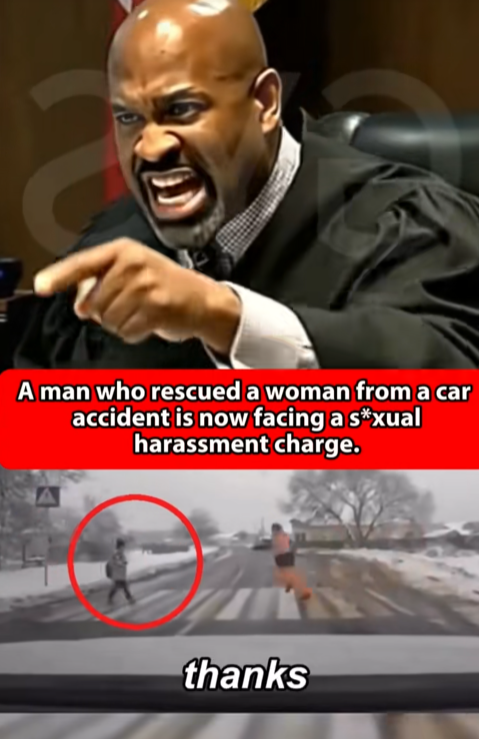
“He Saved Her Life After a Car Crsh — Now He’s Facing a Sxual Har*ssment Charge”

A dramatic and deeply divisive case is sparking heated debate online after a man who helped rescue a woman from a car accdent now finds himself facing a sxual har*ssment charge. What many initially viewed as a heroic act has taken a shocking legal turn, leaving the public split between outrage, confusion, and calls for due process.

The images circulating online paint two very different stories. One shows a visibly furious judge in court, pointing and shouting, underscoring how serious the case has become. Another shows dashcam-style footage from a snowy road, where a man appears to help a woman after a crash, stepping in during what looks like a chaotic and dangerous moment.

According to reports tied to the case, the incident began when a woman was involved in a car acc*dent under hazardous conditions. The road was icy, visibility was low, and the situation posed immediate danger. The man, described as a passerby, reportedly stopped to assist. In moments like these, seconds matter — and his actions were initially seen as lifesaving.

However, what happened next is now at the center of a legal storm.

Authorities allege that during or after the rescue, the man’s behavior crossed a line, leading to accusations of sxual harssment. Details remain limited, but prosecutors argue that helping someone in distress does not excuse inappropriate conduct, regardless of intent or circumstance.

Supporters of the man argue the charge is unfair and dangerously discouraging. They say criminalizing rescuers could make people hesitate in emergencies, potentially costing lives. “If people are afraid of being accused later, they’ll think twice before helping,” one commenter wrote. Many believe the situation was misinterpreted, pointing to the chaos and urgency of the moment.

On the other side, advocates stress that consent and boundaries still apply — even in emergencies. They argue that being vulnerable after a cr*sh does not erase a person’s right to personal safety and dignity. From this perspective, the charge is not about punishing help, but about holding everyone to the same standard of conduct.

Legal experts note that cases like this are extremely complex. Courts must weigh intent, context, witness testimony, and physical evidence. What one person perceives as assistance could be experienced very differently by another, especially in moments of fear and shock. That’s why these cases often come down to credibility, timelines, and fine details.

The courtroom reaction has only intensified public interest. Footage of the judge’s angry outburst has gone viral, with many interpreting it as a sign of how seriously the court views the allegations. Others argue that emotional displays, while powerful, shouldn’t influence public judgment before all facts are presented.

This case also raises broader questions about society’s expectations during emergencies. Where is the line between necessary physical contact and inappropriate behavior? How should good intentions be evaluated when outcomes are disputed? And how can the legal system protect both victims and those who step in to help?

For now, the man maintains his position, while the legal process unfolds. No final judgment has been reached, and both sides are urging the public not to rush to conclusions.

What began as a roadside rescue has evolved into a case that could set an important precedent. As it moves forward, it serves as a reminder that even moments of heroism can become legally complicated — and that truth often lies far deeper than a headline or a single frame of video.

@awlx.zaor

A man who rescued a woman from a car accident is now facing a s*xual harassment charge. #breakingnews #courtroom #crime #truestory

♬ original sound – jessidl2l
“Mom Says She Can’t Control Her Son After His Behavior Turns D*n’turbing — ‘I Don’t Know What to Do Anymore’”

A troubling video circulating online has sparked intense discussion after a mother admitted she no longer knows how to control her son, whose recent behavior she describes as deeply unsettling. The clip, shared widely on social media, shows a young boy walking slowly and deliberately toward a home, while captions compare his movements to a fictional horror character — a comparison that immediately caught viewers’ attention.

But behind the dramatic framing lies a far more serious and emotional reality.

According to the mother, her son’s behavior has changed significantly over time. She says he has become distant, unpredictable, and increasingly difficult to manage. In the video, she appears overwhelmed, admitting that she feels powerless and unsure of how to keep him — and others — safe. Her words don’t come across as angry or cruel, but desperate.

Many viewers initially reacted with fear or shock, focusing on the boy’s blank expression and slow, purposeful walk. Others, however, quickly shifted the conversation toward concern and empathy, pointing out that this is a child — not a monster — and that the situation likely reflects deeper issues that haven’t been addressed.

Mental health professionals online were quick to weigh in. They emphasized that sudden behavioral changes in children can stem from a wide range of factors, including untreated mental health conditions, trauma, developmental disorders, or severe emotional distress. Labeling a child as “uncontrollable,” they warn, can sometimes be a sign that a family urgently needs professional support — not judgment.

The mother’s admission, “I can’t control him,” struck a nerve with parents everywhere. Many commented that parenting becomes terrifying when you feel you’ve lost the ability to protect your child from themselves. Some shared their own experiences with children who struggled with aggression, emotional withdrawal, or impulsive behavior, describing how isolating it can feel when help is hard to access.

Others criticized the way the video was framed online. Comparing a real child to a horror villain, they argue, risks dehumanizing him and turning a family crisis into entertainment. “This isn’t a movie,” one commenter wrote. “This is a cry for help.”

Still, the video has opened an important conversation about early intervention. Experts stress that when parents notice alarming patterns — such as lack of emotional response, fixation on violence, or inability to follow boundaries — it’s crucial to seek professional guidance immediately. Waiting too long can allow problems to escalate, making outcomes far worse for everyone involved.

Law enforcement references in the clip also raised concerns. Many viewers worried that if the situation continues without support, it could eventually involve authorities — something that often ends badly for families dealing with mental health crises rather than criminal intent.

What’s clear is that this story isn’t about fear — it’s about failure of support systems. A mother asking for help should not be met with mockery or viral labels. She should be met with resources, compassion, and solutions that prioritize safety and healing.

As the clip continues to spread, more voices are calling for responsible storytelling and awareness. Children in crisis don’t need to be turned into headlines — they need intervention, care, and understanding.

And for this mother, the most haunting part of the story isn’t how her son walks —
it’s the reality that she feels completely alone trying to stop something she doesn’t understand.

@raindropsmedia1

Mother doesn’t know what to do after her son started moving like Michael Myers. She says she can’t control him. 😳 🚙

♬ original sound – Rain Drops Media
“Mother of Two Found Dad in Dollar Tree Freezer — New Details Leave Everyone Stnned”

A deeply disturbing case out of Miami has captured national attention after a mother of two was found d*ad inside a freezer at a Dollar Tree store. What began as a routine missing-person concern quickly turned into a mystery that has left investigators — and the public — searching for answers.

According to early reports, the woman was traveling in Miami when she suddenly disappeared. Family members became alarmed when they could no longer reach her, prompting concern that something was seriously wrong. Hours later, the situation took a tragic turn when her body was discovered inside a freezer unit at a local Dollar Tree location.

Authorities confirmed the victim was a mother of two, a detail that has amplified the emotional weight of the case. Images circulating online show investigators and emergency responders at the scene, while another frame highlights a man listening to what is described as 911 audio connected to the incident. The footage suggests that critical information may have been uncovered through emergency calls made shortly before or after her disappearance.

Law enforcement officials have stated that they are treating the case with extreme seriousness. A dath occurring inside a commercial freezer immediately raises multiple questions — how she ended up there, whether anyone else was involved, and whether the incident was accidental or intentional. Investigators have not yet publicly confirmed the manner of dath, but they have indicated that the circumstances are highly unusual.

Sources close to the investigation say that store surveillance footage, employee statements, and forensic evidence are all being carefully reviewed. The layout of the store, access to the freezer area, and the timeline of events are considered crucial in determining what truly happened. Even small details, such as who was present in the store that day and how long the freezer door remained closed, could play a major role.

The release of “latest details,” as highlighted in online coverage, has only deepened the mystery rather than resolving it. While some information has emerged, officials are being cautious, stressing that premature conclusions could compromise the investigation. This has led to widespread speculation online, with many demanding transparency while others urge patience out of respect for the victim and her family.

Public reaction has been intense. Many people expressed shock that such a tragedy could occur in a place as ordinary as a discount store. Others focused on the victim herself, emphasizing that beyond the headlines and speculation, she was a mother whose children are now left without her.

Criminal justice experts note that cases like this often take time to unravel. When a scene is both unusual and potentially contaminated by public access, investigators must move methodically. Autopsy results, toxicology reports, and a full reconstruction of the woman’s final movements will be essential before authorities can provide clear answers.

As of now, no arrests have been officially announced, and police have not ruled anything out. They continue to ask anyone with information to come forward, especially those who may have been in or near the store around the time of the incident.

What remains undeniable is the tragedy at the center of this story. A routine day turned into a nightmare, and a family is now grieving under the glare of national attention. As investigators work to piece together the truth, the public waits — hoping that justice, clarity, and accountability will eventually follow.

@iuan2971zajpb27917

A mother of two children mysteriously died in the freezer of Dollar Tree store while traveling in Miami#greenscreen #breakingnews #news #iuan2971zajpb27917 #update #missing #fpy

♬ original sound – iuan2971zajpb27917
“Amish Mother Confesses to Shcking Crme — Deputies Ask One Question That Changes Everything”

A quiet roadside encounter has gone viral after an Amish mother allegedly admitted involvement in a shcking crme, leaving deputies — and viewers — stunned. The body-cam image circulating online shows a woman standing calmly outdoors, flanked by law enforcement, as one simple question hangs in the air: “Can you explain?”

The contrast between the setting and the allegation is what makes this moment so jarring.

The scene appears pastoral and serene. Trees line the background. The woman’s demeanor is reserved, composed, and understated — consistent with a community known for simplicity and privacy. Deputies stand nearby, alert but measured. There’s no chaos, no raised voices. And yet, the gravity of what’s being discussed is unmistakable.

According to captions and commentary attached to the clip, the woman — identified as an Amish mother — confessed to a serious cr*me during questioning. The footage captures the aftermath of that admission, not the act itself. What viewers see is the moment law enforcement seeks clarity, context, and explanation — a turning point where words matter as much as evidence.

Online reactions have been intense and conflicted.

Many viewers expressed disbelief, noting how rarely Amish communities appear in viral policing content. The Amish are often perceived as insulated from modern pressures and crime, which makes allegations like this feel especially unsettling. “It doesn’t fit the picture we have in our heads,” one commenter wrote. “That’s what makes it so disturbing.”

Others cautioned against assumptions, reminding audiences that no community is immune to hardship, secrecy, or wrongdoing. Privacy, they note, can sometimes hide struggles rather than prevent them. When something goes wrong, it can be harder to detect — and harder to address.

Legal analysts pointed out that confessions are complex. Admissions must be corroborated, understood in context, and evaluated alongside physical evidence and witness statements. A confession alone does not always equal guilt — especially if it’s unclear how it was obtained, what exactly was said, or whether the person fully understood the implications.

That’s why the question “Can you explain?” carries so much weight.

It signals a shift from accusation to understanding. Deputies are trying to establish intent, timeline, and responsibility. In cases involving family members and closed communities, those details can be especially difficult to uncover. Silence and self-reliance — values often praised — can complicate investigations when accountability is required.

The clip has also sparked discussion about how law enforcement approaches culturally distinct groups. Many viewers praised the calm, respectful tone shown in the footage, arguing that de-escalation and clear communication are essential when trust is fragile. Others worried that cultural unfamiliarity could lead to misunderstandings on both sides.

Critics of the viral framing warn that words like “shcking crme” may exaggerate or oversimplify a case still under investigation. They urge viewers to wait for verified information rather than relying on captions designed to provoke strong reactions.

Still, even those urging caution acknowledge the emotional impact. Seeing a mother — particularly from a community associated with family and tradition — at the center of a serious allegation forces uncomfortable questions. How do hidden pressures manifest? What support systems exist? And what happens when private struggles spill into public accountability?

What the footage does not show is resolution. There’s no verdict, no sentencing, no closure. Just a moment suspended in uncertainty, where an explanation is requested and the future hangs in the balance.

As the clip continues to circulate, it’s being shared less as spectacle and more as a reminder: appearances can be deceiving, silence can conceal pain, and truth often emerges in the quietest moments.

For many watching, the lingering question isn’t just what happened — it’s how something like this could unfold unseen for so long.

And in that pause, with deputies waiting for answers, the story becomes far more complex than a headline.

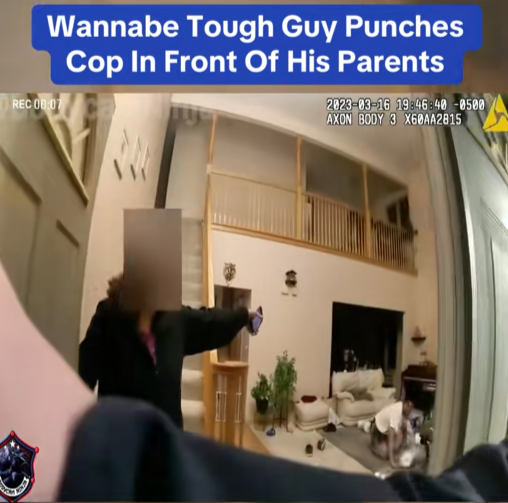
“He Tried to Look Tough in Front of His Parents — Then He P*nched a Cop and Ruined Everything”

A shocking body-cam clip is making waves online after a young man attempted to assert dominance in front of his parents — only to make a decision that instantly changed his life. The video, circulating under the headline “Wannabe Tough Guy Pnches Cop in Front of His Parents,”* captures a moment where ego, emotion, and authority collide in the worst possible way.

The footage begins inside a family home. The setting feels familiar and domestic: a living room with furniture, a staircase leading to a second floor, personal items scattered around. Officers are inside the house, responding to what appears to be a disturbance or ongoing family-related call. Tension is already present, but the situation is still under control.

Then the dynamic shifts.

The young man, face blurred in the video, gestures aggressively and raises his voice. His parents are nearby — watching. According to viewers who’ve analyzed the clip, this is the moment where pride takes over. Instead of de-escalating, he appears to posture, trying to appear fearless and dominant in front of them.

And then he crosses the line.

In a sudden movement, he strikes an officer. The body-cam jolts. Shouting erupts. What was a tense conversation instantly becomes a physical confrontation. Officers react immediately, moving to restrain him as the situation spirals out of control.

Online reactions were swift and unforgiving.

Many viewers called the act “self-destructive,” pointing out that nothing good ever comes from laying hands on law enforcement — especially inside your own home, and especially with witnesses present. Others focused on the parents’ presence, noting how devastating it must be to watch your child make a choice that guarantees severe legal consequences.

Legal experts commenting on the clip were blunt: p*nching an officer is not a heat-of-the-moment mistake — it’s a felony in many jurisdictions. Even if the original police presence was questionable or frustrating, physical assault removes nearly all room for legal sympathy. Any prior context becomes secondary once violence enters the picture.

The phrase “wannabe tough guy” resonated strongly in comment sections. Viewers argued that the act wasn’t about fear or confusion, but about image — trying to prove something in front of others. That desire to look strong, they say, often masks insecurity and leads to irreversible decisions.

Others highlighted how quickly situations escalate when emotions override judgment. Police calls inside homes are already volatile. Add family dynamics, embarrassment, and authority figures — and the pressure can explode.

What’s especially striking about the clip is how fast everything changes. One second, it’s a heated argument. The next, it’s handcuffs, shouting, and consequences that will likely follow this man for years.

The body-cam timestamp and AXON overlay reinforce the reality: this isn’t staged, and there’s no rewind. The moment is permanent.

As the clip continues to circulate, many are sharing it as a warning rather than entertainment. A reminder that trying to “win” an argument through force almost always guarantees losing everything else — your freedom, your record, your future.

For parents watching, the moment hits even harder. It’s the nightmare scenario: seeing your child make a choice you can’t undo, right in front of you.

In the end, this isn’t a story about toughness.
It’s about how fragile control really is — and how one reckless second can turn bravado into regret.

@police.bodycam.911

Wannabe Tough Guy Punches Cop In Front Of His Parents #copsoftiktok #bodycamcops #karma

♬ nhạc nền – Body CamCops
“Neighbor Confronts Woman Over Her Service Dog — The Emotional Moment Caught on Camera”

A short but emotional clip labeled as “Breaking News” is spreading rapidly online after a woman was confronted by a neighbor over her service dog — and viewers say the encounter reveals how misunderstood invisible disabilities still are.

The image shows a woman standing outside, clutching her small dog close to her chest. Her face is tense, eyes downcast, visibly emotional. She presses her face into the dog’s fur as if seeking comfort, while another person stands close by. The moment feels raw and personal, not staged — the kind of interaction that happens suddenly and leaves a lasting impact.

According to captions shared with the video, the woman was approached and questioned about her service dog by a neighbor who appeared to doubt its legitimacy. Situations like this are far more common than many people realize. Individuals with service animals are frequently challenged in public spaces, especially when their disability isn’t immediately visible.

For many viewers, the woman’s reaction is what made the clip go viral.

Rather than responding with anger or shouting, she appears overwhelmed. Holding her dog tightly, she struggles to keep her composure. Commenters say the dog’s presence clearly provides emotional grounding — reinforcing exactly why service animals are so important to the people who rely on them.

Social media responses poured in almost immediately. Thousands expressed outrage toward the neighbor, calling the confrontation invasive and unnecessary. “People don’t owe you proof of their disability,” one comment read. Others shared personal stories of being questioned, embarrassed, or reduced to tears over their own service animals.

Advocates for people with disabilities were quick to point out an important fact: under the law, service dog handlers are not required to disclose their medical conditions. In most places, only two questions are permitted — whether the dog is required because of a disability, and what task it is trained to perform. Anything beyond that crosses a line.

The clip has also reignited discussion about emotional labor. Many viewers noted that people with disabilities are often forced to educate strangers in moments when they’re already vulnerable. Being challenged in public — especially aggressively — can trigger anxiety, panic, or emotional distress, even when someone knows they’re in the right.

What makes this moment especially powerful is its simplicity. There’s no shouting match captured here. No dramatic escalation. Just a woman, clearly hurt, holding onto the one thing that helps her cope — while being judged for it.

Some critics urged caution, reminding viewers that viral clips don’t always show the full interaction. But even those calling for restraint acknowledged that confronting someone over a service dog is rarely appropriate, and often deeply harmful.

The dog itself has become a symbol in the comments. Many noted how calm it appears, nestled against its handler, focused entirely on her. For supporters, that quiet presence speaks louder than any argument could.

As the clip continues to circulate, disability advocates are using it as a teaching moment. A reminder that not all disabilities are visible. That service dogs aren’t accessories. And that compassion should come before confrontation.

For many watching, the takeaway is simple but powerful: you never know what someone is carrying — emotionally or medically. And sometimes, the kindest thing you can do is mind your business.

Because for the woman in this video, that dog isn’t just a companion.
It’s her lifeline.