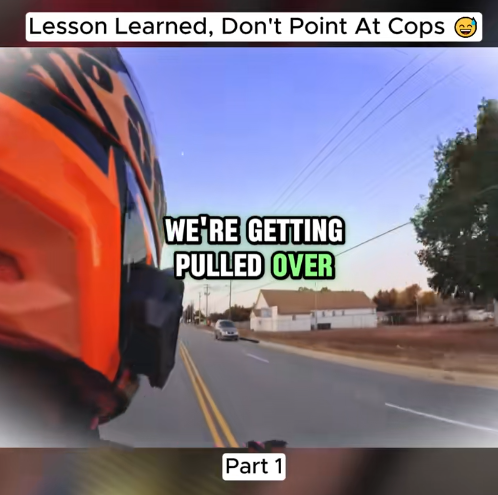
“Lesson Learned the Hard Way — One Gesture Turns a Calm Ride Into a Police Stop ”

What started as a routine ride quickly turned into an unexpected lesson after a simple gesture caught the attention of police — and cameras captured everything. The clip, now making the rounds online, shows a rider confidently cruising down an open road when the mood suddenly shifts. The on-screen text says it all: “We’re getting pulled over.”

According to viewers, the moment that triggered the stop was brief but clear. A finger pointed toward officers, seemingly harmless at first, but enough to change the entire situation. Within moments, flashing lights appeared behind the rider, and what could have been a peaceful ride became a tense encounter.

The video is being shared as a cautionary tale rather than pure entertainment. Many commenters agree on one thing: interactions with police don’t always escalate because of major mistakes — sometimes it’s the small actions that do it. A gesture, a look, or a split-second decision can completely change how an officer perceives a situation.

Online reactions poured in fast. Some viewers laughed, calling it an obvious “don’t do that” moment. Others were more serious, pointing out how quickly misunderstandings can happen on the road, especially when adrenaline, speed, and authority mix together. “It’s not about guilt,” one comment read. “It’s about perception.”

The phrase “Lesson Learned, Don’t Point at Cops” became the unofficial headline in comment sections across platforms.

Experts and experienced riders chimed in with practical advice. When riding or driving, they say, neutrality is your safest option. Avoid gestures that can be interpreted as confrontational or mocking. Even if no harm is intended, officers may see it as a challenge or provocation — especially in traffic situations where safety is already a concern.

The video also sparked a broader discussion about body language and law enforcement. Many people don’t realize how closely officers watch gestures during stops. A point, wave, or sudden movement can raise suspicion instantly. In high-alert environments, officers are trained to assume the worst until proven otherwise.

Some viewers defended the rider, arguing that pointing shouldn’t automatically justify a stop. Others countered that whether it should or not doesn’t matter in the moment — what matters is avoiding unnecessary attention altogether.

What makes the clip so relatable is how ordinary it feels. There’s no high-speed chase, no dramatic shouting. Just a rider on a road, a gesture, and consequences that follow immediately. That realism is exactly why the video resonates with so many people.

By the end of the clip, the message is clear without needing explanation. The rider appears calm but visibly aware that one small action changed the course of the day. The “Part 1” label hints that more footage follows, but for many viewers, the lesson is already complete.

In a world where everything is recorded, moments like this travel fast. They turn into teachable examples shared across social media — reminders that awareness isn’t just about speed limits or helmets, but also about how you communicate nonverbally.

The takeaway is simple and echoed by thousands of commenters:
Stay respectful, stay neutral, and don’t give law enforcement a reason — even unintentionally — to stop you.

Sometimes, the biggest lessons come from the smallest mistakes.

“Teens Accused of m*rder Laugh in Court — The Moment That Left Everyone Furious”

A disturbing courtroom moment is going viral after footage showed teens accused in the m*rder of a retired police officer appearing to laugh and joke during court proceedings. The image, frozen at the exact second one of the defendants turns toward the camera, has ignited outrage across social media and reopened heated conversations about accountability, maturity, and respect for the justice system.

The clip is brief but jarring. In a room meant for solemnity, where life-altering decisions are made, the accused teens are seen smiling, whispering, and seemingly treating the situation casually. For many viewers, the behavior felt like a slap in the face — not only to the court, but to the family of the retired officer whose life was lost.

Online reactions were immediate and intense. Comment sections flooded with anger, disbelief, and frustration. “This isn’t funny,” one user wrote. “Someone is d*ad.” Others questioned how anyone facing charges of this magnitude could appear so detached from reality.

Legal experts were quick to caution that courtroom demeanor does not always reflect guilt or innocence. Young defendants, they explained, may laugh or joke out of nervousness, fear, or emotional immaturity rather than malice. Still, even those offering context acknowledged how damaging such behavior can be — both legally and publicly.

Courtrooms are spaces governed by perception as much as procedure. Judges, juries, and even the public interpret body language, expressions, and reactions. Appearing disrespectful or unconcerned during serious proceedings can influence how a defendant is viewed, regardless of the facts of the case.

The presence of the watermark and viral captions has also raised concerns about sensationalism. Short clips often strip away context, reducing complex legal situations into emotionally charged snapshots designed for maximum engagement. Critics argue that while the behavior may be inappropriate, turning it into viral entertainment risks undermining the seriousness of the judicial process.

Still, the emotional response is understandable. The case involves the death of a retired law enforcement officer — someone who spent their career serving the public. For many, seeing accused individuals appear lighthearted in court feels deeply offensive, regardless of age or legal nuance.

Others focused on a broader issue: youth and accountability. Some commenters argued that being a teenager should not excuse a lack of seriousness when facing charges this severe. Others countered that the justice system exists precisely to evaluate facts, not facial expressions caught on camera.

What’s often missing from viral clips is what happens immediately after. Judges routinely reprimand defendants for inappropriate behavior, and attorneys often advise clients to remain composed. A single moment of laughter does not capture the full tone of an entire hearing — but it can overshadow everything else in the court of public opinion.

As the image continues to circulate, it serves as a stark reminder of how powerful perception can be. In the age of viral justice, a few seconds of video can shape narratives long before verdicts are reached.

For many watching, the anger isn’t just about the teens on screen. It’s about respect — for the victim, for the courtroom, and for the gravity of taking a human life. Whether the laughter was nervous, careless, or misunderstood, one thing is clear: moments like this don’t fade quietly. They linger, fuel debate, and leave lasting impressions far beyond the courtroom walls.

@vicecityvidz

CONVINCED TEENS LAUGHING AND JOKING IN COURT

♬ original sound – …
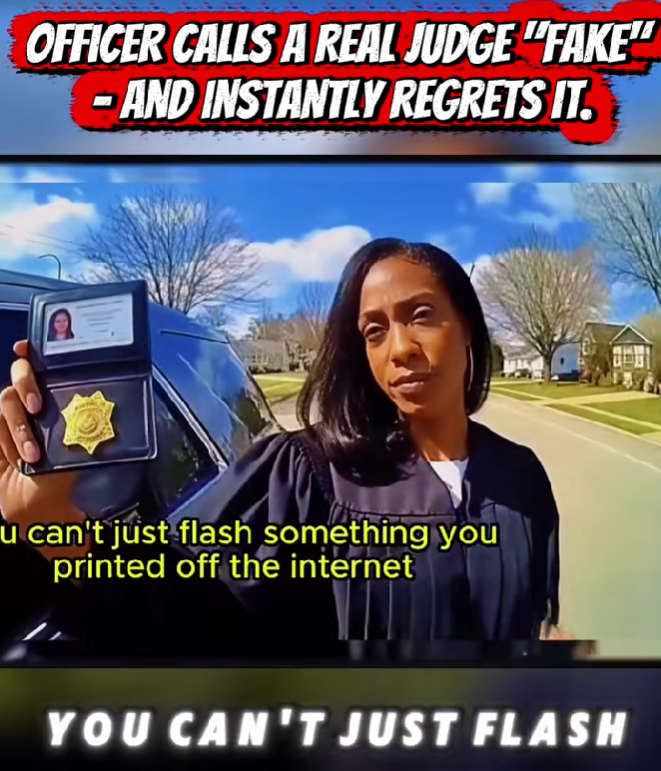
“Officer Says a Real Judge Is ‘F*ke’ — Seconds Later, the Truth Hits Hard”

A viral clip making the rounds online has left viewers stunned, angry, and deeply divided. The footage shows a police officer confronting a woman during what appears to be a routine stop. Calm, composed, and confident, the woman presents her judicial identification. Instead of de-escalating the situation, the officer allegedly dismisses it, claiming the credentials are “f*ke” and suggesting they were printed off the internet.

That single moment — captured clearly on camera — is what sent the video into viral territory.

In the clip, the woman, later confirmed through court records to be an actual sitting judge, holds up her official ID and badge. She does not raise her voice. She does not resist. She simply asserts who she is. The officer, however, appears unconvinced and responds with visible skepticism. Subtitles shown in the video quote the officer saying she “can’t just flash something you printed off the internet,” a statement that has since become one of the most replayed lines in the clip.

Viewers online were quick to point out the power imbalance at play. Judges are officers of the court, sworn to uphold the law — yet here, one is being treated as if she is lying about her own identity. Many commenters argued that the disbelief seemed rooted not in evidence, but in bias.

What escalated public reaction even further was the context surrounding the incident. This was not a traffic stop involving erratic behavior or a high-risk situation. According to reports tied to the footage, the encounter occurred in a quiet neighborhood, in broad daylight, with no immediate threat present. The judge was reportedly cooperative from the start.

As the clip spread, legal experts and former law enforcement officers weighed in. Several noted that questioning credentials is one thing — but outright dismissing official identification without verification crosses a serious professional line. Others emphasized that officers are trained to confirm identity through proper channels, not personal judgment or assumptions.

The officer’s alleged disbelief quickly turned into regret. As more information surfaced and the woman’s identity was confirmed, the situation reportedly unraveled fast. The city later faced legal consequences tied to the arrest and detention, reigniting conversations about accountability and misconduct within policing systems.

On social media, reactions poured in. Some called the incident humiliating and infuriating, especially for those who see it as yet another example of how authority is selectively respected. Others urged caution, reminding viewers that viral videos rarely show the full picture. Still, the words spoken on camera were difficult to explain away.

Civil rights advocates argue that the incident highlights a deeper issue: credibility should not depend on appearance, race, or whether someone “looks” like they belong in a position of power. If a judge can be dismissed so casually, they ask, how are ordinary citizens treated when no camera is rolling?

The clip continues to circulate, often labeled “Part 2” or “Full Breakdown,” as viewers dissect every second. Whether seen as a failure of judgment, training, or bias, the moment stands as a powerful reminder of how fast authority can backfire — and how expensive a few careless words can become.

Angry Woman Loses Control After Targeting Teen on Sidewalk — What Happened Next Shocked Everyone

It started as an ordinary evening walk, the kind most people barely think twice about. A quiet sidewalk, dim streetlights, and a teenager simply heading home. But within moments, what should have been a routine walk turned into a tense and unsettling confrontation that quickly spiraled out of control.

According to the footage, the teen was walking calmly along the sidewalk when an adult woman suddenly appeared, visibly upset and already shouting. Her body language was aggressive, her voice raised, and her movements erratic. Without any clear provocation, she began directing her anger toward the teenager, accusing them of things that made little sense to anyone watching.

Witnesses say the situation escalated fast.

The woman closed the distance, pointing, yelling, and repeatedly stepping into the teen’s path. The teen, clearly confused and alarmed, tried to keep moving, attempting to avoid eye contact and de-escalate the situation. But the woman refused to back off. Instead, she followed closely, continuing her tirade and drawing attention from nearby homes.

What made the encounter especially disturbing was the imbalance of power. This wasn’t an argument between equals — it was an adult singling out a minor, using intimidation and volume as weapons. Viewers later noted that the teen never raised their voice, never responded with insults, and never acted aggressively. Their only goal seemed to be getting away safely.

At one point, the woman’s anger appeared to intensify even further. She gestured wildly, stepping onto the sidewalk and blocking the teen’s path. Her words became more hostile, and her tone suggested she felt completely justified in her behavior. For reasons still unclear, she appeared convinced she was in the right, even as the situation grew more inappropriate by the second.

The turning point came when outside attention became unavoidable.

Lights turned on in nearby houses. A car slowed down. The woman suddenly realized she was no longer alone in her outburst. Her confidence wavered, and her posture shifted. The teen seized the moment, increasing their pace and creating distance, while the woman continued shouting from behind.

Eventually, the confrontation ended not with an apology or explanation, but with the woman storming off, still visibly angry. The teen was left shaken but unharmed, later describing the incident as frightening and confusing.

Online reactions were swift and intense.

Many people expressed outrage that an adult would target a teenager in such a way, calling the behavior unacceptable and dangerous. Others pointed out how quickly situations like this can escalate into physical confrontations, especially when fueled by unchecked anger and entitlement.

The video has since become another example of how everyday moments can turn volatile when someone loses control in public. It also highlights the importance of bystanders, awareness, and accountability — because silence and inaction only allow these incidents to repeat.

For the teen involved, it was a lesson learned far too early: sometimes, the greatest threat doesn’t come from strangers in the dark, but from adults who believe their anger gives them permission to act without limits.

And for viewers, it served as a stark reminder that losing your temper in public doesn’t just embarrass you — it exposes who you really are.

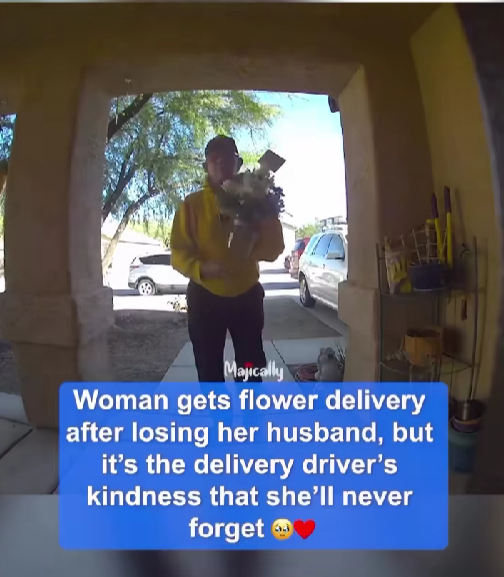
She Lost Her Husband—But a Stranger’s Unexpected Kindness at Her Door Changed Everything

Grief has a way of arriving quietly, settling into everyday moments when you least expect it. For one woman, that moment came at her front door, when a routine flower delivery turned into something far more meaningful than she could have imagined.

The woman had recently lost her husband, a loss that left her navigating the heavy silence of a home forever changed. Friends and loved ones had sent flowers as gestures of sympathy, each bouquet a reminder that people cared, even if words often fell short. But on this particular day, it wasn’t the flowers themselves that stayed with her — it was the person delivering them.

Door camera footage shows the delivery driver approaching her home with a bouquet in hand. At first glance, it looks like any other delivery. But when the woman opens the door, the interaction shifts from routine to deeply human. The driver pauses, clearly sensing the weight of the moment, and takes the time to speak with her rather than rushing away.

According to those familiar with the clip, the driver offered more than just condolences. He listened. He acknowledged her loss without trying to fix it or rush past it. In a world where deliveries are timed down to the minute, that pause meant everything.

The woman later shared that while many people had sent flowers, few had truly seen her grief in that raw moment. The driver’s kindness — his patience, his empathy, his willingness to simply stand there and treat her like a person rather than a stop on a route — left a lasting impression.

Viewers who watched the footage online were deeply moved. Many commented that the interaction reminded them how small gestures can carry enormous weight, especially during times of loss. “It wasn’t the flowers,” one viewer wrote. “It was the compassion.”

Others pointed out how rare it has become for strangers to slow down in moments like this. In an economy built on speed and efficiency, kindness often feels like an afterthought. Yet here was proof that empathy still exists, even in the most ordinary jobs.

Grief experts often say that what mourners remember most are not the grand gestures, but the quiet moments of understanding. A hand on the shoulder. A pause. Someone acknowledging that the pain is real and that it matters. This delivery driver, without knowing it, provided exactly that.

The woman later reflected that she may not remember every bouquet she received, but she will always remember the stranger who took a moment to be kind when she needed it most. His actions didn’t erase her loss — nothing could — but they softened the loneliness that often follows it.

In a time when bad news dominates headlines and viral videos often highlight conflict or cruelty, this moment stood out for a different reason. It reminded people that kindness does not have to be loud to be powerful.

Sometimes, it arrives quietly at your door, holding flowers — and leaves behind something far more lasting than a delivery receipt.

@corybooker

The power of Empathy. The magnanimity of Kindness. op: @Meeshy🦖

♬ original sound – Cory
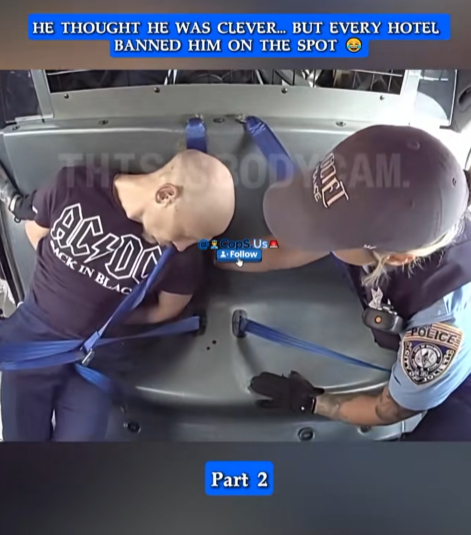
Man Tried to Outsmart the System—Instead He Got Banned From Every Hotel on the Spot

A man who believed he had found a clever way to beat hotel policies learned the hard way that shortcuts don’t always pay off. What started as an attempt to game the system quickly spiraled into a situation that left him banned from hotels immediately, escorted by police, and publicly embarrassed.

According to footage circulating online, the incident unfolded when hotel staff noticed suspicious behavior connected to the man’s stay. While details vary depending on the location, witnesses report that he attempted to exploit hotel rules—allegedly trying to bypass payment, identity verification, or occupancy policies in a way he thought would go unnoticed.

Instead, staff flagged the behavior almost immediately.

Hotel security was contacted, and local police soon arrived. Bodycam footage shows the man restrained and seated while officers investigated the situation further. His attempt to outsmart hotel management backfired badly, resulting in his removal from the property and an on-the-spot ban.

What shocked many viewers was how quickly the consequences escalated. Hotels often share incident reports internally, especially within large chains. Once a guest is flagged for fraud, disturbance, or rule violations, that information can travel fast. In this case, employees reportedly made it clear that the ban was not limited to just one location.

Hospitality professionals online weighed in, explaining that hotels deal with scams far more often than guests realize. From fake identities and stolen cards to policy loopholes, staff are trained to recognize patterns. “If you think you’re the first person to try something, you’re already wrong,” one former hotel manager commented.

The footage also sparked debate online. Some viewers mocked the man for thinking he could outsmart an industry built around risk prevention and surveillance. Others questioned whether the punishment fit the offense, though most agreed that deliberately violating policies is a fast way to lose access to accommodations altogether.

Experts note that hotel bans are more common than people think. Serious violations—especially involving fraud, refusal to pay, aggressive behavior, or repeated deception—can result in permanent exclusion. Once banned, future bookings may be automatically canceled, even if reservations are made under different names.

Beyond the immediate embarrassment, the long-term impact can be significant. Being unable to book hotels can affect travel for work, emergencies, or family needs. In some cases, bans are difficult or impossible to reverse.

The incident serves as a cautionary tale about trying to be “too clever.” What might seem like a harmless trick or shortcut can quickly turn into a situation involving law enforcement and lasting consequences.

In the end, the man walked away without a hotel room, without sympathy, and with a reputation he likely didn’t expect to earn. For many watching, the lesson was clear: when it comes to hotels, playing games usually means losing big.

@sajeelzayn_fan_606

ONE NIGHT AT A HOTEL — AND NOW HE’S BANNED NATIONWIDE 😱 #viral #cops #911 #bodycare #police

♬ original sound – Masters Ohio
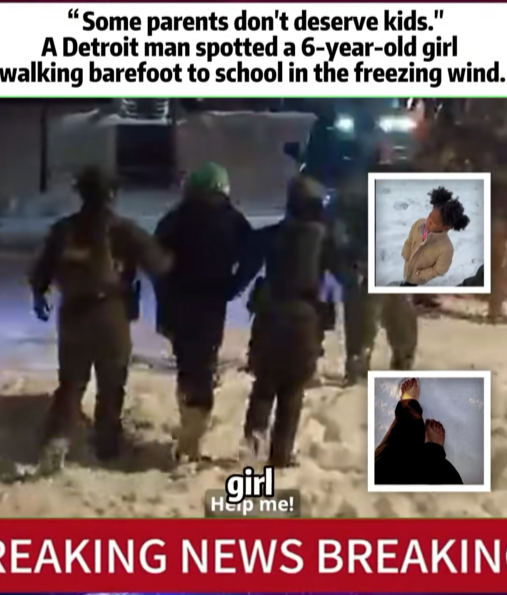
Detroit Man Stunned After Seeing 6-Year-Old Walking Barefoot to School in Freezing Wind

A disturbing scene on a cold Detroit morning has sparked outrage and concern after a local man spotted a 6-year-old girl walking barefoot to school in freezing conditions, prompting a wave of criticism, sympathy, and urgent questions about child safety and neglect.

According to reports shared online, the child was seen trudging through snow and ice with no shoes, visibly struggling against harsh winter winds. Temperatures were reportedly well below freezing, conditions that pose serious risks even to properly dressed adults, let alone a young child.

The man who noticed the girl said he was immediately alarmed. Witnesses claim the child appeared distressed and confused, repeatedly asking for help as she made her way along the icy path. Concerned adults quickly intervened, and authorities were contacted to ensure the child’s immediate safety.

Images circulating online show responders surrounding the girl in the snow, while inset photos highlight her bare feet against frozen ground. The visuals triggered intense reactions across social media, with many users expressing disbelief that a child could be sent out in such conditions without basic protection.

“This is not a parenting mistake. This is neglect,” one commenter wrote. Another added, “No child should ever be exposed to that level of danger. Weather like this can cause permanent damage in minutes.”

Medical experts agree that walking barefoot in freezing temperatures can lead to hypothermia, frostbite, nerve damage, and long-term circulation issues, especially in young children whose bodies lose heat more rapidly. Even brief exposure can be dangerous.

What has fueled even more anger is the unanswered question of why the child was alone and how she left home without shoes. Authorities have not released full details, but child protective services were reportedly notified to investigate the circumstances surrounding the incident.

The phrase circulating most online — “Some parents don’t deserve kids” — reflects the emotional response from viewers who felt the situation crossed far beyond a lapse in judgment. Many parents stated they could not imagine allowing a child to step outside without proper clothing, let alone walk to school barefoot in winter weather.

Others urged caution, reminding the public that investigations should determine whether factors such as poverty, mental health struggles, or emergency situations played a role. Still, even those calling for nuance agreed that the situation represented a serious failure to protect a child.

Community members praised the individuals who stepped in, noting that intervention may have prevented severe injury or worse. In cities with extreme winter climates, neighbors are often the first line of defense when vulnerable individuals are at risk.

The incident has reignited broader conversations about child welfare, mandatory reporting, and the responsibility of communities to speak up when something feels wrong. Experts emphasize that if a child appears unsafe, cold, lost, or distressed, contacting authorities can be lifesaving.

As the investigation continues, many are left shaken by how close this situation came to tragedy. For most viewers, the image of a small child barefoot in the snow is one that will not be forgotten — a stark reminder that protecting children is not optional, and that neglect, intentional or not, can have devastating consequences.

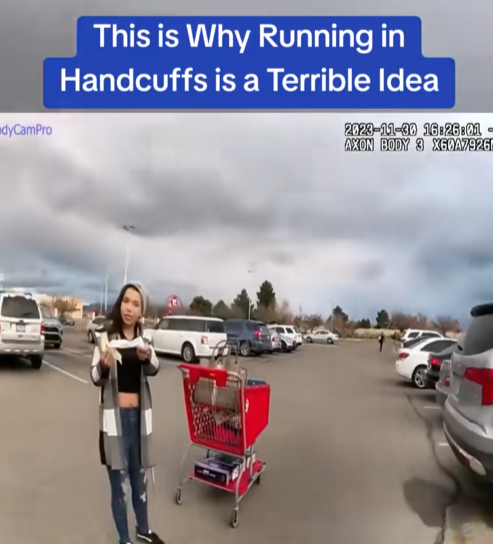
She Tried to Run While in Handcuffs — What Happened Next Was Completely Avoidable

An image taken from police bodycam footage is circulating online with a blunt warning across the top: “This is Why Running in Handcuffs is a Terrible Idea.” The scene appears ordinary at first glance — a parking lot filled with cars, a red shopping cart nearby, and a young woman standing still, holding paperwork. But viewers familiar with bodycam footage know that moments like this often change in seconds.

According to the context attached to the image, this encounter escalated after a suspect made the decision to run while already restrained in handcuffs. Law-enforcement professionals and legal experts alike say this is one of the most dangerous choices a detained person can make — not just legally, but physically.

When someone is handcuffed, their balance is compromised. Arms cannot be used to break a fall, protect the head, or stabilize the body. Even a short sprint can quickly turn into a violent collapse. Broken wrists, shattered teeth, facial fractures, and head injuries are common outcomes when restrained individuals attempt to flee.

Footage like this often spreads online because the outcome feels unnecessary. Many viewers react by saying the same thing: why run when things were already bad — and now they’re worse?

Police trainers explain that once a person is in handcuffs, attempting to escape adds new charges immediately. What may have started as a minor offense can quickly escalate into resisting arrest, evading custody, or assault if an officer is injured during the pursuit. These additional charges often carry heavier penalties than the original reason for detention.

There is also the risk of force escalation. Officers are trained to stop a fleeing suspect quickly, especially one who could injure themselves or others. That can mean takedowns, control holds, or use of force that might not have been necessary if the person had stayed put. In other words, running rarely creates a better outcome.

Psychologists note that panic plays a major role in decisions like this. Once the reality of arrest sets in, adrenaline takes over. People stop thinking long-term and focus only on escape, even when escape is clearly unrealistic. In those moments, logic is replaced by fear.

The parking-lot setting makes the situation even more dangerous. Uneven pavement, curbs, shopping carts, parked cars, and moving vehicles all increase the likelihood of serious injury. A stumble in handcuffs is not like a normal fall — it often ends with the head or face hitting first.

Comment sections under similar clips are usually split. Some viewers mock the decision, calling it reckless or foolish. Others express concern, pointing out that no arrest should end in permanent injury or d*ath over a moment of panic. Both reactions highlight the same truth: running in handcuffs almost never helps.

Legal analysts stress that compliance after being restrained is usually the safest path forward. Courts can address disputes, mistakes, or even wrongful arrests. The street cannot. Once someone runs, control shifts entirely to law enforcement, and consequences become immediate and physical.

What makes images like this resonate is their preventability. There is no mystery villain or unavoidable accident. Just one decision that turns a bad situation into a dangerous one.

The message behind the image is simple, even if the moment itself is chaotic. Handcuffs are not just a legal symbol — they are a physical limitation. Ignoring that reality puts lives at risk, including the suspect’s own.

@minhabyspx8

This is Why Running in Handcuffs is a Terrible Idea

♬ nhạc nền – Jaynelle
Police Knocked… What They Discovered Behind This Door Left Even Officers Stunned

A chilling image taken from police bodycam footage is circulating online, introducing viewers to what’s being described as “a series of shocking cases in America that everyone is unaware of.” The frame shows a closed door inside a public building, a fire extinguisher mounted on the wall, and an officer’s hand reaching for the handle. At the bottom of the screen, clear white text reads: “Sanford Police Department! Come out now!”

It’s the kind of moment that instantly raises your heart rate.

According to the caption attached to the footage, this is not a reenactment or fictional scene — it’s labeled as an “ACTUAL CASE.” And while the image itself doesn’t show what’s behind the door, that uncertainty is exactly what has gripped viewers across social media.

Police bodycam footage often captures the most intense and unpredictable moments of law enforcement work. Officers rarely know what’s waiting on the other side of a door. It could be someone in distress, a dangerous suspect, or a situation far worse than expected. That tension is frozen in this image — the split second before everything changes.

Commenters have noted how ordinary the setting looks. Clean walls. Neutral lighting. Nothing visually alarming. And yet, history has shown that some of the most disturbing cases unfold in the most unassuming places. Offices, apartments, stores, even public buildings — no location is immune.

The caption suggests this is part of a broader pattern: cases that never make national headlines but are no less disturbing. Situations involving hidden crimes, neglected victims, or dangerous individuals who remain unnoticed until police intervene. These are the stories that often slip through the cracks unless bodycam footage or official reports bring them to light.

Experts say this is why transparency matters. Body cameras don’t just document arrests — they reveal the reality of what officers encounter daily. Sudden confrontations, high-risk entries, and emotionally charged discoveries are all part of the job. For viewers, seeing these moments raw and unfiltered can be jarring.

Social media reactions range from fear to disbelief. Some users admit they paused the video, bracing themselves for what might happen next. Others said it reminded them how quickly a normal day can turn into a n*ghtmare. “It’s always the doors you least expect,” one commenter wrote.

Psychologists note that the fear comes from anticipation, not imagery. The human brain fills in the blanks — imagining worst-case scenarios when information is incomplete. That’s why clips like this spread so quickly. They invite viewers to mentally step into the officer’s position.

What’s also striking is how many people admitted they were unaware such cases even happen. Not because they’re rare, but because they’re local, quiet, and often resolved without national coverage. The phrase “everyone is unaware of” resonates because it’s largely true.

Authorities have not released full public details connected to this specific frame, which is common in ongoing or sensitive cases. Still, the footage serves a larger purpose: reminding the public that real-life investigations don’t look like movies. There’s no dramatic music, no warning — just a door, a command, and whatever lies beyond.

This image doesn’t show violence. It doesn’t show chaos. It shows the moment before — and sometimes, that’s the most unsettling part.

A closed door.
A raised voice.
And a reality most people never see… until now.

@lee_cops

A series of shocking cases in America that everyone is unaware of #cops #copsoftiktok

♬ original sound – Lee Cops
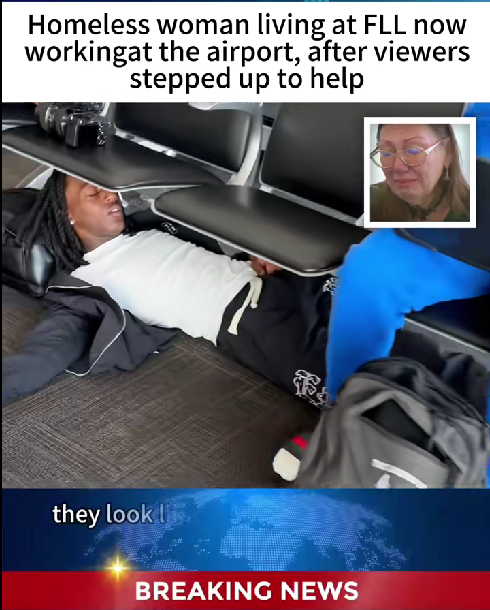
She Was Sleeping on Airport Chairs — What Viewers Did Next Changed Her Life Forever

An image that recently went viral has captured hearts across social media, telling a rare but powerful story of kindness, second chances, and how strangers online can sometimes make a real difference. The image shows a woman lying across airport seating at Fort Lauderdale–Hollywood International Airport (FLL), using her jacket as a pillow, clearly exhausted. Above the image, bold text reads: “Homeless woman living at FLL now working at the airport, after viewers stepped up to help.”

At first glance, it looks like just another sad moment caught in passing — someone trying to rest wherever they can. But the story behind it is far more hopeful.

According to posts circulating alongside the image, the woman had been living inside the airport for an extended period. Like many experiencing homelessness, she blended into the background: sleeping on chairs, carrying her belongings in a backpack, and trying not to be noticed. Airports, with their constant movement and 24-hour activity, often become invisible shelters for people with nowhere else to go.

What changed everything was exposure.

Footage of her situation began circulating online, and instead of scrolling past, viewers paid attention. Some noticed her calm demeanor. Others were struck by how quietly she endured her circumstances. Soon, comments turned into action. People began asking questions, offering help, and sharing resources.

Then something remarkable happened.

With support from viewers — reportedly including donated clothes, food, transportation help, and guidance — the woman was able to apply for work. Not somewhere far away. Not some distant fresh start. But right there at the airport where she had been surviving day by day.

She got the job.

For many watching, that detail is what made the story hit so hard. The same place where she once slept on chairs became the place where she clocked in, earned a paycheck, and started rebuilding her life. The transformation wasn’t instant or easy, but it was real.

A small inset image shows a woman with teary eyes, believed to be someone reacting emotionally to the outcome of the story. That reaction mirrors what thousands of viewers felt — relief, hope, and disbelief that something so positive came from such a painful beginning.

Advocates for the unhoused say stories like this matter, but they also urge caution. While individual acts of kindness can change one life, homelessness itself is a systemic issue tied to housing costs, health care access, mental health support, and wages. Not everyone gets lucky enough to go viral — and help shouldn’t depend on visibility.

Still, moments like this remind people why compassion matters.

Many commenters pointed out that the woman didn’t need pity — she needed opportunity. Once given a chance, she showed she was capable of more than surviving. She was ready to work, contribute, and move forward.

Others noted how easy it is to overlook people in public spaces. Airports, train stations, and terminals are full of stories we never ask about. This one just happened to be noticed.

The image now stands as a before-and-after without needing two separate photos. One frame shows struggle. The caption tells the rest: progress.

From sleeping under airport lights to working beneath them, her journey has become a symbol of what can happen when empathy meets action. Not every story ends this way — but this one did.

And for many who saw it, it served as a quiet reminder: sometimes, stepping up doesn’t require changing the world — just changing one life.