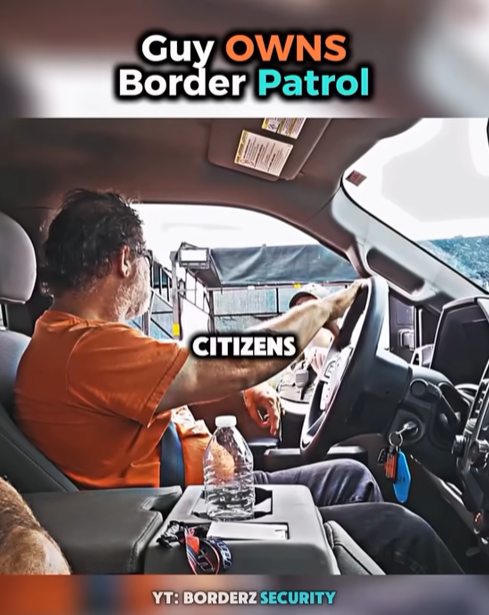

“Guy Owns Border Patrol”: Viral Clip Sparks Debate Over Citizens’ Rights at Immigration Checkpoints
A tense exchange at what appears to be a Border Patrol checkpoint is going viral after a man calmly but firmly asserted his rights during questioning — a moment online captions now describe as a civilian “owning” Border Patrol. The clip has ignited fresh debate about constitutional protections, what officers can legally ask, and how much the average person actually knows about their rights in these encounters.
The image shows a man seated in the driver’s seat of a pickup truck, one arm resting on the steering wheel, facing an officer positioned just outside the window. The scene appears controlled, not chaotic. There is no shouting, no visible aggression — just a conversation that quickly turns into a legal standoff. Text over the video emphasizes one word: “citizens,” signaling the core issue at hand.
According to commentary circulating with the clip, Border Patrol agents questioned the man beyond the basic scope allowed at certain checkpoints. In the United States, Border Patrol has expanded authority within a defined distance from the border, but that authority is not unlimited. At fixed checkpoints, agents may generally ask about citizenship status. However, further detention or questioning typically requires reasonable suspicion of a specific violation.
Viewers say the man refused to answer questions that went beyond citizenship and declined to consent to any search. Instead of becoming confrontational, he remained seated, calm, and repetitive — a strategy legal experts often recommend. By clearly asserting his rights without escalating, he appeared to put agents in a position where they could not lawfully proceed further.
That moment is what fueled the viral framing. Commenters praised the man for knowing the law better than the officers questioning him. Others cautioned that the phrase “owns Border Patrol” oversimplifies what actually happened. In reality, many such encounters end not because officers are “defeated,” but because they recognize the legal threshold has not been met.
Civil liberties attorneys note that this type of interaction highlights a critical imbalance: most people do not know what Border Patrol can and cannot legally do. As a result, many comply with requests that are technically voluntary, simply because they feel pressured by authority. When someone confidently but respectfully declines, the dynamic changes.
Supporters of Border Patrol stress that agents are performing a lawful function and that short clips rarely show full context. They argue that officers must ask questions to do their job and that cooperation helps keep checkpoints efficient. Still, even many law enforcement professionals acknowledge that consent-based encounters must remain truly voluntary.
The clip has become a teaching moment online. Legal educators are using it to explain key principles:
- At checkpoints, you may be asked about citizenship
- You generally do not have to answer unrelated questions
- You can refuse consent to searches
- Calm repetition is often more effective than arguing
Importantly, experts emphasize that asserting rights should never involve insults, threats, or physical resistance. The man in the video did not raise his voice or exit the vehicle — a factor many believe contributed to the peaceful outcome.
The viral label may exaggerate the moment, but the underlying lesson is real. Knowledge changes power dynamics. When people understand where authority begins and ends, encounters often de-escalate rather than explode.
For many viewers, the clip is less about embarrassment and more about empowerment. It shows that asserting rights doesn’t require aggression — just clarity and confidence. And in a world where fear often drives compliance, that calm assertion can be the most effective response of all.
Whether you see it as a win for civil liberties or simply a routine interaction ending as it should, the takeaway remains the same: knowing your rights matters — especially when authority is involved.