
“He Thought Registration Made It Legal — One Sidewalk Ride Proved Him Wrong”
What began as a calm ride through a quiet neighborhood quickly turned into a lesson about how misunderstood traffic laws can be.
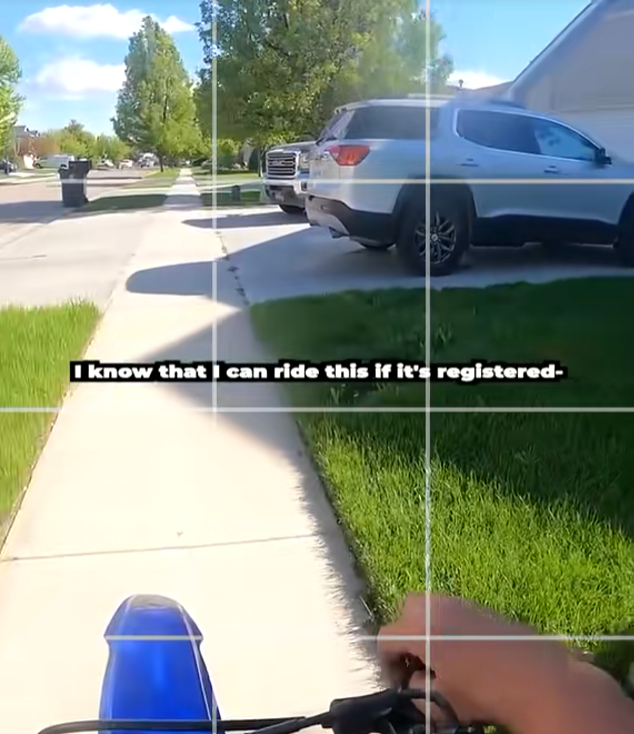
Bodycam-style footage shows a first-person view moving along a suburban sidewalk on a small motorized vehicle. Neatly cut lawns, parked SUVs, and a peaceful residential street give the impression that nothing unusual is happening. Then a sentence cuts through the calm: “I know that I can ride this if it’s registered.”
That belief — common, confident, and often wrong — sits at the center of many encounters between riders and law enforcement.
Across many cities and states, the rules surrounding electric bikes, scooters, and other motorized personal vehicles are far more complicated than most people realize. Registration alone does not automatically make a vehicle legal everywhere. Where you ride matters just as much as what you ride.
Sidewalks, in particular, are a legal gray zone that often turns into a hard “no.” In many jurisdictions, sidewalks are reserved for pedestrians only, regardless of whether a motorized vehicle is registered, insured, or road-legal. The logic is simple: sidewalks prioritize safety for people walking, children, pets, and anyone who isn’t protected by speed or distance.
Riders frequently assume that if a vehicle can be registered, it can be used freely. But laws typically separate road legality from sidewalk legality. A registered vehicle may be allowed on the street, bike lane, or designated paths — yet still be prohibited from sidewalks.
This misunderstanding leads to tense but avoidable encounters. From a rider’s perspective, the rules feel inconsistent and overly technical. From an enforcement standpoint, the concern is visibility, reaction time, and the unpredictability of pedestrians stepping out of driveways or between parked cars.
What makes situations like this notable is how ordinary they look at first glance. There’s no reckless speed, no aggressive behavior, no obvious danger — just someone moving through a neighborhood believing they’re within their rights. That’s often when stops happen: not because of chaos, but because of quiet rule violations that carry real safety implications.
Legal experts often point out that personal electric transportation laws haven’t kept pace with how popular these devices have become. Many statutes were written with traditional bicycles or motorcycles in mind, leaving newer vehicles to be patched into existing rules. The result is confusion for riders and inconsistency between cities, counties, and states.
For riders, the takeaway is straightforward but frequently ignored: registration is not permission to ride anywhere you choose. Sidewalks, school zones, residential paths, and mixed-use areas all have their own restrictions. Knowing them before you ride can save you from warnings, citations, or worse.
For communities, scenes like this highlight a growing need for clearer public guidance. As electric mobility becomes more common, so do misunderstandings that put riders and pedestrians at risk — not out of malice, but out of assumption.
In the end, this moment isn’t about punishment or blame. It’s about how easily confidence can replace knowledge, and how a simple belief — “it’s registered, so it’s legal” — can fall apart the moment the rules are enforced.
Sometimes, the calmest rides deliver the loudest lessons.