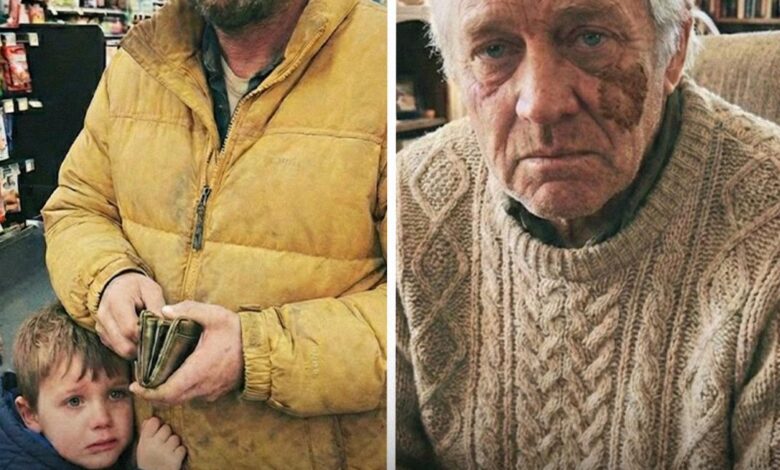

I Paid for a Poor Mans Groceries – and Noticed He Was a Carbon Copy of My Late Husband!
I stopped believing in ghosts three years ago, the day my husband died. After fifty-five years of marriage, Edward was gone in a single afternoon. The doctor said his heart failed quickly, that he didn’t suffer. People said that like it was supposed to help. It didn’t. What it did was leave a silence so dense it felt physical, like living underwater.
I’m Dorothy. I’m seventy-eight. Widowhood stretches time in strange ways. Some days crawl. Others vanish. You forget meals. You forget dates. You forget why you walked into a room. But you never forget the shape of the person you loved.
Edward had habits that drove me mad. Socks on the bathroom floor. Long silences during arguments. Opinions about everything from politics to lawn care. And yet, I loved him with a devotion so deep it felt permanent. I believed our life together was solid, complete, finished exactly as it was meant to be.
That belief shattered in the produce aisle of a grocery store on a bitter January morning.
I hadn’t gone shopping in too long. The refrigerator was bare except for condiments and expired milk. I grabbed a cart and moved slowly, my joints stiff, my mind elsewhere. That’s when I heard a man’s voice—strained, gentle, trying not to break.
“I promise, Mark,” he said softly. “Daddy will get you something special next time.”
A child’s voice answered, thin with tears. “You said Mommy would come back. How long is she with the angel?”
My hands froze on the cart handle. Grief recognizes grief instantly. I turned the corner and saw him kneeling on the linoleum floor in front of three children—two boys and a little girl. He pulled the youngest close, murmuring reassurances that sounded practiced, exhausted, sincere.
Then he stood.
And my heart stopped.
The jaw. The eyes. The posture. Even the way his mouth set when he listened. It was Edward. Not similar. Not reminiscent. Identical.
I told myself it was shock. Loneliness. A trick of grief. But then he turned fully toward the light, and I saw it—the small birthmark above his lip. The one I had kissed for decades. The one I would have recognized anywhere.
I should have walked away. Instead, I followed.
I trailed them through the aisles, pretending to shop, watching the way he spoke to his children, the way they leaned toward him instinctively. At the checkout, the cashier totaled the bill. Milk, pasta, cereal. Nothing indulgent.
The man counted bills, his face falling. “I’m five dollars short,” he said quietly. “Could you take off the milk?”
Before I could think, I stepped forward and paid. He thanked me, introduced himself as Charles, concern flickering across his face when he noticed how pale I’d gone. I barely heard him. All I could see was that face. That mark.
He left with his children, and I stood shaking while the cashier waited.
That night, I pulled out photo albums I hadn’t opened since Edward’s funeral. I traced the familiar lines of his face. The birthmark. The smile. I didn’t sleep.
The next morning, I went looking.
I found Charles getting off a bus a few streets from the store. I followed at a distance, hating myself, needing answers. He lived in a small, worn house behind a chain-link fence. After sitting in my car far too long, I knocked.
He recognized me instantly. When I blurted out that he looked exactly like my husband and showed him Edward’s photograph, the color drained from his face.
“I think you should come inside,” he said.
The house was modest but clean. Children’s drawings covered the refrigerator. Toys lined the hallway. He sent the kids to their room and sat across from me, staring at Edward’s photograph like it might burn him.
“This man,” he said slowly, “ruined my mother’s life.”
Her name was Lillian. She met Edward years before I knew him. He never told her he was married. When she became pregnant, she believed he would leave me. He didn’t. Instead, he paid her to stay quiet. Sometimes he spoke to Charles. Sometimes he argued with Lillian outside his workplace. When Charles was sixteen, his mother told him Edward was his father—and that I was the reason he never had a real family.
I couldn’t breathe. I had lived a lie without knowing it. Edward had lived two lives. I had loved a man capable of abandoning a child and lying to me for decades.
“I never knew,” I whispered. And I meant it.
Charles believed me. He said his mother’s bitterness colored many things. He’d always suspected the truth was uglier and more complicated.
We sat in silence, grief folding in on itself. Finally, he stood and said we could return to our lives. That I owed him nothing.
But I couldn’t do that.
My marriage was not what I thought it was. That hurt more than I could describe. But standing in that house, surrounded by proof of life continuing despite betrayal, I realized something else.
I didn’t want to be alone anymore.
I invited them to dinner. Sunday dinner. Something I’d kept cooking out of habit, serving to no one.
They came.
The children were shy at first. Charles barely spoke. But the house felt alive again. Loud. Messy. Human.
They came the next Sunday. And the next.
Edward is gone. His mistakes belong to him. But Charles and his children are here. So am I. And grief, I’ve learned, doesn’t end when truth arrives—but neither does the capacity to build something new from the wreckage.
Some losses don’t leave you empty. They leave you changed.