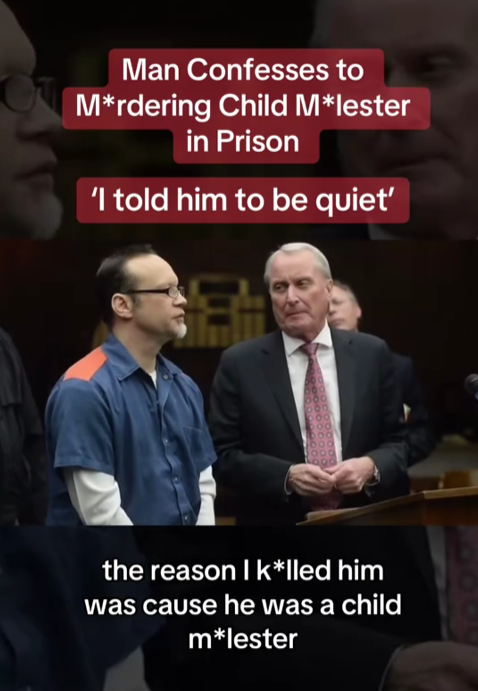

“Inmate Admits to Taking Justice Into His Own Hands — Shocking Courtroom Confession Stuns the Judge”
A courtroom was left in stunned silence when an inmate stood before the judge and openly admitted to taking the life of another prisoner — a man who had been convicted of harming children. The confession, delivered calmly and without hesitation, immediately drew national attention and reignited debate about prison safety, inmate protections, and the dangers of vigilante-style actions behind bars.
The man, dressed in a blue prison uniform and flanked by his attorney, spoke plainly when asked why the deadly incident occurred. He claimed he had repeatedly told the other inmate to “be quiet,” saying the man had been boasting or speaking inappropriately about his crimes. According to the defendant’s statement in court, the conversation escalated into a confrontation that turned deadly. Prosecutors say the inmate violently attacked the man inside a common area, though full details of the encounter remain under investigation.
Throughout the hearing, the accused inmate stared straight ahead, showing little emotion as he described the moment things spiraled out of control. While he maintained responsibility for what happened, his words also revealed simmering anger and frustration—feelings that many inmates reportedly shared toward the victim. Prison officials note that individuals convicted of harming children often face heightened hostility behind bars, making them some of the most at-risk prisoners in the system.
Legal experts emphasize that, despite the emotional context, taking another person’s life inside a correctional facility remains a serious offense. The inmate now faces additional charges that could add decades to his sentence. His attorney argued that the environment inside the prison contributed heavily to the incident, describing conditions as “volatile, overcrowded, and lacking proper supervision.”
Advocates for prison reform say this case highlights a larger systemic issue: many facilities struggle to keep vulnerable inmates safe, even when staff do their best. Overcrowding, understaffing, and limited mental-health support often create situations where conflicts escalate quickly and tragically. They argue that no matter a prisoner’s crimes, the correctional system has a legal and ethical responsibility to protect every individual in its custody.
Family members of the deceased inmate have expressed heartbreak and disbelief, saying that although he was convicted of a serious crime, he still deserved due process and protection while serving his sentence. They insist that what happened inside the facility represents a failure of security and oversight.
Public reaction, however, has been sharply divided. Some viewers online responded with outrage at the violence, stressing that no inmate has the right to act as judge, jury, or executioner. Others expressed complicated emotions, referencing how society views offenders convicted of harming children. But legal analysts warn that allowing vigilante behavior — even in prison — undermines the justice system entirely.
As the case proceeds, the judge has ordered a full investigation into the prison’s handling of both the victim and the accused. Officials are reviewing surveillance footage, staff reports, and inmate interviews to determine whether the facility had prior warnings about escalating tensions.
The hearing ended with the inmate being escorted back into custody, leaving the courtroom in a state of reflection. The incident is a harsh reminder of the hidden dangers inside prison walls — and the ongoing need for reforms that protect both justice and human rights.