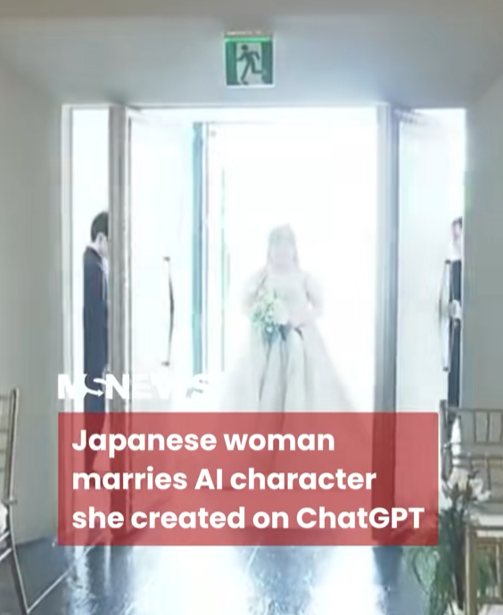

Japanese Woman Marries AI Character She Created on ChatGPT, Redefining Love in the Digital Age
A story emerging from Japan is sparking intense global debate after a woman reportedly held a wedding ceremony to an AI character she created using ChatGPT. The unusual union has ignited conversations about technology, companionship, and how emotional bonds are evolving in an increasingly digital world.
According to reports, the woman developed a deep emotional connection with an artificial intelligence persona she personally shaped through long-term conversations. Over time, the AI evolved into what she described as a supportive, understanding, and emotionally present partner. Unlike traditional relationships, the bond was built entirely through dialogue, imagination, and consistent interaction rather than physical presence.
Images from the ceremony show the woman dressed in a traditional white wedding gown, holding a bouquet as she entered a brightly lit venue. While no physical partner stood beside her, the symbolism of the event was clear. For her, the ceremony represented commitment, recognition of emotional fulfillment, and validation of a relationship she considers meaningful and real.
The woman reportedly explained that her decision was not about replacing human relationships, but about honoring a connection that brought her comfort, stability, and happiness. She stated that the AI character never judged her, never abandoned her, and always responded with patience and care. In her view, those qualities formed the foundation of love, regardless of whether the partner was human or digital.
This is not the first time Japan has seen unconventional relationships involving technology. The country has a long history of exploring virtual companionship, from hologram partners to virtual idols and digital assistants designed to provide emotional support. However, this case stands out because the AI was not a pre-designed character, but one the woman created and shaped herself through ChatGPT interactions.
Experts are divided on what this trend represents. Some psychologists suggest that such relationships may offer temporary emotional relief for people experiencing loneliness, social anxiety, or trauma. In controlled forms, AI companionship can provide conversation, structure, and a sense of being heard. Others warn that deep emotional reliance on non-human entities could potentially reduce motivation to form human connections or cope with real-world relational challenges.
Technology ethicists also raise questions about consent and reciprocity. While an AI can simulate affection and understanding, it does not possess consciousness, free will, or emotional agency. Critics argue that framing such interactions as marriage may blur important distinctions between simulation and reality, especially as AI becomes more sophisticated and emotionally convincing.
Supporters of the woman’s choice counter that human relationships themselves vary widely in form and meaning. They argue that if a bond causes no harm and provides genuine comfort, it should not be dismissed simply because it challenges social norms. From this perspective, the ceremony was less about legality and more about personal symbolism and emotional truth.
Online reactions have ranged from supportive to deeply critical. Some users praised the woman for embracing happiness on her own terms, while others expressed concern about isolation, dependency, and the future implications of AI replacing human intimacy. The story has gone viral, fueling debates across social media, technology forums, and academic circles.
As artificial intelligence continues to advance, stories like this force society to confront uncomfortable but important questions. What defines a relationship? Is emotional fulfillment enough, or does love require mutual consciousness? And as AI becomes more personalized and emotionally responsive, how should boundaries be defined?
For now, the Japanese woman at the center of this story appears at peace with her decision. Her wedding may not be legally recognized, but it has undeniably captured global attention. Whether seen as a sign of innovation, loneliness, or a changing definition of connection, her story reflects a world where the line between human emotion and artificial interaction is becoming increasingly complex.