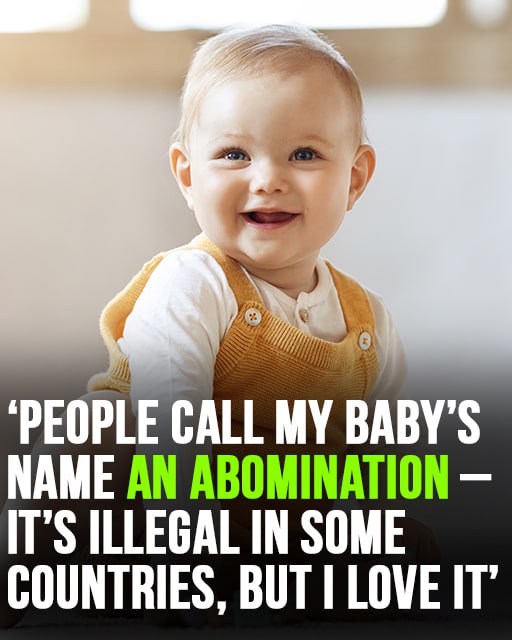

Mom defends baby name that is illegal in some countries – People say it is an abomination!
In the modern landscape of parenting, where the search for a unique and meaningful identity often leads to unconventional choices, few decisions have sparked as much global debate as the one made by Ronni Lily and her partner, Brad. The couple, residents of Birmingham, England, recently became the center of a social media firestorm and a heated cultural conversation after choosing a name for their newborn son that is not only controversial but remains illegal in several countries across the globe. The choice has invited accusations of being an “abomination” and a “cruel” imposition on a child, yet the parents remain steadfast, defending their decision as an act of boldness and an embrace of ancient, positive etymology.
The journey toward this polarizing decision began during Ronni’s pregnancy. Like many modern parents, the couple found inspiration in contemporary media, specifically while watching the popular Netflix series Lucifer, starring Tom Ellis. The show, which portrays the titular character as a charming, misunderstood, and complex figure navigating life in Los Angeles, sparked a discussion between Ronni and Brad that quickly evolved into a firm agreement. They were drawn to the name Lucifer, finding it distinctive, strong, and aesthetically pleasing. For them, it wasn’t about religious rebellion or a desire to shock the public; it was about a name that felt “right” for their fourth child, joining siblings Lola, Lincoln, and Lilac.
However, as soon as the name was made public, the couple realized that their personal enthusiasm was not shared by the broader world. While the name Lucifer is perfectly legal to register in the United Kingdom, it carries a heavy historical and religious weight that many found impossible to ignore. In the Christian tradition, the name is inextricably linked to the fallen angel and the personification of evil. This association led to an immediate and vitriolic backlash from strangers on the internet and, perhaps more painfully, from within their own social circles. One family member was particularly vocal, reportedly labeling the name an “abomination” and refusing to use the child’s full name, choosing instead to omit it entirely from conversation.
Family games
The criticism escalated when Ronni shared her story in various parenting groups on Facebook. Commenters warned that the name was “just stupid” and that she was effectively setting her son up for a lifetime of bullying and professional disadvantage. Some critics even went as far as to suggest that by naming the child after the devil, the parents were inviting a “devilish” personality to manifest in the boy. Ronni, however, viewed these comments as a reflection of narrow-mindedness rather than a valid concern for her son’s future. She argued that a bully would find a reason to pick on a child regardless of their name and that her responsibility as a mother was to raise her children to be confident, headstrong, and resilient. To her, the idea that a name could determine a child’s character was an outdated superstition.
Interestingly, Ronni noted that the negative noise often drowned out a quieter but significant wave of support. She claimed that many mothers reached out to her privately to admit they loved the name but were too afraid of the social consequences to use it themselves. Even the medical professionals who assisted with the birth encouraged the couple to stick with their choice, noting that it was a strong and memorable name. When it came time to visit the registrar’s office to make the name official, Ronni expected a confrontation or at least a judgmental look. Instead, the process was entirely bureaucratic and mundane. The registrar simply confirmed the spelling—L-u-c-i-f-e-r—and processed the paperwork without a single raised eyebrow.
Part of the couple’s defense of the name lies in its linguistic origins, which predate its association with modern religious iconography. Derived from the Latin words “lux” (light) and “ferre” (to bring), Lucifer literally translates to “light-bringer” or “morning star.” This was the meaning that Ronni and Brad chose to focus on—a symbol of enlightenment and a new dawn. They argued that critics were choosing to ignore this beautiful etymology in favor of a dark, singular narrative. By reclaiming the name, they felt they were embracing its original essence rather than its later, more sinister connotations.
The global perspective on the name Lucifer highlights just how divisive the choice remains. While the UK permits it, countries such as New Zealand, Germany, and Iceland have various levels of restrictions or outright bans on the name, often citing the potential for the child to be subjected to psychological harm or social stigma. In 2013, New Zealand’s Department of Internal Affairs officially added Lucifer to its list of banned names after several attempts by parents to use it. This international legal landscape underscores the fact that the name is seen by many governments not just as a matter of parental preference, but as a matter of child welfare.
The case in Birmingham is not the first time this specific name has caused a stir in the British press. In 2020, a couple in Derbyshire, Dan and Mandy Sheldon, faced a similar struggle when a registrar tried to actively discourage them from using the name, telling them that their son would never get a job and that teachers would refuse to teach him. The Sheldons eventually won their right to use the name, but the incident highlighted the deep-seated cultural resistance that persists even in secular societies. For Ronni Lily, these stories served as a reminder of the importance of standing one’s ground against institutional and social pressure.
Despite the “legendary” status she has bestowed upon her son, calling him “Lucifer the Legend,” Ronni is pragmatic enough to provide a safety net. The boy’s middle name is Ashley, a much more conventional and traditional choice. Ronni explained that if her son grows up and decides that the weight of “Lucifer” is too much to carry, he has every right to go by his middle name. This compromise, she feels, respects the child’s future autonomy while allowing the parents to express their creative vision in the present.
Ultimately, the story of baby Lucifer is a reflection of the evolving boundaries of modern identity. It poses difficult questions about where a parent’s right to choose a name ends and a child’s right to a “normal” social experience begins. For Ronni and Brad, the answer is clear: their son is a “cheeky chap” who is loved and cherished, and his name is a reflection of his strength and the light he has brought into their lives. They remain unbothered by the opinions of those who see only darkness in a name that, to them, signifies the morning star. As the boy grows, his name will undoubtedly remain a conversation starter, but his parents are confident that his character, nurtured by their support, will always outshine the controversy of his title.