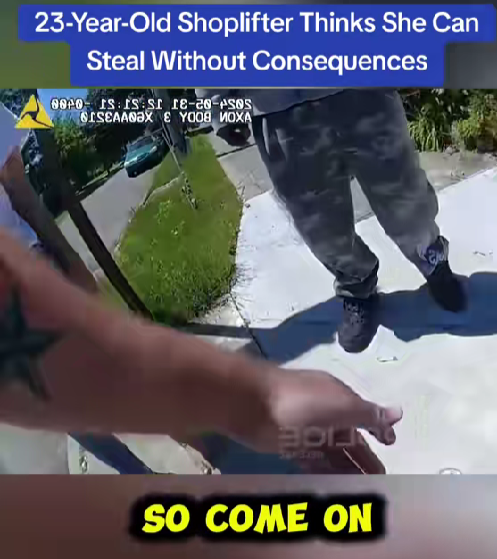
Shoplifting Chaos Erupts in Luxury Home Store — Woman Charged After Resisting Arrest in Summit

It was supposed to be an ordinary afternoon inside one of Summit’s high-end home décor stores—a peaceful place filled with chandeliers, handcrafted ceramics, polished wood tables, and shelves stacked with designer candles. But the quiet elegance of the showroom shattered in seconds when a shoplifting incident spiraled into a dramatic confrontation that left customers stunned and employees scrambling.

The bodycam footage from Part 1 begins with an officer walking through the beautifully arranged store. The ambience is calm, almost serene. Soft lighting glows from chandeliers overhead, highlighting carefully staged dining sets and luxury pieces worth hundreds—sometimes thousands—of dollars. Shoppers browse casually, unaware that moments earlier, a woman had triggered a silent theft alarm.

Store staff had already alerted police to suspicious behavior. According to them, the woman moved quickly between displays, placing small but expensive items into her bag while pretending to examine others. Employees watched from a distance, attempting not to escalate the situation prematurely. But when she headed toward the exit—bag noticeably heavier—one worker stepped forward to intervene.

That’s when things escalated.

Instead of cooperating, the woman reportedly pushed past staff and tried to flee deeper into the store. By the time officers entered, she was attempting to hide among décor displays, weaving between chairs and large tables as if the furniture could shield her from responsibility.

The footage shows officers calmly making their way through the aisles, voices low but firm as they call out commands. Customers pause mid-conversation, some stepping aside, others clutching shopping bags a little tighter. The contrast is striking: a peaceful showroom holding a moment of real tension.

When officers located the woman, she didn’t surrender. Instead, she resisted—pulling away, arguing, and refusing to remove her hands from her bag. Employees stood nearby, watching as the officers attempted to de-escalate the situation. But the resistance only increased. At one point, she tried to turn and run again, forcing officers to step in and physically restrain her.

It was a dramatic scene in the middle of a store known for its quiet ambiance and upscale clientele.

Eventually, officers gained control, recovered the stolen merchandise, and escorted the woman outside, where she continued protesting loudly. The items in her possession included luxury fragrances, small décor pieces, and several high-value accessories—adding up to charges that went well beyond petty theft.

Residents of Summit reacted quickly online:

“This store is always so peaceful… can’t believe this happened here.”
“People really think they won’t get caught with cameras everywhere?”
“Resisting only makes it worse—why do people do this?”

The incident didn’t just involve shoplifting. The resisting component elevated the charges, creating a more serious legal situation for the woman involved. She now faces a combination of theft-related counts and obstruction-related charges—offenses that carry heavier consequences in New Jersey.

Store employees say they’re relieved no one was hurt. The officer’s bodycam footage shows a calm but firm approach, preventing what could have become a far more dangerous situation.

And this is only Part 1, meaning more of the confrontation—and possibly the arrest—unfolds in the next segment.

@police.captain20

Shoplifting & Resisting Arrest: Woman Charged in Summit

♬ original sound – POLICE CAPTAIN
Officer Literally Becomes a Human Shield to Protect His Own Suspect During a Sudden Burst of Gunfire — The Incredible Dashcam Footage

Most traffic stops end with a warning, a ticket, or maybe a brief conversation.
This one ended with an officer risking his life to protect the very person he had pulled over.

The dashcam footage from Part 2 captures a moment so unexpected and so intense that viewers around the world called it one of the most heroic—and ironic—police encounters ever recorded.

It’s nighttime under a long concrete overpass, the kind that echoes even the smallest sound. The officer stands beside a young woman he’s detaining. She’s calm, cooperative, and answering questions while leaning against the barrier. Behind her, her car sits parked along the narrow shoulder, headlights bouncing off the tunnel walls.

Everything seems routine. Quiet. Controlled.

Then, without warning—
Gunfire erupts.

Not from the woman.
Not from the officer.
But from somewhere off in the distance, completely unrelated to the traffic stop.

The officer reacts instantly.

He grabs the suspect he had just been questioning and pulls her behind him, placing his own body between her and the incoming fire. He ducks, angles his shoulders forward, and presses her behind the concrete barrier—using only his body and his vest as protection.

The woman, stunned, whispers “Thank you…”
Her voice shaky, barely audible, but filled with shock.

In that split second, everything changed.
He wasn’t dealing with a suspect anymore—he was saving a human being.

The officer’s training kicks in as he shouts commands, scanning the direction of the shots while keeping the woman shielded. The gunfire echoes under the overpass, creating a terrifying mix of ricochets and amplified noise. Cars in the distance begin to swerve, unsure of where the danger is coming from.

Yet the officer never once steps away from her.

He doesn’t run for cover.
He doesn’t leave her exposed.
He physically guards her, knowing that if anyone got hit by a stray round—it would be him first.

For all the debates the internet has about policing, this moment reminded millions of the humanity behind the badge. Officers are trained to protect life no matter who it belongs to—and this footage is the definition of that principle.

When the shots finally stop, the officer carefully escorts the woman to a safer position, still staying between her and the threat. She thanks him again, breathless, realizing that the same person who moments earlier was detaining her had just saved her life.

Comments flooded social media:

“This is what true professionalism looks like.”
“Hero—no other word fits.”
“Imagine getting arrested AND protected in the same minute…”

Whether she was guilty, mistaken, or completely innocent didn’t matter at that moment.
She was a person in danger.
He was the one who kept her alive.

Child With Down Syndrome & Autism Secretly Records Daycare Worker Striking Her — Heartbroken Parent Speaks Out

Some stories shake a community to its core—not because of dramatic crime scenes or police chases, but because they reveal something far more painful: betrayal at a place where children are supposed to be safe.

This case began when a young girl with Down syndrome and autism—nonverbal, vulnerable, and deeply trusting—managed to record something no parent ever wants to imagine. Hidden in her belongings was a device that captured cruel moments inside her daycare, moments that would leave her family devastated and the community outraged.

On the footage, later viewed by investigators, the daycare worker is seen striking the child. The girl, unable to communicate what happened verbally, had unknowingly provided the only evidence of the abuse she endured. Her video wasn’t planned. It wasn’t intentional. It was a heartbreaking accident that revealed the truth.

That truth ignited fury.

In the image above, her parent, Leslie Ogletree, stands outside the family’s home—his face a mix of anger, disbelief, and heartbreak. The quiet neighborhood behind him contrasts sharply with the emotional storm he describes. His daughter, already facing challenges most adults never will, had been harmed by someone entrusted to protect her.

Ogletree recounts how his daughter began showing signs of anxiety—hesitation at drop-offs, sudden emotional shifts, unexplained withdrawal. At first, the family thought it was stress, routine change, or sensory overload common among autistic children. But the video changed everything.

The footage didn’t just expose a single slap—it documented a pattern of aggression. A daycare worker who should’ve been patient, calm, and caring instead reacted with anger, frustration, and violence. Moments meant for teaching and comfort turned into scenes of humiliation and fear.

When Ogletree saw the recording, he immediately contacted authorities. Police launched an investigation, and state agencies moved quickly to shut down the facility pending further review. What investigators uncovered has sparked conversations nationwide about daycare oversight, caregiver training, and protections for children with disabilities—children who often cannot speak up for themselves.

The daycare worker has since faced administrative action, interrogation, and potential criminal charges depending on the ongoing investigation. Parents whose children attended the center have flooded social media with outrage, demanding accountability and stronger safety protocols.

But the heart of this story remains the child herself—a girl who, despite all her challenges, unknowingly became her own advocate. Her accidental recording exposed abuse that might have otherwise continued unchecked.

For her father, the pain is unbearable.

He told reporters he trusted the daycare. He believed they were trained to work with children who needed specialized care. Instead, he found out his daughter suffered in silence—and only a video could speak for her.

Now, Ogletree is fighting not just for justice for his daughter, but to ensure no other child suffers the same fate. His message is clear: protect our children, especially those who can’t protect themselves.

Europe’s Largest SIM-Card Cybercrime Bust: The Moment Police Found 40,000 Cards in a Single Raid

When Latvian State Police stormed a quiet apartment building hallway, they weren’t expecting what they were about to uncover. What began as a coordinated sweep of a suspected cyber-fraud hub turned into one of the largest SIM-card seizures in European cybercrime history—a discovery that stunned investigators and exposed a criminal network operating across multiple countries.

The footage opens with heavily equipped officers moving silently down a narrow corridor. Their helmets, tactical vests, and communication gear signal the seriousness of the operation. Behind the flashing red banner reading “40,000 SIM cards linked to cyber fraud across Europe,” officers prepare to breach a unit believed to be the nerve center of a major digital scam operation.

Inside that apartment, they would find exactly what they feared—and more.

When the door swung open, investigators stepped into a room filled wall-to-wall with small boxes, envelopes, binders, and crates—all stuffed with SIM cards from different European carriers. Some were prepaid and ready for activation. Others had already been used in crimes involving identity theft, phishing, illegal banking operations, and social-engineering scams.

Authorities say the cards weren’t just for phone calls—they were tools used to:

  • Create thousands of fake identities
  • Bypass two-factor authentication
  • Set up burner accounts
  • Launder money digitally
  • Operate fraudulent call centers
  • Evade law-enforcement tracking

These cards effectively served as the heartbeat of a vast scam network that targeted victims in Germany, France, Spain, Italy, the UK, the Baltics, and beyond.

What shocked officers most was the level of organization. The SIMs were meticulously cataloged, sorted by carrier, region, activation status, and even the type of fraud they were used for. Nearby computers ran scripts and automation tools designed to activate hundreds of numbers simultaneously—feeding a nonstop stream of criminal activity.

Police say the group behind this operation had been re-routing money, breaking into bank accounts, and running impersonation scams that stole from everyday citizens, small businesses, and even major corporations.

Some of the SIMs were linked to:

  • Bank-account takeover attempts
  • Fake parcel-delivery scam calls
  • Cryptocurrency theft
  • Romance scams
  • Social-media hijacking operations

Experts believe the fraud network may have caused millions of euros in losses.

The raid was part of a wider Europol-supported crackdown involving multiple agencies working across borders. Signals intelligence, phone-record tracing, and digital-forensics teams helped pinpoint the exact location where these SIM cards were being stored.

The operation was a massive win for cybercrime investigators.

For years, criminals relied on disposable SIM cards to hide behind untraceable phone numbers. But this seizure struck at the heart of that anonymity—taking away tens of thousands of identities they could’ve used to scam more victims.

As investigators packed up the SIM cards, officers could be heard saying the discovery was “bigger than expected.” And the footage makes one thing clear: this wasn’t just a raid—it was a direct hit on one of Europe’s most extensive cyber-fraud infrastructures.

@independent

Police have uncovered 40,000 SIM cards linked to a five million euro cyber scam across Europe. Latvian State Police shared footage of its SIMcartel operation, confirming five people have been arrested. The force said: “The platform was designed to facilitate anonymous communication and payments, offering access to mobile phone numbers from more than 80 countries.” Click the link in bio for more 🔗

♬ original sound – Independent
Dirty Cop Fired, Charged With First-Degree Assault — And His City Paid a Stunning $650,000 for His Actions

Some police scandals fade quickly.
This one didn’t.
This one exploded into a city-wide reckoning.

The body-cam footage begins on a quiet residential street lined with palm trees. The sun is bright, neighbors are watching from porches, and officers move slowly through the scene. What should have been a routine interaction soon became the spark that exposed one of the most disturbing cases of officer misconduct the department had ever seen.

At the center of the video is a frustrated resident—a man who looks equal parts confused, hurt, and exhausted by the situation unfolding around him. He speaks calmly despite everything he’s been through. In the frame beside him stands a female officer taking notes, trying to piece together the story. Behind them, another officer documents the scene while maintaining a neutral stance.

What viewers eventually learned is that this calm moment was the aftermath—not the incident.

The violence had already happened.
The damage had already been done.
And the officer responsible was nowhere in sight.

According to official reports, the now-fired officer had used unprovoked, excessive, and brutal force during a previous encounter. The victim—seen in the footage—had suffered significant injuries after being assaulted without justification. Witnesses said the officer snapped during what should have been a minor interaction, attacking the man with such rage that even other officers on scene were stunned.

The department launched an internal review. The findings were devastating.

Not only did the officer violate protocol—he violated basic human decency, escalating a calm situation into a violent one through aggression, intimidation, and reckless force. Evidence from body-cam footage, witness accounts, and medical reports left no room for excuses.

He wasn’t just wrong.
He was dangerous.

As the investigation deepened, city officials realized they were facing a legal battle they could not win. The victim filed a lawsuit, his injuries documented extensively, and the public demanded accountability.

The city settled.
$650,000.
Taxpayer money—gone because one officer couldn’t control his temper.

But the consequences didn’t stop there.

The officer was fired, disgraced, and removed from the force entirely. His badge—once a symbol of trust—became a reminder of everything that can go wrong when power is abused. Prosecutors reviewed his actions and filed first-degree assault charges, marking one of the rare times an officer faced serious criminal consequences for on-duty violence.

The footage shared online shows the victim speaking to investigators afterward, calmly explaining what happened while the officers around him listen carefully. The contrast is stark: professionalism now replacing the chaos one rogue officer created.

Viewers reacted with outrage, relief, and disbelief:

“How many times has he done this before?”
“This is why bodycams matter.”
“The victim handled this with more composure than the cop ever did.”

The scandal became a turning point for the department—prompting retraining, policy reforms, and a community-wide push for transparency.

In the end, the officer lost everything.
The city paid the price.
And the victim finally received justice.

Cops Confront Two Women in a Quiet Neighborhood — and What Happens Next Is Pure Chaos

What started as a simple police interaction in a calm suburban driveway erupted into a scene of shouting, defiance, confusion, and escalating tension. This body-cam moment—captured in broad daylight—shows exactly how fast things can spiral when emotions collide with law-enforcement orders.

The clip begins with officers arriving at a narrow residential driveway, where two women had reportedly been involved in a disturbance moments earlier. The neighborhood looks peaceful: bare trees, a garage in the background, a car parked neatly near the fence. But the calm setting is deceiving—because within seconds, everything flips.

The video shows an officer pointing firmly toward one of the women approaching him. She walks forward with determination, frustration already written across her face. Before she says a word, the tone is set: this won’t be an easy conversation.

The officer orders her to stop.
She doesn’t.

He instructs her to step back.
She refuses.

Her voice rises as she says, “I’m NOT getting—” before the audio cuts under the chaos.

Behind her, another woman emerges from near the vehicle, shouting from a distance, pacing back and forth, adding fuel to the fire. Suddenly there’s a second argument unfolding, with both women yelling over one another, over the officers, and over the situation itself.

What began as a simple confrontation becomes a messy storm of:

  • Shouting
  • Overlapping commands
  • Defiance
  • Emotional overload
  • Neighbors peeking from windows
  • Officers struggling to restore order

The officers attempt to de-escalate, but every step they take is met with resistance or interruptions. As the first woman approaches dangerously close, the officer extends his arm, maintaining distance while warning her repeatedly.

Yet she keeps advancing.

The second woman then moves closer as well, yelling something unintelligible, making the scene even harder to control. For a moment, the officers are dealing with two simultaneous confrontations—the kind of split-second pressure that can turn a routine call into a chaotic incident.

Viewers online were stunned by how fast the situation spiraled. Many pointed out that both women seemed more focused on arguing than listening, while others argued the officers stayed surprisingly patient despite the mounting tension.

Either way, one thing is undeniable: this video proves how quickly a calm afternoon can explode into disorder when emotions take over, instructions are ignored, and neither side wants to back down.

“Karen” Attacks the Wrong Person — Gets Arrested, Fired, and Exposed on Bodycam Footage

Some confrontations stay small—an argument, a misunderstanding, a rude comment.
But others explode into something much bigger… especially when someone decides to put their hands on the wrong person.

This dramatic encounter began in a parking lot on an ordinary afternoon. Cars lined the rows. People moved in and out of stores. Nothing seemed unusual—until a woman, now infamously labeled online as a “Karen,” approached a man she believed had somehow slighted her.

And that’s when everything spiraled.

Witnesses say she was already yelling before she even reached him, demanding explanations, accusing him of things he didn’t do, and getting inches from his face. He stayed calm, keeping his hands visible and his voice low, but the woman’s anger only grew. Moments later, she crossed the line.

She put her hands on him.

The shove caught everyone by surprise—including the man she assaulted. Instead of backing off, she escalated, continuing to yell while invading his personal space. But what she didn’t realize was that someone nearby had already called the police… and officers were minutes away.

When they arrived, everything shifted.

The bodycam footage in the image shows the exact moment an officer confronts the situation. The man points calmly, explaining the attack. The officer listens closely, her face tightening as she realizes what happened. Behind her, police units and emergency vehicles light up the scene, creating a stark contrast between the cool blue sky and the tense reality unfolding on the ground.

Within minutes, officers locate the woman. Her story doesn’t match the video. Her claims fall apart. And when confronted with witness statements and footage from multiple angles, the truth becomes undeniable.

She attacked him—unprovoked, unjustified, and on camera.

What came next shocked even the bystanders.

She wasn’t just arrested.
She wasn’t just charged.
She also ended up fired from her job when her employer saw the footage circulating online.

The company released a statement distancing themselves from her behavior, emphasizing that aggression, harassment, and public endangerment do not align with their values. By the end of the day, not only had she lost her freedom temporarily—she had lost her livelihood, too.

The man she targeted never raised his voice, never retaliated, and never responded with aggression. His calm response is now being praised online as a model for how to handle confrontation without making the situation worse.

Social media erupted:

“Instant karma.”
“She really ended her career in one afternoon.”
“This is why cameras matter.”

What began as a random outburst became a harsh, very public lesson:
When you attack someone without cause—especially someone who stays calm and collected—you may end up facing consequences bigger than you ever imagined.

NBA Star Tony Allen in Police Custody — The Arrest Footage That Shocked Fans Everywhere

When the name Tony Allen trends online, fans expect highlights, old-school defensive clips, or throwbacks to his legendary grit-and-grind era.
But today, the basketball world froze for a very different reason.

Body-camera footage emerged showing the former NBA star stepping out of the backseat of a police SUV—hands behind his back, posture stiff, and expression heavy with disbelief. The timestamp reads 2025-11-05, and the footage instantly sent shockwaves through sports media.

This is the moment that stunned fans across the country.

The video begins with bright sunlight bouncing off the black police cruiser as an officer opens the rear door. Tony Allen, dressed casually in light sweatpants and a blue crewneck, carefully steps out. There’s no yelling, no chaos—just a surreal calm. His movements are slow, controlled, like he’s trying to process each second as it passes.

For a man known for fearlessness on the court, this moment is something no one ever expected to see.

Footage shows Allen cooperating fully with officers. His face looks confused, frustrated, almost stunned—as if he’s trying to understand how a morning drive turned into a roadside arrest. The officer gives clear instructions, and Allen nods, complying without argument.

Fans immediately reacted online:

“This can’t be real.”
“Tony Allen?? No way.”
“He was just at an event last week—what happened?”

Details surrounding the arrest remain limited in the clip, but observers note that Allen’s demeanor suggests he wasn’t resisting, wasn’t combative, and wasn’t acting erratically. Instead, the energy is tense but controlled—an officer doing his job, and an athlete trying to keep his composure.

This wasn’t a dramatic chase.
Not a violent confrontation.
Just a quiet, unsettling moment where a beloved sports figure found himself in a situation fans never saw coming.

The footage also reignited conversations about public perception and the pressures that come with fame. Many viewers pointed out that even big names can find themselves face-to-face with the legal system—sometimes fairly, sometimes not. Others urged patience, reminding the public not to jump to conclusions until the full story comes out.

One thing is certain:
Seeing Tony Allen, an NBA defensive icon, step out of a police vehicle in handcuffs is an image nobody will forget anytime soon.

The clip labeled “Part 2” suggests more footage exists—possibly showing what led up to the arrest or the conversation that followed. Fans are already the edge of their seats waiting for the next segment.

@clip.dis

Bodycam footage shows former NBA star Tony Allen in distress as officers arrest him during a traffic stop. Allen insists he had nothing to do with what was found in the car. #fypシ #memohisgrizzlies #tonyallen #policevideos

♬ original sound – Viral Bodycamera
Man Arrested After Exposing State Incompetence — The Shocking Moment Caught on Camera

In a confrontation that has now gone viral, a man attempting to expose state-level incompetence found himself suddenly—and controversially—placed in handcuffs. The footage shows a tense exchange inside a government building, and the moment officers moved in sparked a nationwide debate about transparency, accountability, and the right to record public officials.

The video begins inside what appears to be a government service center or administrative office. People in the background go about their tasks quietly, but the atmosphere shifts instantly as the camera focuses on a uniformed official. He’s wearing a black polo with an agency emblem, speaking sternly, his expression tight with irritation.

The man holding the camera calmly explains that he’s filming to document issues—issues he claims the state has been ignoring or denying for months. Whether it’s mismanagement, lost paperwork, unfair treatment, or long-term incompetence, he’s determined to shine light on it. He isn’t yelling. He isn’t making threats. He’s simply documenting, as the law allows in public-access areas.

But the official doesn’t want the camera there.

Within seconds, the exchange escalates. The official steps closer, attempting to block the lens with his hand. Another staff member appears in the background, clearly uncomfortable with the situation. The man recording stands his ground, repeating his rights: “I’m recording.”

That’s when everything collapses into chaos.

Hands reach in. Commands overlap. Someone shouts for him to stop filming. Officers suddenly move in from the side, grabbing his arms and forcing them down. The camera shakes wildly as he’s restrained, still asking what law he broke, still insisting he’s simply exposing wrongdoing that the public deserves to know about.

It’s the kind of footage that ignites debates instantly.

Viewers argue over whether he was arrested for disorderly conduct—or simply for daring to record a government worker who didn’t want the public to see what was happening. Others point out that filming in non-restricted government areas is protected by law, and that officials cannot arrest someone simply because they feel embarrassed, exposed, or inconvenienced.

The most striking part is the lack of aggression from the man being arrested. No resistance. No shouting. Only confusion—and a camera still rolling.

The arrest raises a painful question:

Was he detained because he caused a disturbance, or because he exposed one?

As the footage continues, viewers hear him say he was documenting proof of repeated incompetence—lost files, mishandled cases, or errors that directly affected him and others. Instead of addressing the issue, officials tried to silence it.

It’s a modern story of power vs. transparency, of citizens holding their government accountable, and of a system that sometimes reacts defensively instead of responsibly.

Whether the charges stick or get dropped, one thing is certain:
This video did exactly what he intended—it exposed something.

Wrongfully Arrested While Simply Passing By — How One Man Turned Injustice Into a $350,000 Victory

It started like countless everyday moments: a man walking down the side of the road, minding his own business, heading home through a quiet stretch of grass near a busy street. No crime. No confrontation. Nothing suspicious. Just another day.

But within seconds, everything changed.

The body-cam footage freezes on a startling image: a deputy suddenly grabbing the man from behind, locking him in a hold he never saw coming. The man’s face shows pure confusion—his eyes wide, his body tense, his voice trembling as he tries to understand why a stranger in uniform is restraining him without warning.

He wasn’t running.
He wasn’t resisting.
He wasn’t even involved.

He was simply passing by.

Moments earlier, officers were looking for a suspect who reportedly fled the scene of a minor incident. Instead of confirming descriptions, directions, or even basic identifiers, one deputy spotted this innocent man walking down the roadside and assumed—wrongly—that he must be the suspect.

No questions.
No verification.
Just immediate force.

The man repeatedly told the deputy he had done nothing wrong. He wasn’t the person they were looking for. He begged them to check his ID, his address, his reason for being there. But each word fell on deaf ears as officers continued restraining him, escalating the situation instead of investigating it.

The humiliation didn’t end roadside.

He was handcuffed.
Detained.
Processed like a criminal.
All while insisting on the truth: they had the wrong man.

It wasn’t until later—after hours of fear, anger, and confusion—that police finally reviewed the evidence and realized the heartbreaking mistake: he had absolutely nothing to do with the original incident.

He was released… with nothing but an apology.

But the damage was already done.

The wrongful arrest left him traumatized, embarrassed, and furious over how easily an innocent person could be swept into a situation by pure assumption. He decided to fight back—not with anger, but with the law.

When his case hit court, the body-cam video told the entire story: no justification, no threat, no crime. Just reckless misidentification.

And the verdict was loud and clear:

The man was awarded $350,000 in damages.

It wasn’t just compensation—it was a message. A message about accountability, fairness, and the importance of proper police procedure. A reminder that assumptions have consequences, and innocent people should never pay the price for someone else’s mistake.

Now, his story stands as a powerful example of how injustice—when exposed—can be transformed into victory. He may have been wrongfully arrested, but in the end, he walked away with something worth far more: vindication, justice, and nationwide support.