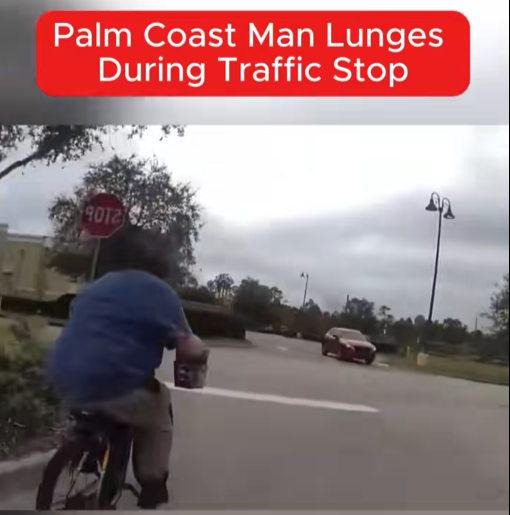

“Palm Coast Man L*nges at Officer During Traffic Stop — Bodycam Captures the Split-Second Chaos”
A routine traffic stop in Palm Coast escalated into a heart-stopping confrontation after a man suddenly l*nged toward an officer, forcing police to react in seconds. The incident, captured on bodycam footage, is now circulating online and raising serious questions about split-second decision-making, public safety, and how quickly everyday encounters can spiral out of control.
The clip begins calmly enough. An officer approaches a man stopped near an intersection, the setting quiet and unassuming. There’s no immediate sign of danger — no shouting, no visible struggle. The man appears to be on a bicycle, positioned near a stop sign, as vehicles pass in the background. It looks like one of countless routine stops officers conduct every day.
Then everything changes.
Without clear warning, the man suddenly moves forward in an aggressive manner. The abrupt motion — described by authorities as a l*nge — catches the officer off guard. In the span of a heartbeat, the tone shifts from routine to dangerous. The bodycam jolts, and the officer reacts defensively, prioritizing distance and control.
Law enforcement officials say this type of sudden movement is one of the most dangerous moments during any stop. Officers are trained to watch hands and body positioning closely, as unexpected advances can signal an imminent threat. Even if no weapon is visible, the unpredictability alone is enough to justify immediate response.
Viewers online have been sharply divided.
Some argue the officer had no choice, emphasizing that hesitation in such moments can cost lives. “You don’t wait to see what happens next,” one commenter wrote. “You react.” Others questioned what led up to the moment, asking whether communication broke down or if the man misunderstood instructions.
What’s clear from the footage is how little time there was to assess intent.
Experts in police training note that l*nging toward an officer — especially during a stop — is universally interpreted as a high-risk action. Whether driven by panic, anger, impairment, or confusion, that single movement can override everything that came before it.
Authorities later confirmed that the incident is under review, as is standard protocol whenever force or perceived threats are involved. No additional details about charges or injuries have been officially released, but officials stressed that the investigation will examine both the officer’s response and the man’s behavior leading up to the confrontation.
The location — Palm Coast — has also drawn attention, with residents expressing concern over safety during everyday interactions. Many locals noted how ordinary the setting looked, making the sudden escalation even more unsettling. “That could have been anywhere,” one resident commented. “That’s what’s scary.”
Legal analysts say cases like this often hinge on milliseconds. Courts typically examine whether an officer’s perception of threat was reasonable at the moment force was considered — not with hindsight, but based on what the officer knew then. Sudden forward movement, especially toward an officer, often weighs heavily in those assessments.
Beyond legality, the incident has reignited broader conversations about de-escalation and communication. While training emphasizes verbal commands and distance, experts acknowledge that not every situation allows time for calm resolution.
Sometimes, a single movement decides everything.
As the video continues to spread, many are sharing it as a cautionary example — not just for officers, but for civilians as well. During any police encounter, sudden or aggressive movements can be dangerously misunderstood, even if no harm was intended.
In the end, this wasn’t a high-speed chase or a dramatic standoff. It was a quiet street, a routine stop, and one split-second decision that changed the entire encounter.
A reminder that in moments of tension, how you move can matter just as much as what you say — and that sometimes, there’s no time to take it back.