“We Trust a $5 Online Baby Carrier — But Fear Methods Used for Thousands of Years?”
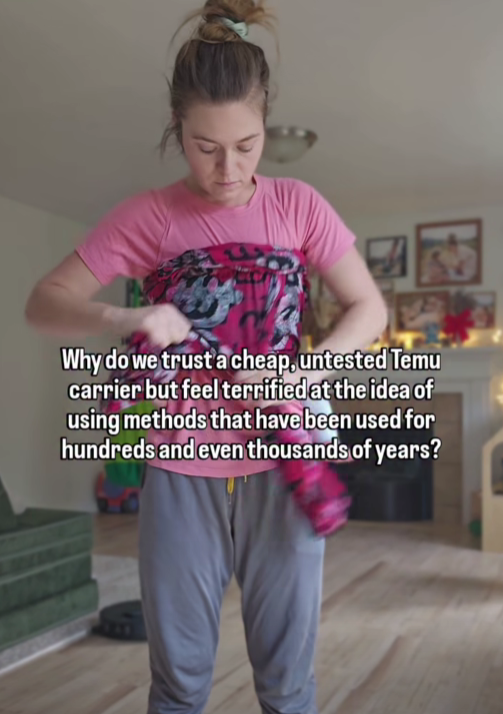
At first glance, the image feels ordinary. A woman stands in her living room, adjusting a fabric wrap around her torso. The space is familiar — soft light, everyday furniture, traces of a lived-in home. Nothing about the scene looks dramatic or extreme.
And yet, the text layered over the image stops people cold:
“Why do we trust a cheap, untested Temu carrier but feel terrified at the idea of using methods that have been used for hundreds and even thousands of years?”
It’s a question that cuts deeper than it first appears.
Modern parenting exists in a constant state of contradiction. Parents are told they must do everything “right,” yet the definition of “right” seems to change every year. New products promise safety, convenience, and peace of mind — often wrapped in fear-based marketing that subtly suggests parents are one mistake away from disaster.
In that environment, ancient practices can feel suspicious simply because they aren’t new.
For thousands of years, caregivers across cultures carried their babies using fabric wraps. Not as a lifestyle choice. Not as an aesthetic. But because it worked. Babies stayed warm, regulated their breathing and heart rate, and remained close enough to be fed, soothed, and protected while adults went about daily life.
Entire civilizations were built with children carried on backs, chests, and hips.
And yet today, many parents feel more comfortable ordering a mass-produced baby carrier from an unfamiliar online marketplace than trusting a method refined through centuries of real-world use.
That tension is what this image quietly exposes.
The woman in the photo isn’t performing for the camera. She isn’t lecturing. She isn’t trying to convince anyone of anything. She’s simply tying fabric — calmly, confidently, without fear. Her posture is relaxed. Her focus is inward, attentive to the task at hand rather than external judgment.
That calm stands in stark contrast to how parenting is often framed online: anxious, hyper-vigilant, and obsessed with potential failure.
Somewhere along the way, “new” became synonymous with “safe,” while “old” became synonymous with “risky.” But history doesn’t support that narrative.
Ancient babywearing methods didn’t survive because people were reckless. They survived because they were tested — not in laboratories, but in daily life. Across generations. Across climates. Across cultures. Through trial, error, and constant adaptation.
Meanwhile, many modern products enter the market with minimal long-term data, driven by trends, speed, and profit. A sleek design and thousands of reviews can create an illusion of safety — even when the product hasn’t stood the test of time.
Parents who reacted to the image online voiced this discomfort clearly.
Some admitted they were initially afraid of wraps because they weren’t “structured” enough. Others shared how they had been warned away from traditional methods by well-meaning friends or even professionals, only to later realize those fears were based more on unfamiliarity than evidence.
There’s also a deeper layer at play: loss of trust.
Modern parenting culture often teaches parents to distrust themselves. Trust the manual. Trust the brand. Trust the influencer. Trust the warning label. But don’t trust your instincts. Don’t trust your body. Don’t trust practices unless they’ve been packaged, branded, and approved.
That mindset creates anxiety — especially for new parents already overwhelmed by responsibility.
The image challenges that anxiety without confrontation. It doesn’t claim ancient methods are superior to all modern tools. It simply asks why methods that carried humanity forward for millennia are treated as inherently dangerous, while cheap, fast-produced alternatives are embraced without question.
And that question is uncomfortable.
Because answering it means acknowledging how deeply marketing shapes our sense of safety. It means admitting that fear is often sold as protection. That convenience can override wisdom. That we’ve been conditioned to equate price tags, certifications, and trends with trust — even when those things are relatively new.
The woman in the image embodies something rare in modern parenting content: quiet confidence.
She isn’t rushing. She isn’t defensive. She isn’t explaining herself. She looks grounded, present, and unafraid of judgment. That alone is powerful in a world where parents are constantly told they are doing something wrong.
Of course, safety matters. Research matters. Not every ancient practice should be blindly replicated. Progress exists for a reason. But progress doesn’t require erasing everything that came before it.
Sometimes, progress means remembering.
Remembering that human beings raised children long before instruction manuals existed. That closeness, touch, and presence were once default, not debated. That many so-called “alternative” practices are only alternative because modern life has drifted so far from them.
The image doesn’t shame parents who choose modern carriers. It doesn’t attack anyone’s choices. Instead, it invites reflection — and reflection is something parenting culture rarely allows.
Why do we feel safer clicking “buy now” than tying fabric with our own hands?
Why does familiarity equal danger, while novelty equals trust?
Why do we assume ancient knowledge is inferior simply because it isn’t marketed?
Those questions linger long after the image is gone.
And perhaps that’s why it resonates so deeply.
Not because it gives answers — but because it reminds parents that they are allowed to ask them.