
“You’re Being Arr*sted — Turn the Camera Off”: Street Encounter Raises Alarms About Recording Police
A tense sidewalk encounter caught on video is reigniting debate over citizens’ rights to record police after officers were heard telling someone to “turn the camera off” moments before announcing an arr*st. The clip, filmed in a busy shopping district, has spread rapidly online, drawing concern from civil rights advocates and questions about when — and whether — police can lawfully order someone to stop recording.
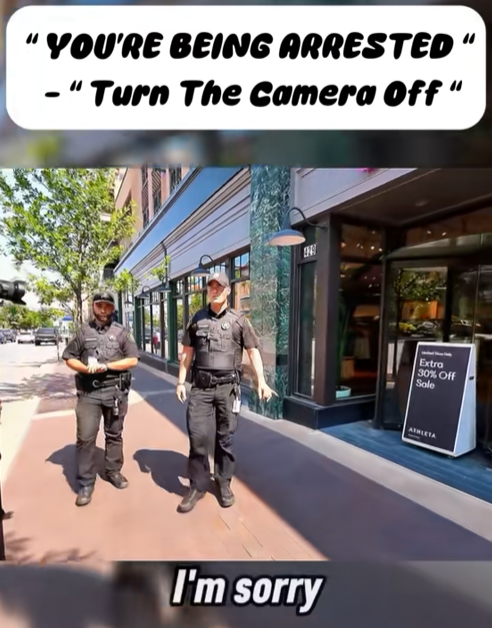
The image shows two uniformed officers walking toward the person filming along a sunny retail street. Storefronts line the sidewalk, shoppers pass nearby, and nothing initially appears out of the ordinary. Then the exchange escalates. According to captions circulating with the footage, the filmer is told they are being arr*sted and instructed to stop recording — a command that immediately triggered backlash across social media.
At the heart of the controversy is a well-established principle: in public spaces, individuals generally have the right to record police performing their duties, so long as they do not interfere. Courts across multiple jurisdictions have repeatedly affirmed this right as protected speech. That is why the order to shut off the camera, paired with an arr*st announcement, struck many viewers as alarming.
Supporters of the person filming argue the video illustrates a troubling pattern — that recording itself can become the trigger for enforcement rather than any underlying crime. “If filming is the problem, that’s not policing, that’s censorship,” one commentator wrote. Others pointed out that cameras often protect both civilians and officers by creating an objective record of events.
Law enforcement defenders caution that videos rarely show full context. Officers may issue commands when they believe recording is interfering with an investigation, obstructing movement, or escalating a crowd. In such cases, temporary restrictions can be lawful. However, experts stress that simply filming from a reasonable distance, without obstruction, is not grounds for detention or arr*st.
The clip’s most unsettling moment is the sequencing: the demand to stop recording appears to precede any clear explanation of probable cause. Legal analysts say that order matters. If an arr*st is motivated by recording rather than a legitimate offense, it risks being deemed unlawful — and any subsequent charges could collapse under scrutiny.
Civil liberties organizations note that commands to “turn the camera off” have increasingly become flashpoints in police encounters. Smartphones are ubiquitous, and public expectations around transparency have shifted. Many departments now train officers to assume they are always being recorded and to avoid giving unlawful orders that could undermine cases or public trust.
The video also highlights the power imbalance inherent in street encounters. Even when people know their rights, the threat of arr*st can be intimidating. Advocates advise staying calm, asking whether you are being detained, and complying with lawful orders while documenting badge numbers and seeking legal recourse later — rather than escalating on the spot.
As the clip continues to circulate, viewers are asking familiar questions: Was there a legitimate basis for the arr*st? Did the person filming interfere in any way? And why was stopping the recording emphasized at all? Without additional footage or official statements, those answers remain unclear.
What is clear is the broader impact. Each viral moment like this deepens public scrutiny of on-the-street decision-making and reinforces the importance of clear policies. Transparency, many argue, is not the enemy of safety — it is a safeguard against misunderstanding and misuse of power.
Whether this encounter leads to disciplinary action, dropped charges, or policy review has yet to be seen. But for now, it stands as another reminder of a simple rule that carries heavy consequences when ignored: in public, the right to record is not a courtesy — it is a protection.